

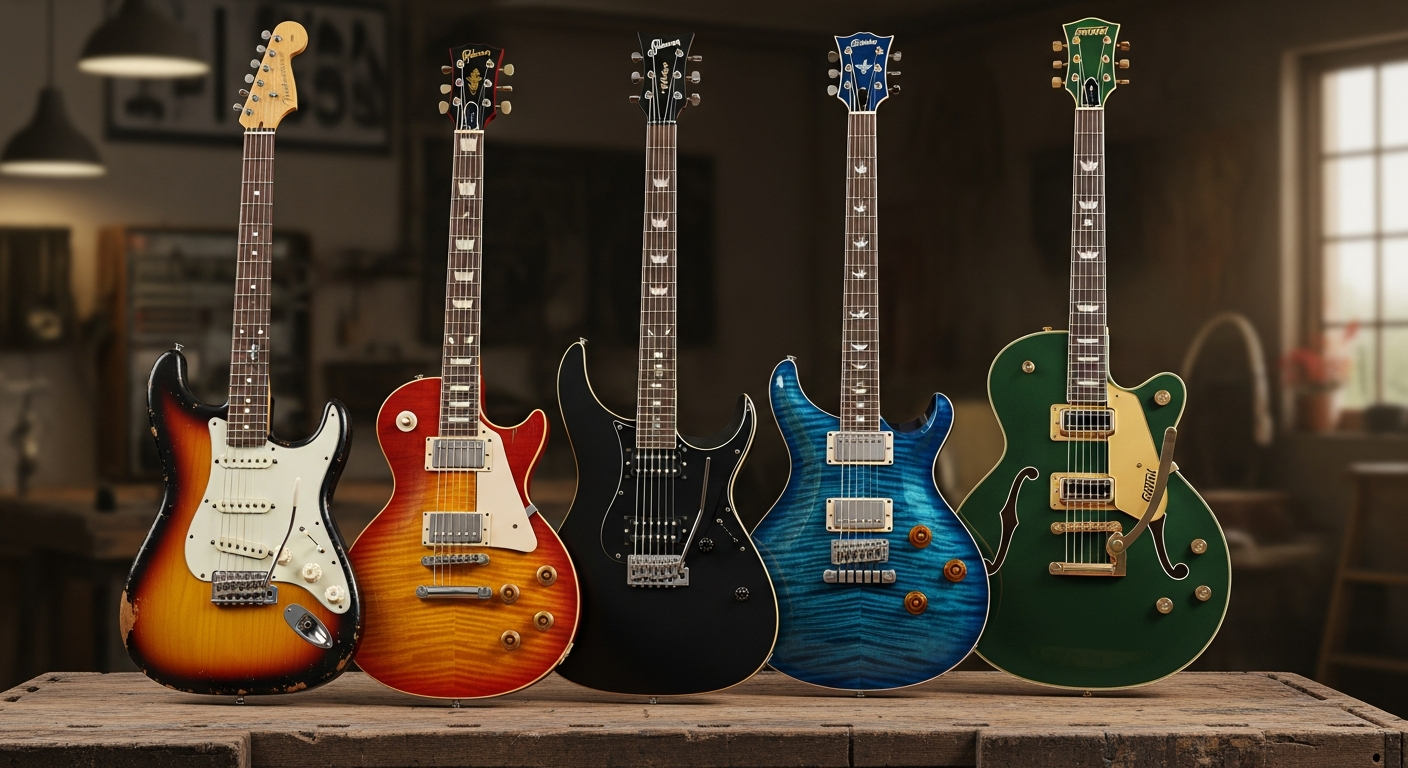
Best Electric Guitars: 5 Must-Read Reviews
When talking about guitars electric, the market is a jungle. There are hundreds of models, prices ranging from a pizza to a used car, and promises of “definitive” sound everywhere. For those, like me, who started tinkering in the garage and found themselves building or modifying guitars, the choice of a good starting point is fundamental. You don't need to spend a fortune to have something valid, quite the opposite.Often, the most interesting guitars are those that allow you to get your hands on them, to learn, to understand how each single piece works. Those that, with some targeted modifications, can transform from honest instruments into true workhorses. And I'm not talking about very expensive guitars, but about those that give you a lot for the price you ask.
In this overview, I've put together five models that, in my opinion and according to what you read among hobbyists and budget-conscious buyers, represent an excellent starting point. They're not perfect, no guitar is. But they are honest, have good potential and, above all, allow you to learn a lot of things. Whether you want to start playing or understand how to modify an electric guitar, here you'll find plenty to sink your teeth into.
Consider these electric guitar reviews come il consiglio di un amico che ha già fatto un po’ di strada, ha sbagliato, ha riparato e ora sa cosa cercare. —
1. Squier Classic Vibe ’60s Stratocaster: The Accessible Classic


The Squier Classic Vibe ’60s Stratocaster is somewhat the grandmother of all quality budget guitars. When it came out, it turned the market upside down, proving that you could have a piece of Fender history without breaking the bank. I've seen and tried it in a thousand configurations, and every time I'm amazed at how solid it is as a base. It's not just a beginner's guitar, it's a platform for those who want a classic sound without excessive budget compromises.
Technical features
Body: Poplar (Poplar), light and with good resonance, similar to alder for many tonal characteristics.Handle: Maple (Maple) with a “C” profile, comfortable and fast. The glossy finish may not appeal to everyone, but it's well made.
Keyboard: Indian Laurel (Indian Laurel), an alternative to Ebony or Rosewood, with a good feel and density. Radius 9.5″ (241 mm).
Pick-up: 3 single-coil Fender Designed Alnico V. These are honest pickups, designed to give that classic ’60s Stratocaster sound, with good attack and transparency.
Stairs: 25.5″ (648 mm), the Fender standard.
Hardware: Vintage-style synchronized tremolo bridge with 6 steel saddles. Vintage-style tuners. They're not top-of-the-line, but they do their job.
Finish: Gloss polyurethane. Solid, resistant, even if a bit thick.
Relevant construction notes: The neck is often the strong point of these Squiers, well finished for the price range. The pickups are a pleasant surprise, very usable right out of the box.
Popular sentiment
Among guitarists, the Classic Vibe is almost an institution. Many consider it the best Squier ever produced, or at least the one with the best value for money. People buy it for the neck feel, very close to that of a Mexican or American Fender from a few years ago. The pickups, despite being “Fender Designed”, receive many compliments for their vintage character, not too thin and with a nice chime.Of course, there are complaints. The tuners, despite being vintage-style, sometimes don't hold tuning perfectly, especially if the tremolo is abused. The tremolo itself can be a bit “rubbery” and requires good setup to work well without stability issues. Some find the neck finish too glossy and prefer to lightly sand it for a more satin feel. But these are all flaws that a hobbyist can easily fix.
Pros and cons in relation to price
PROS: Authentic sound: The pickups offer a very credible Stratocaster tone for the price range.Excellent neck: Comfortable, well-profiled, with a good overall finish.
Modding potential: An excellent base for upgrades to pickups, electronics, tremolo block.
Solid construction: Despite the price, the guitar is well-assembled and robust. AGAINST: Tuning stability: The tuners and tremolo can be a weak point if not well adjusted.
Neck finish: Glossy paint might not appeal to everyone and make the hand a bit 'sticky'.
Hardware materials: The hardware is functional but not high quality, typical of this range.
Who is it suitable for / who is it best avoided by?
Suitable for: Those looking for the classic Stratocaster sound without spending crazy money.Demanding beginners who want an instrument that will accompany them for a long time.
Modders and hobbyists looking for a solid base to experiment with upgrades (new pickups, electronics, bridge).
Those who appreciate the vintage feel and versatility of the Strat. Better to avoid it if: Looking for a guitar with a tremolo that can withstand extreme abuse (like Vai-style dive bombs).
You don't feel like doing a good initial setup or some minor modifications.
You prefer thin, fast superstrat necks.
Final advice and alternatives
If you want a Stratocaster that sounds like a Stratocaster, this is your choice. With a good setup and maybe a set of locking tuners, it becomes a truly reliable instrument. It's a guitar that allows you to understand what you like about the Fender sound and what you might want to change. Alternatives: Se il budget è ancora più stretto, potresti guardare la Squier Affinity Stratocaster, ma preparati a un passo indietro sulla qualità generale e sul manico. Se vuoi qualcosa di leggermente più moderno, la Yamaha Pacifica 112V (che vedremo dopo) è un’ottima contendente. —2. Yamaha Pacifica 112V: The Honest Workhorse
The Yamaha Pacifica 112V is the guitar that all music store clerks recommend to beginners, and for good reason. It has no frills, it doesn't pretend to be a “vintage reissue” or a “superstrat killer”. It’s simply a well-made, reliable, and incredibly versatile guitar. I’ve seen it in the hands of students, but also professionals who use it as a backup or for experiments. It’s one of those guitars that, if you put your hands on it, gives you back double.Technical features
Body: Alder. A classic wood for guitars, light and resonant, with good tonal balance.Handle: Acero (Maple) with a “C” profile, satin finish on the back for remarkable smoothness.
Keyboard: Rosewood or Indian Laurel, depending on the year of production, with a 13.75″ (350 mm) radius, a bit flatter than a standard Strat.
Pick-up: HSS configuration (Humbucker at the bridge, Single-coil in the middle and at the neck). The pickups are Yamaha Alnico V. The humbucker can be split via push/pull on the tone, offering a great tonal variety.
Stairs: 25.5″ (648 mm), the Fender standard.
Hardware: Vintage-style tremolo bridge with 6 steel saddles. Reliable die-cast tuners.
Finish: Gloss polyurethane on the body, satin on the neck.
Relevant construction notes: The overall build quality is high for the price range. The ability to split the humbucker is a huge bonus for versatility.
Popular sentiment
The Pacifica 112V enjoys an excellent reputation. It's the guitar that “does its job and does it well”. Guitarists appreciate its reliability, the comfort of the satin neck, and the versatility of the HSS pickups. The ability to switch from full-bodied sounds to more crystalline sounds with the coil split is a much-cited strong point. Many call it “the best entry-level guitar” and not without reason.Criticisms are few and often subjective. Some find the pickups a bit 'generic' or 'anonymous', in the sense that they don't have a strong distinctive character like a set of boutique pickups might. There are those who don't like the vintage tremolo bridge if they're looking for extreme stability, but for moderate use, it works excellently. The flatter fretboard radius might not appeal to those accustomed to more curved profiles.
Pros and cons in relation to price
PROS: Incredible versatility: HSS configuration with coil split covers a very wide range of genres.Build quality: Yamaha is renowned for its consistency, and this guitar is proof of that.
Comfortable neck: Satin finish and well-designed profile for good playability.
Excellent value for money: Hard to find something better at the same cost. AGAINST: Pickup character: While good, they might not have the “mojo” or identity of more expensive pickups.
Aesthetics: Somewhat “safe” design, not particularly distinctive or refined.
Tremolo: Functional but not a Floyd Rose, stability is good but not extreme.
Who is it suitable for / who is it best avoided by?
Suitable for: Beginners who want a guitar that sounds good in any context.Guitarists looking for a versatile instrument for study, rehearsals, and small gigs.
Anyone who wants a reliable and easy-to-play guitar right away.
Hobbyists looking for a solid and well-finished base for targeted upgrades (maybe a new bridge humbucker). Better to avoid it if: Looking for a very specific look and feel (e.g., only vintage Strat or only Les Paul).
You are a sound purist and are looking for pickups with a very defined and boutique character.
You want high-end hardware right away.
Final advice and alternatives
The Pacifica 112V is the guitar that allows you to do everything. It's a reliable workhorse, and if you decide to change its pickups, you'll end up with an instrument that can compete with much higher-priced guitars. It's a safe investment. Alternatives: Squier HSS Stratocaster (per un look più classico), Ibanez GRG121SP (per un feeling più da superstrat con due humbucker). —3. Epiphone Les Paul Special VE: The Charm of Minimalism
The Epiphone Les Paul Special VE (Vintage Edition) is proof that you don't necessarily need a Les Paul Standard to get that Gibson feeling. It's a spartan, essential guitar, but with its own well-defined character. I've seen many kids start with this, and for those who want to approach the world of Les Pauls without spending a fortune, it's a very sensible choice. Of course, it has its compromises, but precisely for this reason, it's an excellent battleground for DIY enthusiasts.Technical features
Body: Poplar. Light and easy to work with.Handle: Mahogany with a “SlimTaper D” profile, thin and fast, great for those with smaller hands or who prefer modern necks.
Keyboard: Rosewood or Indian Laurel, 14″ (356 mm) radius, rather flat.
Pick-up: 2 Epiphone 650R (neck) and 700T (bridge) Open-Coil humbuckers. They are ceramic pickups, with a rather high output, ideal for rock and metal.
Stairs: 24.75″ (628.6 mm), the standard Gibson scale.
Hardware: Tune-o-matic bridge and Stopbar tailpiece. Premium covered 14:1 tuners.
Finish: Vintage Worn (satin), which gives it a worn look and makes it smooth.
Relevant construction notes: The 'Vintage Worn' finish is a plus for the tactile feel, and the SlimTaper neck is very comfortable. It's a no-frills guitar, straight to the point.
Popular sentiment
The Epiphone Les Paul Special VE is a guitar that divides opinions a bit. Some love it for its simplicity and ridiculously low price, while others criticize it for cheap materials and some construction flaws. The general 'sentiment' is that it's a good guitar for beginners, especially for more aggressive genres thanks to the ceramic pickups. Many appreciate its slim neck, somewhat a rarity for a Les Paul in this price range.The most common flaws? The pickups, despite being powerful, are often described as 'a bit muddy' or 'lacking definition' compared to more expensive Alnico humbuckers. The internal electronics are spartan, with cheap potentiometers and switches that might require an upgrade over time. Sometimes there are some imperfections in the finish or fret alignment, but nothing catastrophic for the price.
Pros and cons in relation to price
PROS: Unbeatable price: One of the cheapest Les Pauls on the market.Comfortable neck: The SlimTaper profile is fast and suitable for different hands.
Powerful sound: Ceramic humbuckers push well, great for rock and metal.
Satin finish: Pleasant to the touch and with a 'worn' look.
Tune-o-matic bridge: Solid hardware for intonation and sustain. AGAINST: Basic pickups: They may lack clarity and dynamics for more nuanced genres.
Cheap electronics: Potentiometers and switches might be the first to need replacement.
Variable quality control: Being a very cheap guitar, some units may have small imperfections.
Body wood: Poplar, though functional, does not have the resonance and sustain of mahogany.
Who is it suitable for / who is it best avoided by?
Suitable for: Beginners who want a Les Paul feel without spending a lot.Those who play rock, punk, metal and are looking for a powerful and direct sound.
Modders with a limited budget who want an inexpensive base to install quality pickups or redo the electronics.
As a 'beater' guitar, to take around without too many worries. Better to avoid it if: You are looking for the classic and articulate sound of a Les Paul with Alnico humbuckers.
You are a purist of wood and mahogany sustain.
You don't intend to get your hands on it for future upgrades.
You are looking for a guitar with impeccable quality control right out of the box.
Final advice and alternatives
The Les Paul Special VE is a guitar that gives you a lot for its price. Don't expect perfection, but expect a good starting point. With a pickup change and maybe new electronics, it becomes a secret weapon. It's a great opportunity to learn how to solder and understand how components affect the sound. Alternatives: Se vuoi spendere un po’ di più, la Epiphone Les Paul Studio o Standard sono un passo avanti. Per un’alternativa super-economica ma con un feeling diverso, potresti guardare alle Harley Benton SC-Junior. —4. Squier Affinity Telecaster: The Essential and Robust
The Squier Affinity Telecaster is the embodiment of the 'less is more' philosophy. A simple, direct guitar, with that unmistakable twangy sound that made the history of rock, country, and blues. I've had it in my hands on several occasions, even for some routing experiments for new pickups. It's the ideal guitar for those who want a no-frills Tele sound, a true workhorse that won't let you down. It's a bit like grandpa's old van: it's not beautiful, but it always starts.Technical features
Body: Poplar or Alder, depending on the production period and finish. Light and resonant.Handle: Maple with a slim 'C' profile, very comfortable for most guitarists. Satin finish on the back, glossy on the headstock.
Keyboard: Maple or Indian Laurel, radius 9.5" (241 mm).
Pick-up: 2 vintage-style Squier single-coils. Designed to deliver the classic Telecaster sound, with a good 'twang' at the bridge and a rounder sound at the neck.
Stairs: 25.5″ (648 mm), the Fender standard.
Hardware: Telecaster string-through-body bridge with block saddles, for good sustain and stability. Die-cast tuners.
Finish: Gloss polyurethane.
Relevant construction notes: The string-through-body bridge is a significant plus for sustain and resonance, often absent on cheaper Telecasters. The neck is thin and smooth.
Popular sentiment
The Squier Affinity Telecaster is highly appreciated for its simplicity and characteristic sound. Guitarists choose it for its authentic 'twang' and overall robustness. Many consider it an excellent base for modifications, thanks to its simple structure and the wide availability of aftermarket Telecaster spare parts. It is seen as an honest guitar that does exactly what it promises.The critical points mainly concern the pickups, which, while decent, are often described as a bit 'weak' or 'lacking character' compared to high-end Telecaster pickups. Some complain about the quality of the tuners, which might not hold tuning perfectly under stress. The finish can be a bit thick, and sometimes small imperfections are noticed on the frets or nut, but nothing that a good luthier (or a patient hobbyist) cannot fix.
Pros and cons in relation to price
PROS: Classic Telecaster sound: The 'twang' is there, especially at the bridge.Thin and fast neck: Very comfortable and easy to play.
String-through-body bridge: Improves sustain and resonance, an important feature for a Tele.
Excellent base for modding: Its simplicity makes it perfect for pickup, electronics, and tuner upgrades.
Affordable price: An excellent entry point into the Tele world. AGAINST: Basic pickups: They may lack dynamics and articulation for more discerning tastes.
Mechanics: They might not be the most precise or stable, especially with intense use.
Quality control: As with other budget guitars, there may be small imperfections.
Finish: A bit thick and glossy, might not appeal to everyone.
Who is it suitable for / who is it best avoided by?
Suitable for: Beginners who want to learn to play the Telecaster.Blues, country, rock guitarists looking for that specific sound.
Modders and hobbyists who want a solid and iconic base to experiment with custom pickups or vintage electronics.
Those looking for a robust and unpretentious guitar for study and practice. Better to avoid it if: You are looking for a guitar with an already “perfect” sound and don't want to make upgrades.
You are a purist and only look for ash or alder wood without compromises.
You don't like the single-coil sound and prefer humbuckers or more complex configurations.
Final advice and alternatives
The Squier Affinity Telecaster is a timeless classic for a reason. It's simple, it works, and it gives you a fantastic base for learning and customizing. A set of mid-range Telecaster pickups and good tuners transform it into an instrument that can rival much more expensive guitars. It's an excellent guitar for understanding the importance of pickups and how to change them. Alternatives: La Squier Classic Vibe ’50s Telecaster (un passo avanti in qualità), la Harley Benton TE-52 (un’altra Telecaster economica molto apprezzata). —5. Harley Benton Fusion-III HSS Roasted DB: The Affordable Superstrat That Amazes
Harley Benton is a brand that, in recent years, has made a name for itself for its ability to offer high-end instruments at incredibly low prices. The Fusion-III HSS Roasted DB (Dark Burst) is a prime example of this philosophy. When I first tried it, I was amazed by the amount of “stuff” they give you for the price. It's a modern superstrat, designed for those looking for versatility, speed, and a contemporary look, without emptying their wallet. It's proof that with a little attention, real gems can be found even on a budget.Technical features
Body: Mahogany (Mahogany) with a flame maple veneer top (Flame Maple Veneer), which gives it a premium look.Handle: Roasted Maple (Roasted Maple), heat-treated for greater stability and a super smooth satin feel. “Modern C” profile.
Keyboard: Roasted Maple (Roasted Maple), compound radius (Compound Radius) 12″-16″ for extreme comfort across the entire fretboard, from riffs to solos. 24 stainless steel jumbo frets.
Pick-up: HSS configuration. 1 Roswell HAF-B humbucker at the bridge, 2 Roswell S74-C single-coils at the neck and middle. The humbucker is splittable with push/pull.
Stairs: 25.5″ (648 mm).
Hardware: Wilkinson 5002B 2-point tremolo bridge. Grover locking tuners. Graph Tech TUSQ XL nut.
Finish: Gloss polyurethane on the body, satin on the neck.
Relevant construction notes: The roasted neck, steel frets, and Grover locking tuners are features usually found on much higher-priced guitars. The compound radius and TUSQ XL nut are other details that make it a real bargain.
Popular sentiment
The Harley Benton Fusion-III is a guitar that has generated almost unanimous enthusiasm in the online community. Guitarists are incredulous to find so many “premium” features in such a low price range. The roasted neck with steel frets and compound radius is the most cited highlight, offering exceptional playability. Grover locking tuners are another big plus for tuning stability.Criticisms, when they exist, are often minimal and related to small imperfections typical of economical mass production. Sometimes it is complained that the pickups, while decent, are not at the level of branded ones and might be the first upgrade to consider. The internal electronics are functional but not high quality. Some users have reported small blemishes on the finish or fret edges, but nothing serious. The Wilkinson bridge, while good, is not a Floyd Rose and has its limits if an extreme tremolo is sought.
Pros and cons in relation to price
PROS: Premium features: Roasted neck, stainless steel frets, compound radius, locking tuners, TUSQ XL nut. Incredible for the price.Exceptional playability: Smooth and fast neck, jumbo steel frets for easy bending.
Versatility: HSS configuration with coil split covers a wide range of sounds.
Tuning stability: Quality locking tuners and nut help a lot.
Appealing aesthetics: Flame maple top and modern finishes. AGAINST: Pick-up: Functional but could be the first desired upgrade for a more defined sound or with more character.
Quality control: Being an inexpensive product, some specimens may have small imperfections.
Electronics: Basic potentiometers and switches, might require an upgrade over time.
Tremolo bridge: Good for moderate use, but not for extreme abuse.
Who is it suitable for / who is it best avoided by?
Suitable for: Modern guitarists looking for a versatile and fast superstrat.Those who play rock, metal, fusion, and genres that require a smooth neck and the ability to perform technical solos.
Modders who want a base with already high-quality hardware and neck, and perhaps only change the pickups.
Demanding beginners who want an instrument that will accompany them for many years without having to change it. Better to avoid it if: You are looking for a purely vintage look and feel.
You don't like thin necks and prefer sturdier profiles.
You are a sound purist and are looking for pickups with a very specific character right from the start.
You are not willing to do a small initial setup to optimize it.
See also
Download the Luthier Survival Kit
Free PDF with checklist, problem-cause table and project card template.
Download the Luthier Survival Kit
Free PDF with checklist, problem-cause table and project card template.
 English
  Italiano
Stuck on your build?
If you ran into the same problem or have a question, drop it in the comments. I read and reply to every one.
Write a comment