

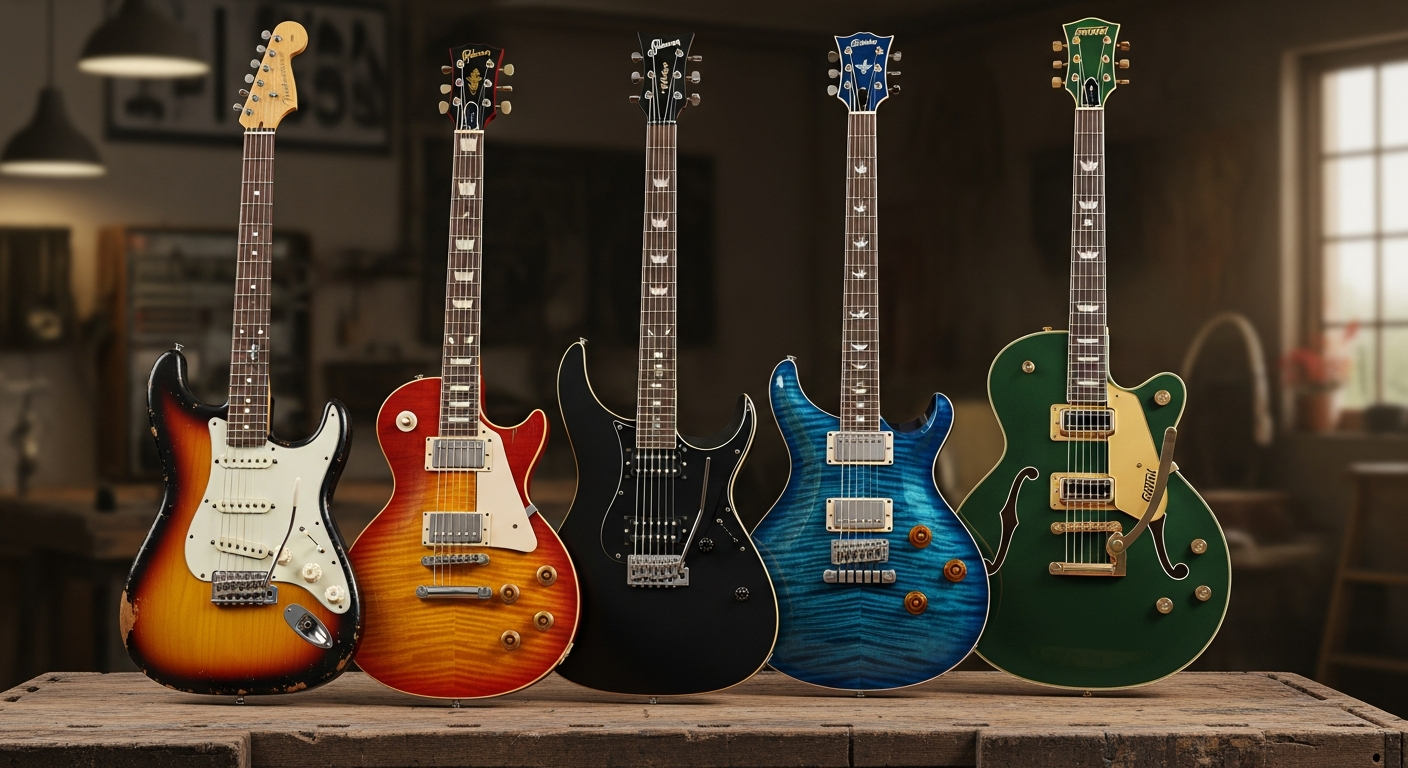
Fender electrics: comparison of main models.
Choosing an electric guitar, especially when talking about a brand like Fender, can turn into a real labyrinth. Stratocaster, Telecaster, Jazzmaster, Jaguar… It feels like being in front of a menu of regional specialties, and every time you wonder if the one you've chosen is really the right one for you. I've been there too, believe me. The first time I got my hands on one of these iconic guitars electric, I was so confused that I ended up buying a model that, in hindsight, wasn't really the best for what I wanted to do. I learned, I made mistakes, I sold, I bought again. And now I'm here to help you avoid my own mistakes. I'm not a luthier from a historic workshop,
is a guitar guru. I'm someone who, like you, has spent hours in the garage disassembling, soldering, sanding, and reassembling. I've built a few guitars from scratch, modified a lot, and discovered that behind every spec sheet there's a world of sensations and compromises. If I succeeded, with a little patience and the right tools (and some YouTube tutorials), you can do it too.
In this comparison, let's get straight to the point. No marketing fluff, but what I've learned in the field and what's actually being said in the communities, far from glossy catalogs. Let's see the main Fender electric guitars, the ones you find most often around and that are the starting point for many of us. The goal is to make you understand not only What I am, but for whom are. Because the perfect guitar doesn't exist, the perfect one exists for you.
Fender Stratocaster: The Queen of Versatility
The Stratocaster is an icon. You recognize it even from a kilometer away, with its sinuous shapes and unmistakable headstock. It was my first real guitar, and like many, it made me fall in love with the Fender world. It's the guitar you see in the hands of blues, rock, funk, and even pop legends. It's no coincidence.
Technical specifications of the Stratocaster
Let's talk about the basics, because the Stratocaster has been produced in a thousand variants.
The body is almost always in alder (alder), a wood that offers a good balance of resonance and sustain, with a balanced sound. To delve deeper into the world of woods used in guitars, you can take a look at this article on most common tonewoods. On some vintage or high-end models, you might find ash, which tends to be brighter and more resonant, but also heavier. Cheaper series, like Squier or some entry-level Fender models, can use poplar or agathis.
The neck is in maple (maple), with a fretboard in maple, rosewood, or ebony. The maple fretboard gives a brighter sound and a more defined attack, while rosewood and ebony tend to soften the highs a bit, offering a warmer and softer sound. Neck profiles vary greatly: from the thinner and faster modern “C”, to the “V” of vintage models, up to the flatter “D”.
The pickups are the heart of the Strat sound: almost always three single coil (S-S-S). These pickups are known for their crystalline, clean, and bright sound, with that unmistakable “quack” in the intermediate positions (2 and 4) of the 5-way selector. Some models, especially those oriented towards harder rock, mount a bridge humbucker (H-S-S) for a fatter, noise-free sound.
The scale is standard Fender: 25.5 inches (648 mm), which contributes to sustain and string tension. The hardware includes a synchronized tremolo bridge with six screws or two pivots, which allows for the typical Strat bends and vibratos. The tuners are usually standard, but on higher-end models, you often find locking ones.
The finishes are endless: from classic Sunburst to solid colors like Olympic White, Black, Candy Apple Red. The paints can be polyurethane (more resistant) or nitrocellulose (thinner and more resonant, typical of vintage and Custom Shop models).
Popular sentiment on the Stratocaster
The Stratocaster is loved for its sonic versatility. It's the guitar that can take you from a warm, velvety blues to a snappy funky, up to an energetic rock. Many consider it the “blank canvas” on which to paint their own sound. The comfort of the body shape, with its bevels, makes it pleasant to play both standing and sitting. However, not all that glitters is gold. A frequently cited sore point is the background noise (hum) of single-coils, especially in environments with a lot of electromagnetic interference. It's an intrinsic characteristic of these pickups and, for some, a price to pay for their iconic sound. Some solve it with “noiseless” single-coils or humbuckers, but the sound changes. Another debated aspect is the tremolo bridge. If it's not perfectly adjusted or if good quality strings are not used, it can cause tuning problems. Many guitarists, myself included, prefer to block it or keep it “floating” only for light bends, so as not to go crazy with stability.
Pros and Cons of the Stratocaster in relation to the price
Considering the different price ranges, the pros and cons balance each other out.
Pros:
- Incredible sonic versatility: From crystalline clean to bluesy crunch, it covers a wide range of genres.
- Ergonomics and comfort: The shape is designed to be comfortable, with bevels that adapt to the body.
- Wide availability and resale value: It's one of the most widespread guitars, easy to find and resell.
- Modification potential: It's the most modified guitar in the world. Pickups, bridges, electronics, everything is customizable. Here on the blog we have often talked about how modify a guitar Fender is a rewarding experience.
- Iconic sound: That “twang” and that “quack” are unmistakable and appreciated in every context.
Against:
- Single-coil noise (hum): For some genres or contexts, it can be annoying.
- Tremolo stability: If not well set up, the bridge can cause tuning loss.
- High price for USA models: The American Professional or Ultra series can be a significant investment. Player models (made in Mexico) offer an excellent compromise, but not always the same finish.
- Sometimes “anonymous”: Being so widespread, it may lack an “extreme” sonic identity for those looking for a niche sound.
For whom is the Stratocaster suitable / For whom is it better to avoid it
The Stratocaster is perfect for the guitarist looking for an instrument versatile, capable of ranging between blues, classic rock, funk, pop, and even light jazz. It’s ideal for those who love to experiment with sounds and aren’t afraid to get their hands dirty with some modifications. If you’re a beginner, a Stratocaster (even a Squier or a Fender Player) is an excellent starting point to learn and understand what you like. You should avoid it if you’re looking for a sound ultra heavy metal without significant modifications, or if you hate the noise of single-coils and don’t want to invest in noiseless pickups. If your genre is purely extreme metal and you’re not interested in cleaner or vintage sounds, you might find the Stratocaster a bit “light” for your taste, unless you load it with powerful humbuckers and a fixed bridge.
Fender Telecaster: The Indestructible Workhorse


The Telecaster is the “big sister” of the Strat, a simpler, more direct design, but with incredible character. It’s the guitar for the “tough guys”, for those who don’t need frills but want a sound that cuts through the mix. Its history is legendary, from country to rock’
‘roll, up to the most modern indie.
Technical specifications of the Telecaster
As with the Strat, the Telecaster’s body is typically made of alder or ash. Ash is very common on vintage and reissue models, contributing to its bright and resonant sound. The shape is iconic and without beveled contours, a solid and unmistakable block of wood. The neck is almost always made of maple, often with a maple fretboard, but also rosewood. The profiles tend to be a bit more robust than some Strats, but here too there are many variants, from the fuller “U” to the modern “C”. The feeling is always one of great solidity and stability. The pickups are two single coil (S-S), one at the neck and one at the bridge. The bridge pickup is famous for its penetrating and bright “twang”, perfect for country and rockabilly. The neck one is warmer and rounder, great for blues and clean sounds. Unlike the Strat, Telecaster pickups, especially the bridge one, are mounted on a metal plate that contributes to their unique tonal characteristics. There are also variants with humbuckers, such as the Telecaster Custom or Deluxe, which offer fuller sounds. The scale is the classic 25.5 inches. The bridge is usually fixed, with three brass or steel saddles (vintage style) or six individual saddles (modern style). This fixed bridge is one of the keys to the Telecaster's sustain and tuning stability. There is no tremolo, which simplifies electronics and maintenance. The finishes are often more understated than the Strat, with classic colors and a more "tool-like" aesthetic, but no less fascinating for it.
Popular sentiment on the Telecaster
The Telecaster is revered for its simplicity, its reliability and its direct and incisive sound. Many guitarists consider it the “workhorse” guitar, one that never betrays you and adapts to almost any situation. The “twang” of the bridge pickup is legendary and often imitated, but never equaled. Despite its apparent simplicity, the Telecaster is incredibly expressive. The tone and volume controls allow for a wide range of nuances. It's a guitar that pushes you to play with your hands, to exploit touch and dynamics. Criticisms are few, but they exist. Some find the sound of the bridge pickup too sharp or “thorny” for their taste, especially if used with bright amplifiers. The lack of a tremolo can be a limitation for those accustomed to Stratocaster vibratos. Furthermore, the body shape without bevels may be less comfortable for some compared to the Strat.
Pros and Cons of the Telecaster in relation to the price
Here too, the quality-price ratio varies a lot between series, but the Telecaster always maintains its standard.
Pros:
- Unique and powerful sound: The “twang” of the Telecaster is unmistakable and cuts through the mix effortlessly.
- Reliability and stability: Fixed bridge and robust construction make it a true workhorse.
- Simplicity and ease of use: Fewer complex controls, more time to play.
- Excellent for many genres: Country, blues, rock’
‘roll, indie, punk, pop. - Significant sustain: The fixed bridge contributes to enviable sustain.
Against:
- Less versatile for certain genres: The sound may be too specific for those looking for softer or more extreme sounds without modifications.
- Lack of tremolo: A limit for those who use it often.
- Relative comfort: The “slab body” shape can be less ergonomic for some compared to the Strat.
- Single-coil noise: As with the Strat, single-coils can generate hum, even if the bridge pickup is often less problematic in this sense.
For whom is the Telecaster suitable / For whom is it better to avoid it
The Telecaster è the ideal guitar for the musician who is looking for an instrument reliable, direct and with a strong character. If you love country, blues roots, rockabilly, classic rock or indie, the Telecaster will give you immense satisfaction. It's perfect for those who play a lot with a pick and are looking for a decisive attack, or for those who want to explore the dynamics of touch. It's also an excellent choice for those who love simplicity and don't want to get lost in a thousand settings. You should avoid it if tremolo is a fundamental part of your style or if you are looking for a very soft and round sound without the slightest hint of brightness. If you play genres that require very "fat" and compressed sounds, like modern metal, a stock Telecaster might not be the best choice, unless you opt for models with humbuckers or are willing to make significant modifications.
Fender Jazzmaster: The Resonant and Complex Alternative
The Jazzmaster is a guitar with a fascinating history. Born for jazz musicians (hence the name), it found its true calling in other genres: surf rock, indie, shoegaze, noise rock. It is the guitar for those who love to stand out, with a unique aesthetic and sound.
Technical specifications of the Jazzmaster
The body of the Jazzmaster è a piece of design in its own right: its shape offset is large and winding, almost always in alder. This shape, in addition to the aesthetics, contributes to a particular balance and a specific resonance, especially when seated.\n\nThe neck è in maple with rosewood or pau ferro fretboard (often on more recent versions). The scale is the classic 25.5 inches. The neck profiles tend to be comfortable and not excessively thick, often with a flatter fretboard radius compared to vintage models (like 9.5″ or 12″ on modern versions). The pickups are one of the most distinctive aspects: two wide and flat single-coil. They are not P90s, although they are sometimes confused. They are pickups with a longer, flatter winding, which produces a warmer, more mid-range, and less bright sound compared to Stratocaster or Telecaster single-coils. They have a more “open” and less compressed response. The hardware includes a floating tremolo (floating tremolo) with a locking system, positioned away from the bridge. This tremolo è famous for its smooth action and remarkable sustain. The bridge è often a “bridge muting” or a Tune-o-Matic on more modern models, but the original design featured a bridge with barrel saddles that could cause stability issues with thin strings. The tuners are standard or locking. The electronics are the most complex part: in addition to the 3-way pickup selector, the Jazzmaster has a “Rhythm” circuit and a “Lead” circuit. The Rhythm circuit, activatable via a switch on the upper part of the body, has separate volume and tone controls for the neck pickups, offering a darker and “jazz” sound. This allows for quick switching between two preset sounds, somewhat like having a boost or an immediate tonal alternative.
Popular sentiment on the Jazzmaster
The Jazzmaster is loved for its warm, resonant and “airy” sound. It has a unique character, less aggressive but very expressive. The floating tremolo è one of its most appreciated peculiarities: it allows for wide vibratos and incredible sustain, and è a key element for genres like surf and shoegaze. Its aesthetic è a cult, and many choose it precisely to avoid the usual Strat or Tele. Main criticisms often concern the complexity of the electronics. For those not used to it, the dual circuit and various switches can seem like a labyrinth. Many guitarists, including myself, tend to predominantly use the Lead circuit or modify it to simplify the electronics. Another sore point, especially on vintage or faithful reissue models, è the bridge. The barrel saddles and string angle can lead to “string skipping” problems (strings jumping out of the saddles) and buzzing. Many solve this by replacing the bridge with a Tune-o-Matic or a Mastery Bridge (an expensive but very effective upgrade).
Pros and Cons of the Jazzmaster in relation to the price
The Jazzmaster, in its various incarnations (Player, Vintera, American Professional/Vintage), offers several options.
Pros:
- Distinctive sound: Warm, resonant, mid-range, perfect for unique cleans and crunches.
- Expressive floating tremolo: Allows for wide vibratos and unique sustain.
- Iconic and cool aesthetic: It stands out from the mass of Strats and Teles.
- Comfortable when seated: The offset shape è very comfortable for those who play in a seated position.
- “Alternative” versatility: Great for surf, indie, shoegaze, noise rock, but also blues and jazz.
Against:
- Complex electronics: The two circuits can be confusing for those seeking simplicity.
- Bridge problems (vintage/reissue models): Strings can skip or buzz, often requiring an upgrade.
- Pickups not for everyone: The sound è less bright and more “open” compared to Strat/Tele, and not everyone prefers it.
- Bulky: The large body can be a bit uncomfortable for those used to smaller guitars.
Who is the Jazzmaster suitable for / Who should avoid it
The Jazzmaster is for the guitarist looking for a sound unique, warm and resonant, and who is not afraid to experiment with more complex electronics. It is the perfect choice for those who play surf, indie rock, shoegaze, alternative or post-punk. If you love tremolo and want a smooth action and unique sustain, this is the guitar for you. It's also for those who want a distinctive look on stage or in the studio. You should avoid it if you are looking for the plug-and-play simplicity of a Telecaster or the “standard” versatility of a Stratocaster. If you are not interested in tremolo or do not want to deal with potential bridge problems (although modern versions have often solved them), you might find it frustrating. If your genre requires very bright and sharp or extremely aggressive sounds, the stock Jazzmaster pickups might not be enough without modifications.
Fender Jaguar: The Short Scale with a Percussive Sound
The Jaguar is often confused with the Jazzmaster, but it is a different animal. It shares the offset aesthetic and complex electronics, but its shorter scale and specific pickups give it a character all its own. Born to compete with Gibson in the high-end market, it found a home in surf, punk, and indie.
Technical characteristics of the Jaguar
The Jaguar also has a body offset, usually in alder, but it is slightly more compact than the Jazzmaster. The aesthetic è similar, but the proportions are different, especially due to the reduced scale. The most distinctive feature è the short 24-inch scale (610 mm). This makes the Jaguar easier to play for those with small hands, and bending is less tiring. The neck è in maple with a rosewood or pau ferro fretboard (often on more recent versions). The profiles are often thin and fast. The pickups are two narrow and shielded single-coils, different from those of the Jazzmaster. These pickups produce a brighter, sharper, and more percussive sound, with a fast attack and excellent definition. They are also known to be a bit “thinner” or less powerful than other single-coils. The hardware è almost identical to that of the Jazzmaster: floating tremolo with a locking system and the same type of bridge (often with the same potential problems). Here too, many guitarists opt for upgrades like the Mastery Bridge. The electronics are even more complex than those of the Jazzmaster. In addition to the pickup selector (which here are on/off switches for each pickup), there are three individual switches on the lower part of the body: two to activate/deactivate the pickups and one to activate a “strangle switch” (or “bass cut”) filter that cuts low frequencies, making the sound even thinner and sharper. Here too, there is a separate “Rhythm” circuit with dedicated volume and tone controls.
Popular sentiment about the Jaguar
The Jaguar is loved for its percussive, bright sound and its playability due to its short scale. It is a guitar that “snaps” and responds immediately to touch. The “strangle switch” filter è a gem that allows for even more particular sonorities, ideal for arpeggios or sharp riffs. It is the preferred guitar of many punk and indie musicians for its aggressiveness and unique look. Criticisms often focus on the short scale, which is not for everyone. For those accustomed to 25.5″ or 24.75″, the Jaguar can seem “small” or require adaptation. The pickups, although unique, are often perceived as underpowered or “weak”, especially for genres requiring high output. Here too, the electronics are a point of discussion: many find them excessively complex and tend to modify them or ignore some of the controls. The bridge problems are the same as the Jazzmaster.
Pros and Cons of the Jaguar in relation to the price
The Jaguar, like the Jazzmaster, is available in different series, from Player to Vintera, up to the American Original/Vintage versions.
Pros:
- Excellent playability: The short scale makes the guitar easier to play, with easier bending.
- Bright and percussive sound: Great for sharp riffs, arpeggios, and rhythmic sounds.
- Iconic and unique aesthetics: A true visual statement.
- Strangle switch filter: Allows for very particular additional sonorities.
- Expressive floating tremolo: As on the Jazzmaster, a strong point for those who use it.
Against:
- Short scale not for everyone: Requires adaptation for those accustomed to longer scales.
- Low output pickups: They might seem “weak” for some genres or preferences.
- Complex electronics: Many switches and controls can be a source of confusion.
- Bridge problems (vintage/reissue models): Often requires upgrades for stability.
- Less sustain: The short scale can slightly affect sustain compared to guitars with longer scales.
Who is the Jaguar suitable for / Who should avoid it
The Jaguar is the perfect guitar for those who have small hands or prefer a shorter scale for greater ease of playing. It's ideal for guitarists looking for a bright, percussive sound with a fast attack, ideal for surf, punk, new wave, indie, and noise rock. If you love tremolo and want a guitar with a distinctive character and a retro look, the Jaguar is an excellent choice. You should avoid it if you prefer a long scale for more sustain and string tension, or if you have large hands and find short scale guitars too “tight”. If you're looking for a fat, powerful sound without modifications, the Jaguar's stock pickups might disappoint you. And, as with the Jazzmaster, if you're not willing to deal with complex electronics or invest in a bridge upgrade, you might find yourself frustrated.
Final advice and alternatives
Here we are at the end of our journey among the Fender electric guitars main ones. As you can see, there isn't one “best” guitar, but only the one most suitable for your hands, your ear, and your budget. The Stratocaster is the queen of versatility, the Telecaster is the indestructible workhorse, the Jazzmaster is the resonant and complex alternative, and the Jaguar is the short scale with a percussive sound. My advice, based on years of testing and, let's admit it, some wrong purchases, is always the same: try, try, try. Go to a store, pick up these models, connect them to an amp you know, and feel the differences. Don't be influenced only by the look or the specs on paper. What matters is how the guitar makes you feel when you play it. If budget is an issue, don't despair. Fender has its Squier line, which offers affordable versions of all these models. Squier Classic Vibe, for example, are often considered a benchmark for their value for money, and are an excellent base for future guitar modifications. Also brands like G&L (founded by Leo Fender himself) or Yamaha offer excellent alternatives, sometimes with a superior value for money in certain ranges. Remember, a guitar is an instrument, not a collector's item (unless you are a collector, of course). It's made to be played, to inspire you. And if there's something you don't like, well, you're on Biafax.it, and here we know well that modify a guitar can be an incredibly rewarding adventure. Don't be afraid to customize your instrument to truly make it “yours”.
Conclusions
I hope this comparison has given you a compass to navigate the vast universe of Fender electric guitars. Each model has its soul, its strengths, and its small (or large) idiosyncrasies. The key is to understand which of these characteristics best align with your musical style, your ergonomic preferences, and, of course, your wallet. There's no right or wrong answer, just the guitar that will make you want to play for hours and hours in your garage, just like it happened to me.
FAQ
What is the main difference between Stratocaster and Telecaster?
The main difference lies in versatility and sonic character. The Stratocaster, with its three single-coils and tremolo bridge, is extremely versatile, offering crystalline sounds and brilliant “quack”, ideal for blues, classic rock, and funk. The Telecaster, with two single-coils and a fixed bridge, has a more direct, bright, and “twangy” sound, loved for country, rock’
‘roll and blues roots, and is known for its robustness and simplicity.
What are the main “flaws” of the Jazzmaster and Jaguar that I should consider?
The most common “flaws” of Jazzmaster and Jaguar, especially in vintage or faithful reissue models, concern the bridge and electronics. The original floating bridge can cause string stability issues and buzzing, often solvable with upgrades. The electronics, with their dual circuits and numerous switches, can be complex and unintuitive for those seeking simplicity, requiring a period of adaptation or, for many, a modification to simplify them.
Download the Luthier Survival Kit
Free PDF with checklist, problem-cause table and project card template.
 English
  Italiano
Stuck on your build?
If you ran into the same problem or have a question, drop it in the comments. I read and reply to every one.
Write a comment