

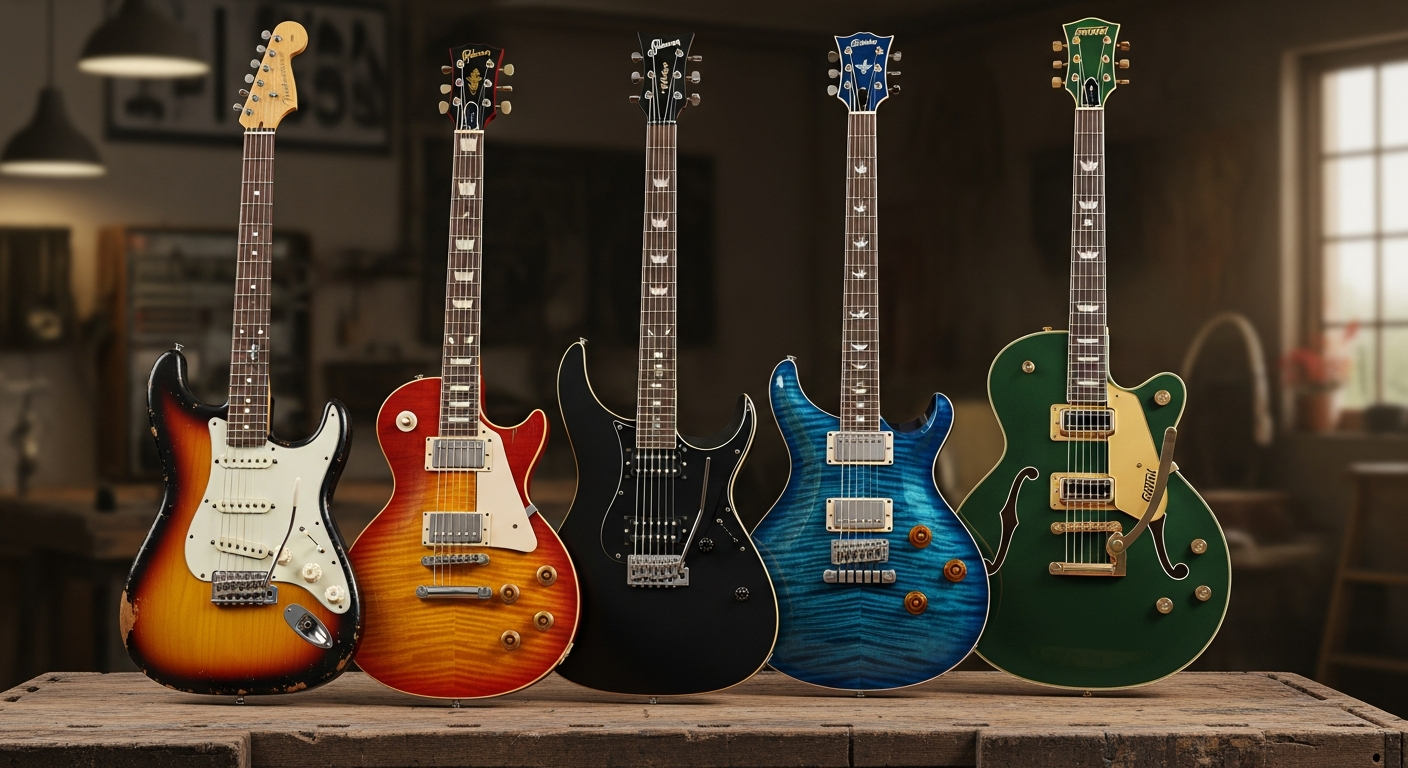
Main Hagstrom Electric Guitars Reviewed
So, let's talk about Hagstrom. If you've arrived here, you've probably already heard the name, maybe you've seen one of those guitars with a slightly out-of-the-box design, or you're looking for something that isn't the usual Strat or Les Paul, but won't empty your wallet. I understand you perfectly. The market is full of options, and often, when the budget is limited, you end up falling back on the usual suspects, settling. But sometimes, digging a little, small gems pop out. And the Hagstrom electric guitars, for me, are exactly this: pearls with some rough edges, but a character to sell. I'm not a professional luthier, you know. I'm someone who has spent hours in the garage, with a soldering iron in hand and wood dust everywhere, trying to figure out why that pickup sounded dull or how the hell to straighten a warped neck. I've tried a lot of guitars; many I bought used to disassemble and reassemble them. And in this carousel of experiments, Hagstroms have always intrigued me. They're not perfect – almost no guitar is, especially in certain price ranges. But they have construction solutions that deserve attention and a sound all their own. The intent of this article is clear: to shed some light on what are the Hagstrom guitars worth looking at, what those who play them say and, above all, who they could really serve. I won't tell you they're the best in the world, but I'll give you an honest picture to understand if one of these “Swedish” (or rather, Swedish-inspired, given that modern production is elsewhere) can end up on your workbench or on your stage.
A Dive into Hagstrom's History (and Why We're Still Interested)


[GRIGLIA FOTO] When evaluating one of the Hagstrom electric guitars modern, there are some fixed points that distinguish them and that you should keep an eye on. These are not minor details, and often make the difference in feeling and sound. 1. The Neck and Fingerboard: This is the true Hagstrom trademark. All modern models I've had the chance to try (or fix) feature the famous H-Expander truss rod and the Resinator fretboard. We will talk in depth about these two elements, but know that they are the heart of the Hagstrom experience. The neck is usually thin, fast, and the fretboard has a unique feel, halfway between ebony and rosewood. 2. The Pickups: Hagstrom has its proprietary pickups, often called Custom 58 (humbucker) or P-90 (in single coil versions). They are not “boutique” pickups costing hundreds of euros, but they are designed to give a sound that pairs well with the wood and construction of the guitar. They have a medium-high output and a rather defined character, often with good brilliance. 3. The Design and Ergonomics: Hagstroms often have lines inspired by the past, but with a modern touch. They are not always the most comfortable in the world if you are used to super-contoured guitars, but they have their own balance. Many have a relatively thin body, even in solid bodies, which makes them lighter than expected. 4. The Hardware: You usually find die-cast tuners (often Hagstrom branded or generic but of good quality), Tune-o-matic bridges or Hagstrom vibrato (like the “Vintage Tremar” tremolo on some Vikings). The hardware is functional, robust, and I have rarely encountered serious problems. Of course, they are not Gotoh or Schaller, but they do their job. 5. The Price: This is the crucial point. Hagstroms are positioned in a mid-price range, let's say between 500 and 1000 euros for most new models. This makes them competitive, but also puts them in direct competition with renowned brands in their “economic” ranges. The added value, however, lies precisely in the unique features I have listed for you. These are the points I always examine when I'm faced with a Hagstrom. They help me immediately understand what to expect and where the pros and cons might be.
Hagstroms on My Workbench: Models Under the Lens

[BOX AFFILIAZIONE] Now, let's get to the meat. I have selected three models that I consider representative of the Hagstrom philosophy and that are among the most popular and discussed. I've held them in my hands, some I've disassembled, others I've only thoroughly tested.
Hagstrom Swede: The Classic with a Swedish Twist
The Swede is probably Hagstrom's most iconic model, their interpretation of the classic single-cut. It's not a Les Paul, and it doesn't want to be. It has its own character, its own look, and, above all, its own sound.
Technical Specifications of the Swede
Body: Mahogany, with a carved maple top. It's often a bit thinner than a traditional Les Paul, which makes it lighter and more comfortable. Handle: Mahogany, glued (set neck). The profile is usually a “Slim D”, very comfortable and fast. Keyboard: Resinator Fretboard, with a 15-inch radius. The frets are medium jumbo. Stairs: 24.75 inches (the classic Gibson-scale). Pick-up: Two Hagstrom Custom 58 Alnico 5 humbuckers. Hardware: Hagstrom Long Travel Tune-o-matic bridge with Hagstrom Stopbar tailpiece. Hagstrom 18:1 Die-Cast tuners. Controls: 2 volumes, 2 tones, 3-way selector. Often there's an additional switch (mini-toggle) that activates a low-pass filter or a coil split, depending on the version. This is a nice touch for versatility. Finish: Gloss polyurethane, available in various classic colors like Black Gloss, Wild Cherry Transparent, Gold Top. Relevant Construction Notes: The H-Expander truss rod is always present. The construction is solid, well-finished for the price range. Popular Sentiment on the Swede
On forums and among enthusiasts, the Swede is a bit of a cult object for those looking for something different. Many praise its sustain, which is truly remarkable, thanks to the mahogany body and Resinator fretboard. The neck, then, is almost universally appreciated for its speed and comfort. “It feels like flying” is a phrase I have often read and heard. The Custom 58 pickups are a point of discussion. Some adore them, finding them warm but with good definition and enough output for rock and blues. Others find them a bit generic or “dark” and immediately think of an upgrade. In my tests, I must say they have their own character; they are not anonymous. They have a vintage tone but with a bit more “grit”. The main complaints? Sometimes the weight, even if lighter than some Les Pauls, can be a factor for those looking for feather-light guitars. Some have found small imperfections in the finish, but we are talking about details often found even on more expensive guitars. Another point, sometimes, is the sensitivity of the potentiometers, which are not always as super progressive as one would expect. But this, for me, is a minor issue, easily solvable with a electronic modification. Pros and Cons in Relation to Price
PROS: Sound and Sustain: Mahogany and Resinator work well together, providing remarkable sustain and a full-bodied sound. Handle: Fast, thin, and stable thanks to the H-Expander. A real pleasure to play. Versatility: The Custom 58 pickups with the additional switch offer a good tonal range for rock, blues, jazz, and even hard rock. Aesthetics: A distinctive look, not a copy, that stands out. Price: It offers a package of unique features and a feel for its price range. AGAINST: Pick-up: They might not appeal to everyone. If you're looking for a very specific sound (like super vintage PAF or extreme metal), you'll probably have to change them. Weight: Although lighter than some competitors, it is not an ultra-light guitar. Finish: Rarely, small imperfections can be found, but nothing serious. Who is it suitable for / Who should avoid it?
There Hagstrom Swede It's for the intermediate or advanced guitarist looking for a single-cut with a strong identity. It's perfect if you love classic rock, blues-rock, or even more melodic hard rock. If you're tired of the usual Les Pauls but want that kind of sustain and push, the Swede is an excellent candidate. It's also for those who appreciate a fast neck that's a bit thinner than usual. You should avoid it if you're looking for an ultra-light guitar, if you're a purist of Fender sounds (sparkling single coils), or if you're not willing to give a chance to a neck with a 'different' feel, like one with a Resinator fretboard. Even if your budget is super-tight (under 400 euros), you'll have to look for used options or other brands. Hagstrom Viking: Semihollow, But Not Like All the Others
The Viking is Hagstrom's answer to the world of semi-acoustic guitars. Here too, it's not a 335, but a machine with its own character and a particular feel. It has been a must-have for many guitarists, especially for those looking for a more airy sound but with the stability of a solid body. Technical Specifications of the Viking
Body: Laminated maple semihollow, with mahogany center block. This helps reduce feedback. Handle: Mahogany, glued (set neck), with “Slim D” profile. Keyboard: Resinator Fretboard, with 15-inch radius and medium jumbo frets. Stairs: 24.75 inches. Pick-up: Two Hagstrom Custom 58 Alnico 5 humbuckers. Hardware: Tune-o-matic Long Travel bridge with Hagstrom Trapeze Tailpiece or, on some versions (Viking Tremar), a Hagstrom Vintage Tremar vibrato. Hagstrom 18:1 Die-Cast tuners. Controls: 2 volumes, 2 tones, 3-way selector. Finish: Glossy polyurethane, often in attractive colors like Black Gloss, Wild Cherry Transparent, White. Relevant Construction Notes: H-Expander Truss Rod. The thin body and the central block make it much more manageable than other semi-acoustic guitars.
Popular Sentiment on Viking
The Viking is highly appreciated for its versatility and for that “big” sound that only a semi-hollow can give, but with better feedback control compared to a full-hollow. Many use it for blues, rock, jazz, funk, and even indie rock. The neck is, once again, a strong point. It's fast and comfortable, ideal for those who move a lot on the fretboard. The Custom 58 pickups here sound a bit different compared to the Swede, thanks to the semi-hollow body. They have greater resonance, a bit more “air” in the sound, but maintain their clarity. Some guitarists, especially in jazz, prefer to replace them with something warmer and less bright. But for rock and blues, they are more than suitable. The version with the Tremar vibrato is another special feature. It's not a Floyd Rose, but it's a vintage-style system that holds tuning well for moderate use and adds a touch of class to the look. Complaints? Sometimes the Tremar can be a bit “stiff” at first and requires some breaking in. Some find the body slightly bulky compared to a super-contoured solid body, but it's a common compromise for semi-hollows. The finish, as with the Swede, may have some minor cosmetic flaws, but nothing that compromises playability.
Pros and Cons in Relation to Price
PROS: Semi-hollow Sound:A rich, resonant sound, but with good feedback control thanks to the central block. Handle: The usual Hagstrom excellence: fast, stable and comfortable. Aesthetics: A distinctive and elegant design, with a vintage touch. Versatility: Suitable for a wide range of musical genres. Value for money: It's difficult to find a semi-hollow with these features and this build quality at a similar price. AGAINST: Pick-up: Once again, the Custom 58s might not be the definitive choice for everyone, especially for those seeking very specific jazz sounds. Dimensions: For those accustomed to small guitars, the Viking might feel a bit large. Tremar Vibrato: It requires a bit of practice to be used optimally and is not for shredders.
Who is it suitable for / Who should avoid it?
There Hagstrom Viking is perfect for the guitarist looking for a full and resonant sound, typical of semi-hollows, but with the playability and stability of a solid body. If you play blues, rock ‘
‘ roll, jazz, indie or pop, this guitar will give you a lot of satisfaction. It's also an excellent choice for those looking for a look that stands out from the crowd. You should avoid it if you are looking for an extreme metal guitar (even if with a pickup change and a good amp it can hold its own), if you don't like the size of semi-hollows, or if your budget is really tight and you can't afford to invest in a guitar in this price range.
Hagstrom Ultra Swede: The Modern That Doesn't Forget Its Roots
The Ultra Swede is somewhat the slimmer and more modern sister of the Swede. It retains the Hagstrom DNA but takes it in a more contemporary direction, with a focus on speed and even greater ergonomics. It's proof that Hagstrom knows how to look forward without losing sight of its roots.
Technical Specifications of the Ultra Swede
Body: Mahogany, often with a flamed or figured maple top. The body is very thin, lightened, which makes it extremely comfortable and lightweight. Handle: Mahogany or maple (depending on the version), glued (set neck). The profile is usually an “Ultra-Slim D”, even thinner and faster than the traditional Swede. Keyboard: Resinator Fretboard, with 15-inch radius and medium jumbo frets. Stairs: 24.75 inches. Pick-up: Two Hagstrom Custom 60 Alnico 5 humbuckers (slightly more modern and with higher output than the Custom 58s). Often with coil-split function via push/pull on the tone potentiometers. Hardware: Hagstrom Long Travel Tune-o-matic Bridge with Stopbar. Hagstrom 18:1 Die-Cast Tuners. Controls: 2 volumes, 2 tones (often push/pull for coil split), 3-way selector. Finish: Gloss polyurethane, often with transparent tops to highlight the wood. Relevant Construction Notes: H-Expander Truss Rod. The thin body is one of its distinctive features, making it very comfortable and less tiring to play for long sessions. Popular Sentiment on the Ultra Swede
The Ultra Swede is loved by those looking for a fast, light, and versatile guitar. The “Ultra-Slim D” neck is a true highway for those who love shredding or legato. The lightness of the body is another plus, making it a very comfortable stage guitar. The Custom 60 pickups are perceived as a step up from the Custom 58s for those seeking a more modern sound. They have more punch and definition, and the coil-split makes them incredibly versatile, allowing you to switch from full-bodied humbuckers to credible single-coil sounds. Many use it for genres ranging from rock to light metal, passing through pop and fusion. Criticisms are few. Sometimes, the lightness of the body can lead to a slight neck dive (the neck tends to drop when the guitar is hung on the strap), but it's not a common or serious problem. As with other models, some minor aesthetic imperfections can occur, but we're talking about details. Some purists might find it “too modern” compared to the vintage feel of the original Swede, but this is more a matter of taste than a defect. Pros and Cons in Relation to Price
PROS: Fast Handle: The Ultra-Slim D is exceptional for speed and comfort. Lightness and Ergonomics: The thin body makes it one of the most comfortable guitars in its category. Timbre Versatility: The Custom 60 pickups with coil-split offer a wide range of sounds, from crystal clear clean to aggressive crunch. Modern Aesthetics: An elegant and contemporary look, with very beautiful thick figured maple tops. Value for money: A complete package for those looking for a modern and high-performance guitar. AGAINST: Neck Dive: A slight neck dive might occur due to the light body. Pick-up: Although versatile, they are not boutique pickups. They might not satisfy those looking for a very specific or high-end sound. Finish: As with other models, small imperfections are possible. Who is it suitable for / Who should avoid it?
There Hagstrom Ultra Swede It’s ideal for the guitarist looking for a fast, light, and versatile solid body. If you play modern genres, from alternative rock to pop-punk, from fusion to light metal, this guitar will give you an edge. It’s perfect for those who do long standing sessions or for those accustomed to thin and fast necks. You should avoid it if you are looking for a purely vintage sound (even if it can get close with the right settings), if you prefer chubby and full-bodied necks, or if your style requires an infinite sustain typical of much heavier and more massive guitars. The Secret of the Hagstrom Neck: H-Expander Truss Rod and Resinator Fretboard
Here, this is the point I want to dwell on for a moment, because this is where Hagstrom truly stands out from the crowd. It's not just marketing, I assure you. I've had the chance to get my hands on several Hagstrom necks and the feedback is always the same: they are stable and have a unique feel. The H-Expander Truss Rod
Most truss rods are single-action or double-action, but Hagstrom's H-Expander is a bit different. It's a lightweight alloy truss rod that runs the entire length of the neck and isn't just 'a bar', but has an H-shape. The idea is to provide extra rigidity and uniform tension along the entire neck. What does this mean in practice? 1. Incredible Stability: I noticed that Hagstrom necks are less prone to changes due to humidity or temperature. Once you adjust it, it tends to stay there. This is a nice advantage, especially if you live in climates with strong temperature fluctuations. 2. Improved Sustain: A stiffer and more stable neck transfers string vibrations better to the body. The result? More sustain. It's not a legend, you can hear it. 3. Low Action Without Fret Buzz: A stable neck allows for a very low action without encountering annoying fret buzz, because the curvature is more controlled and uniform. This is a dream for those who love to play fast. Of course, if you need to make an adjustment, it's a truss rod like any other, but its effectiveness in maintaining stability is above average, especially in this price range. It's an engineering solution I've always appreciated.
The Resinator Fretboard
And then there's the Resinator fretboard. It's not wood. It's a composite material, a kind of laminate that Hagstrom developed in the 60s. They created it to have an extremely stable, uniform fretboard that sounded like ebony, but without the problems of availability or cost. The advantages I found: 1. Stability and Uniformity: Similar to the truss rod, the Resinator is incredibly stable. It doesn't deform, doesn't crack, and offers a perfectly uniform fretboard surface. This is fundamental for good intonation and low action. 2. Bright and Fast Sound: The Resinator has a density similar to ebony, which gives it a fast attack and a certain brilliance in the sound. It's not “woody” like rosewood, but it has a clear and defined tone that pairs well with Hagstrom pickups. 3. Minimum Maintenance: It's not wood, so it doesn't need to be hydrated like rosewood or ebony. A wipe with a damp cloth and you're done. For those who don't want too many worries about maintenance, it's a significant plus. 4. Unique Feeling: The feeling under the fingers is smooth, fast, almost “rubbery” in a good way, but not sticky. It's different from wood, but you get used to it quickly and many love it. Some purists might turn up their noses because it's not “real wood”. But, honestly, in the context of a modern guitar in this price range, it's a smart and effective solution that offers concrete advantages in terms of playability and stability. And I assure you, if they succeeded in the ’60s, imagine today. It's an example of how innovation can lead to excellent results, even if unconventional. Modifying a Hagstrom: Is it Worth It?
This is a question I often get, and the answer is: yes, absolutely. The Hagstrom electric guitars are an excellent base for modifications, precisely because they have a solid construction and excellent basic characteristics (neck, body). The first point of intervention, as often happens, are the pickups. Even if the Custom 58 or 60 are good, if you are looking for a very specific sound, changing them can make a huge difference. I have seen Hagstrom Swede guitars transform into pure rock machines with a set of Seymour Duncan JB/Jazz humbuckers, or into blues guitars with more vintage PAFs. The options are endless. Then there's the electronics. Often, the stock potentiometers and capacitors are functional but not of the highest quality. Replacing them with potentiometers branded (like Bourns or CTS) and higher quality capacitors (like Orange Drop or Mallory) can improve the response of tone and volume controls, making them smoother and more musical. A small intervention, but one that makes a difference. Even the hardware, although generally good, can be improved. High-end locking tuners, a superior quality bridge, or a Tusq or bone nut can further elevate tuning stability and instrument resonance. The great thing about Hagstroms is that the “core” of the instrument is solid. You're not starting with a cheap guitar with poor woods or a neck that won't stay put. Starting from a solid base, every modification you make will have a more marked positive impact. It's a bit like starting with an excellent recipe: the basic ingredients are already good, you just need to perfect the seasoning. See also
Hagstrom vs. Competition: When to Choose Swedish?
When looking at the price range between 500 and 1000 euros, Hagstroms find themselves competing with a lot of brands. How do they position themselves against the “usual suspects”? Vs. Squier/Epiphone (High-End): Hagstroms often offer more unique features. While Squier and Epiphone focus more on imitating classic Fender and Gibson models, Hagstrom offers its own design and construction solutions (H-Expander neck, Resinator). The build quality is usually comparable or superior for Hagstrom, especially regarding neck stability. If you are looking for something different and with a strong identity, Hagstrom is an excellent choice. If you want a good budget Les Paul or Strat, Epiphone and Squier are great, but less “original”. Vs. Yamaha Pacifica/Reverend: Yamaha Pacifica is a very strong competitor for value for money, especially the 600/800/900 models. They often offer excellent playability and versatility. Reverend Guitars is another brand that offers guitars with a lot of personality and interesting solutions, often at a similar or slightly higher price. Hagstrom stands out for its “vintage-modern” feel and for the specific neck/fretboard solutions, which other brands do not replicate. Vs. Chinese/Korean Brands (Low-End): Here the comparison is different. Many guitars in this price range (under 400 euros) can have significant compromises on wood, hardware, and finish. Hagstrom, even in its most accessible models, tends to maintain a higher level of construction quality and finish, in addition to offering those unique characteristics that distinguish them. If the budget is very tight, you might find guitars with a “similar” sound for less, but often with less character and long-term reliability. In summary, Hagstrom positions itself as an excellent choice for those looking for a guitar with a well-defined identity, intelligent construction solutions, and a unique feel, without wanting to spend “boutique” guitar prices. They are a step ahead of the basic models of major brands, offering something more “special” in terms of design and engineering.
FAQ – Frequently Asked Questions about Hagstrom Guitars
Are Hagstrom pickups suitable for metal?
The Hagstrom Custom 58 and 60 pickups have a medium-high output and good definition, which can work well for rock and hard rock genres. However, for more extreme metal, which requires a more aggressive sound, with more gain and a greater bass response, you might find the stock pickups a bit limited. Many guitarists who use Hagstrom for heavier genres opt for replacing the pickups with more metal-oriented models, such as some Seymour Duncan or DiMarzio humbuckers.
Is it easy to find spare parts for Hagstrom guitars?
Finding generic spare parts like tuners, bridges, or potentiometers is easy, given that Hagstrom uses standard hardware in many cases. For specific parts like the H-Expander truss rod or the Resinator fretboard, it's best to contact Hagstrom customer service directly or authorized dealers. In general, the quality of the stock hardware is good and often does not require immediate replacement, unless a targeted upgrade is sought. In conclusion, the Hagstrom electric guitars They are an excellent option for those looking for something different, with a strong character and intelligent construction solutions, especially considering the quality-price ratio. They are not perfect guitars, as I said, but they have a soul and offer a sound and playability experience that is absolutely worth exploring. Whether you are an emerging guitarist with an eye on the budget, or a more experienced musician looking for an instrument with a unique identity, a Hagstrom could be the right choice for you.
Download the Luthier Survival Kit
Free PDF with checklist, problem-cause table and project card template.
 English
  Italiano
Stuck on your build?
If you ran into the same problem or have a question, drop it in the comments. I read and reply to every one.
Write a comment