
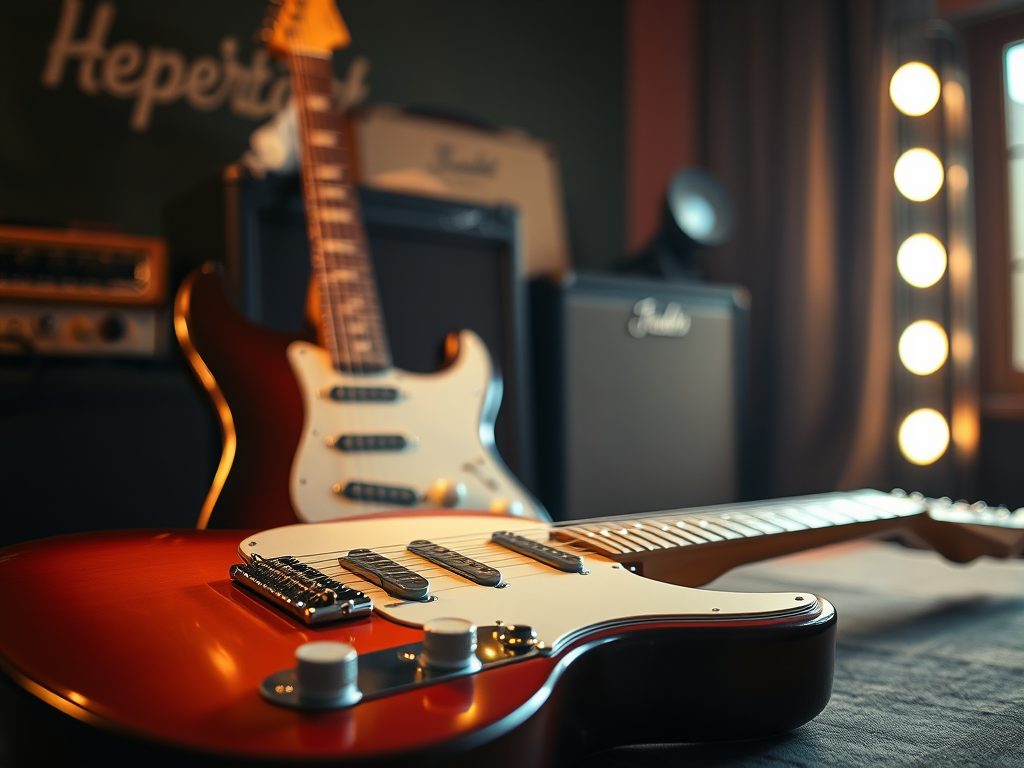
The Fascinating History of Fender Electric Guitar Models
When you think of an electric guitar, it's almost impossible not to think of a Fender. It's not just an instrument, it's an icon. It's the soundtrack of generations, the faithful companion of legends of rock, blues, and country. But above all, it's a piece of history that, even today, inspires anyone who wants to pick up a six-string or, like me, try building one in the garage. I'm not a professional luthier, you know. I'm someone who's spent hours installing pickups, stripping body paint, and fiddling with tremolo bridges. And every time I get my hands on one of my replicas or a custom build, I think of Leo Fender. A genius, yes, but above all a pragmatist. Someone who had never played an instrument, yet he revolutionized the world of music. Incredible, right? In this article, I want to take you on a journey through the history of these incredible sound machines. From Leo's first intuitions to the models that shaped the modern sound. We'll see how each innovation wasn't just a technical gimmick, but a way to give musicians a new tool for expression. And trust me, there are plenty of anecdotes and details that will make you appreciate your next gig even more. guitar modification.The Birth of Fender Electric Guitars: An Epic Musical Revolution
Imagine a world where electric guitars were complicated affairs, often rudimentarily amplified acoustic instruments, with uncontrollable feedback and a sustain that would make you cry. Then came Leo Fender. He wasn't a musician, but a radio technician, a repairman. He saw the problems and looked for practical solutions. His first real intuition, the one that changed everything, was the solid-body electric guitar. No soundboard, no feedback. Just a block of wood and pickups that did their job. It seems trivial today, but back then it was pure magic. Before the Telecaster, there was the Esquire, then the Broadcaster (a name they had to change due to a trademark that had already been registered). But in 1950, along came the Fender Telecaster. A basic electric guitar, sturdy as a tank, and with a sound that cut through the mix. I remember the first time I got my hands on a Telecaster. I was used to more “refined” instruments, full of frills. The Tele seemed… spartan. But as soon as I plugged it into the amp, I understood. That twangy, bright sound, but also big and mean when pushed. It was pure immediacy. Its simple construction was brilliant: an ash or alder body, a bolt-on maple neck, two single-coil pickups, a fixed bridge with adjustable saddles. Simple stuff, but well made. And above all, built to last. It was a battle-hardened instrument, one that musicians could afford and carry around without too much fuss. * **Solid body**: Goodbye feedback, hello sustain. * **Bolt-on neck**: Easy to build, repair, and replace. * **Simple controls**: Volume, tone, 3-way selector. No frills. * **Distinctive sound**: Bright, punchy, perfect for country, blues, and nascent rock 'n' roll. Artists like James Burton and Keith Richards made history with a Telecaster. And if you think about it, the design has remained virtually unchanged for over seventy years. It's proof that sometimes, simplicity is the key to success. It's the guitar that, if you drill a pickup cavity wrong, you think, "Oh well, it'll sound good anyway." And Leo probably had exactly that in mind.The Evolution of Fender Models: From the Telecaster to the Stratocaster, an Unprecedented Story
After the success of the Telecaster, Leo Fender certainly didn't rest on his laurels. He had proven that his "form follows function" philosophy worked. But musicians wanted more. They wanted more versatility, more comfort, more "effects." And so, in 1954, the Fender Stratocaster was born. The Strat, as it was affectionately called, wasn't just a new guitar. It was a spaceship. Its futuristic design, with those sinuous curves and double cutaway, was light years ahead of anything else on the market. I remember the first time I saw one live, in the hands of a guitarist. It looked sculpted by the wind. But the aesthetics were just the beginning. The Stratocaster was a concentration of innovations designed with the musician in mind. 1. Three single-coil pickups: This was a breakthrough. With a 3-way selector switch (which soon became a 5-way switch, thanks to guitarists who "locked" the lever halfway to get intermediate sounds), you could achieve an incredible range of tones. From the crystal-clear sound of the neck pickup to the brighter sound of the bridge, passing through the intermediate positions that gave that unmistakable "quack." When I tried wiring my first Stratocaster, I realized how brilliant this idea was. Three pickups, infinite possibilities. 2. **The synchronized vibrato system**: This was the real game-changer. Not a simple tremolo like the ones that were available before, but a system that allowed you to lower and raise the pitch of the strings in a stable manner. Sure, it was a little tricky to set up at first, and how many curses I uttered trying to get it to stay in tune on my first replica! But once I got the hang of it, it was pure magic. Hendrix, Jeff Beck, David Gilmour… they wouldn't have been the same without that vibrato. 3. **Body Contour**: The Telecaster was comfortable, but the Stratocaster was ergonomic. The forearm and belly contours made the instrument incredibly comfortable to play, whether standing or sitting. A detail that seems small, but makes a huge difference after hours of rehearsals or gigs. 4. **Maple Neck with Maple or Rosewood Fingerboard**: The feel of the neck was, and is, unmistakable. Fast, smooth, with easy access to the upper frets thanks to the double cutaway. The Stratocaster didn't just change the way people played guitar, it changed music itself. From Eric Clapton's blues to Jimi Hendrix's psychedelic rock to Nile Rodgers' funk, every genre found its voice in the Stratocaster. It was an instrument that invited you to experiment, to push the limits. And that, for a DIY enthusiast, is the best. There is no limit to what you can do with a **Fender electric guitar** of this type.Beyond Tele and Strat: Jazzmaster, Jaguar, and the Basses That Made History
To think that Fender stopped at just the Telecaster and Stratocaster would be a huge mistake. Leo and his team were a veritable powerhouse of ideas, always seeking new solutions for musicians. And so, in the years that followed, other iconic models were born, which, while not as universally popular as the two legendary models, left an indelible mark.The “Offsets” for the alternative sounds
In the '50s and '60s, the music world was in turmoil. There was rock 'n' roll, but there was also jazz, surf rock, and new sounds that required different instruments. * **Fender Jazzmaster (1958)**: Initially designed for jazz guitarists (hence the name), with its larger, less aggressive P-90-style pickups than traditional single coils, a complex rhythm/lead circuit, and a floating tremolo. It didn't make it big in jazz, but it became the queen of surf rock and, much later, indie rock and shoegaze. I remember trying one and struggling with the bridge. A little temperamental, yes, but the sound was unique, warm but with a certain air. * **Fender Jaguar (1962)**: Even more complex than the Jazzmaster, with its brighter-sounding pickups, short scale (24 inches, like a Gibson Les Paul), and countless switches for each pickup. It was meant to take on the Gibsons, but ended up defining the sound of bands like Nirvana and Sonic Youth. A nightmare to wire, I tell you from experience, but what a satisfaction when all those switches work! These ’offset’ **Fender electric guitars** were, and are, a world apart. They have a charm all their own, an aesthetic that divides but a sound that unites those looking for something different. They are proof that Leo wasn't afraid to experiment.The basses that revolutionized the groove
But Leo Fender didn't just revolutionize the world of guitars. He did the same with electric basses. Before him, bassists were forced to carry around bulky double basses. * **Fender Precision Bass (1951)**: This was the first mass-produced solid-body electric bass. “Precision” because, unlike the fretless double bass, it had frets, allowing for precise intonation. And its sound? Big, round, with a percussive attack. It ushered in a whole new era for the rhythm section. Every time I hear a P-Bass, I think about how essential a good bass is to any band. * **Fender Jazz Bass (1960)**: The “big brother” of the Precision, with a slimmer, asymmetrical body, a thinner neck and two single-coil pickups. It offered a wider range of sounds, from warm and full to a brighter, growly sound. It became a favorite of jazz, funk, and fusion bassists. These instruments changed the way music was made. They liberated bassists, giving them instruments that were easier to carry, more powerful, and more versatile. And if you've ever tried building a bass, you know how important the choice of pickups and wood is to achieving that deep, resonant sound that only a Fender bass can deliver. The electric guitar isn't the only protagonist, after all.The difficult years and the rebirth: an icon that never fades
Despite the resounding success of his instruments, the story of Leo Fender and his company was not always a bed of roses. In 1965, Leo, for health reasons, decided to sell his company to Columbia Broadcasting System, better known as CBS. This change of ownership marked the beginning of a controversial period for Fender. The 1970s and early 1980s are often remembered as Fender's "dark years." Under CBS management, the focus shifted from quality craftsmanship and innovation to mass production and cost reduction. * **Changes in materials and construction**: Less valuable woods and thicker polyester finishes began to be used, and construction methods became less scrupulous. The three-bolt neck, for example, introduced to facilitate production, was often a source of instability. * **Controversial Innovations**: Models were introduced that departed greatly from the classic design, often without great success (think of the Stratocaster with Wide Range humbuckers or the ’bullet’ truss rod design). * **Loss of Identity**: Many musicians and enthusiasts felt that the soul of **Fender electric guitars** was being lost. The magic, the attention to detail that had distinguished Leo's creations, seemed to have vanished. I've held a few Fenders from those years in my hands. And I have to admit, the difference was noticeable. They weren't “bad” instruments by any means, but they were missing that “something” that made pre-CBS Fenders so special. It was as if the heart was no longer there.The rebirth: the return to the origins
Fortunately, the story doesn't end there. In 1985, a group of employees and investors, led by William “Bill” Schultz, managed to buy the company back from CBS. It was a pivotal moment, a true rebirth. The new management team had a clear vision: to restore Fender to its former glory, focusing on quality, innovation, and respect for the original design. * **Focus on Quality**: The use of select woods, higher-quality hardware, and more meticulous construction methods was a clear sign of this direction. * **The Custom Shop Era**: In 1987, the Fender Custom Shop was founded, a place where expert craftsmen could build custom instruments, faithfully replicate vintage models, and experiment with new solutions. This contributed enormously to reestablishing Fender's reputation as a maker of the highest quality instruments. * **Focused Innovation**: It wasn't just about replicating the past. Fender continued to innovate, but with greater attention to the needs of modern musicians, developing new pickups, circuits, and ergonomic solutions, without ever betraying the essence of its electric guitars. This rebirth was crucial. It demonstrated that even after a difficult period, with the right vision and passion, you can come back stronger than before. And today, when I pick up a modern Fender electric guitar, I feel that the spark, the soul that Leo had infused into his instruments, has returned. It's the story of how a company, and its instruments, have reinvented themselves without losing their identity.The Legacy and Future of the Fender Electric Guitar
Today, Fender is stronger than ever. Its electric guitars aren't just instruments, they're cultural touchstones. They're the icons you see on stage, the ones you dreamed of owning as a kid, and the ones you perhaps learned to disassemble and reassemble in your garage. Leo Fender's legacy is visible everywhere. Every guitarist who picks up a solid body guitar, every bassist who strums the strings of a Precision, is in some way paying homage to his pragmatic genius.The wide range of current models
Fender has evolved, offering a range of instruments that cover every need and budget, while remaining faithful to its fundamental principles: * **Player Series**: The entry point for many, made in Mexico, it offers exceptional value for money. They are sturdy and reliable instruments, perfect for beginners or those looking for a solid foundation to customize. I've had one in my hands, and I must say that for the price, they sound amazing. * **American Performer/Professional/Ultra Series**: The American production lines, with higher quality standards, specific hardware and pickups, designed for professionals and the most demanding enthusiasts. Here you can feel the leap in quality, that special "feel" that only a USA Fender can give. * **Custom Shop**: The top of the line. Instruments hand-built by master luthiers, often faithful replicas of vintage models or unique creations based on customer specifications. These aren't just instruments, they're works of art. * **Signature Models**: The guitars of your heroes. From Eric Clapton to Jimi Hendrix, from John Mayer to HER, every artist has their own custom version, often with unique pickups and finishes. These models, ultimately, are all the offspring of Leo's initial idea: a well-made, reliable electric guitar with a distinctive sound.Continuous innovation, respecting tradition
Fender doesn't just rehash the past. It continues to experiment with new technologies, new woods, new pickup designs. But it does so with an awareness of its history. You'll never see a Stratocaster or Telecaster reworked beyond recognition. Instead, you'll see subtle improvements, new options that expand versatility without betraying its soul. For us DIYers, Fender's history is an inexhaustible source of inspiration. Every Fender electric guitar is an open project, a starting point. Want to change the pickups on your Strat? You can. Want to re-work your Telecaster? Go ahead. The simple, modular architecture of these instruments is a constant invitation to experiment, to get your hands dirty. Leo Fender wasn't a luthier in the traditional sense. He was an innovator, an engineer, a visionary. And his legacy lives on in every note that comes from one of his creations. Whether you're a professional musician or a garage hobbyist, the history of these instruments reminds you that passion and ingenuity can truly change the world. To further explore the history and specifications of Fender models, I recommend checking out the official Fender website, which is packed with information and technical details on the various models and their evolutions. You can find a very detailed section on their history here: Fender.com – The History of Fender Guitars and Basses.FAQ on the history of Fender electric guitar models
What was Fender's first mass-produced solid body electric guitar?
Fender's first mass-produced solid body electric guitar was the Broadcaster in 1950, which was renamed shortly thereafter. Telecaster Due to a trademark conflict, this model revolutionized the concept of the electric guitar, making it more robust and free of feedback.
What are the main innovations introduced by the Fender Stratocaster?
There Fender Stratocaster, Introduced in 1954, the 1954 model introduced several key innovations: three single-coil pickups for greater sonic versatility, a synchronized vibrato system for stable pitch-bending effects, and an ergonomic body design with contours for player comfort. It set a new standard for electric guitars.
 English
  Italiano