

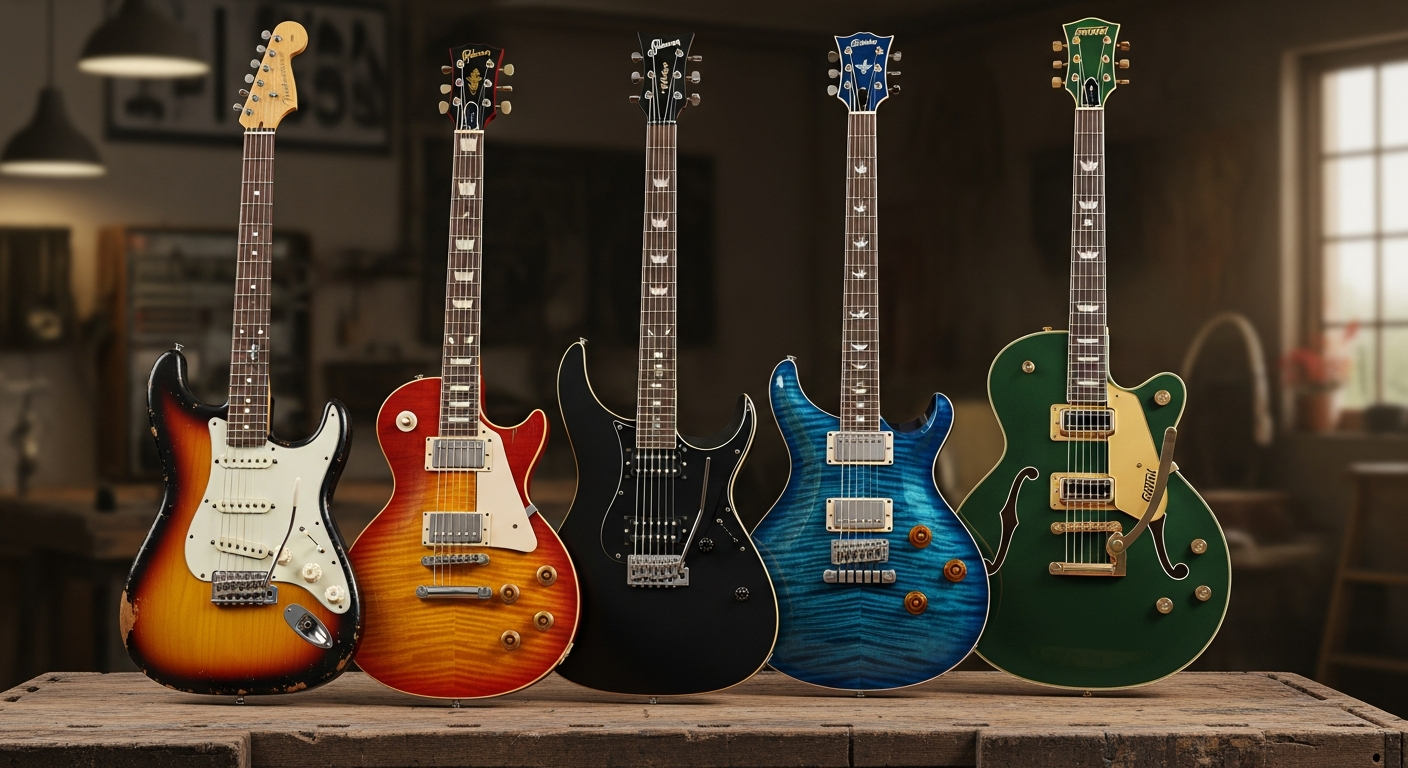
Fender CS '56 Review Stratocaster: In-Depth Analysis for the Hobbyist
So, let's get straight to it. When we talk about Fender Custom Shop ’56 Stratocaster, we are not talking about just any guitar. It's not just another re-edition you find in stores,
it's a model you buy to start with. This is serious stuff, the kind of instrument that makes you dream, but also makes you break out in a cold sweat when you look at the price tag.
I've seen it, held it in my hand, and yes, I've even played it a few times. And every time the same question pops into my head: is it really worth this money? Or is it just the aura of the Custom Shop inflating everything? As a hobbyist who has spent hours mounting crooked pickups and routing bodies with a Dremel, I know well that the difference between a good instrument and an exceptional one is sometimes measured in details that are invisible to others. But also in a very different bank account.
This article is not a marketing puff piece, I won't tell you it's the perfect guitar for everyone. I want to take stock of the situation, as a sincere friend would before letting you spend a fortune. Let's see what's under the hood of a CS '56 Strat, what people who have bought and played it for years say, and above all, if it's the right guitar for tea. Because in the end, a guitar is a bit like a pair of shoes: beautiful until you wear it.
Technical Specifications: What's Under the Relic (and beyond)


Now, let's move on to the interesting part. What do people who have bought, played, and perhaps even worked on these guitars say? On forums, in enthusiast groups, there's always a lot of talk about the Fender Custom Shop '56 Stratocaster. And, as often happens with products in this range, opinions are polarized but full of insights.
The Appreciated (and almost praised) Strengths


Criticisms and Practical Considerations (that not everyone says)
1. The 7.25″ Keyboard Radius: This is a workhorse. For purists it's a must, but for those accustomed to playing modern guitars with flatter radii (9.5″, 10″, 12″), bending beyond the twelfth fret can become a nightmare. The strings “fret out” easily, forcing many to raise the action a bit too much. It's not a defect, it's a historical characteristic, but it's a limitation for certain styles.n2. The Small Vintage Keys: Similar to the radius. Small, low frets make contact with the fretboard very direct. Some love it, others find it uncomfortable, especially for vibrato or for those with a heavier touch. They don't allow the same ease of “gliding” that jumbo frets offer.n3. The Relic: Love and Hate: Ah, the relic. Some adore it and some detest it. Many complain that artificial relic, however well done, doesn't have the same “soul” as natural wear. And above all, relic costs. Sometimes, you pay a significant extra to have a guitar that looks used, when you could have a NOS (New Old Stock) that is aesthetically perfect and will age naturally with you. I've seen endless discussions about this: “the relic looks fake”, “the relic is art”, “the relic is just a way to charge more”. The truth is, it's a matter of personal taste and wallet.n4. Minor Inconsistencies: Although the Custom Shop is synonymous with quality, sometimes one reads about small variations between one example and another. Perhaps a slightly different “Soft V” neck, or a body weight that isn't exactly what was hoped for. These are not serious defects, but at these prices, expectations are very high. That's why, if you can, you must try it before buying it.n5. The “Heel Adjust” Truss Rod: For a hobbyist who loves to get their hands on their guitar, adjusting the truss rod at the base of the neck is a nuisance. Every time you have to loosen the strings, unscrew the neck, make the adjustment, screw it back on, retune, and recheck. It's not a drama, but it's less practical than a truss rod accessible from the headstock. It's historically accurate, but sometimes practicality wins over historical fidelity, at least for those who use the guitar seriously and set it up often.In summary, the general sentiment is one of great appreciation for the sound and feel, but with some reservations about vintage specifications that may not suit all modern guitarists. And, of course, about the price, which is always the sore point.
Pros and Cons in Relation to Price: Is it an Investment or Madness?
Let's get to the point: the price. A Fender Custom Shop '56 Stratocaster new, depending on the degree of relic and options, can easily cost between 5,000 and 7,000 euros, and sometimes even more. Used, it can be found for slightly lower, but still significant, amounts. It's a sum that makes you think, and not a little.The PROs that try to justify the cost
The Unmatched Sound: For many, the sound of a CS ’56 is The sound Stratocaster. It's that magic you hear on historical records. If you're looking for exactly that tone, with that dynamic and resonance, you'll hardly find it in lower-end guitars. The pickups, the woods, the nitro, everything contributes to a sonic harmony that is difficult to replicate.The Authentic Feeling: If you are a vintage purist, the “Soft V” neck, 7.25″ radius, and small frets are a tactile experience that takes you back in time. It's not just a guitar, it's a piece of history you hold in your hands. The nitro finish that “breathes” and ages with you adds to this authenticity.
Superior Build Quality: Every aspect of the guitar is meticulously cared for. Wood selection is rigorous, and assembly is handcrafted by master luthiers. This results in an extremely stable, reliable instrument with remarkable intrinsic resonance.
Potential Holding/Increase Value: Unlike many mass-produced guitars, Custom Shop models tend to retain their value better over time, and in some cases can even increase it, especially if they are limited editions or particularly successful. It's not a guaranteed investment like real estate, but it's less likely to drastically lose value.
The Experience: Owning and playing a Custom Shop is an experience in itself. There's a sense of pride, of connection with the instrument's history. For some, this emotional value is an integral part of the price.
The CONS that make you think about the cost
The Prohibitive Price: This is the biggest limitation. 5,000-7,000 euros is a lot of money. For most musicians, it's an out-of-reach sum, and with that amount, you could buy several excellent guitars or an entire studio/stage setup.Non-Universal Vintage Specs:
The curved radius, thick neck, small frets. These characteristics, however historically accurate, do not suit all guitarists. If you are used to playing shred or genres that require extreme bending and speed, you might feel uncomfortable. It's not a “do-it-all” guitar.
The Relic (and its cost): As mentioned, relicing is an expensive extra. If you don't like the idea of paying for a guitar that already looks battered, or if you prefer your own history to mark it, you're paying for something you don't appreciate. And “fake” relicing can ruin the aesthetic for some.
Valid Alternatives at a Lower Cost: You can get great vintage sounds and feel with guitars that cost much less. A Fender American Vintage II, a Vintera II, or even replicas from independent luthiers can offer a very similar experience at a significantly lower cost. Some say a good American Vintage II reaches 90% of the Custom Shop for a third of the price.
It Doesn't Make You a Better Guitarist: An expensive guitar won't give you talent. It will give you an excellent instrument, but the fingers and ear are yours. Sometimes, a good guitarist with a 1,000 euro guitar will sound better than a mediocre one with a 7,000 euro guitar.
Ultimately, the Fender Custom Shop '56 Stratocaster It's a niche product. Its price is justified by the quality of materials, artisanal craftsmanship, and historical/collectible value. But it's not a purchase made lightly, and it's not necessarily the “best” purchase for every guitarist. It's an almost emotional purchase, for those who know exactly what they want and can afford it.Who It's Suitable For and Who Should Avoid It
Understanding if such an instrument is for you is fundamental. It's not just about budget, but about philosophy, about what you're looking for in a guitar.Who It's Suitable For (and perhaps indispensable)
The Vintage Sound Purist: If you've spent years chasing that sound, that of Buddy Holly's records, Eric Clapton in early Cream, or David Gilmour in his early years, and if you are willing to pay to have it as faithfully as possible, then the CS '56 Strat It could be your ultimate guitar.
The Collector or the History Enthusiast: If you see the guitar not just as an instrument but also as a piece of history, a luthier's work of art, and you already have other guitars for your daily needs, then a Custom Shop can be a valuable addition to your collection.
The Demanding Professional Musician: If you play gigs, record, and your sound is your signature, and you need an instrument that responds perfectly to every nuance, with top quality and reliability, and budget is not an issue, then the Custom Shop offers a level of performance that can make a difference.
Those who love the “Soft V” neck and vintage specs: Some guitarists are perfectly comfortable with the thicker neck, curved radius, and small frets. If you've tried guitars with these specifications and loved them, then the ’56 Custom Shop is the best you can get in that direction.
For those looking for a guitar with a unique character: Every Custom Shop, however replicated, has its own personality. It's not a generic guitar, but an instrument with a strong soul, which pushes you to play in a certain way.
Who Should Avoid It (and save their money)
Those on a Budget: This is obvious. If you have to sell a kidney to buy it, it's probably not the right choice. There are many excellent guitars at much more accessible prices that will give you great satisfaction.For those looking for a modern “all-purpose” guitar:
If you need a versatile guitar, with a comfortable neck for shredding, jumbo frets for easy bending, and electronics that give you a wide range of modern sounds, the CS '56 Strat It's not for you. Its vintage specifications may be restrictive for certain styles.
The Beginner or Intermediate Guitarist: If you are still starting out or still looking for your sound, investing such an amount is premature. It's better to invest in lessons, a good amplifier, and mid-range guitars that allow you to experiment without the pressure of such an expensive instrument. You can modify an existing guitar to give it more of your own feel.
Who Doesn't Like Relic: If the idea of an “artificially aged” guitar bothers you, or if you prefer an immaculate finish that will age with you, then the extra cost of relicing (and its almost ubiquitous presence on CS models) is a disadvantage. You can look for a NOS model, but they are less common for ’56s.
Who Wants a Guitar to Mistreat: If you are the type of musician who carries the guitar around, drops it, bangs it on stage, then such an expensive Custom Shop might give you more anxiety than joy. It's an instrument to be treated with care, and not everyone is willing to do that.
In short, the Custom Shop '56 Stratocaster it's a guitar for those who know exactly what they want, who have a very specific taste and an adequate wallet. It's not an “absolutely better” guitar, but it's a “different” and “special” guitar for a well-defined audience.Final Advice and Practical (and Less Expensive) Alternatives
So, Mimmo, what do you say? Should I buy it or not? The answer, as often happens, is: it depends. If you have the money, if you know that the vintage feel with the “Soft V” neck, the 7.25″ radius and the small frets is exactly what you're looking for, and if the sound of the ’56 pickups gives you goosebumps, then yes, try one. Don't buy it blindly, ever. Get your hands on it, play it for an hour in the store, feel if it “speaks” to you. Because at these prices, you can't afford to make a mistake.
But if you have a more limited budget, or if the vintage specs scare you a bit, don't despair. There are excellent alternatives that will bring you very close to that sound and feel, without emptying your bank account.Valid alternatives to the Fender Custom Shop '56 Stratocaster
1. Fender American Vintage II '57 Stratocaster: This is probably the most direct and closest alternative. The American Vintage II series is Fender's answer to the demand for historically accurate replicas, but at a more accessible price (around 2,000-2,500 euros). The ’57 has many of the specs you find on the CS ’56: ash body, one-piece maple neck with a “V” profile (often a light “Soft V” or “C”), 7.25″ radius, and Pure Vintage ’57 Single-Coil pickups. The quality is excellent, and the feel is very, very close. For many, this series offers 90% of the Custom Shop experience for less than half the price. An excellent choice for those who want vintage without the exorbitant cost.n2. Fender Vintera II '50s Stratocaster: Going down further in price (we are around 1,000-1,200 euros), the Vintera II series offers excellent value for money. You will find an alder or ash body, a maple neck with a lighter “C” or “V” profile, 7.25″ radius, and Pure Vintage ’50s Single-Coil pickups. It doesn't have the same wood selection or the same craftsmanship as the Custom Shop or the American Vintage II, but it's a solid, well-built guitar with an authentic sound. Perfect for those who want the vintage look and feel without spending a fortune.n3. Nash Guitars T-57 / S-57: Bill Nash is a master of relic and vintage replica construction. His guitars, often with ash or alder bodies and maple necks, feature Lollar or Fralin pickups and are famous for their broken-in feel and exceptional sound. The price is intermediate between an American Vintage II and a Custom Shop (around 2,500-4,000 euros), but they offer a “boutique” experience and a relic that many find more convincing than Fender's. If you like the idea of a guitar that already looks lived-in, Nash is an option to consider.n4. Suhr Classic S Antique: Suhr is another boutique brand that offers vintage-inspired guitars but with a modern touch of superior quality. The Classic S Antique have a light relic, very comfortable necks (often with a compound radius of 9″-12″), stainless steel frets, and Suhr pickups that replicate classic single-coils. The price is similar to that of a Nash (3,000-4,500 euros), but the approach is more “modern-vintage”, combining the best of both worlds. Excellent for those who want the vintage look without sacrificing modern playability.n5. G&L Legacy: G&L are the guitars founded by Leo Fender after selling his company. Often overlooked, they offer an interpretation of the Stratocaster with remarkable build quality and excellent pickups. The Tribute models (made in Indonesia) are incredibly affordable (under 1,000 euros), while G&L USA offer Custom Shop quality at more reasonable prices (1,500-2,500 euros). They are not faithful replicas of the ’56, but they are excellent guitars with a unique “Fender-esque” tone.n6. Build it from scratch or modify it: And then there's my favorite way, the DIY one. You can buy a good quality ash body, a maple neck with the profile you prefer (even an aftermarket “Soft V” or “Boat Neck”), a set of pickups that replicate the ’56 (like the Seymour Duncan Antiquity or the Lollar ’56), and assemble your own “replica”. It won't be a Custom Shop, but it will be yours*, you will have made it with your own hands, and you will have learned a lot of things. And the cost will be a fraction.
See also
Download the Luthier Survival Kit
Free PDF with checklist, problem-cause table and project card template.
 English
  Italiano
Stuck on your build?
If you ran into the same problem or have a question, drop it in the comments. I read and reply to every one.
Write a comment