

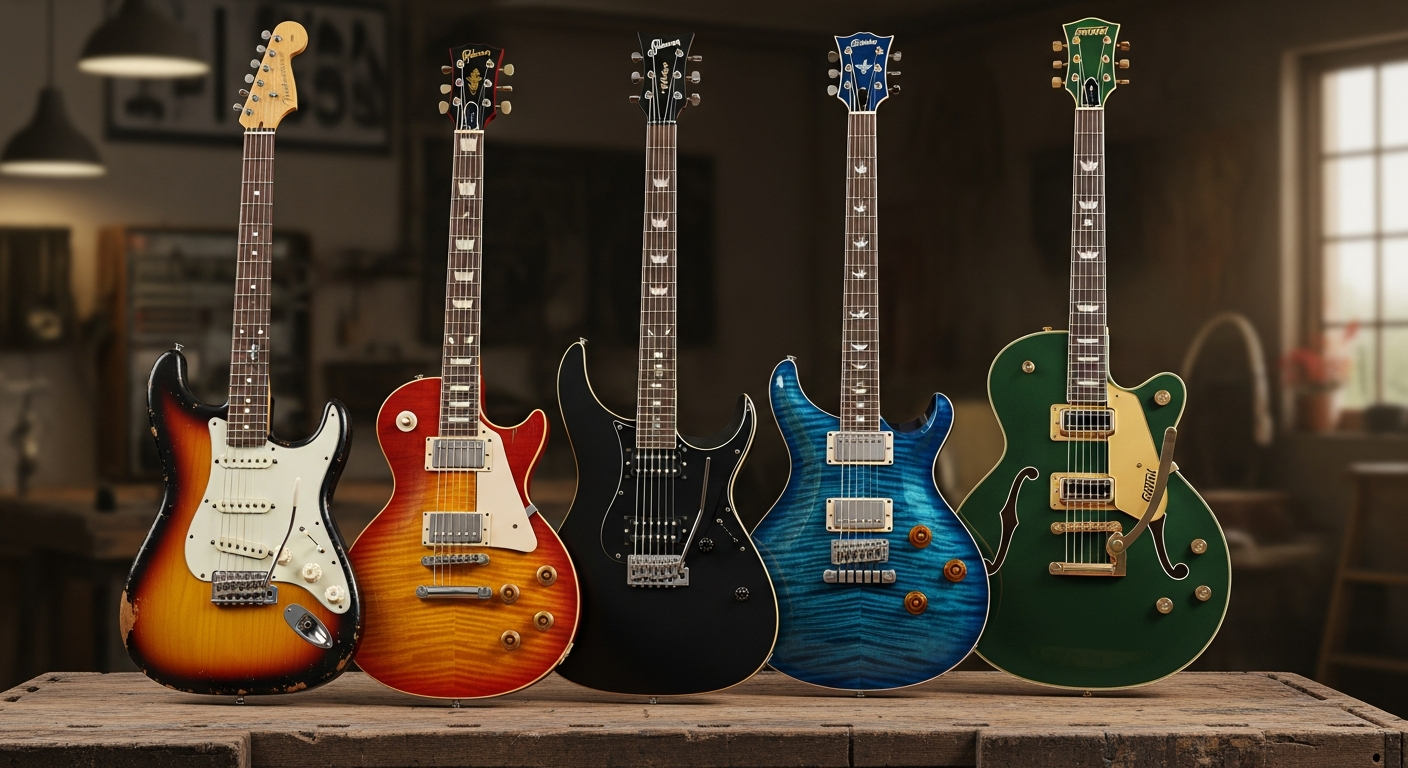
Guide to the main Gibson electrics
So, let's get comfortable. Talking about Gibson electric guitars it's a bit like opening Pandora's box for a lot of people. There are those who venerate them, those who criticize them fiercely, those who dream of them at night, and those who, like me, have disassembled and reassembled them in the garage to understand something more. If you're here, you probably have one of those six-strings with an open-book headstock in mind, and you're wondering if it's worth it, which one to choose, and above all, if the money you'll throw at it is well spent. I'm not a professional luthier, mind you. I'm someone who, like you, has learned through trial and error. I've bought the wrong woods, I've soldered pickups backward, I've done routing that looked like it was done by a crazy beaver. But in the end, every time, I learned something. And what I learned is that behind the name “Gibson” there's a world of history, innovation (and sometimes questionable choices), that needs to be well understood before pulling out the credit card. The problem I often see is that people buy a name, an icon, without really understanding what they're bringing home. Maybe you like the sound of Slash, or Angus Young, and you think it's enough to buy a Gibson to have that sound. It's not that simple. Each model has its soul, its merits and its flaws, and the “popular sentiment” circulating online, believe me, is not always unfounded. On the contrary. The idea of this guide is precisely to give you a compass. Let's look together at the most iconic models, those that have made history and are still the most desired today. Let's analyze what's under the hood, what those who have gotten their hands on them (and their money) say, and try to understand for whom a certain guitar is made and for whom, instead, it might be a mistake. This is not a glossy catalog, but an honest chat, from someone who has seen a few tricks of the trade and is not afraid to call a spade a spade.
The Gibson world: what to expect in general
Before diving into the individual models, let's take a step back. When we talk about Gibson guitars, there are some constants, almost some “trademarks”, that you will find a bit everywhere. Understanding these general characteristics will help you to better frame each single six-string. First of all, the scale. Most of the Gibson electric it has a 24.75-inch scale (approximately 62.86 cm). This è shorter than the Fender standard (25.5 inches). What does this mean for you? Slightly lower string tension, a 'softer' feel to the touch and, for many, easier bending. The sound tends to be a bit warmer and with remarkable sustain, although sometimes a touch of brightness and definition is lost compared to guitars with a longer scale. The woods are another cornerstone. Historically, Gibson has made extensive use of mahogany for the body and neck, often paired with a maple top for Les Pauls. This combination of woods contributes to that warm, full-bodied, and resonant tone that è has become synonymous with the brand. Over the years, there have been variations, such as walnut bodies or maple necks for some specific models or series, but mahogany remains king. The pickups, almost always humbuckers, are another distinctive element. From P.A.F. historical to Burstbucker, ’57 Classics, 490R/498T and others, Gibson has always focused on humbuckers that offer generous output and a rich mid-frequency sound. This makes them perfect for rock, blues, and jazz, but also capable of getting dirty well with a bit of gain. Finally, the finish. Gibson guitars are almost always finished with nitrocellulose lacquer. This finish is thinner than modern polyurethanes, allowing the wood to “breathe” and age more naturally, developing the classic “checking” (cracks in the paint) over time. Of course, it is also more delicate and less resistant to bumps and scratches.
Gibson Les Paul: The Undisputed Icon


Let's start with the big one, the Gibson Les Paul. There’s no guitar that screams “rock” more than it. Born in the ’50s, it has gone through decades of music, ending up in the hands of legends like Jimmy Page, Slash, Joe Perry and dozens of others. But behind the myth, what is there really?
Gibson Les Paul Standard
The Les Paul Standard is the benchmark, the one that comes to mind when you think of “Les Paul”. Over the years it has had several incarnations, but the basic concept remains the same: a rock and blues machine with incredible sustain.
Technical features
Body wood: Solid mahogany with figured maple top (flamed or quilted maple). Often, in modern versions, it features a “weight relief” (tonal chambers or holes) to reduce the weight. Handle wood:Mahogany. Handle type: Varies depending on the year and series. It can be a '50s vintage profile (thicker and rounder) or a '60s Slim Taper (thinner and faster). Rosewood fretboard or, in the past, ebony. Pick-up: Typically humbucker, like Burstbuckers (in recent years often Burstbucker 61R/T or Burstbucker Pro), designed to replicate the sound of the original P.A.F.s. HH configuration. Stairs: 24.75 inches. Hardware: Tune-o-matic bridge and Stopbar tailpiece in aluminum (or zinc alloy), Grover or Kluson (vintage-style) tuners. Nut in Graph Tech or bone. Finish: Gloss nitrocellulose, often with iconic “burst” colors. Relevant construction notes: Cream binding on body and neck, trapezoidal inlays on the fretboard. Sometimes, ’50s style wiring for better volume/tone interaction.
Popular sentiment
The Les Paul Standard is revered for its big, warm sound and almost infinite sustain. The community considers it the quintessential rock tone. However, its weight is often a subject of discussion: non-weight-relieved versions can be really heavy, a problem for those who play for hours standing up. Sonic versatility is good, but it's not a guitar that adapts to all genres with the same ease as a Stratocaster. The price is high, and this often makes it a “lifetime” purchase. Build quality is generally high, but in the past there have been periods when Gibson's quality control was criticized, especially on minor details.
Pros and Cons in relation to the price
PROS: Iconic and unmistakable sound, exceptional sustain, classic and charming aesthetic, high resale value. AGAINST:Very high price, considerable weight (especially on non-weight-relieved models), the ’50s neck profile is not for everyone, the nitro finish is delicate.
Who it's suitable for / Who should avoid it
Suitable for: Rockers, bluesmen, jazz musicians looking for a full-bodied and warm sound, musicians who appreciate the classic aesthetic and feel of a historic guitar. Those with a high budget who want a long-term investment. Better to avoid it if:You have a limited budget, prefer lightweight guitars, are looking for super-versatility for modern genres, or don't get along well with thicker necks.
Gibson Les Paul Studio
There Les Paul Studio was born as a more “spartan” and accessible version of the Standard, designed for musicians looking for the Les Paul sound and feel without the aesthetic frills and high cost.
Technical features
Body wood: Solid mahogany, often with a maple top, but without the aesthetic figuring of the Standard. Often with weight relief. Handle wood:Mahogany. Handle type: Generally a Slim Taper ’60s profile, more comfortable for many. Rosewood fretboard. Pick-up: Often features Gibson 490R (neck) and 498T (bridge) humbuckers, known for being a bit hotter and more modern than Burstbuckers. Stairs: 24.75 inches. Hardware: Tune-o-matic bridge and Stopbar tailpiece, Grover or equivalent tuners. Finish: Nitrocellulose, often satin or gloss, but with fewer color options than the Standard and without binding on body and neck. Relevant construction notes: Absence of binding on body and neck, dot inlays or simple trapezoidal inlays.
Popular sentiment
The Studio is seen as the “working man’s Les Paul”. Many appreciate it for its quality/price ratio, offering a sound and feel very close to the Standard at a significantly lower cost. Some consider it “less prestigious” due to the lack of binding and figured tops, but most agree that the sound is right. It is one of the Gibson electric most popular for those who want to enter the brand's world without breaking the bank.
Pros and Cons in relation to the price
PROS: Excellent quality/price ratio for the Les Paul sound, lighter (often) and more comfortable to play than some Standards, the Slim Taper neck profile is highly appreciated. AGAINST:Less “premium” aesthetic (lack of binding, non-figured top), the 490R/498T pickups are excellent but might not appeal to those looking for the pure vintage sound of Burstbuckers.
Who it's suitable for / Who should avoid it
Suitable for: Musicians looking for the sound and feel of an authentic Les Paul but with a more limited budget. Excellent for concerts where you don't want to risk a more expensive instrument. Better to avoid it if:The aesthetic and prestige of a “complete” Les Paul are essential for you.
Gibson Les Paul Special and Junior
These two are the younger sisters, more spartan and direct, but with a character all their own.
Technical specifications (general)
Body wood: Solid mahogany, often without a maple top (slab body). Handle wood:Mahogany. Handle type: Various profiles, often more robust. Rosewood fretboard. Pick-up: Junior: A single P90 at the bridge. Special: Two P90s (neck and bridge). Stairs: 24.75 inches. Hardware: Wraparound bridge (compensated or not), Kluson style tuners. Finish: Nitrocellulose. Relevant construction notes: Simple design, without binding, dot inlays.
Popular sentiment
The Junior and Special are loved for their simplicity, the raw and powerful sound of the P90s, and their “punk-rock” character. The Junior, with its single P90, is the quintessence of “less is more”, while the Special offers a bit more versatility. They are considered excellent for genres that require a direct and aggressive sound, from blues to garage rock. The wraparound bridge is sometimes a subject of discussion for intonation, but many find it part of the vintage charm.
Pros and Cons in relation to the price
PROS: Powerful and unique P90 sound, lightness, more accessible price compared to other Les Pauls, vintage and iconic look. AGAINST:Limited versatility (especially the Junior), wraparound bridge intonation can be a compromise, P90 sound can be noisy (single coil hum).
Who it's suitable for / Who should avoid it
Suitable for: Punk, garage rock, blues musicians looking for a raw, direct sound with a lot of character. Those who love the simplicity and responsiveness of P90s. Better to avoid it if:You're looking for a versatile guitar for many genres, you need silent humbuckers, or you don't like the “growly” sound of P90s.
Gibson SG: The Agile Little Devil
There Gibson SG, born as the “Les Paul Solid Guitar” in the ’60s, quickly became an icon in its own right, associated with guitarists like Angus Young, Tony Iommi, and Pete Townshend. It's a completely different beast from the Les Paul, lighter, faster, and with a distinctive character.
Gibson SG Standard
The SG Standard is the most recognizable and desired model of the SG family.
Technical features
Body wood: Solid mahogany. Handle wood:Mahogany. Handle type: Slim Taper ’60s profile, fast and thin. Rosewood fretboard. Pick-up: Generally Gibson 490R (neck) and 498T (bridge) humbuckers or ’57 Classics. Stairs: 24.75 inches. Hardware: Tune-o-matic bridge and Stopbar tailpiece, Kluson Deluxe or Grover tuners. Finish: Gloss nitrocellulose. Relevant construction notes: Symmetrical double cutaway, “batwing” pickguard (bat-shaped) or smaller. Trapezoidal inlays.
Popular sentiment
The SG is loved for its lightness, excellent access to the upper frets thanks to the double cutaway, and fast neck. It's a guitar that “hugs” the body well and allows great freedom of movement. Its tone is often described as more “airy” and with more sustain compared to a Les Paul, but also more “thin” or less full-bodied. The famous “neck dive” (the neck that tends to drop when playing standing up) is a common complaint, but many learn to live with it or use wider straps. It is one of the Gibson electric preferred by those who play hard rock and metal.
Pros and Cons in relation to the price
PROS: Lightness, excellent access to the upper keys, fast neck, iconic and distinctive look, aggressive and clear sound. AGAINST:Neck dive problem, the sound might be perceived as less “fat” than a Les Paul, the bridge position can be a bit uncomfortable for some.
Who it's suitable for / Who should avoid it
Suitable for: Hard rock, blues-rock, metal guitarists looking for a light, fast guitar with easy access to the high registers. Perfect for those who move a lot on stage. Better to avoid it if:you can't stand neck dive, you prefer the massive sound and infinite sustain of a Les Paul, or you're looking for a very balanced guitar for playing seated.
Gibson ES-335: The Semi-Hollow Elegance
There Gibson ES-335, introduced in 1958, was a true revolution. It combined the resonance and warmth of a hollow-body guitar with the feedback resistance of a solid-body, thanks to its maple center block. It became the choice of jazz musicians, bluesmen, and rock stars, from B.B. King to Dave Grohl.
Technical features
Body wood: Laminated maple (3-ply) with a solid maple center block. Handle wood:Mahogany. Handle type: Various profiles, often Slim Taper or '50s rounded. Rosewood fretboard. Pick-up: Typically humbuckers, like '57 Classics or Burstbuckers, for a warm and vintage sound. Stairs: 24.75 inches. Hardware: Tune-o-matic bridge and Stopbar tailpiece, Kluson vintage-style tuners. Finish: Gloss nitrocellulose. Relevant construction notes: F-holes on the top, binding on body and neck.
Popular sentiment
The 335 is universally praised for its incredible versatility. It can go from velvety jazz tones to gritty blues crunch, all the way to rock roars. The center block solves most of the feedback problems of pure hollow-bodies, making it suitable for higher volumes too. Its size is a factor: it's a large guitar, and not everyone finds it comfortable. The price is high, but justified by the construction complexity and sound quality. It is one of the Gibson electric most sophisticated and appreciated.
Pros and Cons in relation to the price
PROS: Extreme sonic versatility, excellent sustain, warm, resonant, and harmonically rich sound, elegant and iconic aesthetic. AGAINST:Generous dimensions that can be uncomfortable for some, high price, can still suffer from feedback at very high volumes and extreme gain.
Who it's suitable for / Who should avoid it
Suitable for: Jazz, blues, classic rock, fusion musicians looking for a versatile guitar with a rich sound and great expressiveness. Those who appreciate the resonance of semi-hollows. Better to avoid it if:You're looking for a small and compact guitar, you play very high-gain genres (extreme metal), or you have a limited budget.
Gibson Explorer and Flying V: The Bold Shapes
The Gibson Explorer And Flying V, also introduced in 1958, were so ahead of their time that they initially didn't achieve success. Only in the '70s and '80s, with the advent of hard rock and metal, did these radical shapes find their audience, becoming symbols of aggression and originality.
Technical specifications (general for both models)
Body wood: Solid mahogany. Handle wood:Mahogany. Handle type: Often fast Slim Taper '60s profiles. Rosewood fretboard. Pick-up: Powerful humbuckers, often the 490R/498T or even hotter models, designed for rock and metal. Stairs: 24.75 inches. Hardware: Tune-o-matic bridge and Stopbar tailpiece, Grover tuners. Finish: Nitrocellulose. Relevant construction notes: Extreme shapes are the main characteristic.
Popular sentiment
These guitars are loved for their unique look and their 'rebel' attitude. The Explorer is often praised for being surprisingly comfortable to play seated (the lower edge rests well on the leg) and for its sustain. The Flying V, on the other hand, is a visual icon but can be a bit more uncomfortable to play seated due to its shape. Both offer a powerful and aggressive sound, perfect for rock and metal. 'Neck dive' can be a more pronounced problem on the Flying V.
Pros and Cons in relation to the price
PROS: Unique and distinctive head-turning look, powerful and aggressive sound, excellent sustain, surprisingly comfortable for some (Explorer when seated). AGAINST:Extreme shapes can be uncomfortable in some situations (Flying V when seated), neck dive can be a problem (especially V), they are not the most versatile guitars for 'clean' genres.
Who it's suitable for / Who should avoid it
Suitable for: Hard rock, metal, progressive guitarists who want to stand out and are looking for a powerful sound. Those who have a soft spot for 'weird' and iconic shapes. Better to avoid it if:You prefer anonymity, you're looking for an extremely ergonomic guitar for every situation, or you play genres that require very clean and delicate tones.
General tips for buying a Gibson
After exploring the main models, I'd like to give you some tips that apply to all Gibson guitars, especially if you are about to make a significant purchase.
New or Used?
New Gibsons are expensive, let's not beat around the bush. Used can be a great option to save money, but it requires attention. Always check the serial number for the year of production, carefully examine the neck (curvature, worn frets, working truss rod), the electronics (noisy potentiometers, cold solders), and the headstock (a weak point for breaks). A good used Gibson can be an amazing deal, but a beat-up one can turn into a nightmare.
Pickups and Sound
don't stop at the pickup name. A Burstbucker is not the same as a 490R/498T, which in turn is different from a P90. Each pickup has its own character. If you buy a Les Paul Studio and don't like the sound, don't despair. Changing pickups is one of the most common and satisfying modifications. I've spent entire nights trying different configurations, and believe me, it makes a huge difference. You can explore a world of possibilities for modify your guitar, starting right from the pickups.
The Setup is Fundamental
Any guitar, but a Gibson in particular, needs a good setup. Action that's too high, incorrect intonation, or an unadjusted truss rod can ruin the experience. If you're not experienced, take it to a good luthier. A professional setup transforms the instrument and truly makes it yours. I remember the first time I adjusted the action on my Les Paul, it felt like playing a different guitar!
Don't Be Afraid to Experiment
don't buy a Gibson just because your idol has one. Try different models, feel how they fit you, how they sound with your amplifier. The perfect guitar is the one that inspires you and makes you want to play. And don't be afraid to customize it. A TonePros bridge, quality capacitors, or a new set of tuners can work wonders.
Final considerations and alternatives
We have reached the end of this journey into the world of Gibson electric main ones. I hope this honest chat has given you some extra tools to guide you. Gibson guitars are not perfect; they have their flaws and peculiarities, but they have a soul and a sound that have shaped the history of music. If your budget doesn't allow it, or if you're simply looking for something different, the market offers many valid alternatives. Epiphone, Gibson's 'sister brand,' produces very faithful replicas at affordable prices. Companies like Tokai, Greco, Heritage Guitars (formed by former Gibson employees) offer very high-quality instruments that often replicate or are inspired by classic Gibsons, sometimes with a surprising quality/price ratio. But remember, none of these will be 'a Gibson' 100%, and it doesn't mean they have to be. The important thing is to find the instrument that resonates with you. Choosing a Gibson guitar It's often a matter of heart, but I hope this guide helps you make the decision with your head too. Carefully evaluate your needs, your budget, your musical style and, above all, try, try, try. Only then will you find the right six-string for you. Remember that you make the music, not just the instrument, but a good travel companion always makes a difference.
FAQ
Which is the best Gibson to start playing?
To start, a model like the Gibson Les Paul Studio or the Gibson SG Standard can be an excellent choice. They offer the Gibson sound and feel at a more accessible price compared to top models, without sacrificing too much in terms of quality. Their versatility makes them suitable for exploring various musical genres.
Is it worth buying a used Gibson?
Absolutely yes, buy a Gibson guitar A used one can be an excellent deal. Often, high-quality instruments can be found at a significantly lower price than new. However, it is essential to carefully inspect the guitar or have it checked by a trusted luthier to ensure it is in good condition and has no hidden problems.
Download the Luthier Survival Kit
Free PDF with checklist, problem-cause table and project card template.
 English
  Italiano
Stuck on your build?
If you ran into the same problem or have a question, drop it in the comments. I read and reply to every one.
Write a comment