

The Beginnings: From Radio to Rock ‘n’ Roll
Imagine post-war America. There’s a desire for music, for fun, but also for practicality. Country, blues, and western swing musicians were looking for a more powerful sound that could cut through the mix and be heard even in larger venues. Amplified acoustic guitars, with those rudimentary pickups, were a disaster of feedback and instability. Leo Fender, in his shop in Fullerton, California, had already started to make a name for himself repairing and building amplifiers. He listened to musicians, understood their problems. And the solution that flashed in his mind was counterintuitive for the time: a guitar with a totally solid body. No soundbox to resonate and generate unwanted feedback. Just a block of wood, a bolt-on neck, and pickups that captured the vibrations of the strings.The Birth of the Solid-Body: Esquire and Broadcaster/Telecaster
Advertisement

American Performer Stratocaster HSS - 3-Tone Sunburst with Rosewood Fingerboard
See on Amazon

The Stratocaster: An Icon Born from Necessity
The Telecaster was a success, but Leo Fender never stopped. He listened to musicians, gathered feedback. There were requests for more comfort, more sonic versatility, for something that could go beyond the Tele's “twang”. So, in 1954, the Stratocaster. And, believe me, the world of music would never be the same. The Stratocaster was a huge leap forward, both in terms of design and engineering. Leo and his team (George Fullerton, Freddie Tavares) worked to create something that was ergonomic and sonically versatile.Ergonomics and Revolutionary Design
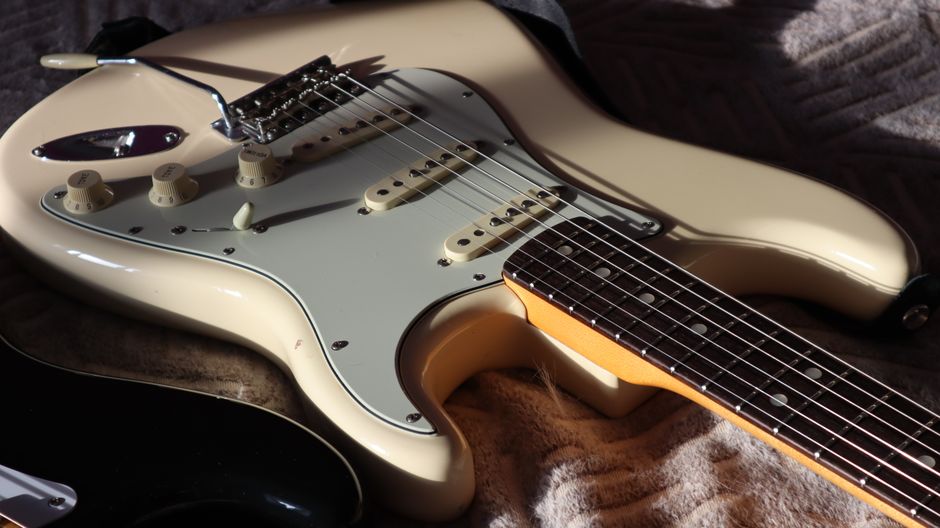
One of the first things that stands out, and that you feel as soon as you pick it up, is the contoured body. The famous “comfort contours”: a cut on the back that allowed the guitar to fit better against the guitarist's body and a bevel on the forearm for greater comfort. It seems like a small detail, but after hours of rehearsals or concerts, it makes a huge difference. The Telecaster was a plank, the Stratocaster was an embrace. The neck, initially maple with a maple fretboard, was tapered and easy to play. And, of course, it was a bolt-on neck, maintaining that modularity that Leo so appreciated and that allowed musicians (and us hobbyists) to change the neck without too much hassle.The Synchronized Tremolo: More Expression for the Guitarist
But the real innovation, the one that changed the way the guitar was played, was the synchronized tremolo. It wasn't the first tremolo ever, but it was the first that worked Well and kept tuning decently (or at least, decently for the time). It allowed guitarists to bend notes, create expressive vibratos, and add a touch of drama to their music. Initially, many blocked it or used it very little, but over time, guitarists like Jimi Hendrix made it their sonic signature, squeezing every drop of expressiveness from it. I spent hours in my garage adjusting the tremolo of a Stratocaster, looking for the right balance between spring tension and bridge height. It's not a trivial operation, but when you succeed, when the tremolo responds as you want it to, it's an invaluable satisfaction.Three Single-Coil Pickups and “In-Between” Sounds
The Stratocaster featured three single-coil pickups, a novelty compared to the Telecaster's two. This configuration, combined with a 3-position selector (later becoming 5 positions), opened up a world of sonic possibilities. The intermediate selector positions (neck+middle and bridge+middle) produced that “quacky” or “out-of-phase” sound that became a Strat trademark. A crystalline, somewhat scooped sound, perfect for funk, pop, but also for certain blues or rock passages. This meant that a single guitar could cover a much wider sonic range. From the warm, round sound of the neck pickup, to the aggressive twang of the bridge, passing through those “vintage” sonorities that we still seek today. The versatility of the Stratocaster made it the definitive instrument for very different musical genres, from rock to blues, from pop to funk, to jazz fusion. The Stratocaster is perhaps the most modified and customized guitar ever. Its modular design makes it an ideal testbed for all kinds of experiments. Want to change the pickups? Easy. Want to route a cavity for a humbucker? It can be done. In my garage, I've had at least three different Stratocasters, and none remained the same as the original for more than a few months. It's the guitar that invites you to get your hands on it, to make it your own.Enjoying this article? Subscribe to the newsletter: one email a week, zero spam.
Subscribe →Electric Bass: Precision Bass and Jazz Bass
Leo Fender didn't just revolutionize the world of guitars. His brilliant intuition led him to understand that bassists also needed a modern, amplifiable instrument. Until then, bassists mainly relied on the acoustic double bass, a large, cumbersome instrument, difficult to amplify and, let's face it, not always perfectly in tune, especially for those without perfect pitch.The Precision Bass: Intonation at Your Fingertips
In 1951, almost simultaneously with the Telecaster, Leo introduced the Precision Bass, or P-Bass. The name “Precision” was not chosen by chance. It was a clear allusion to the presence of frets on the fretboard, which allowed bassists to play with an intonation precision impossible to achieve with the same ease on a fretless double bass. P-Bass was another work of engineering simplicity. Solid body, bolt-on neck, and a single split-coil pickup. This pickup, divided into two sections and wired out of phase, had an important characteristic: it was a humbuckers. What does that mean? It was designed to “cancel” the hum typical of single-coils, making the sound cleaner and more powerful. This pickup gave the P-Bass a warm, round, and powerful sound, with a percussive attack and deep resonance. The P-Bass immediately became the standard for bassists of all genres, from rock to pop, jazz to soul. It's a robust, reliable instrument, with a sound that sits perfectly in the mix. Even today, it's one of the most recorded and played basses in the world. If someone asked me which bass to use to start playing or recording, a P-Bass would always be among the top options. Its simplicity also makes it ideal for those who want to start understanding bass electronics.The Jazz Bass: Versatility and Refinement
Ten years later, in 1960, Fender introduced the Jazz Bass, or J-Bass. This instrument was designed to offer bassists a more versatile and refined alternative to the P-Bass. The J-Bass featured a more elegant offset body, similar to that of the Jazzmaster (which we'll see shortly), and a thinner, faster neck, particularly appreciated by those with smaller hands or who preferred a smoother feel. Jazz Bass featured two single-coil pickups, one at the bridge and one at the neck. Each pickup had its own independent volume control, plus a general tone control. This configuration allowed for a much wider tonal variety compared to the P-Bass. You could blend the sound of the two pickups to obtain infinite nuances: from the warm, deep sound of the neck pickup, to the brighter, sharper sound of the bridge pickup. The J-Bass became a favorite of many jazz, funk, and fusion bassists, as well as rock and pop, thanks to its ability to adapt to different styles. The sound of the Jazz Bass is often described as more “defined” and “articulated” than the P-Bass, with a greater presence in the high frequencies. In my journey as a hobbyist, I've had the opportunity to get my hands on several J-Basses, and versatility is truly its strong suit. Understanding the wiring of two single-coil pickups and how the volume and tone potentiometers interact is an excellent basic electronics lesson.Beyond the Classics: Jazzmaster, Jaguar and Other Experiments
Fender didn't stop at the Tele, Strat, and basses. Leo and his team were constantly looking for new solutions, trying to intercept the needs of other markets, even if sometimes with unexpected results.The Jazzmaster: Born for Jazz, Adopted by Surf and Indie
In 1958, Fender launched the Jazzmaster, an instrument designed specifically for jazz guitarists, who at the time preferred hollow-body or semi-hollow guitars from brands like Gibson. The Jazzmaster was an attempt to offer a solid-body alternative with a warmer and rounder sound, suitable for jazz. The design was radically different: a large and sinuous offset body, wide and flat single-coil pickups (often confused with humbuckers, but actually single-coils with a different and wider winding than those of the Strat), and a very elaborate floating tremolo system with a tremolo lock. But the thing that made it truly complex was the electronics: a standard “lead” circuit and a separate “rhythm” circuit, with dedicated volume and tone controls, activatable via a switch. Ironically, jazz guitarists did not adopt it en masse. They found the sound too bright and the tremolo not very useful. But the Jazzmaster found an unexpected home: in 60s surf rock, where its tremolo and bright sound were perfect for the Californian beach atmospheres. And then, in the 80s and 90s, it became the iconic guitar of the indie and alternative rock scene, with bands like Sonic Youth and My Bloody Valentine who exploited its sonic potential and its “anti-establishment” attitude. I tried wiring a Jazzmaster from scratch, and I assure you, it's an undertaking that tests the patience of a saint. All those potentiometers, all those switches… Not for the faint of heart, but when it works, it's a satisfaction. A true labyrinth of wires, but also a lesson in electronic versatility.The Jaguar: Short Scale, Sharp Sound
In 1962, came the Jaguar, another offset guitar with a design similar to the Jazzmaster, but with some key differences. The Jaguar had a shorter scale (24 inches against the 25.5 of the Strat and Tele), which made it easier to play for some, but also with lower string tension and slightly reduced sustain. It featured single-coil pickups with metal claws (“claws”) that contributed to a brighter and more aggressive sound. The Jaguar also had a very complex switching system, with three switches to activate/deactivate the pickups and a “strangle” circuit that cut low frequencies. Like the Jazzmaster, the Jaguar did not have immediate success with the mainstream public, but it became another icon of the surf scene, and then, again, of indie and punk rock. Kurt Cobain, for example, was a big fan. These “alternative” Fender guitars are a perfect example of how innovations, even if not immediately understood by the reference market, can find new life and define new musical genres. They are guitars that push you to experiment, to seek different sounds, just like us in our garage.Not Just Guitars: Amplifiers and Rhodes Pianos
One cannot speak of Fender without also mentioning its impact in the world of amplifiers. The Tweed circuits, the Blackface, the Silverface: all amplifiers that have defined the sound of generations. And let's not forget the legendary Rhodes Piano, an electric piano that, for a period, was produced by Fender and left an indelible mark on jazz, soul, and R&B music. Leo Fender was a well-rounded innovator, and his vision went far beyond the simple six-string instrument.The Legacy and the Future: Fender Today
The history of Fender has not always been a bed of roses. After Leo Fender sold the company to CBS in 1965, there was a period, lasting almost twenty years, during which the quality of the instruments declined. CBS, with its conglomerate mentality, focused more on quantity than on artisanal quality, and this was reflected in the instruments produced during that period. Many purists consider “pre-CBS” guitars as the Holy Grail, and not without reason. Fortunately, in 1985, a group of employees and investors, led by William Schultz, managed to buy back the company. It was the beginning of a rebirth. The new Fender focused again on quality, innovation, and the rediscovery of the roots that had made the brand legendary.Fender Today: Between Tradition and Innovation
Today, Fender is a giant that perfectly balances its historical legacy with the needs of the modern market. They still produce the classic Telecaster and Stratocaster, faithful to the original designs, but also modernized versions with new specifications, different pickups, and cutting-edge finishes. The Fender Custom Shop is a true laboratory where very high-quality guitars and basses are created, often exact replicas of vintage models or unique instruments custom-designed for artists. It's an excellence, somewhat like every amateur luthier's dream, but on an industrial scale. A fundamental aspect of Fender's legacy is modularity and constructive simplicity. This characteristic, desired by Leo to facilitate production and repair, is a true gift for us DIY enthusiasts. The bolt-on neck, the relatively simple electronics (at least in basic models), the availability of spare parts and aftermarket parts: all this makes Fender guitars perfect for learning, experimenting, and customizing. I have built several guitars starting from Fender-style bodies and necks, and each time it's a new adventure, a new lesson. You can change a pickup, experiment with new wiring, refinish the neck. It's a continuous invitation to get your hands on it. The impact of Fender on modern music is incalculable. They have given musicians the tools to create new sounds, new genres, new expressions. And their design philosophy, based on practicality and efficiency, continues to inspire anyone who wants to build or modify an instrument. If you want to delve a bit deeper into their history, Fender's official website has a dedicated section that is a treasure trove of interesting information: The Fender Story. Ultimately, the story of Fender is the story of a guy in his garage who had an idea. He wasn't a musician, but he listened to musicians. He tried, he failed, he perfected. And he changed the world. And this, for me, is the most beautiful message: you don't need to be a genius or a professional to leave your mark. You just need to have curiosity, a desire to do, and not be afraid to make mistakes. Just like us, every day, in our small workshop, with a soldering iron in hand and wood dust on our clothes.See also
Download the Luthier Survival Kit
Free PDF with checklist, problem-cause table and project card template.
 English
  Italiano
Stuck on your build?
If you ran into the same problem or have a question, drop it in the comments. I read and reply to every one.
Write a comment