

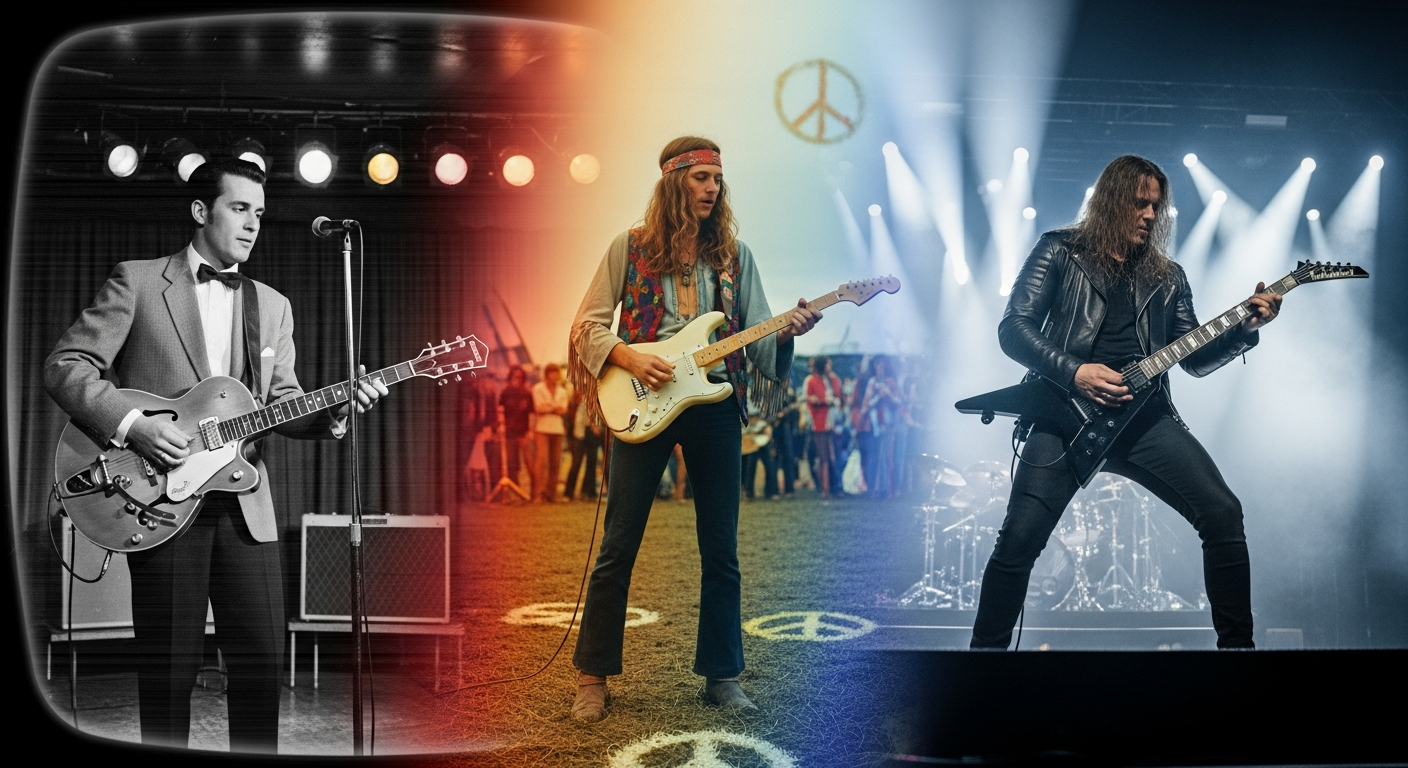
3 Rare guitars: evolution and historical value
Who hasn't ever fantasized? Of flipping through an old magazine, or maybe a dusty catalog, and stumbling upon a faded image of a guitar you've never seen before. A model so strange, so out of the ordinary, that it sparks that thought: "What is this thing? And why have I never heard of it?".
Well, I'm not a collector of vintage instruments; my passion is more about getting my hands dirty in the garage. However, there's an undeniable charm in these jewels of lutherie, in these rare guitars that defined an era, or perhaps were simply too ahead of their time. They are pieces of history, but also true prototypes that tell us so much about the ingenuity, the challenges, and sometimes, the mistakes of those who attempted to create something new.
For us who work on a raw body or a circuit to solder, understanding the history behind these creations is fundamental. It helps us understand the "why" of certain constructive solutions, the "how" the sound we love came to be defined. And, let's face it, it also gives us some cool stories to tell when the discussion at the bar inevitably turns to six strings.
Today we take a small trip back in time. I have chosen three unique instruments, three milestones that, each in its own way, tell us an important piece of the evolution of the electric guitar. They are not just museum pieces; they are lessons in lutherie, electronics, and, why not, marketing.
Rickenbacker Electro A-22 “Frying Pan”: The Beginning of Everything (or Almost)
Let's now move on to another of the rare guitars which, for years, was more a legend than a tangible reality: the Gibson Moderne. We are at the end of the 1950s, a golden age for lutherie innovation. Fender had already launched Stratocaster and Telecaster, dominating the market with its bold and functional designs. Gibson, for its part, felt the pressure to respond, to propose something equally revolutionary.
Ted McCarty, then president of Gibson, was a man with a vision. He wanted to push Gibson beyond the boundaries of traditional design, beyond the classic shapes of Les Paul and ES-335. So, in 1957, he launched an audacious project: the "Modernist" series. This series included three models that were supposed to represent the future of the electric guitar: the Flying V, the Explorer, and, indeed, the Moderne.
While the Flying V and Explorer saw production (albeit limited at first), the Moderne became the trio's ghost. For decades, there was no concrete evidence of its actual production in the 1950s. Just a patent, a drawing, and a few rumors. It was said that only a few prototypes were ever built, if any at all. It was a guitar that existed only on paper, an idea too futuristic for its time.
The design of the Moderne was radical, even more so than the Flying V. It resembled a stylized arrow, with an asymmetrical body and a "pointed" headstock that echoed the body's design. The idea was to create an instrument that screamed "future" in every line. Materials and Sound:
Like the Flying V and Explorer, the Moderne was also designed to be built from Korina (Limba), a tropical wood similar to mahogany but with a lighter grain and slightly lower weight. Korina was chosen not only for its unique aesthetic but also for its sonic properties: a warm, resonant tone, with good sustain and a balanced response across the entire frequency spectrum.
It was equipped with the legendary Gibson PAF (Patent Applied For) humbucker pickups, which were the pinnacle of their time for noise reduction and a full-bodied, powerful, and harmonically rich sound. These pickups, paired with the Korina, would likely have produced a warm, rounded sound with excellent definition, perfect for the blues-rock and jazz of the era.
The neck was glued (set neck), as per Gibson tradition, ensuring excellent transmission of vibrations between neck and body and contributing to sustain. The scale was the classic Gibson 24.75 inches, which makes bending easier and gives a softer feel to the strings. The mystery and the rediscovery:
For decades, the Moderne remained an enigma. Then, in the 1980s, Gibson decided to resurrect the project. Replicas were produced, first in limited series and then with various reissues over the years. These reissues finally gave substance to the legend, allowing guitarists to get their hands on an instrument that had been just a dream for years.
But the real twist came much later, when some original specimens from the 1950s emerged. These were not prototypes, but actually produced guitars, albeit in extremely small numbers. This transformed the Moderne from legend to reality, making it one of the rare guitars most sought-after and expensive on the collectors' market, with a value easily exceeding a million dollars for an original specimen. What does the history of Moderne teach us, those of us who work in garages?
The Moderne is a powerful reminder that innovation is not always appreciated immediately. Sometimes, an idea is simply too far ahead of its time. Don't be afraid to dare: Ted McCarty dared, even if the market wasn't ready. If you have a radical idea for a body shape or a circuit, try it. The worst that can happen is that not everyone likes it. But maybe, in twenty years, someone will rediscover and celebrate it.
The importance of the “concept”: Even if it didn't have immediate success, the concept of the Moderne influenced generations of luthiers and designers. Every guitar you build or modify, even the simplest one, has its own concept. Take care of that.
The value of the “unconventional”: Sometimes, things that don't work right away become the most valuable. This also applies to experiments in your workshop: don't throw anything away, you might have created something unique without knowing it.
The Gibson Moderne is more than a guitar; it's a symbol of vision, mystery, and the unpredictable nature of success and innovation in the world of music. It's one of the rare guitars that make you dream, and remind you that history is full of twists and turns.
Gretsch White Penguin: Over-the-Top Luxury
For our third stop, we completely change gears. From the Spartan origins of the "Frying Pan" and the enigmatic futurism of the Moderne, we move to the unbridled luxury and opulence of the Gretsch White Penguin. If the White Falcon was the "Cadillac of guitars", the White Penguin was its even more exclusive counterpart, the "limousine" or "concept car" version that very few could afford, and even fewer have ever seen one. It's one of the rare guitars par excellence, a true status symbol.

We are in the 1950s, and Gretsch was experiencing a golden age. The Brooklyn-based company was known for its semi-acoustic and hollow body guitars, often associated with bright, twangy sounds, much loved in country, rockabilly, and surf rock. But Gretsch also wanted to compete with Gibson and Fender in the luxury electric guitar segment. In 1954, Gretsch introduced the White Falcon, a huge, white guitar with gold hardware, sparkling binding, and flashy inlays. It was a stage guitar, designed for orchestra leaders, for those who wanted to stand out. Four years later, in 1958, Gretsch further raised the bar of luxury, introducing the White Penguin.
The White Penguin was, in essence, a smaller, solid body (or semi-hollow with reduced tone chambers) version of the White Falcon, but with an even more refined aesthetic and extremely limited production. Its rarity is precisely due to this: it was conceived as an object of art, a whim for a select few. Design and Features:
Imagine a guitar with a maple body, often with tone chambers to lighten it and add resonance, finished in an immaculate, almost pearlescent white. The binding, instead of being the usual white or cream, was gold, often with a touch of glitter, which gave it an almost jewel-like appearance. The hardware was all gold-plated: the pickups, the bridge, the tuners, the Bigsby tremolo arm.
The headstock was a true work of art, featuring a Gretsch horseshoe inlay and often a "G-arrow" at the tip. The ebony fingerboard was also adorned with elaborate inlays, often featuring engraved mother-of-pearl blocks or "hump blocks." And let's not forget the gold pickguard, often featuring an engraved penguin, hence the name. The Filter'Tron Pickups:
Beneath all this glitz, the White Penguin featured Filter'Tron pickups, an invention by Ray Butts for Gretsch. These pickups were a direct response to Gibson's humbuckers. Butts' goal was to create a hum-cancelling pickup (one that eliminated 60-cycle hum like humbuckers) but retained the sparkle and clarity of Gretsch single-coils, without the "muddiness" sometimes associated with early Gibson humbuckers.
The result was a pickup with a slightly lower output than P.A.F. humbuckers, but with a wider frequency range, well-defined lows, and crystalline highs. The sound was bright, airy, with that distinctive Gretsch "twang", but with more body and sustain than single coils. Perfect for rockabilly, country, blues, and jazz. The Value and the Rediscovery:
The original production of the White Penguin was so limited that, for years, it was almost impossible to find. It is estimated that only a few dozen specimens were produced between 1958 and the early 1960s. This extreme rarity, combined with its unique aesthetic and distinctive sound, has made it one of the most coveted instruments by collectors.
Today, an original White Penguin specimen can be worth hundreds of thousands of euros, depending on its condition and year of production. It's one of the rare guitars which represents the culmination of an era's luthier opulence. In subsequent years, Gretsch re-released the White Penguin in several re-editions, allowing more people to own a modern version of this jewel. What can White Penguin teach us garage luthiers?
The White Penguin is proof that sometimes, luxury and meticulous attention to detail can create something truly special. It's not just about functionality, but also about emotion and aesthetics. Aesthetics matter: Even if you're building a guitar for yourself, don't underestimate its visual impact. A beautiful color, well-made binding, and unique hardware can transform a functional guitar into one you'll love.
Details that make the difference: Small details, such as the type of binding, inlays, and hardware finish, can elevate a project. Don't be afraid to spend a little extra time on the specifics.
Experimenting with pickups: Filter’Trons are an example of how one can seek a different sound, a middle ground between two worlds (single coil and humbucker). When you're dealing with your guitar's electronics, don't limit yourself to the usual schemes. Try different combinations of magnets, windings, potentiometer and capacitor values. Sometimes, a small change can give your instrument a unique character. If you find yourself wanting to customize your guitar, perhaps inspired by some particular detail of these models, remember that on the blog we have a lot of resources on how to modify a guitar.
The Gretsch White Penguin is not just a guitar; it's a work of art, a piece of history that reminds us how lutherie can go beyond mere functionality, becoming an expression of luxury and style.
What we learn from these hidden gems of violin making
We've had quite a journey, haven't we? From the birth of the electric guitar with the “Frying Pan”, through the mystery and futuristic vision of the Gibson Moderne, to the opulence and exclusivity of the Gretsch White Penguin. Three different stories, three ways of conceiving an instrument, but all with a common thread: innovation, passion, and, ultimately, a touch of madness.These rare guitars These aren't just museum pieces for collectors with accordion wallets. They're true lessons in history, engineering, and design. For those of us who love getting our hands dirty, who spend hours sanding a body or soldering a circuit board, these stories are an incredible source of inspiration.
They remind us that: Innovation is often driven by necessity: Without the need for volume, we wouldn't have had the "Frying Pan." If your guitar doesn't sound the way you want it to, don't settle. Find a solution, experiment.
The courage to dare pays off, even if not immediately: The Moderne was too far ahead of its time, but its design has become iconic. Don't be afraid to do something different, to try a shape, a color, an electronic setup that no one has ever seen. Maybe you'll be the one to inspire someone in the future.
Details make the difference: The White Penguin is the emblem of luxury and meticulous care. Even if your budget is limited, you can always pay maximum attention to details, finish, and component selection. This is what transforms a “homemade” guitar into “my guitar”.
Making mistakes is part of the process: All these innovators made attempts, discarded ideas, faced misunderstandings. Myself, how many times have I soldered a potentiometer backward or routed a cavity too wide? A lot! But every mistake is a lesson, and the next attempt will be better.
The next time you find yourself at your workbench, perhaps with a piece of wood in your hand or a hot soldering iron, think of these pioneers. Think of Beauchamp and Rickenbacker trying to make a guitar audible in the midst of an orchestra. Think of Ted McCarty dreaming of futuristic shapes. Think of Gretsch building instruments like jewels. You don't have to build the next million-dollar guitar. You have to build the next. your* guitar, the one that makes you want to play, the one that has your story within it. And if I succeeded, with my garage tools and my dirty hands, you can succeed too. The important thing is passion, curiosity, and the desire to learn, always. Good work and good music!
See also
Download the Luthier Survival Kit
Free PDF with checklist, problem-cause table and project card template.
 English
  Italiano
Stuck on your build?
If you ran into the same problem or have a question, drop it in the comments. I read and reply to every one.
Write a comment