

The 5 best woods for electric guitar necks
When you think about building a guitar electric, or even just replacing a neck, the choice of wood is one of those decisions that makes you break out in a cold sweat. It sounds like something for scientists, right? “Ah, but this wood has a more open resonance on high frequencies, that one is more compressed…” I've been there, trust me. The first time I had to decide, I got lost in a sea of forums and technical sheets, ending up buying a piece of maple that, let's say, wasn't exactly ideal for the project I had in mind. But you know what? I learned. I learned that you don't need a degree in materials engineering, you need to understand two fundamental things and then get your hands dirty. In this article, I won't give you the secret formula for the perfect sound – that doesn't exist. But I will give you a compass to guide you through the types of wood for electric guitar necks most common and appreciated, the ones I've tried myself in my garage, with all the pros and cons I've encountered. I'll explain why certain woods are preferred, what to expect when working with them, and most importantly, how to avoid my own mistakes. Because if I, who at first couldn't distinguish a quartersawn from a flatsawn except by price, managed it, you can too.
Maple: The King of Stability and Brilliance
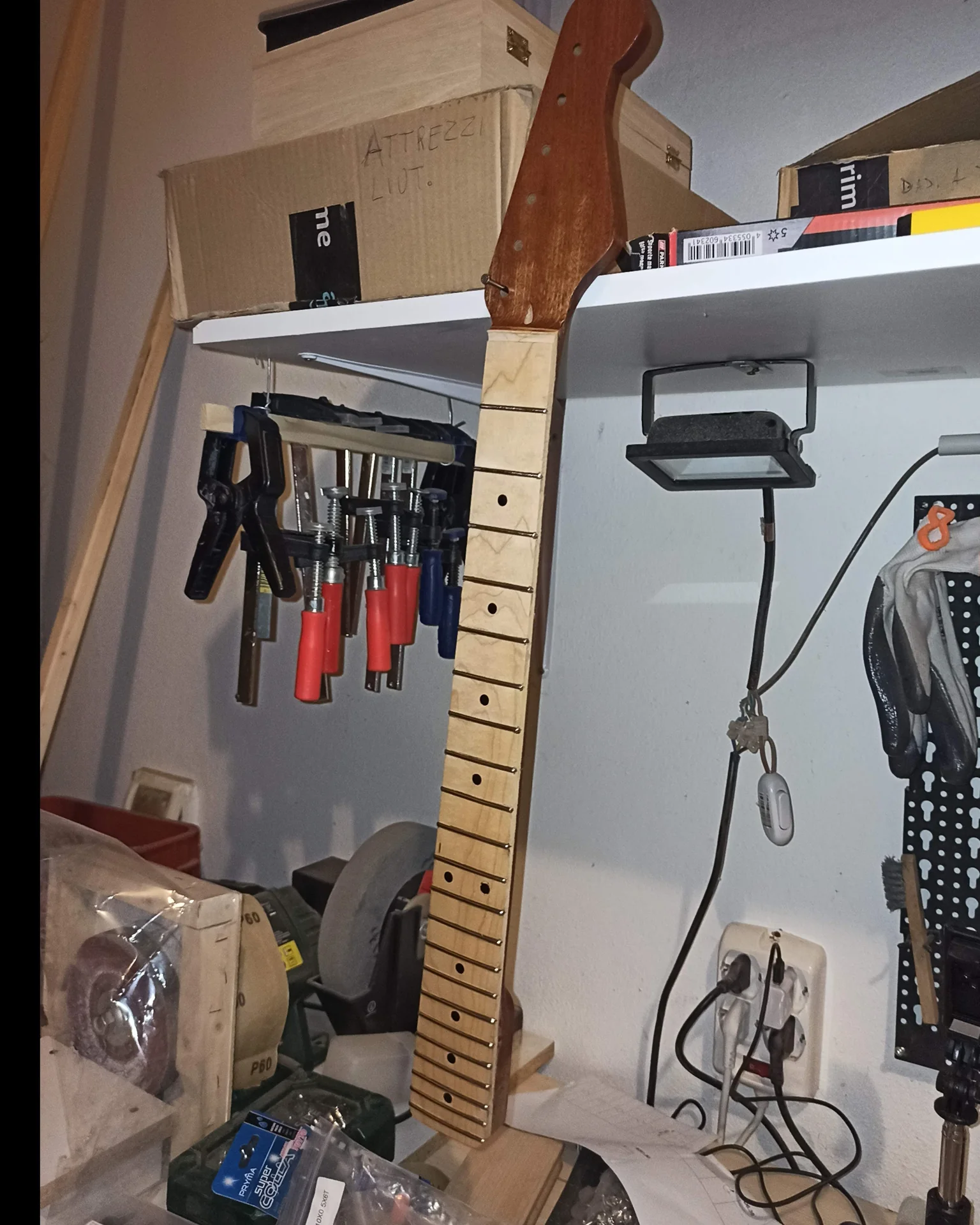

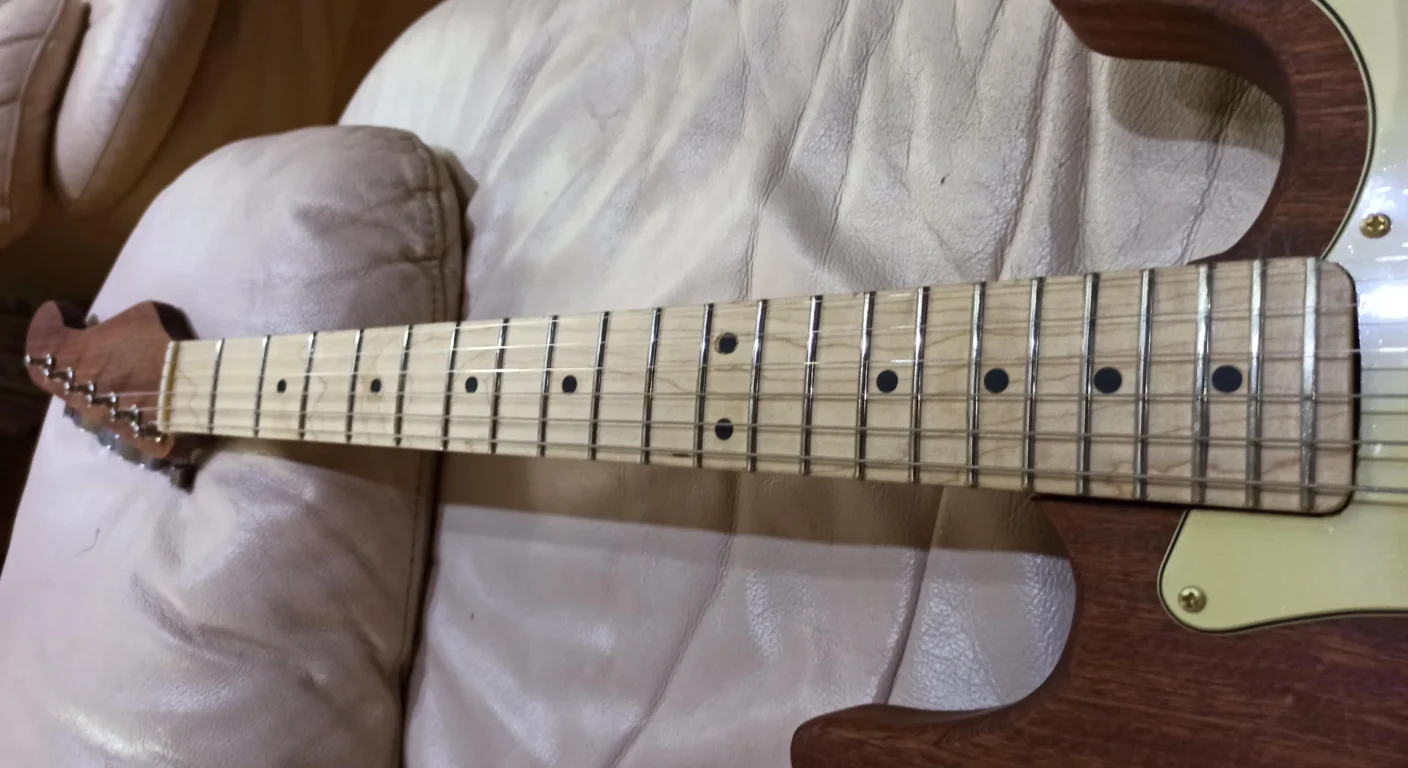
Maple is the most common wood for electric guitar necks, and there's a reason. It's hard, dense, stable, and has an incredibly bright and defined sound. If you're looking for that "snap" sound you hear on many Fender Stratocasters or Telecasters, maple is probably the culprit (in a good way, of course!).
Maple Characteristics: Stability and Attack


Sonically, maple is synonymous with clarity, percussive attack, and excellent high-frequency projection. It's not a particularly warm or resonant wood in the "singing" sense like mahogany, but its density gives it solid sustain and an immediate response. Every strum is reproduced faithfully, making it ideal for genres requiring precision and definition, such as rock, blues, funk, and metal. In terms of workability, maple is a hard wood. It requires sharp cutters and a bit of force to work, but it's also very predictable. Its tight, uniform grain structure means less risk of chipping or tear-out compared to more porous woods. This makes it an excellent choice for those new to neck building. I myself started with maple for my first projects, and its predictability was a lifesaver.
Maple Varieties and Cuts
Not all maple is created equal. There are different varieties and, above all, different ways of cutting the log, which influence stability, sound, and appearance. Hard Rock Maple (Sugar Maple / Acer saccharum): It is the hardest and densest maple, coming from North America. It is the preferred choice for its exceptional stability and bright, defined sound. If you hear about “maple” for a high-quality guitar neck, it is almost always this one. Its density is high, which makes it heavier, but its stability is unbeatable. Soft Maple (Silver Maple / Acer saccharinum, Red Maple / Acer rubrum): Slightly softer and less dense than Hard Rock Maple, it is cheaper and easier to work with. Sometimes it is used for entry-level guitar necks or for less critical parts. It still has a good bright sound, but it might be slightly less stable over time compared to its harder cousin. Flamed Maple (Flame Maple) and Quilted (Quilted Maple): These are aesthetic varieties. The “flame” or “quilt” are undulations in the wood grain that create incredible and three-dimensional patterns. They do not significantly affect the sound, but they make the neck (or body top) a true work of art. They are often more expensive and require more careful processing to avoid tear-out on the grain. Another crucial factor is the cut: Tangential Cut (Plainsawn/Flatsawn): It is the most common and least expensive method. The trunk is cut to obtain maximum yield, but the grain is more inclined relative to the axis of the neck. This makes it more susceptible to twisting and expansion/contraction with changes in humidity. The grain is “V”-shaped on the surface of the fretboard. Radial Cut (Quartersawn): The trunk is cut into quarters and then the boards are cut so that the grain is almost perfectly parallel to the axis of the neck. This makes the wood incredibly stable, resistant to twisting, and less affected by humidity. It is more expensive because more wood is wasted, but it is absolutely worth it for a high-performance and durable neck. The grain is straight and parallel on the fretboard surface. If you can, always choose quartersawn for a neck. Enjoying this article? Subscribe to the newsletter: one email a week, zero spam.Maple Necks: Price and Performance
Maple offers excellent value for money. Plainsawn maple necks are relatively inexpensive and easy to find, even as spare parts. A quartersawn maple neck, especially if made of Hard Rock Maple, will be more expensive but will guarantee you superior stability and longevity. For a low budget, a plainsawn maple neck is a solid choice. For a medium-to-high budget, a quartersawn maple neck is an investment that will pay off over time. Mahogany: Legendary Warmth and Sustain
From bright maple, we move to warm and resonant mahogany. This is the wood you immediately associate with Gibson and a rounder, fuller sound with incredible sustain. If maple is a punch, mahogany is a hug. The Character of Mahogany: What you need to know
Mahogany is a medium-density wood, with a porous but very stable structure. It is lighter than ’maple and has a color ranging from light reddish to dark brown. Its porosity, while making it easier to work with (and believe me, after ’maple, mahogany is a blessing for cutters!), also contributes to that warm and rich sound that distinguishes it. The sound of a mahogany neck is characterized by a strong emphasis on mid-frequencies, with present but non-invasive lows and soft, never harsh highs. This translates into a more “singing” sustain, with a less percussive attack compared to ’maple. It is the ideal sound for blues, classic rock, jazz, or any genre where you seek warmth and depth. I used mahogany for the neck of a Les Paul style guitar that I assembled, and the difference in feel and resonance compared to the maple necks I had made before was evident. The notes seem to “swell” and linger for a surprisingly long time. Mahogany Varieties and their Availability
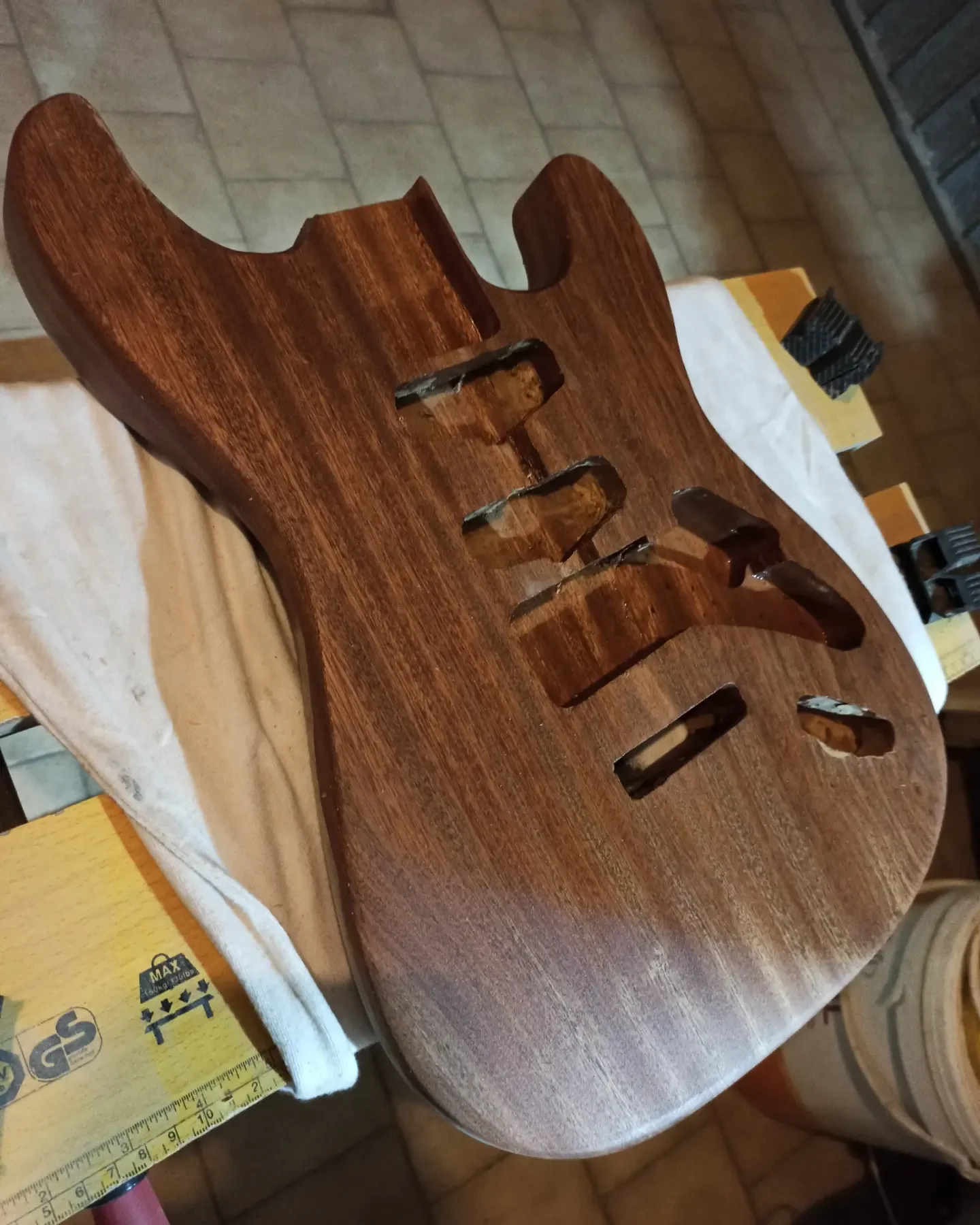
Here too, there isn’t just one type of mahogany. The history of mahogany is a bit complex due to deforestation and CITES restrictions, but there are still excellent options. Honduran Mahogany (Genuine Mahogany / Swietenia macrophylla): Considered the “true” mahogany, it’s what defined the sound of many iconic guitars. It’s lightweight, incredibly resonant, and stable. Unfortunately, it’s increasingly difficult to find and very expensive, often subject to restrictions. If you find a piece, it’s a treasure. I had a small piece years ago for a neck, and the scent when I worked it was unmistakable. African Mahogany (African Mahogany / Khaya spp.): This is the most common and accessible type of mahogany today. It has sound and working characteristics very similar to Honduran mahogany, although some purists argue that it is slightly less resonant. In my tests, the difference is subtle and probably imperceptible to most guitarists. It’s an excellent alternative, and I use it regularly for my projects. It’s easy to find and offers good value for money for the neck building material. Sapele (Entandrophragma cylindricum): Often confused with mahogany, Sapele is an African wood with a similar appearance and sound properties, but with a tighter grain and a bit more “rebellious” to work with. It tends to be a bit brighter than traditional mahogany. It’s an excellent economical alternative, but be careful of cross-grain that can cause tear-out problems during planing or routing. Utile (Entandrophragma utile): Another close relative of African mahogany, with very similar characteristics. It has a slightly darker color and a more uniform grain than Sapele. This is also a good candidate for a neck if you are looking for the “mahogany sound” without spending a fortune. Mahogany Processing: A (nearly) pleasure
Mahogany is generally easier to work with than maple. It cuts and planes with less effort, and sanding is a wonder. It is less prone to burning cutters and generating splinters. However, being a porous wood, it requires a bit more attention in finishing, especially if you want a completely smooth surface. It is often necessary to use a grain filler (pore filler) to fill the pores before applying the finish. I skipped this step once, thinking “it’s just a garage neck”, and the result was a disaster of tiny holes and imperfections under the finish. Don’t make my same mistake. Take the time for the grain filler, it’s worth it. Rosewood: The Legendary Touch and its Challenges
Now let's talk about rosewood. Traditionally, rosewood is the wood of choice for fretboards on many guitars, but sometimes it is also found in entire necks, or in laminated necks for greater stability. When you think of the feel of a dark, smooth fretboard, you think of rosewood. The Sound and Feel of Rosewood
Rosewood is a dense and oily wood. This density, combined with its oily nature, gives it a warm, harmonically rich sound, with a soft sustain and a slightly compressed attack. The high frequencies are softened, and the mids are complex and rich. If used for an entire neck, rosewood tends to give a feeling of greater mass and vibration under the fingers. The feel is one of its most appreciated characteristics. It is naturally smooth, almost silky, and does not require heavy finishes. Many rosewood fretboards are left natural, only oiled, to preserve this feel. I remember the first time I held a full rosewood neck in my hands (it was a Warmoth, I didn’t build it myself!), the feeling was incredible, very different from maple or mahogany. It was like having a soundboard under your fingers, with an almost organic resonance. Rosewood Challenges: CITES and Alternatives
Unfortunately, rosewood is a wood that brings with it significant challenges. Various species of rosewood (in particular Indian Rosewood, Dalbergia latifolia, and Brazilian Rosewood, Dalbergia nigra) have been subject to severe CITES (Convention on International Trade in Endangered Species of Wild Fauna and Flora) restrictions for their protection. This has made authentic rosewood very expensive, difficult to import/export, and often with complex documentation. Even though restrictions for finished guitars have been relaxed, for raw wood things are still complicated. This has pushed manufacturers to look for valid alternatives for the wood for the electric guitar neck. Pau Ferro: Often used as a rosewood substitute, Pau Ferro is a South American wood with a very similar look and feel. It is slightly harder and brighter than rosewood, but offers an excellent compromise between sound, workability, and availability. I used it for a fretboard and liked it a lot, both for its aesthetics and for its workability. Ebony: A wood even denser and harder than rosewood, with an intense black color (although striped varieties exist). It offers a very fast attack, incredible sustain, and a bright, percussive sound. It's an excellent choice for fretboards, but for an entire neck, it's very heavy and expensive. Its processing is demanding; cutters wear out quickly. Richlite: It is not wood, but a composite material made of recycled paper and resin. It is incredibly stable, dense, and has an appearance similar to ebony. From a sonic point of view, it is very neutral and does not add particular colorations. It is an interesting solution for those seeking stability and sustainability, even if it does not have the “warmth” of natural wood. I tried it on a guitar and I must say that it is a very consistent and easy-to-work material, but it lacks a bit of the soul of real wood. If you decide to use rosewood for a neck, make sure to buy from reliable suppliers who can certify the origin and legality of the wood. For a hobbyist, it may be more practical to opt for Pau Ferro or Ebony for the fretboard, or limit rosewood to thin layers in a laminated neck.
Koa: The Exotic with a Unique Sound
Now let's move on to a wood that might not be the first that comes to mind, but which has a charm and a sound all its own: Koa. This exotic wood, native to Hawaii, is appreciated not only for its aesthetic beauty but also for its particular sonic characteristics.
The Sonic and Visual Character of Koa
Koa is a medium-density wood, similar to mahogany but with greater resonance and a tendency to emphasize both mid and high frequencies, while maintaining good warmth in the bass. The sound can be described as a cross between the warmth of mahogany and the brightness of maple, but with its own unique personality. It has a sweet attack, a rich and harmonious sustain, and a clarity that makes it very articulate. Aesthetically, Koa is simply stunning. It has a color that varies from golden brown to dark reddish, often with flamed or “curly” grain patterns that give it a three-dimensional and luxurious appearance. It is a wood that “breathes” under light, changing appearance depending on the viewing angle. I once used it for a body top, and people stopped to look at it. For a neck, the effect is even more pronounced.
Availability and Cost: A Luxury for Your Neck
Koa is one of the most expensive and difficult woods to find. Its growth is limited to Hawaii, and demand is high not only for musical instruments, but also for luxury furniture and art objects. This makes it a niche option, often reserved for high-end custom instruments. If you decide to invest in a Koa electric guitar neck, you are choosing a piece that will not only sound exceptional but will also be a work of art. Due to its cost, many builders use it for laminated necks, where thin layers of Koa are combined with other more stable and less expensive woods to achieve a good compromise between aesthetics, sound, and stability.
Koa Processing: Attention to Detail
Koa works quite well, similar to mahogany, although the flamed grain can be a bit more difficult and require very sharp cutters to avoid tear-out. It tends to release a fine, fragrant dust during processing. It is a wood that lends itself well to oil finishes, which enhance the depth of the grain without covering it. If you are looking to build a guitar with a distinctive sound and visual character, and budget is not an insurmountable problem, Koa is an option to seriously consider for the headstock and fretboard material. It will give you a neck that is a true jewel, both for its sound and its aesthetics.
Wenge and Bubinga: The Warriors of Stability and Density
These two woods, Wenge and Bubinga, are less traditional for solid necks, but have become extremely popular for laminated necks (multi-piece necks) thanks to their incredible stability, density, and resonance. They are the “warriors” of neck woods, robust and reliable.
Wenge: Detail and Definition
Wenge is a very dense and heavy African wood, with a dark color ranging from brown to almost black, and very pronounced grain that creates an almost zebra-like effect. It is known for its exceptional stability and resistance to bending. From a sonic perspective, Wenge offers a very fast attack and incredible definition, with a resonance that focuses on the mid-low and mid-high frequencies. It doesn't have the “rubbery” warmth of mahogany, but rather an almost metallic clarity, which makes it excellent for genres that require a lot of articulation, such as metal or fusion. If you want every note to be sculpted and precise, Wenge is an excellent choice. Its porosity is very evident, with open pores that can make finishing a bit more complex, requiring a good grain filler. When working with it, be careful of splinters: they are hard and sharp, and it's not uncommon for them to get under the skin. I learned the hard way to always wear gloves when handling Wenge!
Bubinga: Strength and Sustain
Bubinga, also an African wood, is another giant in terms of density and hardness. It has a reddish or reddish-brown color, with often straight or slightly wavy grain. It is even denser and heavier than Wenge and also Maple. Sonically, Bubinga is famous for its enormous sustain and a deep, powerful sound, with very present lows and rich mids. It has a natural brilliance that makes it articulate, but without the “snap” of Maple. It is a wood that “pushes” the sound, ideal for basses or guitars that require a solid and imposing sound foundation. Like Wenge, it is a very stable wood. Its processing is challenging due to its hardness, but if you have sharp cutters and patience, the results are excellent. The finish is simpler than Wenge, with less open pores.
Laminated Necks: The Synergy of Wenge and Bubinga
Where Wenge and Bubinga truly shine is in laminated necks. Combining layers of different woods is not just an aesthetic matter, but a strategy to increase stability and balance sound properties. Imagine a 5-piece neck, with alternating layers of Wenge, maple, and Bubinga. Wenge and Bubinga provide rigidity and a rich sound, while maple adds brightness and attack. The combination of different grain directions (if quartersawn) makes the neck incredibly resistant to twisting and bending. I built a 5-piece neck with maple and Wenge for a 7-string guitar, and the stability was something never seen before. Even with very tight strings, the neck remained straight as an arrow. This technique, while more complex to implement (it requires precise cuts, perfect gluing, and great attention to the planing phase), is the answer to many of the hobby builder's pain points that fears twists and instability. If you are an intermediate level hobbyist, I recommend trying a laminated handle. It is a project that will give you a lot of satisfaction and an extremely performing handle. To learn more about the choice of materials and processing techniques for your next project, if you are thinking of improving a guitar you already own, perhaps starting with the neck or its finish, check out our guide on how to modify a guitar.
Build better. Subscribe for updates, guides and free ebooks.
Subscribe →Beyond Wood: Construction Factors and Stability
Okay, we've talked about the main woods, but choosing the right essence is only half the job. A neck, to be good, must be stable. And stability doesn't just depend on the wood, but also on how you prepare and assemble it. This is where the experience of someone who has broken a few pieces of wood comes in handy.
The Number One Enemy: Neck Twist
The terror of every guitar builder, especially a hobbyist, is neck twist. You commit, measure, mill, glue, paint… and then, after a few months, you see that the neck has bent or, worse, twisted. It's frustrating, believe me, I’ve experienced it. You feel like you've wasted time and money. But it's not the end of the world, it's an opportunity to learn. Twist is mainly caused by two factors: humidity and grain direction. Wood is hygroscopic, it absorbs and releases moisture, and this makes it expand and contract. If the wood is not seasoned correctly or if the grain is not oriented in the most stable way (remember flatsawn vs quartersawn?), the neck is more vulnerable. My passionate advice: Don't rush. Buy the wood well in advance and let it “acclimatize” in your workshop for several weeks, if not months. This way, the wood will stabilize to the humidity of your environment. And if possible, prefer a quartersawn cut for the wood suitable for the neck.
Construction Techniques for Maximum Stability
Here we get to the heart of practical solutions to prevent problems. 1. Laminated Necks (Multi-piece Necks): We talked about it before. Instead of a single piece of wood, 3, 5, or even 7 layers glued together are used. The idea is that each layer has slightly differently oriented grains, creating a structure that “counteracts” torsional forces. It's like building a super strong wood sandwich. It's more work, but the results in terms of stability are unmatched. 2. Scarf Joint (Scarf Joint): This technique is used to join two pieces of wood to form the neck and the headstock. It allows the grain of the headstock to be oriented so that it is more resistant to breakage (a common weak point in one-piece necks with an angled headstock) and to save wood. Two pieces are cut with complementary angles and glued together. It is a delicate operation that requires precision, but it is a classic in lutherie. 3. Reinforcing Rods: In addition to the truss rod, which serves to adjust the neck's curvature, many modern necks include carbon or titanium reinforcement bars. These bars are not adjustable, but they enormously increase the neck's rigidity, making it less susceptible to twists and curvature changes due to string tension or humidity. I have used them in several of my necks and the difference is remarkable. It requires an additional groove to be routed, but it's a small price to pay for greater peace of mind. You can find excellent carbon fiber bars from specialized lutherie suppliers, such as StewMac (here's a link to give you an idea: [https://www.stewmac.com/luthier-tools/body-and-neck-tools/carbon-fiber-rods/carbon-fiber-neck-rods/]). I have found that the investment is negligible compared to the benefit. 4. Quality Truss Rod: It is not a structural reinforcement, but it is essential for adjustment. Make sure to use a good quality, double-action truss rod that allows you to adjust the curvature in both directions (both to relieve and to add relief). Its correct positioning and gluing in the groove is critical. A truss rod that doesn't work well is a nightmare.
The Role of the Fretboard in Stability
Even though the fretboard is a separate component, its choice and installation influence the overall stability of the neck. A fretboard made of dense and stable wood, such as maple or ebony, adds mass and rigidity to the neck, helping to counteract torsional forces. The gluing of the fretboard must be impeccable, without voids that could compromise the transmission of vibrations and structural stability.
What Are the Cheaper Alternatives?
If budget is a concern, don't despair! There are great options that won't force you to sell a kidney: Good quality plainsawn maple handles: As I said, the plainsawn maple is cheaper but still offers a bright sound and good playability. If you find a well-seasoned and worked piece, it can be an excellent choice for an economical but functional neck. Woods “alternative” for laminated handles: In addition to Wenge and Bubinga, there are woods like Padauk (an intense, dense, and resonant red) or Jatoba (very hard and dense, similar to Wenge) that can be used in combination with maple to create stable and interesting-sounding laminated necks, at a lower cost compared to rare exotic woods. Maple handles “common” with carbon reinforcements: Adding carbon reinforcement bars to a plainsawn maple neck can transform it into a much more stable instrument, making it an excellent alternative to a more expensive quartersawn or laminated neck. Who Is Each Wood Suitable For?
Maple: Ideal for guitarists looking for attack, brilliance, and definition. Perfect for rock, blues, funk, metal. Excellent choice for hobbyists thanks to its workability. Mahogany: Perfect for those who love a warm, full sound with a lot of sustain. Great for classic rock, blues, jazz. Requires a little more attention to the finish due to the open pores. Rosewood: Although more common for keyboards, a full neck offers a warm sound, rich in harmonics and a smooth feeling. Great for those looking for a more “vintage” and comfortable sound. CITES restrictions limit its use. Koa: For those looking for a unique sound, a mix of warmth and brilliance, and breathtaking aesthetics. It is a luxury option, perfect for those who want a distinctive instrument. Wenge/Bubinga: Excellent for laminated necks, they offer incredible stability, definition, and deep resonance. Ideal for guitarists who require precision and reliability, especially in more “demanding” genres like metal or progressive.
Final Advice: What to Risk and What to Avoid
When you choose the wood for the neck of your electric guitar, remember these key points: Stability first of all: A handle that deforms is useless, regardless of how good it sounds. Prioritize stable woods, quartersawn cuts if possible, and consider laminated handles or those with carbon reinforcements. Do not underestimate seasoning: The wood must be well seasoned and acclimated to your environment. Buying “green” wood is a recipe for disaster. Budget vs. Quality: You don't necessarily have to spend a fortune. A well-made maple neck can sound and last as long as one made of mahogany or exotic woods. Evaluate your budget and your sonic and aesthetic priorities. Workability: If you're just starting out, maple is more forgiving. Mahogany and exotic woods require a bit more attention. Wenge and Bubinga are hard, but their use in laminated necks makes them manageable. * Finish: Porous woods like mahogany or wenge require more work to achieve a smooth finish. Dense woods like maple or ebony are easier to finish. The biggest risk is buying unseasoned, poorly cut, or low-quality wood, hoping to save money, only to end up with an unstable neck that will force you to redo everything. It's better to invest a little more at the beginning in a good piece of wood. And remember, even the best wood can be ruined by poor craftsmanship. Take your time, use the right tools, and if in doubt, ask!
FAQ
What is the best wood for an electric guitar neck if I want a bright sound and a clear attack?
For a bright sound with a clear and defined attack, maple is the best choice. In particular, quartersawn Hard Rock maple offers maximum stability and the desired brightness. If you're looking for an alternative, Ebony for the fretboard can add further definition and attack.
Can I use mahogany for a shredder guitar neck?
Mahogany is known for its warmth and pronounced mid-frequencies, which might not be ideal for an ultra-bright and sharp “shredder” sound. However, combined with a maple or ebony fretboard and high-output pickups, it can still work. For a shred-focused neck, maple or laminated necks with Wenge/Bubinga are generally preferred for their fast and defined response.
For further technical details you can consult this external resource.
Download the Luthier Survival Kit
Free PDF with checklist, problem-cause table and project card template.
 English
  Italiano
Stuck on your build?
If you ran into the same problem or have a question, drop it in the comments. I read and reply to every one.
Write a comment