

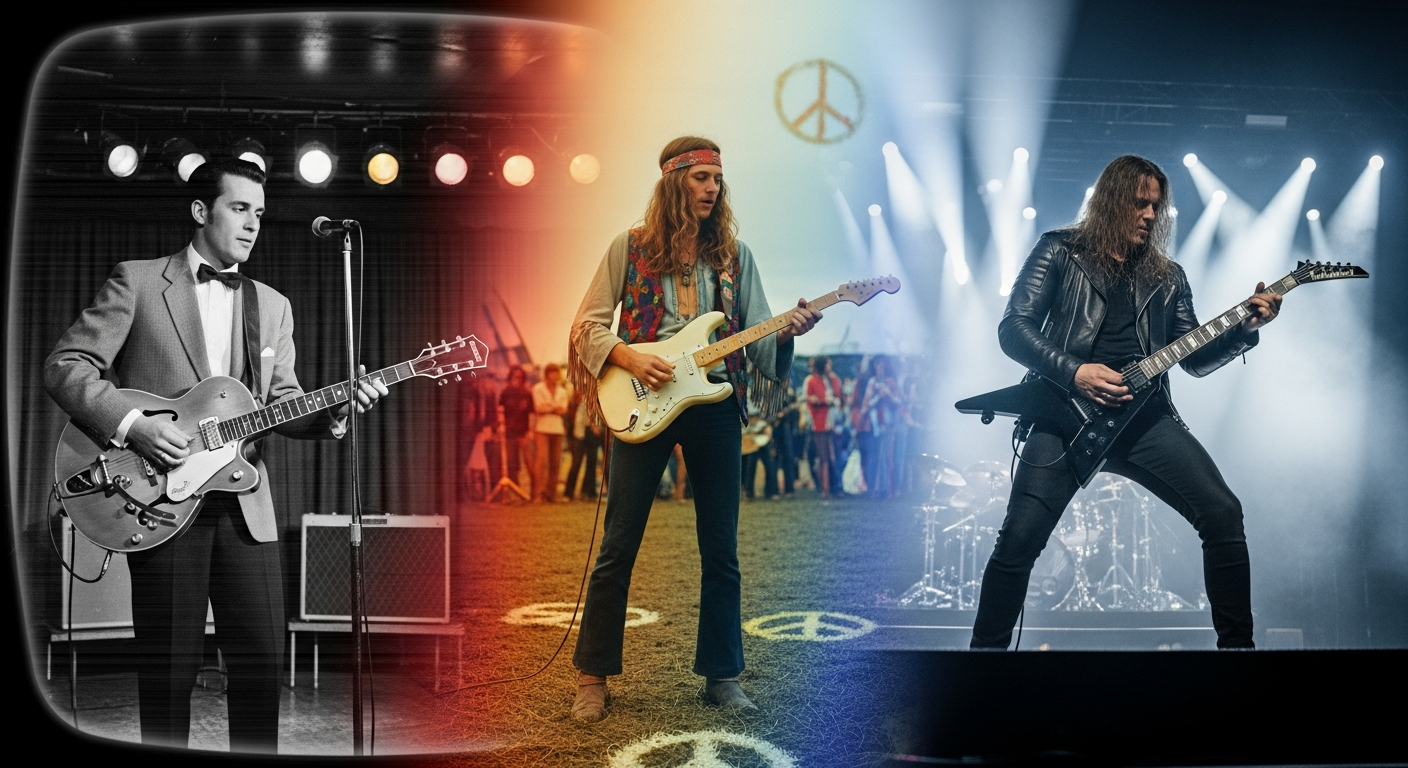
The 3 electric guitars from the '50s you need to know
When we talk about electric guitars, we often get lost among models, specifications, and urban legends. But there's a decade, the Fifties, that literally shaped the sound and aesthetics of what we now call rock, blues, country, and, in practice, all amplified music. It's not just a matter of strings and wood; it's a story of ingenuity, brilliant insights, and, let's face it, even a bit of luck. Those were the years when the giants took their first steps, designing instruments that even today, seventy years later, are the benchmarks for anyone who picks up a neck and an amplifier. And if, like me, you've found yourself with sawdust in your hair, trying to understand why a certain wood sounds that way or why that pickup performs in that manner, well, these are the models to start with. I'll tell you right away that I'm not a professional luthier; I learned by making mistakes, redoing things, and discovering that often the simplest solution is the one that works best. But the history of these instruments is fundamental to understanding the "why" behind every constructive choice. It's not an encyclopedia list, let's be clear. It's more of an enthusiast's story, one of those you'd tell your friend while showing him your latest garage project. We're talking about three icons, three different philosophies, three ways of understanding the instrument that changed everything.
1. The Telecaster: When Leo Fender put work at the center


The history of the Telecaster is one of a simple, yet revolutionary idea. Leo Fender, a radio technician with a passion for music and a keen eye for the needs of musicians, was not a traditional luthier. He didn't come from the world of luxury acoustic instruments. He came from the world of functionality. He wanted to create an electric guitar that was robust, easy to mass-produce, easy to repair, and, above all, sounded great. In 1950, the Fender Broadcaster (the original name, soon changed to avoid copyright issues with Gretsch) made its appearance. It was a bold design, almost brutal in its simplicity.
- Ash or Alder Body: Unlike traditional guitars with mahogany or maple bodies, Fender chose more accessible American woods with distinct sonic characteristics. Ash is known for its brightness and sharp attack, while alder offers a more balanced and round sound, but always with good punch. These woods were also easier to work with for mass production.
- Bolt-On Maple Neck: This was one of the key innovations. The maple neck, with a maple fretboard (or, in early versions, rosewood), was bolted to the body with four screws. This meant that if the neck was damaged or if you wanted to change it, it was a relatively simple operation. No complex gluing, no specialized machinery. It was a design intended to be "modular." And let's face it, how many times have we found ourselves having to adjust the truss rod or wanting to change a neck on a Tele? The ease of access is priceless.
- Pickups Single Coil: The Telecaster was equipped with two single coil pickups. The neck pickup, with its metal cover, offered a warm and full sound, almost like a "lap steel." The bridge pickup, on the other hand, was mounted on a metal plate that also served as the base for the bridge and saddles. This contributed to creating that "twangy" and sharp sound, iconic of the Tele. It was a direct, no-frills sound, perfect for country, blues, and rockabilly.
The Telecaster sound: Twang, attack, and versatility


The Telecaster's sound is unmistakable. It's bright, sharp, with a percussive attack that almost seems to "bite" the amplifier. The bridge pickup is the king of twang, that country sound that immediately makes you think of Nashville. The neck pickup offers a softer, rounder, almost jazz-like tone. And the middle position, obtained by mixing both pickups, has its own special magic, a somewhat nasal but incredibly defined sound. For those who love to tinker, the Telecaster is a dream. The thin body, the bolted neck, easy access to the electronics… it's the perfect instrument to start understanding how an electric guitar works. I've spent hours soldering and desoldering pickups, changing capacitors, trying different potentiometer combinations. And each time, the result has been a valuable learning experience. If you want a passionate tip: try mounting pickups from different brands or with slightly different characteristics. The change in sound will be surprisingly evident. And for those venturing into building, the flat body is much simpler to work with than a carved top. You won't need complex milling machines, but a good band saw and a straight router bit for the pickup and bridge cavities will suffice.
2. The Gibson Les Paul: The elegance of American sound
If the Telecaster was the pragmatic and almost industrial approach, the Gibson Les Paul was the artisanal, sumptuous answer, the "Rolls-Royce" of electric guitars. Gibson, a company with a century-old history in producing high-quality acoustic instruments, certainly couldn't stand by while Fender took over the solid body guitar market. But the Les Paul wasn't born merely as a reaction. It was born from the vision of a man, Lester William Polsfuss, better known as Les Paul. A brilliant guitarist, an inventor, a pioneer of multitrack recording. Les Paul had been experimenting for years with solid body guitars, trying to eliminate feedback and increase sustain. His famous prototype "The Log" (a guitar neck attached to a 4x4 piece of wood with two acoustic guitar wings attached to the sides) is proof of his relentless research.
The collaboration between Gibson and Les Paul: a marriage of style and substance
In 1952, Gibson joined Les Paul to create an instrument that bore his name. The result was the Gibson Les Paul, a guitar that was the exact opposite of the Telecaster in many aspects, but equally revolutionary.
- Mahogany Body with Carved Maple Top: The mahogany body offers warmth and sustain, while the carved maple top adds attack and brightness, as well as a luxurious aesthetic. This design, especially the arched top, was a nightmare for mass production, but it gave the Les Paul a timeless elegance. The choice of mahogany for the body is fundamental for that "big" and resonant sound.
- Glued Neck (Set Neck): Unlike the Telecaster, the Les Paul's neck is glued to the body (set neck). This contributes to greater sustain and a more uniform resonance between the neck and body. But, let's face it, if the neck breaks, the repair is a much more complex undertaking than a bolt-on. I've seen it done, and it's not garage work, unless you're truly daring. Precision in gluing is everything.
- Humbucker Pickups (from 1957): Initially, the Les Paul was equipped with P-90s, single coils thicker and "fatter" than Fender's. But the real turning point came in 1957 with the introduction of humbuckers, invented by Seth Lover of Gibson. Two coils wired out of phase to eliminate hum, hence the name. The sound? Big, warm, powerful, with incredible sustain. Without annoying hum, a dream for the era. Understanding how a humbucker works, its ability to cancel background noise, is a fundamental step for anyone who loves electric lutherie.
The sound of the Les Paul: Warmth, power, and infinite sustain
The sound of the Les Paul is synonymous with rock. It's a full sound, rich in harmonics, that seems to never end. It's the guitar of Jimmy Page, Slash, Eric Clapton (in Cream). Perfect for powerful riffs, blues and rock solos, and for a lead sound that fills the room. For those who venture into DIY, building a Les Paul from scratch is a challenge of a completely different level compared to a Telecaster. The carved top requires routers, templates, and a lot of patience. The set neck, then, is a delicate operation: alignment is crucial, and once glued, there's no easy going back. When I approached the world of Les Pauls, I understood why they cost more and why they are considered works of art. There's much more than simple assembly.
A practical tip: If you happen to get your hands on a vintage Les Paul, or even a quality replica, pay attention to the weight. Those from the 1950s were often heavier than current ones, due to less “chambering” (hollowing) of the body. This contributes to sustain and resonance. And if you ever think of replicating a humbucker, know that Seth Lover left a complex legacy, including Alnico magnets, number of turns, and windings not exactly identical between the two coils, which contributes to the unique character of these pickups. A true field of research for those of us who love to tinker.
3. The Gretsch 6120 Chet Atkins: The rebellious voice of Rockabilly
While Fender and Gibson were vying for solid body supremacy, another company was carving its own path, with unique aesthetics and sound: Gretsch. Founded in 1883, Gretsch was famous for drums, banjos, and acoustic guitars. But with the advent of rock’
‘roll, they also had to adapt. And they did it their way, with style and a touch of eccentricity. The Gretsch 6120 Chet Atkins, introduced in 1954, is the emblem of this philosophy. It was a guitar designed for a specific genre, country and rockabilly, and it did so with a look and sound that screamed “rebel”. It wasn't a guitar for everyone, it was the guitar for those who wanted to stand out.
The collaboration with Chet Atkins: A signature sound
Chet Atkins, a country guitar virtuoso, was fundamental in the development of this model. His influence is seen in every detail, from the “Western Orange” (or “Orange Stain”) color that made it impossible to ignore, to aesthetic details like the “snow” inlays (thumbnail inlays) and the pickguard plate with Chet's signature.
- Hollow Body: Unlike Fender and Gibson solid bodies, the 6120 was (and largely still is) a hollow body, meaning with a hollow body. This gives it greater acoustic resonance and a more “airy” and warm sound. Although later versions introduced a central block (trestle bracing or center block) to reduce feedback, its hollow nature was its beating heart. Building a hollow body requires incredible precision, especially for gluing the tops and managing the sides.
- Pickups Filter’Tron: It originally mounted DynaSonic (or DeArmond), then from 1957, Gretsch introduced Filter’Tron, designed by Ray Butts (who also worked with Chet Atkins). These pickups were a kind of halfway point between single coils and humbuckers: less “chubby” than Gibson humbuckers, but with more punch and less noise than Fender single coils. They contribute to that “chimey” and bright sound, perfect for rockabilly and surf rock. Their timbre is unique, bright but with a certain depth.
- Bigsby Tremolo: The Bigsby vibrato was an iconic component of the 6120. It wasn't a tremolo for extreme dive bombs, but it allowed adding a touch of modulation and “wiggle” to the sound, fundamental for the style of Chet Atkins and many rockabilly guitarists. Installing a Bigsby requires attention, especially regarding the string break angle over the bridge and tuning stability.
The sound of the Gretsch 6120: Resonance, brilliance, and a touch of wildness
The sound of the Gretsch 6120 is bright, resonant, and with great definition. It's the guitar of Brian Setzer of the Stray Cats, Duane Eddy, Eddie Cochran. It's the sound of rock’
‘wilder and more unbridled roll, but also of the most sophisticated country. Working on a hollow body is a completely different experience. You can't just drill the body as you would with a solid body. Every internal intervention requires patience and specific tools. I had the opportunity to disassemble and reassemble the bridge and the Bigsby on a Gretsch, and I tell you right away that alignment is crucial. And the grounding of the Bigsby, especially, can cause some headaches if you're not careful. I have never built a hollow body from scratch – it's a project that requires superior carpentry – but I have learned to appreciate the complexity and beauty of these instruments.
An observation: One of the things I've noticed with Gretsch guitars is the number of controls. They often have a pickup selector, a tone selector (master tone switch), and potentiometers for individual pickup volume and a master volume. Understanding how all these controls interact to sculpt the sound is almost an art. And believe me, when you get your hands on it for a re-wiring, it can become quite a puzzle. But that's also the beauty of it, discovering the infinite sonic possibilities these instruments offer. To delve deeper into the fascinating history of Gretsch and its impact, you can take a look at this detailed article on Wikipedia: Gretsch on Wikipedia.
Why these guitars still matter, and what we DIYers can learn
These three 50s electric guitars are not just museum pieces or collector's instruments. They are archetypes, milestones that have defined not only the sound but also the constructive possibilities of the instrument. And for those of us who get our hands dirty in the garage, there's a lot to learn.
The Legacy of Great Designers
Every guitar we've seen is the result of a very precise philosophy:
- Leo Fender: The genius of simplicity and modularity. His idea that a guitar should be easy to produce, repair, and modify is still very relevant today. How many times have we found ourselves changing a pickup on a Strat or a Tele? It's a relatively simple operation precisely because of his design.
- Les Paul (and Gibson): The art of traditional lutherie combined with innovation. The set neck, the carved top, the humbuckers: everything aimed for a bigger, warmer, more refined sound. It's an invitation not to be afraid of complexity, if the sonic result is worth it.
- Chet Atkins (and Gretsch): Personality and aesthetics as an integral part of the sound. The 6120 demonstrates that there isn't just one way to make a guitar electric, and that visual identity can be as powerful as the sound.
What we learn for our DIY projects
1. Function follows Form (or vice versa): Every design choice, from the type of wood to the shape of the body, from the pickups to the tremolo system, has a direct impact on sound and playability. It's never a coincidence. If you build a guitar with a mahogany body and a maple top, expect a certain type of sound. If you use ash with a maple neck, you'll get another.
2. Experimenting is the Key: Les Paul was a maniac for experimentation. Leo Fender was not afraid to try new solutions. We, in our own small way, should do the same. Don't be afraid to try different pickups, alternative wiring schemes, or even just a different type of potentiometer. Every modification is a lesson.
3. Appreciate Maintenance: The history of the Telecaster teaches us the importance of ease of maintenance. When designing a guitar, think about how easy (or difficult) it will be to change the pickups, adjust the truss rod, or perform a soldering job. A smart design is sometimes more important than a “beautiful” design.
4. Sound is a Personal Matter: There is no absolute “best” guitar. There is the right guitar for a certain sound, a certain style, a certain musician. Tele, Les Paul, and Gretsch have created distinct sonic worlds. We, as builders, have the opportunity to shape that sound according to our tastes.
Tips for your next project inspired by the ’50s
If you feel inspired by these legends and want to try to infuse a bit of ’50s spirit into your next project, here are some ideas:
- For a Tele-style sound: Look for an ash body (if you can find one not too heavy) and a maple neck. Don't underestimate the importance of the string-through-body bridge (the strings pass through the body). And for the pickups, if you want the true twang, look for alnico V single coils with not too hot windings. The simplicity of the circuit will give you a lot of satisfaction. You might also be interested in exploring possible modifications on these guitars, by taking a look at how to modify your guitar.
- For a Les Paul-ish sound: A mahogany body with a maple top is a classic. If the carved top scares you, you can opt for a flat top or a less pronounced semi-carved. For the pickups, PAF-style humbuckers (Patent Applied For) are the right choice. Pay close attention to the neck angle if you're doing a set neck, it's fundamental for action and intonation. And use good glue, don't skimp!
- For a Gretsch vibe: If building a hollow body is too much, you can always start with a semi-hollow with a center block. Filter’Tron-style pickups will give you that bright and defined sound. And a Bigsby B7 (for guitars with arched tops) or B5 (for flat tops) is a must for aesthetics and feel. Remember that Bigsbys are not exactly plug-and-play, they require a bit of attention for installation and tuning stability.
The beauty of these instruments is that, despite being born decades ago, they continue to be a point of reference. They are not just instruments; they are pieces of history that have given voice to generations of musicians. And with a bit of manual skill, patience, and the desire to learn from mistakes, even we, in our garage, can follow in those footsteps and perhaps, who knows, add a small piece to our personal history of lutherie electric DIY. After all, if I succeeded, you can too. Just start.
See also
FAQ
What is the main difference between a Telecaster and a Les Paul in terms of construction?
The fundamental difference lies in the method of joining the neck to the body. The Telecaster uses a “bolt-on” neck, while the Les Paul employs a “set neck”. This affects sustain, resonance, and ease of repair. Furthermore, the Les Paul typically features a mahogany body with a carved top, while the Telecaster uses lighter woods like alder or ash with a flat body.
Why are the humbucker pickups of the Les Paul so different from the single coil pickups of the Telecaster?
Humbuckers, with their two coils, are designed to cancel the electrical hum typical of single coils, while offering a fuller, more powerful sound with greater sustain. Telecaster single coils, on the other hand, while being more susceptible to noise, have a brighter, sharper, and “twangy” tone that has become iconic for certain musical genres.
Download the Luthier Survival Kit
Free PDF with checklist, problem-cause table and project card template.
 English
  Italiano
Stuck on your build?
If you ran into the same problem or have a question, drop it in the comments. I read and reply to every one.
Write a comment