

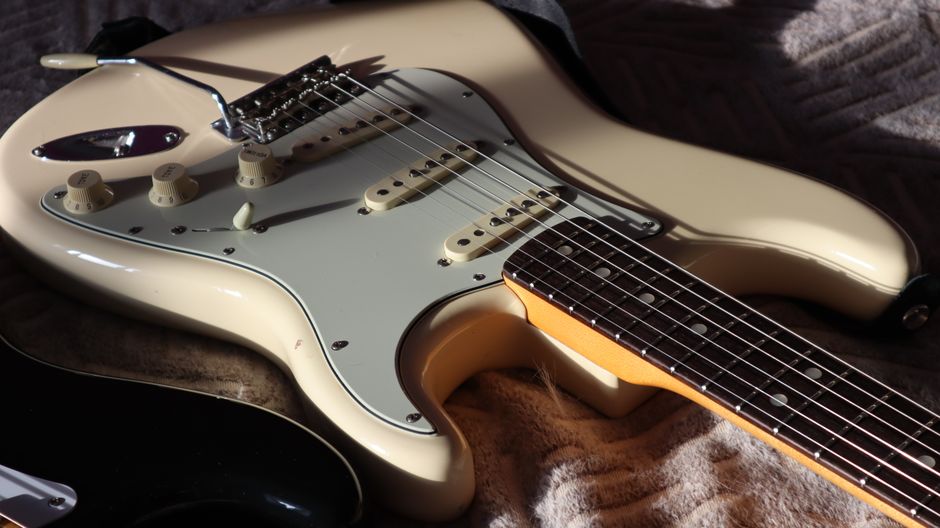
Fender History: From the origins to the top models
There are brands that are not just names, but real chapters in the history of music. And among these, Fender occupies a place of honor, almost mythological. I'm not just talking about guitars, but about an idea, a way of thinking about the instrument that changed the world. What I'm telling you today is not a boring history lesson, but the epic of a builder who, starting from a garage, put their dream instrument into the hands of millions of musicians. And, trust me, if I managed to understand certain design logics and get my hands on them, you can do it too.
The Man Behind the Myth: Leo Fender and His First Steps
With the foundations laid, the Fender history was about to accelerate, giving birth to two instruments that would not only define musical genres, but would become pillars of electric luthiery.
The Birth of the Telecaster (1951)


Its simplicity is its strength. An ash or alder body, a maple neck, two single coils that sound like bells in the bridge and rounder at the neck. The three-position selector, volume and tone. That's it. There's not much else. Yet, that “twangy” and incisive sound, with incredible punch, has shaped country, rockabilly, blues, and even harder rock. Sturdy construction: Extremely resistant, designed for the musician on the road. It could fall, take hits, and keep playing. I've seen Telecasters used as oars and still perfectly in tune! (Okay, maybe I'm exaggerating, but that's the idea).
Distinctive sound: That bridge pickup, with its steel base, is a cannon. It cuts through the mix like a scalpel. The neck pickup, warmer, is perfect for blues riffs or full chords. The middle position, with both pickups in parallel, offers a crystalline and “out of phase” sound that is iconic.
Ease of modification: Being so simple, it's a blank canvas for the DIYer. Changing pickups, electronics, bridge… it's all relatively easy. It was my training ground for understanding how a guitar works.
The Telecaster has never gone out of style. It's the “less is more” guitar. It works and works well. It's no coincidence that even today it's one of the best-selling and most imitated guitars in the world.
The Bass That Changed Everything: The Precision Bass (1951)
Also in 1951, Leo Fender was not content with revolutionizing the guitar. He also ventured into the world of bass, creating an instrument that would forever change the role of low frequencies in modern music: the Precision Bass.
Until then, bassists carried giant acoustic double basses. They were difficult to transport, not very amplifiable, and, above all, intoning them was a nightmare for the less experienced, as they had no frets (fretless). Leo, with his usual practical logic, thought: “Why not make an electric bass, with frets for precise intonation?”. Hence the name: “Precision”.
The first Precision Bass had a body similar to the Telecaster, a maple neck with frets, and a single coil pickup. Then, in 1957, the definitive design arrived, the one we know today: the more rounded body and the split-coil pickup (divided into two staggered halves) which became its trademark.
Accurate intonation: The frets were a godsend for bassists, allowing for consistent and easier intonation.
Volume and sustain: Finally, a bass that could compete with the power of guitar amps and drums. The solid body provided incredible sustain.
Unmistakable sound: The P-Bass split-coil pickup produces a powerful, round, and mid-range sound that sits perfectly in the mix. It's the sound of thousands of records, from rock to funky, from pop to jazz.
The Precision Bass is the bassist's true “workhorse”. Simple, reliable, with a sound that is always right. If I had to choose just one bass to record an entire album, it would probably be a P-Bass. It never disappoints.
The Icon: The Stratocaster and the Golden Age
After the success of the Telecaster and the Precision Bass, Leo Fender did not stop. His mind was always buzzing, looking for improvements, for new solutions for musicians. And so, in 1954, an instrument saw the light that was not just a guitar, but a functional work of art, an icon destined to define the sound and image of rock and roll: the Stratocaster.
The Birth of the Stratocaster (1954)
There Stratocaster was not anevolution of the Telecaster, but a completely new project, designed to offer greater comfort, tonal versatility, and new expressive possibilities. If the Tele was the “workhorse”, the Strat was the “luxury sports car” (even if it cost almost the same at the time).
Leo and his team (George Fullerton, Freddie Tavares) listened to musicians' feedback. The Tele, however effective, was a bit “flat”, squared. Bassists and guitarists wanted something more ergonomic.
Contoured Body: A true ergonomic innovation. The cutouts on the front and back of the body (belly cut and arm contour) made the guitar incredibly comfortable to hold and play, both standing and sitting. I've spent hours sanding guitar bodies to replicate that comfort, and believe me, it makes a difference.
Three single coil pickups: Another stroke of genius. With a three-position selector (later becoming five), five different sounds could be obtained (neck, neck+middle, middle, middle+bridge, bridge). This enormously expanded the sound palette available to the guitarist. The famous “quacky” or “out of phase” sound of the intermediate positions became a trademark.
Synchronized Tremolo: This was the stroke of genius. A vibrato system that allowed the pitch of the strings to be lowered or raised stably and reliably, which other systems did not. Of course, it wasn't perfect at first, and even today, setting a tremolo to stay in tune is an art, but it opened up a world of expression for guitarists. Think of Jimi Hendrix, Jeff Beck, David Gilmour… their sound is inseparable from the vibrato arm.
The Stratocaster wasn't just an instrument, it was a statement. Its futuristic design, its elegant curves, its versatile and brilliant sound made it instantly popular. It became the guitar of rock.’
‘'roll, surf rock, and electric blues. He set aesthetic and functional standards that are still valid today.
Other Golden Age Gems: Jazzmasters, Jaguars, and Amplifiers
During the 1950s and early 1960s, Fender was not limited to Tele and Strat. He continued to innovate, seeking to capture new market segments.
Jazzmaster (1958): Born for jazz musicians (but adopted by rockers and surfers!), with a larger, offset body, wider and flatter pickups (which sound darker and warmer than standard single coils) and a complex “Rhythm/Lead” circuitry system with two tone presets. Its “floating” tremolo was different from the Strat's. It didn't achieve the hoped-for success in jazz, but became an icon for surf rock and, much later, for indie rock and noise.
Jaguar (1962): Similar to the Jazzmaster in its offset body and tremolo, but with a shorter scale (24 inches, like a Gibson Les Paul) and single-coil pickups with metal shields to reduce noise. This also found its niche in surf and then in alternative.
But Fender It wasn't just guitars. His amplifiers were equally revolutionary and fundamental to the sound of the time. Bassman, The Twin Reverb, The Deluxe Reverb… were and still are milestones. Tube amplifiers with a clean and bright sound, a spacious reverb, and a warm tremolo (or vibrato). A “Fender” sound is not just the guitar, but also the amplifier. Leo thought of the system guitar-amplifier, and this is a crucial aspect not to forget.
The golden age of Fender, under Leo's guidance, was a period of incredible creativity and innovation. His instruments were not just beautiful, they were functional, reliable And accessible. And this philosophy is what made the brand so powerful and lasting.
The CBS Era: Crisis and Resurrection
Every great history has its twists and turns, and that of Fender is no exception. After years of uninterrupted success, a crucial moment would mark a turning point, testing the brand's resilience.
The Sale to CBS (1965): A New Chapter
In 1965, Leo Fender, due to health problems, decided to sell his company to the communications giant CBS (Columbia Broadcasting System). The price was $13 million, a huge sum for the time. It was the end of an era.
Leo, while remaining as a consultant for a short period, lost creative control. CBS, as a large corporation, had a different mentality. The goal was no longer artisanal innovation or the pursuit of functional perfection, but the maximization of profits and the optimization of large-scale production processes.
This led to significant changes, and not always for the better:
Design changes: Introduction of three-bolt necks (3-bolt neck) with “Bullet” truss rod adjustment on the headstock, multi-piece bodies, thicker (and less resonant) polyurethane finishes, larger headstock (large headstock) on the Stratocaster. Some of these changes were aimed at speeding up production, others at reducing costs.
Decline in quality: With increased production and pressure to reduce costs, the overall quality of the instruments began to suffer. Many musicians and luthiers (and I too, when I worked on some Strats or Teles from that period) noticed less attention to detail, less selected woods, cheaper electronics. The guitars of the 70s by Fender are often considered less desirable than their pre-CBS counterparts.
Loss of identity: The brand, from a symbol of craftsmanship and innovation, became part of a larger machine, losing a bit of its soul.
This isn't to say that all CBS guitars were bad. Many great records of the '70s were recorded with Strats and Teles from that era. But the general perception was that Leo's magic had faded a bit.
The Rebirth: From Crisis to New Splendor (1985)
The situation became critical in the 1980s. Japanese competition, with brands such as Ibanez, Tokai, Greco, produced copies of Fender and Gibson with often superior quality and lower prices. CBS no longer knew what to do with the brand.
It was at this point that a group of employees, led by William Schultz, decided to take action. In 1985, they bought Fender from CBS for a paltry sum ($12.5 million, less than it had been sold for 20 years earlier!). It was a huge gamble, but one driven by passion.
The new management immediately understood that to revive the brand, they had to return to its origins: quality, innovation, and a keen eye for the needs of musicians. They had no factories, only the name and a warehouse. So, they started from scratch:
1. Fender Japan: To maintain production and market presence, they entered into an agreement to produce high-quality guitars in Japan. The Fender Japan are still highly sought after today for their quality/price ratio.n2. Fender USA: They acquired a new factory in Corona, California, and focused on producing very high-quality instruments, resuming the classic pre-CBS designs.n3. American Standard: In 1987, the American Standard series was launched. These guitars combined the best of classic design with some modern improvements (more efficient truss rod, jumbo frets, two-pin bridge). It was an immediate success and marked the true rebirth of Fender.
This was the Fender which returned to its roots, to what Leo had always wanted: reliable and well-made instruments. It was during this period that the culture of guitar modification took hold massively, also because many of the “old” CBS guitars needed a good facelift to play properly again. And I assure you, getting your hands on one of those guitars and seeing it come back to life is an invaluable satisfaction.
There Fender history, in these years, is an example of how passion and vision can save a company from the abyss, bringing it back to its former glory.
Fender Today: From the Standard Series to the Custom Shop
Today, Fender has returned to being one of the leading companies in the world of musical instruments, with a range of products that covers practically every need and every budget. The lesson of the CBS years has been learned, and quality has returned to being a priority.
The Current Range: For Every Musician, His Guitar
The strategy of Fender is clear: to offer quality instruments at different price levels, without compromising the philosophy of the original design.
Player Series (Made in Mexico): These are my favorites to start a modification project. Excellent starting point. They offer exceptional value for money. They are well-made guitars, with a modern feel and pickups that sound good, perfect for those looking for a true Fender without spending a fortune. If you have to get your hands on one, they're ideal.
American Performer / American Professional II (Made in USA): Here we step up a level. The Performers are an excellent middle ground, with practical innovations. The Professional IIs are the heart of American production: classic design with modern improvements, high-quality hardware, specific pickups for each model (V-Mod II, Pure Vintage). They are professional work instruments, designed to last and play at their best.
American Vintage II / American Original: For vintage purists. These series faithfully replicate the specs and feel of the original guitars from the '50s, '60s, and '70s. From the nitrocellulose finish to the neck profiles and pickups that faithfully reproduce those of the era, they're a journey back in time for those seeking authentic sound and feel.
Signature Series: Many models are dedicated to legendary guitarists (Eric Clapton, Jimi Hendrix, Stevie Ray Vaughan, John Mayer, etc.). They often offer unique pickup and circuit combinations based on the artists' preferences. Let's not forget the basses! Jazz Bass, introduced in 1960, is the other pillar alongside the Precision. With its two narrower single coil pickups and thinner neck, it offers a brighter and more versatile sound, perfect for funk, jazz, and modern rock. The Jazz Bass also has its versions in every price range.
The Fender Custom Shop: The Art of Luthierry
At the peak of production Fender there's the Custom Shop. Here we are no longer talking about mass production, but about true artisanal lutherie. Each instrument is handcrafted by master luthiers, with meticulous attention to every detail.
Vintage Replicas: The Custom Shop is famous for its incredibly faithful replicas of vintage instruments. Not only aesthetically, but also for the sound and feel.
Relicing: The art of artificially aging a guitar to make it look like a true vintage instrument, with scratches, dents, and worn paint. It's a divisive topic, but the Custom Shop does it masterfully, creating instruments with a unique character from day one.
Dream Guitars: Here musicians' dreams come true. Custom specifications, exotic woods, unique finishes. If you can imagine it, the Custom Shop can build it.
Of course, a Custom Shop costs an arm and a leg. But for those seeking the ultimate in quality, customization, and collector's value, they are works of art. They are not for everyone, but they represent the excellence that a historic brand like Fender can still achieve.
Innovation and Tradition: The Future of Fender
There Fender history is a constant balance between respect for tradition and the drive for innovation. Leo Fender was an innovator, and the brand continues to be so, introducing new technologies (like "Noiseless" pickups or automatic tuning systems) without ever forgetting the models that made its fortune.
Personally, I find it fascinating how a design born almost 70 years ago can still be so relevant and desirable. This tells us a lot about the goodness of Leo's original ideas. And for us DIY enthusiasts, understanding this history It means having a solid foundation for appreciating every single component, every design choice, and for knowing where and how to get our hands on our tools.
Whether you're playing a Player Strat or dreaming of a Custom Shop Tele, every Fender guitar brings with it a piece of this incredible story. It's a story worth telling and, above all, playing.
To learn more about Fender's history and innovations, you can visit the official Fender history page: Fender History.
See also
Download the Luthier Survival Kit
Free PDF with checklist, problem-cause table and project card template.
 English
  Italiano
Stuck on your build?
If you ran into the same problem or have a question, drop it in the comments. I read and reply to every one.
Write a comment