

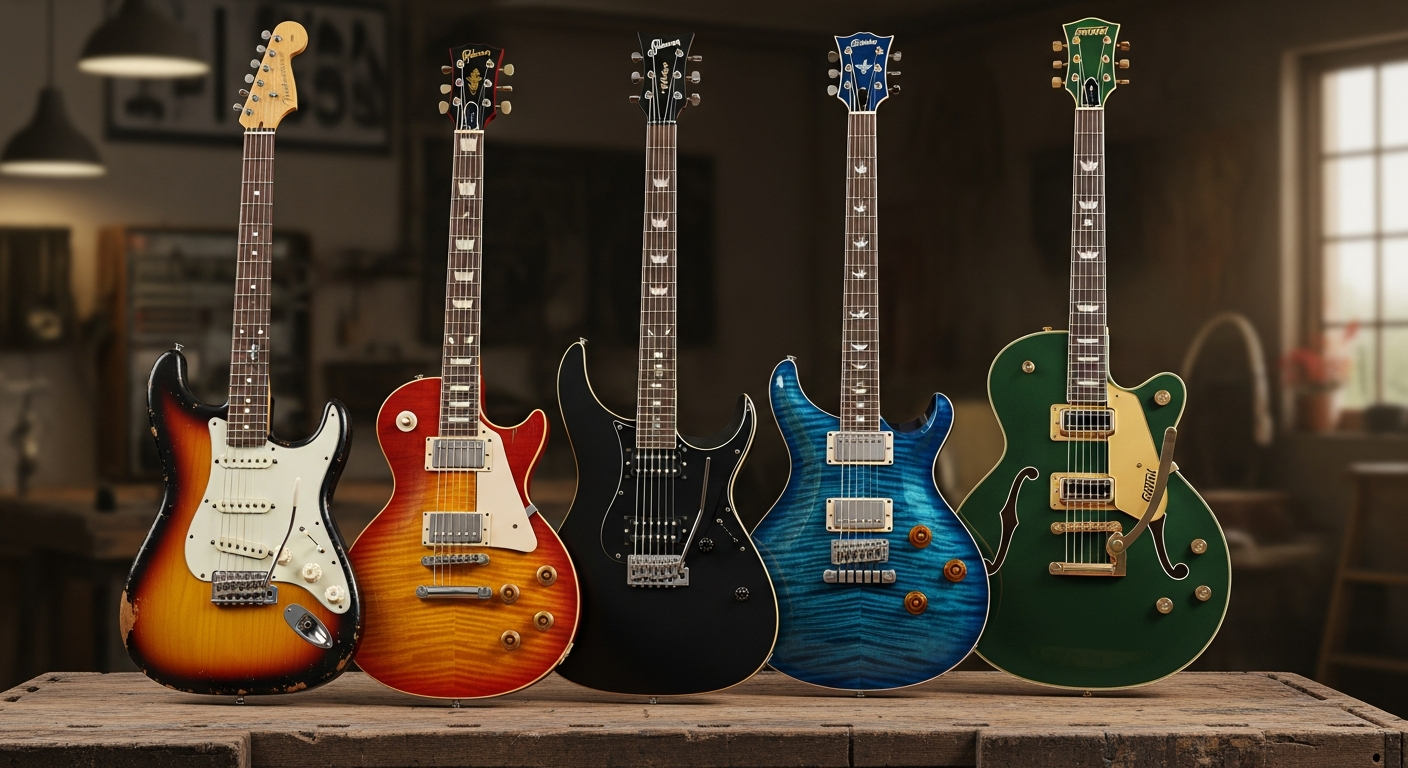
Electric guitar under 1500€: buying guide
So, guys, let's get comfortable for a moment. The search for the guitar electric under 1500€ It's a bit like looking for a needle in a haystack, but with the difference that the needle is there, it's good, and it can give you a lot of satisfaction. It's not the "entry-level" range where you take what comes, but not even the "boutique" one where every detail is hand-carved and costs like a small car. We are in the middle, in the territory where you start to get serious, but without draining your bank account.
I'm telling you clearly, I've been there. I spent years looking for the deal, buying used guitars that seemed good and then turned out to be sieves, modifying them until they made sense to me. I made a lot of mistakes, I spent money on pickups I didn't like, on necks that didn't fit me. But precisely because I made all these mistakes, I learned to recognize a good base, an instrument that is worth the money it costs and that, perhaps, with some small modifications, can become a real war machine.
This is the price range where you make the leap in quality. Maybe you already have a studio guitar, one of those they gave you to start, and now you feel you've outgrown it. Or perhaps you want a second guitar, maybe with a different sound, to take around without the anxiety of ruining your thousands-of-euros jewel. Here's where the electric guitar under 1500€ comes into play. It's not a toy, it's a serious tool that, if chosen well, will give you years of faithful service. And above all, it will make you have a lot of fun.
My goal here is not to tell you “buy this model X”, because prices change, models go out of production, and what is good today might not be good tomorrow. I want to give you the tools to understand what to look for, what to expect and, above all, how to avoid scams. Because if I succeeded, who started in the garage with a soldering iron and a Dremel, you can succeed too.
What to Expect from an Electric Guitar under €1500
When we talk about a electric guitar under 1500€, we are no longer in the field of extreme compromises. Here you will find instruments made with quality woods, often with a good selection, and an attention to construction that begins to make itself felt.
You might come across models with branded pickups, solid hardware, and refined finishes. Don't expect boutique masterpieces, but certainly a level of detail and performance that allows you to play with satisfaction both at home and on stage.
The main difference compared to lower price ranges is consistency. There’s less variability in the quality of the final product, and even the production “Monday mornings” are less frequent. This means that the chances of finding a well-made instrument, with a good factory setup, are significantly higher.
Often, in this range, companies try to offer the maximum possible value, perhaps giving up purely aesthetic details to invest in functional components. È a delicate balance, but when it works, the results are excellent.
Technical Specifications: The Heart of the Instrument
Understanding the technical specifications is fundamental for choosing the electric guitar under 1500€ right. It's not just about numbers, but about how these influence the sound, playability, and durability of your instrument.
Body and Neck Woods
The type of wood used for the body and neck has a huge impact on the timbre and sustain of the guitar. In this price range, tried and tested woods are generally found.
- Alder: Light, resonant, with a balanced timbre and good emphasis on the mids. It's a classic for Stratocaster and Telecaster type guitars, offering a versatile sound base.
- Ash: Often heavier than alder, ash has a bright sound, with excellent attack response and pronounced sustain. It is distinguished between Swamp Ash (lighter and more resonant) and Northern Ash (denser and brighter).
- Mahogany: A darker and denser wood, typical of Gibson-style guitars. It offers a warm tone, rich in mids and with a very generous sustain. It is ideal for genres that require body and drive.
- Pioppo (Poplar) e Tiglio (Basswood): Cheaper woods but not for this reason poor quality. They are light and tonally neutral, which makes them excellent “white canvases” for modifications, especially if you want to experiment with different pickups. I've had a couple of basswood guitars that, with the right pickups, sounded better than much more renowned instruments.
For the handle, the’Maple is almost a standard, for its stability and contribution to a bright sound. Sometimes you find Roasted Maple necks (heat-treated), which makes it even more stable and with a slightly warmer and more resonant tone, almost as if it were aged wood. This is a nice plus to look for.
Fretboard (Fretboard)
The fretboard is not just a surface, but contributes to the feel and, to a lesser extent, to the sound.
- Rosewood: Dark, porous, offers a soft feel and a warm sound. It is very common and appreciated.
- Ebony: Even darker and denser, with a smooth and fast surface. Contributes to a more defined attack and a bright tone. It is often found on slightly higher-end instruments, but it is not uncommon to see it on some 1500€ models as well.
- Maple: The maple fretboard has a smoother and faster feel, and contributes to a brighter and snappier tone. It requires a bit more maintenance due to dirt that can accumulate.
The important thing is that the frets are well seated and finished. I have seen expensive guitars with unleveled frets, and mid-range guitars with impeccable work. This is one of the first details to check, because good fretwork makes the instrument immediately playable and comfortable.
Handle Type and Profile
The neck is the main point of contact with the instrument. In this range, options become more varied.
- Bolt-on (screwed): The most common, typical of Fender guitars. It offers a more immediate attack and a bright sound. It is also easier to replace or modify.
- Set-neck (glued): Typical of Gibson, it offers greater sustain and a smoother transition between body and neck.
- Neck-through (through the body): Less common in this range, but not impossible. The neck runs the entire length of the body, offering maximum sustain and stability.
Neck profiles vary enormously: from the thin and fast “Modern C”, to the more pronounced “Vintage V”, to the thicker “baseball bat” profiles for those with large hands. Trying them is the only way to understand which one fits you best. Don't be fooled by marketing: a “fast” neck for someone might be uncomfortable for you.
Pickup: The Electronic Heart
In this price range, it is very likely to find branded or high-quality pickups, not the generic ones that equip cheaper instruments.
- Single-coil: Typical of Stratocaster and Telecaster, they offer a bright, crystalline and defined sound. Excellent for blues, funk, light rock. Real Seymour Duncan or DiMarzio in this range are a nice advantage.
- Humbucker: With a thicker, more powerful sound and less background noise. Perfect for rock, metal and genres that require more drive. Here too, models like the Seymour Duncan JB/Jazz or DiMarzio Super Distortion/PAF Pro are a sign of quality.
- P90: A middle ground between single-coil and humbucker. They offer a fat, “growly” and dynamic sound, with a bit more output and body than traditional single-coils.
Sometimes, active pickups (e.g. Fishman Fluence or EMG) are also found, which offer high output and a more compressed sound, ideal for metal and high-gain genres. The choice depends on the musical genre and your sound preferences. Remember that potentiometers and capacitors, if of good quality, also contribute to a more transparent and usable sound.
Hardware: Stability and Reliability
Hardware is crucial for tuning stability and resonance. In this range, robust and functional components are found.
- Mechanics (Tuners): Locking tuners are a great advantage, improving tuning stability and speeding up string changes. Brands like Gotoh or Grover are synonymous with quality.
- Bridge:
- 2-point tremolo: Common on Stratocaster-type guitars, it offers good stability and fluidity in using the tremolo arm.
- Hardtail: Fixed bridge, maximum stability and sustain.
- Floyd Rose (or licensed): Although found, Floyd Rose in this price range can be a weak point if they are not branded (e.g. Gotoh or Schaller). A “cheap” Floyd Rose can be a source of endless tuning frustration. My experience tells me to be careful here.
- Bigsby: Less common but present on some models, it offers a soft and vintage vibrato, but may not be the best for tuning stability.
- Nut: Materials like TUSQ (synthetic graphite), bone, or graphite are superior to cheap plastic. They contribute to tuning stability and the resonance of open strings.
Scale (Scale Length)
The scale length, i.e., the distance between the nut and the bridge, influences string tension, tone, and playability.
- 25.5 inches (Fender-style): Higher tension, brighter and more defined sound. Typical of Stratocaster and Telecaster.
- 24.75 inches (Gibson-style): Lower tension, warmer sound and easier string bending. Typical of Les Paul and SG.
There are also intermediate or multi-scale (fanned frets) scales that try to combine the advantages of both, but they are less common in this range.
Finish
Finishes can be polyurethane (more resistant), polyester (even more resistant) or, in rare cases, nitrocellulose (thinner, allowing the wood to “breathe” and age more naturally, but they are delicate). In this range, polyurethane or polyester finishes are the norm, and they are perfectly fine. The important thing is that they are applied well, without imperfections or areas that are too thick that could stifle the wood's resonance.
Relevant Construction Notes and Quality Control
Good quality control (QC) is fundamental. Even an excellent guitar with poor QC can be a disaster. In this price range, companies generally have more rigorous QC processes than entry-level models.
Look for neck alignment, the quality of the joints (neck joint), the absence of paint smudges or deep scratches. A good factory setup is an indicator of attention. Many companies, even if they produce in Asian countries, do a final setup in Europe or the USA before distribution, and this makes a huge difference.
Sometimes, models with a double-action truss rod are found, which allows for more precise neck adjustment, both forward and backward. It's a technical detail that I always appreciate, especially if you intend to keep the guitar for a long time.
Popular Sentiment: Voices from the Community
When talking about a electric guitar under 1500€, the online community is a chorus of voices that, if listened to carefully, can give you a clear idea of what to expect. Not all that glitters is gold, but often real gems are found.
What Fans Say
On forums like The Gear Page, Reddit r/guitars or even Italian platforms like Accordo.it, the general consensus is that this price range represents the “sweet spot” for many guitarists. There is talk of excellent value for money, with instruments that often “perform well above their cost”.
Much praise goes to the choice of woods, which are no longer production residues, but carefully selected pieces. And then there are the branded pickups: “finally I don't have to change the electronics immediately!” is a comment that is often read. The presence of Seymour Duncan, DiMarzio or Fishman Fluence as standard is a huge added value.
Playability is another strong point. Many users report comfortable necks, well-finished fretboards, and satisfying string action right out of the box. This means less time tinkering with the setup and more time playing, which is what we all want.
The Criticisms and Common Weaknesses
It's not always a walk in the park. The most frequent criticism concerns quality control, which, although improved compared to lower-end models, can still be inconsistent from one unit to another. “I tried three identical models and one sounded much better than the others” is a common complaint. This highlights the importance of trying the instrument in person.
Another sore point can be the non-branded hardware in some areas. Maybe the pickups are great, but the potentiometers or the switch could be generic and deserve an upgrade. Or the bridge, while functional, is not as robust as a Gotoh or a Schaller. “The tuners were good, but I put locking ones on and you can feel the difference” is a classic.
Finally, the fretwork. Although generally good, it can happen to find some frets slightly high or not perfectly polished. This is not a serious defect, but it means that a visit to the luthier for a rectification and polishing (or “fret dressing”) might be necessary to maximize comfort. I myself, on a couple of guitars in this range, had to do a small touch-up to the frets, but the cost is minimal compared to the benefit.
Pros and Cons in Relation to Price
Evaluate a electric guitar under 1500€ means balancing expectations and reality. Here's a summary of the pros and cons I've encountered, also based on general feedback.
Pro
- Solid Build Quality: Often one finds selected woods and careful assembly that guarantees durability and resonance.
- Brand Components: Many models include pickups from renowned manufacturers (Seymour Duncan, DiMarzio, Fishman Fluence) and good quality hardware (Gotoh, Grover). This reduces the need for immediate upgrades.
- Excellent Playability: Comfortable necks, well-finished fretboards, and a generally good factory setup make the instrument pleasant to play right out of the box.
- Sonic Versatility: The combination of woods and pickups allows covering a wide range of musical genres with excellent results.
- Excellent Base for Modifications: Even if already good, a guitar in this range is an excellent platform for future customizations, such as changing potentiometers, capacitors, or small hardware improvements.
- Well-groomed Aesthetics: The finishes are often well applied and the general appearance is professional, without the “cheap” look of entry-level models.
Against
- Inconsistency in Quality Control: Although rare, it can happen to find specimens with small imperfections or a non-optimal setup. Trying the instrument is always recommended.
- Generic Hardware: Sometimes, to keep costs down, some minor hardware components (e.g., potentiometers, switches, sometimes unbranded bridges) might not be top-notch and deserve an upgrade.
- Fretwork to Refine: In some cases, a small leveling or polishing of the frets might be necessary to achieve maximum smoothness.
- Lack of “Boutique Character”: Don't expect the craftsmanship or custom details of a multi-thousand euro instrument. It is still mass production, albeit of high quality.
- Variable Resale Value: Although they hold their value well, they are not investments like vintage or custom shop guitars.
For Whom It Is Suitable and For Whom It Is Better to Avoid It
Not all guitars are for everyone. Understanding if one electric guitar under 1500€ is right for you is crucial before pulling out your credit card.
For Whom It Is Suitable
- The Intermediate/Advanced Guitarist: If you have passed the beginner phase and are looking for a quality leap, a more performing instrument with a more defined sound, this range is perfect.
- The Musician who plays live: Do you need a reliable instrument for rehearsals and concerts, one that sounds good and doesn't make you anxious about damaging it? Here you'll find solid and performing options.
- The Modification Enthusiast: If you like to tinker, change pickups, improve the hardware, these guitars offer an excellent base on which to build your ideal instrument without starting from scratch with a flimsy instrument.
- Who seeks a Specific Sound: Many models in this range are designed to excel in specific genres, offering authentic tones without the premium price tag.
- Who seeks a Second Guitar: Maybe you already have an expensive gem and are looking for a valid alternative to take around or keep in the studio for a different sound.
Who Should Avoid It
- The Absolute Beginner: If you are taking your first steps, 1500€ might be an excessive investment. It's better to start with something cheaper (300-500€) and understand what you really like, then make a targeted upgrade.
- The Collector/Investor: These guitars are made to be played, not to be hung on the wall as works of art or to increase in value over time. If you are looking for an investment, you need to look elsewhere.
- The Professional Musician who doesn't want compromises: If your career depends on an instrument that is absolutely impeccable in every detail, with 100% guaranteed QC and zero defects, you might have to go up another price range, towards custom shop or top-tier productions. Although, to be fair, many professionals satisfactorily use instruments in this range, perhaps with some small customizations.
- Who Seeks a Specific Brand at All Costs: If you are obsessed with a specific logo or model, you might find yourself sacrificing overall quality for the brand. In this range, it's better to look for value and features, not just the name.
Final Advice and Alternatives
If you've made it this far, you've understood that choosing a electric guitar under 1500€ is a matter of balance between expectations and reality. My advice, based on years of testing and, let's admit it, some wrong purchases, is always the same: try, try, try.
Never buy blindly, unless you have enough experience to know exactly what you are looking for. Go to the store, pick up the models you are interested in. Feel the neck, try the string action, listen to the sound. Don't be afraid to ask to plug it into an amplifier you know. If you can't try it, look for detailed reviews and online demos, but always with a critical eye.
Also consider the used market. In this price range, you can find incredible deals. Many guitarists buy, try for a few months, and then resell to move on to something else. With a little patience and a keen eye, you could take home a guitar that would cost much more new, perhaps with some upgrades already made by the previous owner. Obviously, in the used market, it is even more important to inspect the instrument well or rely on trusted sellers.
And don't forget that a good guitar is a good base. Even if it's not perfect, with some targeted modifications it can become your ideal companion. Whether it's changing pickups, improving the electronics, or simply doing an impeccable setup, the customization potential is enormous. If you're interested in learning more, here on the blog we have a lot of guides on how to modify your guitar.
Finally, don't be too influenced by brands. There are less renowned brands that offer excellent build quality and components at competitive prices. Yamaha Revstar, Schecter, G&L Tribute, Ibanez Premium, or the PRS SE series, to name a few, are all excellent examples of how you can get a lot without spending a fortune. Quality is not just in the name on the headstock. An excellent resource for delving into pickup selection and their impact on sound is the Seymour Duncan blog, which offers detailed and well-written guides on different types and their applications: Seymour Duncan Blog – The Tone Garage.
FAQ – Frequently Asked Questions
What is the main difference between a 500€ guitar and a 1500€ guitar?
The main difference lies in the quality and consistency of materials and components. A 1500€ guitar will have selected woods, branded pickups, more robust hardware, and more rigorous quality control, ensuring better playability, tone, and durability compared to a 500€ model which often features generic components and greater production variability.
Can I find a reliable guitar with Floyd Rose in this price range?
Yes, it is possible, but you have to be careful. Some models in this range include Floyd Rose “special” or good quality licensed versions (like Gotoh or Schaller ones). However, avoid generic or low-grade Floyd Rose bridges, as they can cause tuning stability problems and frustration. It's always better to opt for a fixed bridge or a quality 2-point tremolo if the budget is tight and you don't want surprises.
Conclusion
Choosing a electric guitar under 1500€ is an exciting adventure that will open the doors to serious and rewarding instruments. With the right information and a little patience, you will find the perfect companion for years of music and enjoyment, without having to mortgage your house.
Download the Luthier Survival Kit
Free PDF with checklist, problem-cause table and project card template.
 English
  Italiano
Stuck on your build?
If you ran into the same problem or have a question, drop it in the comments. I read and reply to every one.
Write a comment