

[BOX AFFILIAZIONE]
Assembling an Electric Guitar: 7 Steps to a Top Sound
I still remember my first guitar built from scratch. A disaster, I'll tell you right now. The neck was crooked, the electronics buzzed like an angry beehive, the frets cut my fingers. I set out with the idea of saving money, but instead I learned the hard way that building a guitar electric is an art, but also a science. And above all, it's made of patience and mistakes. Many mistakes. However, you know what? That guitar, despite everything, I loved it. Because it was my. Every smudge was the sign of an afternoon spent learning, every adjustment was a small victory. And if I, who understood as much about electrical engineering as about quantum physics, could do it, so can you. Without spending a fortune on professional luthier tools, but with the right amount of attention and some tips that, trust me, would have helped me a lot. In this article, I will guide you through the seven fundamental steps for theassembly of your electric guitar. Don't expect perfection on the first try – that comes with practice – but I'll give you all the information to avoid the most common mistakes and to get a sound that satisfies you. My goal is not to make you luthiers in a day, but to give you the confidence to start and the knowledge to understand what you are doing, step by step. Ready? Let's get started.
1. Preparation of the Neck and Body: The Foundations of Sound
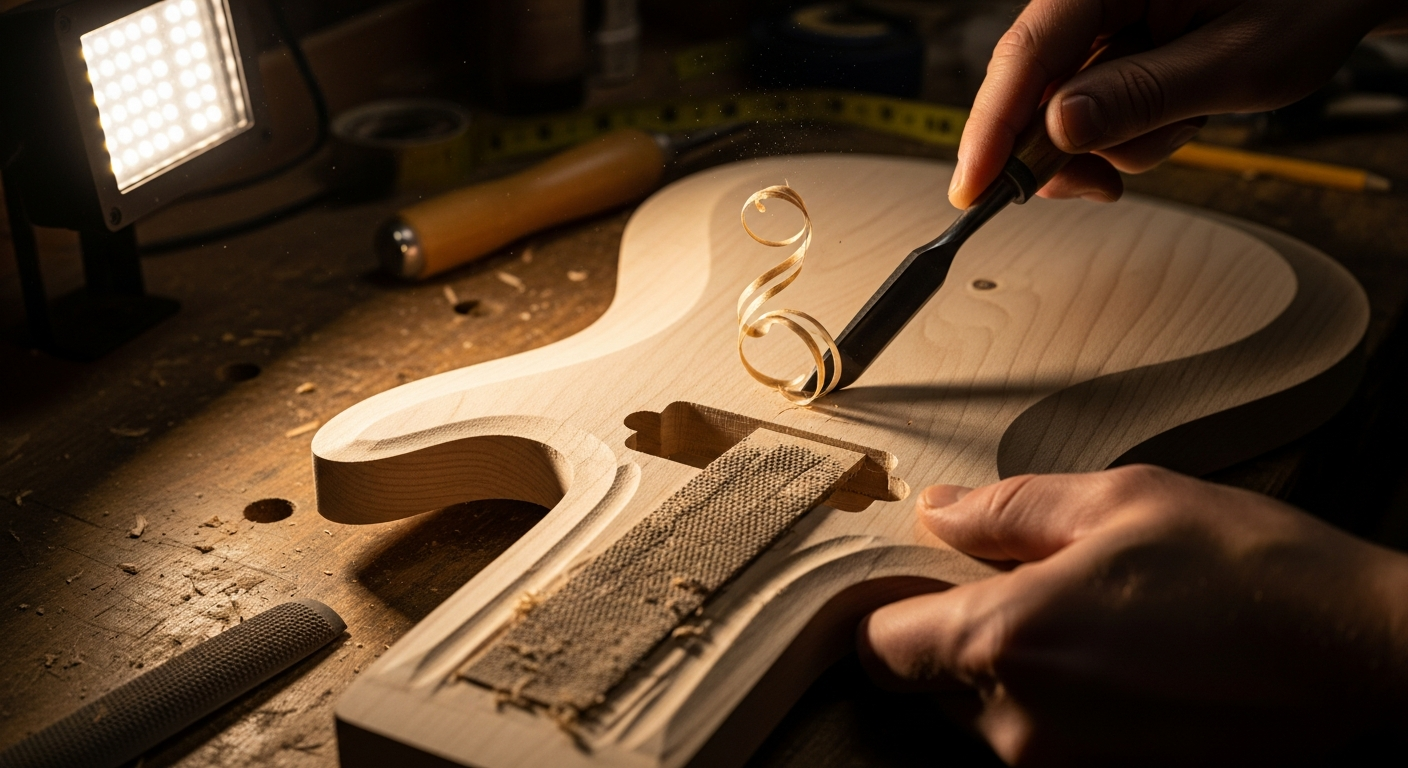
Before starting to assemble the electric guitar, it is essential that its “bones” are in place. I'm talking about the neck and body. Even if you've purchased a pre-finished kit, there are details that make the difference between a mediocre instrument and one that sounds and feels good. Never underestimate this phase.
The Neck: Taking Care of Details for Perfect Playability
The neck is the heart of playability. If the frets are not well leveled and polished, every bending will be agony and the sound will suffer.
What to do:
- Fret Inspection and Leveling: Check each fret with a precision straightedge. If you notice any irregularities (frets higher than others), you will need to level them. This is one of the most delicate steps and often ignored by beginners. The first time, I skipped this step and ended up with a very high action to avoid fret buzz.
- Fret Crowning and Polishing: After leveling, the frets will have a flat surface. You will need to restore their “crown” shape with a special file and then polish them to a mirror shine. Well-polished frets reduce friction and improve sustain.
- Neck Finish: If the neck is not painted, you can opt for oil (such as tung oil or Danish oil) for a more natural and fast feel, or a polyurethane/nitrocellulose finish for greater protection. Make sure it is completely dry and smooth before proceeding.
- Truss Rod Check: Give the truss rod (the metal bar inside the neck that controls its curvature) an initial adjustment. It should be neutral or have a very slight concavity, but not tight or convex.
Common mistake: Do not level the frets or polish them. This leads to action problems, buzzing, and an unpleasant feel. Invest in a good fret file and very fine-grit sandpaper.
The Body: The Canvas to Build On
Even if the body is pre-finished, a check never hurts.
What to do:
- Cavity Inspection: Check that the cavities for the pickups, electronics, and neck are clean and well-routed. Sometimes there are small wood residues that can hinder assembly.
- Shielding (Optional but Recommended): To reduce background noise and electromagnetic interference, you can shield the cavities with conductive paint or copper tape. This is an upgrade I highly recommend, especially if you use single coil pickups. I learned the hard way how frustrating a persistent hum can be.
- Finish (if necessary): If the body is raw, this is the time to apply the finish you prefer. Painting is an art in itself, but an oil finish can also give excellent results and a very natural look.
Expert tip: The quality of the finish affects not only the aesthetics but also the sound. A finish that is too thick can “suffocate” the wood, reducing resonance. Look for a balance.
2. Neck Attachment: Stability and Alignment
This è a critical step for the stability and playability of your guitar. A well-secured neck è fundamental for sustain and for proper string alignment.
Bolt-on Neck: The Most Common Choice in DIY
Most kits for assemble an electric guitar uses a bolt-on neck, i.e. screwed to the body.
What to do:
- Pairing Verification: The “neck pocket” (the cavity in the body where the neck is inserted) must accommodate the neck precisely, without excessive play but also without forcing it. A tight fit improves vibration transfer and thus sustain. If there is too much play, the neck might move slightly, compromising tuning and intonation.
- Alignment: Insert the neck into the neck pocket without screwing it in. Place a ruler or a string along the center of the neck and check that it is perfectly aligned with the center of the body and the future position of the bridge. This is crucial to prevent the strings from slipping off the fretboard or being too close to an edge.
- Drilling and Screwing: If the holes are not pre-drilled, you will need to mark them precisely and drill pilot holes in the neck. Use a drill bit slightly smaller than the screw diameter to avoid splitting the wood. Screw the neck firmly, but without overtightening to avoid damaging the wood or the screws. A trick is to tighten the screws gradually and in a cross pattern, as you would with wheel bolts.
Common mistake: Misaligned or too wide/narrow holes. This can cause a crooked neck, instability, or stripped screws. Take all measurements calmly and use a drill press if possible, for maximum precision.
Personal anecdote: My second guitar, in a hurry, I assembled it with the neck holes slightly off-axis. The result? The strings were too close to the upper edge of the fretboard on the high frets. I had to disassemble everything, fill the old holes, and redo the work. A huge waste of time, but a valuable lesson on the importance of precision.
3. Hardware Installation: Bridge and Tuners
With the neck firmly in place, it's time to add the main hardware. These components are not only functional but directly influence tuning stability and sustain.
The Bridge: The String Anchor Point
The bridge is where the string vibrations meet the body. Its position is of paramount importance for intonation.
What to do:
- Scale Length Determination: Measure your guitar's scale length (distance from the nut to the 12th fret, multiplied by two). This is the theoretical distance from the nut to the bridge.
- Bridge Placement: Position the bridge on the body, aligning it perfectly with the center of the neck. The exact position of the saddles (the string supports on the bridge) must be slightly further back than the theoretical scale length, to allow for intonation compensation. For a Tune-o-matic bridge, you will need to drill for the “studs” (anchor posts). For a Tremolo bridge, the situation is more complex and requires precise routing of the cavity.
- Drilling and Mounting: Mark the drilling points with extreme precision. Use a pilot bit appropriate for the type of screw or post. Mount the bridge. If it's a tremolo, ensure that the pivot posts or screws are secure and that the bridge moves freely.
Pro Tip: For fixed bridges, measure from the nut to the 12th fret, then from the 12th fret to the point where the bridge saddles are located. These two measurements should be as similar as possible, taking compensation into account. Use a strobe tuner if you have one for perfect intonation right from the start.
The Tuners: The Key to Stable Tuning
The tuners on the headstock are responsible for holding the tuning. Don't skimp on their quality.
What to do:
- Assembly: Insert the tuners into the headstock holes. If they are locking tuners, ensure the lock is oriented correctly.
- Fixing: Screw in the front bushings and then the rear screws that prevent the tuners from rotating. Once again, drill precisely for the pilot screws.
Common mistake: Tuner screws that are too long and protrude from the front of the headstock, or misaligned tuners. Always check the screw length and visual alignment.
4. The Electronic Heart: Wiring and Shielding
Electronics are often the sore point for those venturing intoassembling an electric guitar. But with a little patience and the right diagrams, it's not that difficult. This is the time to give voice to your instrument.
Pickups, Potentiometers, Switches and Jack: Connecting the Dots
Each component has a specific role in shaping the sound.
What to do:
- Planning: Before you start soldering, carefully study the wiring diagram for the configuration you want (Humbucker, Single Coil, with split, phase, etc.). There are endless possibilities! A great starting point for diagrams is the Seymour Duncan website: Seymour Duncan Wiring Diagrams.
- Component Mounting: Install the potentiometers (volume and tone), the pickup selector (toggle switch or blade switch), and the output jack in their cavities. Tighten the nuts securely.
- Pickup Installation: Mount the pickups in their frames or directly on the body. Ensure they are at the correct height (adjustable with the side screws) to prevent the strings from touching them but close enough to capture the signal.
- Welding: This is the most critical step.
- Use a fine-tipped soldering iron and good quality solder.
- Make clean and solid solders, without cold solder “balls”.
- Connect the pickup wires to the potentiometers, then the potentiometers to the selector, and finally the selector to the output jack.
- Don't forget the ground connections. Every metal component (bridge, strings, tuners) must be grounded to reduce noise.
- Shielding: If you haven't done it before, you can use copper tape in the cavities and connect it to ground. This is crucial for reducing hum, especially with single coils.
Common mistake: Cold solders, missing or incorrect ground connections, crossed or uninsulated wires. This leads to hum, signal interruptions, or no sound. Check every solder joint and test connections with a multimeter if in doubt.
Personal anecdote: The first time I wired a guitar, I forgot a crucial ground connection. The result was a deafening background noise that varied every time I touched a metal part of the guitar. It took me hours to figure out the error, but from that day on I learned that “grounding” is sacred.
5. String and Nut Installation: Giving Voice to the Instrument
Finally, we begin to see the guitar take shape and, more importantly, hear the first sounds. The nut and strings are crucial for action and intonation at the first fret.
The Nut: The Zero Point
The nut is where the strings rest before the first fret. Its height and the spacing of the grooves influence the action on the first frets and overall playability.
What to do:
- Assembly: Insert the nut into its slot on the headstock. If it's not pre-cut, you'll need to cut the string grooves with specialized files.
- Height: The nut height is crucial. The strings should be just above the first fret, without touching it. If it's too high, the action on the first frets will be hard; if it's too low, you'll have open string buzzing. This is a precision job, often involving filing and testing.
- Spacing: Ensure that the grooves are well-spaced and that the strings pass freely, without pinching.
Expert tip: Start with a nut slightly higher than necessary and gradually lower it, checking the action. It's easier to remove material than to add it. Use a caliper to measure the string height above the first fret.
The Strings: The First Sound
There's nothing more gratifying than hearing the first chord on your creation.
What to do:
- Stringing: Thread the strings through the bridge and into the tuners. Make sure to wrap the strings correctly around the tuner posts for a stable hold. Usually, two or three wraps are sufficient for thicker strings, and three or four for thinner ones.
- Tuning: Tune the guitar. Initially, the tuning will be very unstable; the strings need to “settle in”. Gently pull them upwards and retune several times.
Common mistake: Insufficient or excessive wraps on the tuners, leading to tuning problems. Learn the correct technique for stringing the guitar.
6. Initial Setup: Action, Intonation and Neck Relief Adjustment
Now that the guitar is assembled and tuned, it's time to make it truly playable. This phase, the “setup”, is crucial and often requires several iterations. This is where your guitar will come to life and adapt to your playing style.
Neck Relief: The Starting Point
The curvature of the neck, or “relief”, is the first parameter to adjust. It directly influences the action and prevents fret buzz.
What to do:
- Verify: Tune the guitar. Press a string (for example, the sixth, low E) at the first fret and simultaneously at the last fret (or where the neck joins the body, around the 17th fret). Look at the space between the string and the top of the 7th/8th fret. There should be a small gap, enough to insert a business card or a feeler gauge of about 0.2-0.3 mm (for electrics).
- Truss Rod Adjustment: If the gap is too large (concave neck), tighten the truss rod (turning clockwise). If there is no gap or the string touches the frets (convex neck), loosen the truss rod (turning counter-clockwise). Make small adjustments (a quarter turn at a time) and let the wood settle for a few minutes before rechecking.
Common mistake: Adjusting the truss rod too drastically or without allowing the wood time to settle. This can damage the neck or the truss rod itself. Patience is the keyword here.
Action: The String Height
The action is the height of the strings from the fretboard. Low action is comfortable, but can cause buzzing if not balanced with relief and fret leveling.
What to do:
- Bridge Height: Adjust the bridge saddles (or bridge posts, depending on the type) to raise or lower the string height. Start with a medium action and gradually lower it until you only hear a slight buzzing when playing forcefully.
- Nut Height: If the action is too high on the first frets, it may be necessary to slightly lower the nut slots. This is a delicate point, as we have seen.
Reference measurements (general, may vary): For an electric guitar, open at the 12th fret, the low strings (E, A) can be between 1.5mm and 2.0mm, the high strings (B, E) between 1.0mm and 1.5mm. These are just indications, personal comfort is the priority.
Intonation: Perfectly Tuned Sound Across the Entire Fretboard
Intonation ensures that every note played on the fretboard is in tune. It's frustrating to have a guitar that's in tune open but out of tune on the high frets.
What to do:
- Tuning the guitar: Use a precise tuner.
- Checking Intonation: Play the open string and tune it. Then press the same string at the 12th fret and play it. The 12th fret should be identical to the open note, but an octave higher.
- Adjusting the Saddles:
- If the note at the 12th fret is flat (too low), move the saddle towards the headstock (shortening the vibrating length of the string).
- If the note at the 12th fret is sharp (too high), move the saddle towards the bridge (lengthening the vibrating length of the string).
Common mistake: Do not retune the open string after each saddle adjustment. This will falsify the reading. Be methodical and patient.
Personal anecdote: The first time I adjusted the intonation, I thought I was done after two strings. Then I tried playing a barre chord at the 7th fret and it was a cacophony! I realized that each string must be treated individually, and the process must be repeated until everything is perfect.
Pickup Height Adjustment: Volume Balance
Pickup height affects output volume and tone.
What to do:
- Adjustment: Use the screws on the sides of the pickups to raise or lower them. Start with the pickups closer to the strings and lower them if the sound is too “loud” or distorted, or if sustain is reduced (a magnetic field that is too strong can “brake” the string).
- Balance: Seek a balance between the pickups. The neck pickup is usually slightly further from the strings than the bridge pickup, to balance the intrinsic volume difference between positions.
Expert tip: There is no fixed rule for pickup height. It's a matter of personal taste. Experiment and find the configuration you like best. Many pickup manufacturers provide recommendations for distances.
7. Final Test and Finishing Touches: Top Sound is Within Reach
You're almost done! After all these steps, your guitar is ready to be played. But it's not yet time to put away the tools. There's always a final phase of checking and finishing.
Sound Test: Listen and Feel
Connect your guitar to the amplifier and play it. Not just chords and scales, but try bending, vibratos, single notes across the entire fretboard.
What to do:
- Electronics Check: Listen for any hums or background noise. Move the potentiometers and the pickup switch: do they work correctly? Are there crackles? If so, go back to the wiring section.
- Playability Check: Feel the action: is it comfortable? Are there notes that buzz (fret buzz) at specific points on the fretboard? If so, further adjustment of the truss rod or bridge saddles, or perhaps a small fret touch-up, may be necessary.
- Intonation Check: Replay the octaves at the 12th fret and check that they are still perfect. Sometimes, after playing for a while, the strings settle and the intonation may vary slightly.
- Tuning Check: Does the guitar hold its tuning well? If it tends to go out of tune quickly, there might be a problem with the tuners, the nut (the strings “pinch” in the slots), or the bridge.
Aesthetic and Functional Finishing Touches
Small details can make a big difference in the final look and feel of the guitar.
What to do:
- General Cleaning: Clean the guitar from any soldering residue, fingerprints, or dust. Use specific products for the body and fretboard finish.
- Screw and Nut Check: Make sure all screws and nuts (neck, bridge, tuners, potentiometers) are tight. Don't overtighten, but they should be firm.
- Final Polishing: If you have painted or polished the body, give it a final wipe to make it shine.
- Protection: Apply some nut lubricant in the string slots to improve tuning stability and prevent wear.
Expert tip: Don't be afraid to go back. If something is wrong, it's better to disassemble a part and redo the work than to live with a problem. Patience and perseverance always pay off in the world of DIY lutherie. Every mistake is an opportunity to learn and improve your guitar modification or your next build.
You're done! You have assembled your electric guitar. Now it's time to enjoy it and show your creation to the world. It may not be perfect, perhaps, but it will be yours, and every note played will have the taste of your dedication and your work. Remember, building a guitar is not just a technical process, but a journey of discovery and passion. And the next one will be even better, I assure you.
Frequently Asked Questions (FAQ)
Is it necessary to have professional tools to assemble an electric guitar?
or, it is not strictly necessary to have all the tools of a professional luthier. Many jobs can be done with common garage tools, such as screwdrivers, wrenches, pliers, and a soldering iron. However, for best results, specific tools like fret files, precision calipers, and a good strobe tuner make a big difference and are an excellent investment.
How long does it take to assemble an electric guitar from a kit?
The time varies enormously based on your experience and the level of detail you want to achieve. A basic assembly can take a weekend, but if you include wood finishing, fret leveling, and meticulous setup, you might spend several weeks, working intermittently. The important thing is not to rush and enjoy every phase of the process.
Download the Luthier Survival Kit
Free PDF with checklist, problem-cause table and project card template.
 English
  Italiano
Stuck on your build?
If you ran into the same problem or have a question, drop it in the comments. I read and reply to every one.
Write a comment