

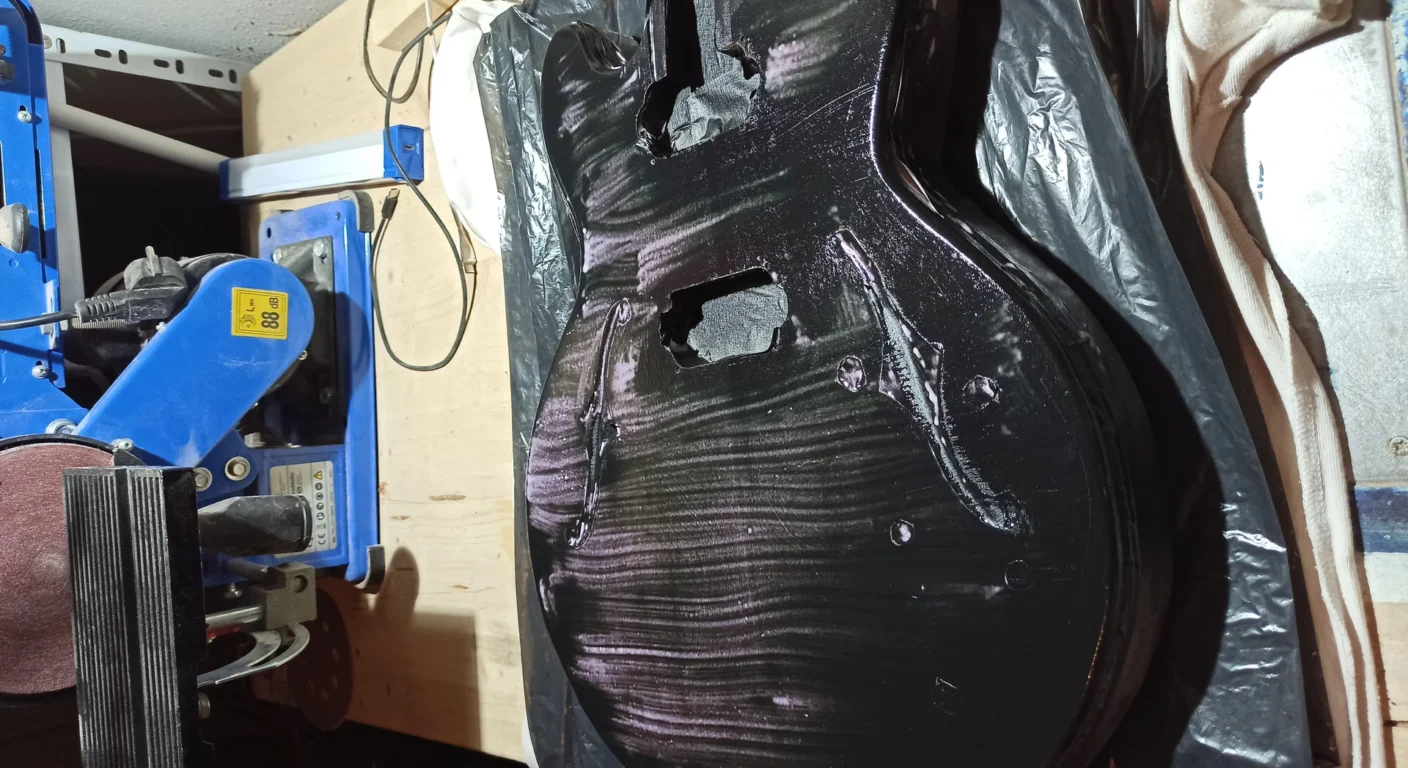
Building an Electric Guitar Body: 5 Mistakes to Avoid
Building an electric guitar from scratch is a journey. A journey that takes you from the scent of raw wood to the first chord played with your own hands. The satisfaction is immense, I don't deny it. But the road is not always straight. Indeed, it is often full of hairpin bends and some skids. I speak from experience. The first time I tried to make the building the body of an electric guitar, I felt a bit like a child given the keys to a tractor. Enthusiasm through the roof, but little idea how to handle that power. I made mistakes, big ones too. Mistakes that taught me more than a thousand tutorials. And it's precisely these mistakes I want to talk to you about today. Not to scare you, but to give you a compass. If I went through it, and came out with a playable (and even decent!) guitar, you can do it too. The important thing is to know where the most common traps lie. Because, let's face it, the body is the heart of your guitar. It's not just a shaped piece of wood. It's the basis for everything: sound, balance, ergonomics. Making a mistake here means compromising the project from the start. But don't worry, with a little attention and the right advice, you'll avoid a lot of headaches. So, buckle up and let's get ready to explore the 5 most common mistakes in the body construction of an electric guitar. And, trust me, they weren't the only ones I made, but they were the ones that made me sweat the most.
Project Roadmap: From Board to Guitar
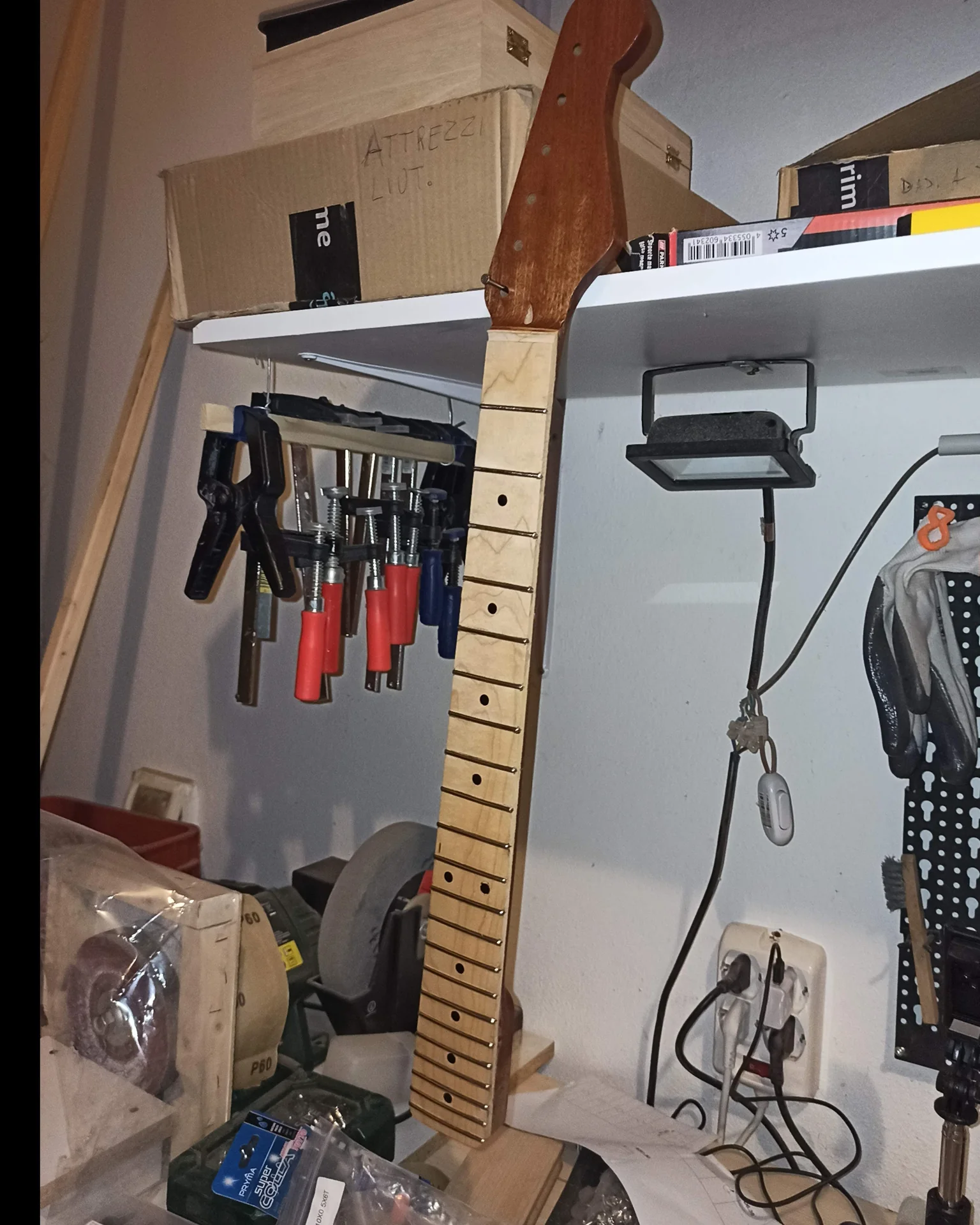
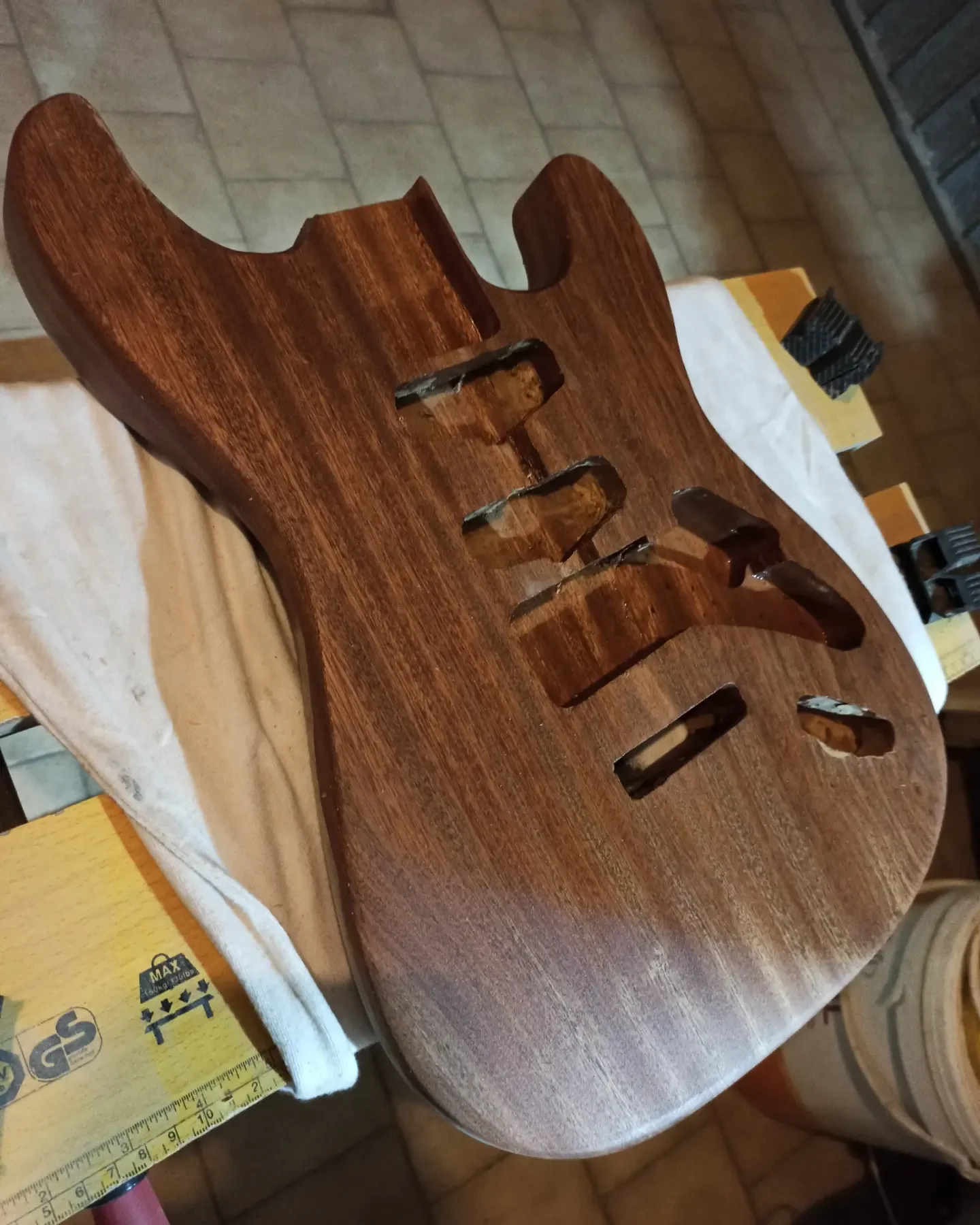
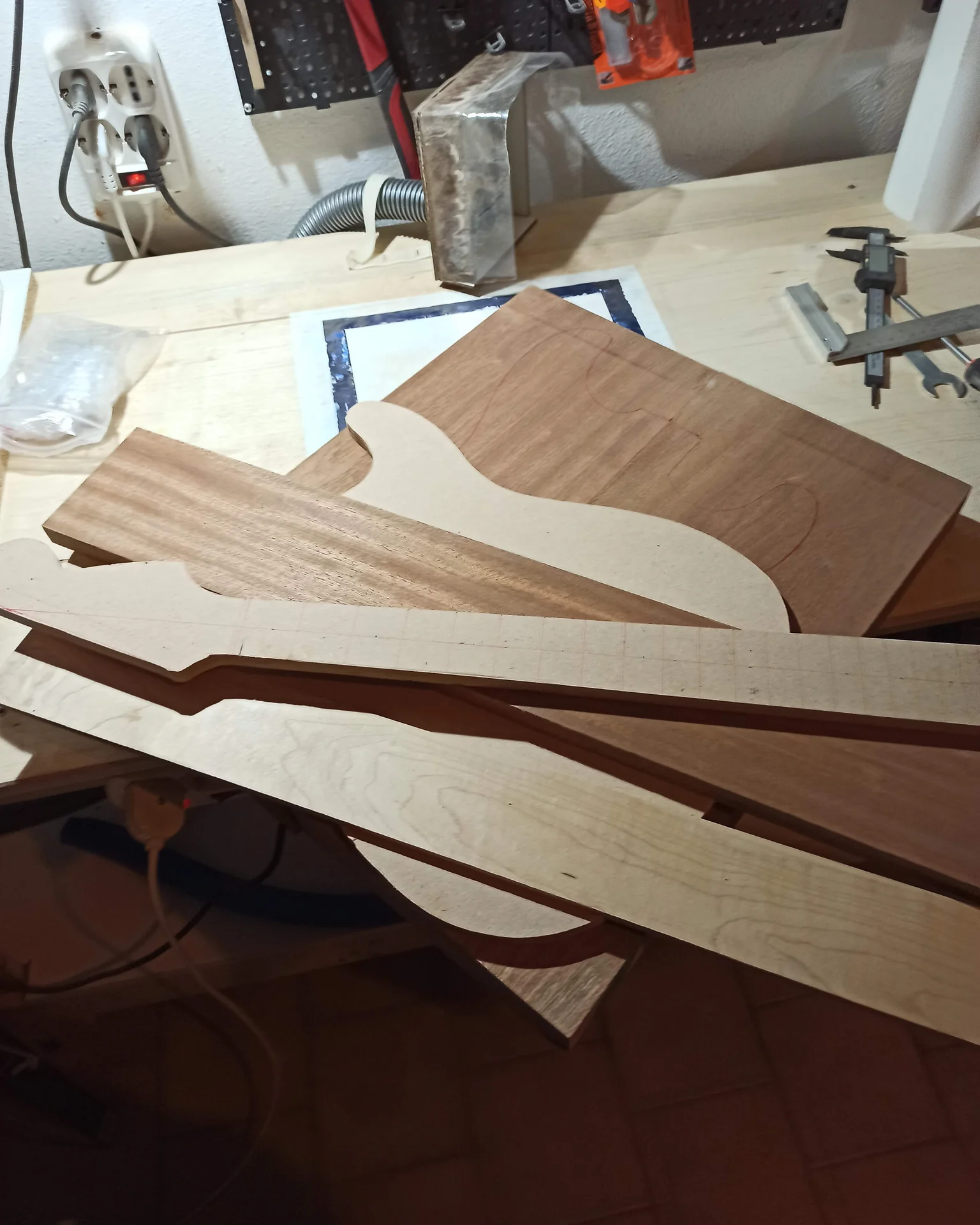
Before we get started, let's take a moment to review. Building an electric guitar body is a project that requires planning. It's not something you do in an afternoon. Here's a general roadmap to give you an idea of the steps and timelines.
Phase 1: Planning and Material Acquisition (1-2 weeks)
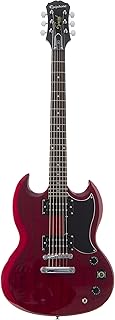

This is the most important phase for avoiding mistakes.
- Project Definition: What type of guitar do you want to build? Stratocaster, Telecaster, Les Paul, or an original design? This will influence the choice of wood, bridge type, pickups, etc.
- Wood Research and Selection: Choose the type of wood based on the desired sound, weight, and aesthetics. Consider woods like Alder, Ash, Mahogany, Basswood.
- Wood Purchase: Order wood from reliable suppliers. Make sure it is seasoned and has the correct moisture content.
- Component Purchase: Order pickups, bridge, tuners, electronics, neck (if you're not building it yourself).
- Tools and Consumables Purchase: Make sure you have everything you need: paints, glues, sandpaper, routers, etc.
Phase 2: Wood Preparation and Shaping (1-3 weeks)
This is where the actual work begins.
- Planing and Joining: If the body is made of multiple pieces, plane them to obtain flat surfaces and glue them.
- Final Planing: Bring the wood block to the desired thickness (e.g., 44-45 mm).
- Template Creation or Use: Prepare or purchase precise templates for the body outline, neck pocket, pickup cavities, and electronics.
- External Shaping: Use the band saw or router with the template to define the body's contour.
- Routing: Perform the routings for the neck pocket, pickups, l’electronics, and the bridge. This is the most delicate phase.
Phase 3: Detail Work and Preparation for Finishing (1-2 weeks)
The body takes shape in the details.
- Chamfers and Fillets: Create rounded or beveled edges according to the design.
- Drilling: Drill the holes for the jack, potentiometers, switches, and string-through holes (if necessary).
- Initial Sanding: Begin progressive sanding with progressively finer grits.
- Grain Filling (if necessary): Fill the pores of open-grain woods.
- Final Sanding: Continue sanding up to 320-400 grit, ensuring the surface is perfectly smooth and free of defects.
Phase 4: Finishing (2-4 weeks, depending on the type)
The aesthetic and protective phase.
- Base Coat/Primer Application: If necessary, apply one or more coats of base coat/primer.
- Sanding Base Coat/Primer: Sand the base coat/primer with very fine grits (600-800).
- Color/Top Coat Application: Apply the colored paint or the final clear coat.
- Drying and Curing: Strictly adhere to drying and curing times between coats. This is crucial.
- Sanding and Polishing: Once the finish is dry, sand with very fine grits (1000-2000) and polish to achieve the desired finish (glossy or satin).
Phase 5: Assembly and Setup (1 week)
The moment of truth.
- Gluing or Screwing the Neck: Mount the neck on the body.
- Hardware Installation: Mount bridge, tuners, pickguard, etc.
- Electronics Installation: Wire pickups, potentiometers, switches, and jacks.
- String Installation: Put on the strings.
- Setup: Adjust the action, intonation, pickup height.
From 7 to 12 weeks, depending on your speed, equipment, type of finish, and the time you can dedicate.
Materials and Indicative Costs
Here is an estimate of the necessary materials and associated costs. Prices are indicative and can vary greatly based on origin, quality, and offers.
Wood for the Body
- Alder (Alder): 50-100€ for a block of adequate size. Good tonal balance, medium weight.
- Swamp Ash: 70-150€ for a block. Light, bright, resonant.
- Mahogany (Mahogany): 60-120€ for a block. Warm, with pronounced mids, high sustain.
- Basswood (Lime): 40-80€ for a block. Light, neutral, easy to work with.
- Maple: Often used for layered tops, but also for entire bodies (heavier). 60-120€.
Handle
- Pre-finished Neck: 100-300€ (depending on wood type, profile, fretboard, frets). Brands like Fender, Warmoth, Musikraft are excellent options.
- Neck Kit: Sometimes you find necks in kits to assemble and finish.
- Neck Construction from Scratch: Requires specific wood (maple, mahogany), truss rod, fretboard (rosewood, ebony, maple), frets. Variable cost, from 100€ upwards, but requires specific tools and a lot of skill.
Hardware
- Bridge: 30-200€ (Stratocaster type Tremolo, Telecaster type Fixed Bridge, Tune-o-matic, Floyd Rose).
- Mechanics: 30-100€ (set of 6).
- Pickguard: 15-40€.
- Saddles (if not included in the bridge): 20-50€.
- Screws, Strap Buttons, Jack Plate: 20-40€.
Electronics
- Pick-up: 50-400€ (for a set of 2 or 3). The quality and type of pickup greatly influence the sound.
- Potentiometers (Volume, Tone): 10-30€ (2-3 pieces).
- Pickup Selector: 10-20€ (3 or 5-way).
- Capacitors: 2-5€.
- Wiring, Wire, Soldering: 5-10€.
Finish
- Paints (Nitro, Polyurethane, Acrylic): 30-100€ (depending on type and quantity).
- Primer/Sealer: 10-20€.
- Oil/Wax (for natural finishes): 15-30€.
- Solvents, Thinners, Tack Cloths: 15-30€.
Consumables and Tools (Variable initial cost)
- Wood glue (e.g. Titebond): 10-20€.
- Sandpaper (various grits): 20-40€.
- Wood router bits: 50-200€ (depending on quality and number of bits).
- Templates (MDF, Acrylic): 30-100€ (if bought).
- Screws, Clamps, Adhesive tape: Variable cost.
From 300€ to 1000€ (excluding the cost of tools, which amortize over time).
Essential Tools for Body Construction
To tackle the building the body of an electric guitar without too many hitches, some tools are essential. You don't need a complete woodworking shop, but these are the basics:
Woodworking Tools
- Bandsaw or Jigsaw: To cut the body outline. The bandsaw is more precise and easier to use.
- Router: Essential for creating neck pockets, pickup cavities, electronics, and for following templates. A 1/2″ or 1/4″ model is ideal.
- Column Drill: Much more precise than a hand drill for straight and accurate holes.
- Jointer and Thickness Planer: If you work from rough blocks, these tools are essential for obtaining flat surfaces and the desired thickness. If you buy pre-planed wood, you can do without them.
- Hand Plane: Useful for finishing and small corrections.
- Clamps: Of various sizes and types (bar, G, screw) for holding the wood and for gluing. You need many!
Measuring and Marking Tools
- Digital Caliper: Essential for precise measurements of thicknesses, widths, and depths.
- Steel Ruler and Square: For drawing straight lines.
- Tape Measure: For more general measurements.
- Pencil and Markers: For marking.
Sanding and Finishing Tools
- Sanding Blocks: Made of rubber, cork, or wood, to keep surfaces flat during sanding.
- Random Orbital Sander: Greatly speeds up the sanding of flat surfaces.
- Sandpaper: Of various grits, from 80 to 800 (or more, depending on the finish).
- Spray Gun or Spray Cans: For paint application.
- Tack Cloths: To remove dust before painting.
- Dust Mask and Hearing/Eye Protection: Safety first!
Assembly Tools
- Screwdrivers and Allen Keys: For screws and bolts.
- Soldering iron and tin: If you need to wire the electronics.
- Pliers and Wire Cutters: For electronics.
Remember that many of these tools can be bought used to keep costs down. The important thing is that they are in good condition and working.
5 Mistakes to Avoid in Electric Guitar Body Construction
1. Underestimating the choice of wood and its preparation
This is one of the most classic mistakes, and also one of the most insidious, because its effects are only seen much later. When you venture into building the body of an electric guitar, the first thing that comes to mind is the shape, the cavities, the neck. Right. But the raw material? It's often relegated to “any old piece of wood”. Big mistake. The first time, I got a nice piece of solid beech from a carpenter friend. It was beautiful, compact, seemed perfect. I planed it, cut it, routed it. Everything went smoothly. I assembled everything. After a couple of months, the guitar had developed a hump on the top that looked like a hill. Intonation gone, action sky-high. Panic. The problem? The wood wasn't properly seasoned.
Why is wood selection and preparation crucial?
Wood is not an inert material. It's alive, it breathes, absorbs and releases moisture. This process causes it to move, swell or shrink. If the wood hasn't been properly dried and stabilized, your guitar will do the same. Imagine building a house on moving foundations. Well, it's the same thing. The dimensional stability of the wood is fundamental for the stability of the guitar over time. Then there's the sound. Each wood has its own tonal characteristics. Alder is balanced and resonant, excellent for Strat and Tele. Swamp Ash is light, with bright highs and powerful lows. Mahogany is warm, with pronounced mids and remarkable sustain. Basswood is light and neutral, easy to work with. There isn't one “best” wood, but there is the wood most suitable for the sound you're looking for and the type of guitar you want to build.
How to avoid the mistake: practical advice
- Buy from trusted suppliers: Don't skimp on wood. Turn to specialized woodworking shops for musical instrument woods or reputable online suppliers. They know how to season wood. Some well-known names are LMI (Luthier’s Mercantile International) or StewMac, but there are also excellent European suppliers. Do some research, read reviews.
- Check the moisture content: If you can, use a wood moisture meter. For woods intended for instruments, the humidity should be between 6% and 8%. If it's higher, the wood still needs to “rest”.
- Acclimatization: Even if the wood is already seasoned, once it arrives at your home, let it rest for a few weeks in your workspace. This allows it to adapt to the humidity and temperature of your garage or workshop. Avoid storing it in places that are too humid or too dry.
- Glue the pieces together well: If your body is made of multiple pieces (like most guitars), the gluing must be impeccable. Use a specific wood glue (Titebond is a classic), apply it evenly and put the pieces under pressure with appropriate clamps. Make sure the surfaces are perfectly planed and joined. No gaps, no bubbles.
- Planing and thickness: Once glued, plane the block on both sides to achieve the desired thickness (usually between 40 and 45 mm for electrics). Check the thickness in several places with a caliper. A flat and even base is essential for all subsequent work.
Remember, wood is the starting point. Investing time and resources here will save you a lot of frustration later. And it will give you a guitar that will sound great and last a long time.
2. Inaccurate drawings and templates: the basis of everything
Okay, the wood is ready. Beautiful, seasoned, planed. Now it's time for the shape! And this is where many, myself included, hit the first real roadblock. How do you transfer the desired shape onto the wood? And how do you ensure it's precise? The very first time, I found an image of a Stratocaster on the internet, printed it, cut it out with scissors, and glued it onto the wood. Then I tried to follow the outline with a band saw. The result? A Stratocaster that looked more like an abstract work of art than a guitar. The curves were irregular, the edges jagged. A disaster. This is because I underestimated the importance of having template (masks) precise.
Why are templates your Bible?
Imagine you want to build a piece of furniture. You don't go by eye, right? You have a plan, precise measurements. For the body shaping of a guitar is the same, but with even greater precision. Templates are not only for the outer contour. They are for:
- The external shape of the body.
- The neck pocket.
- The pickup cavities.
- The electronics cavity (control cavity).
Every single part must be precise to the millimeter. A slightly crooked neck pocket means a crooked neck. An off-center pickup cavity means a pickup that doesn't align with the strings. And the intonation? A poorly positioned bridge ruins it. The precision of the templates is the guarantee that all mechanical and electronic elements will align perfectly. And that your guitar will be playable and in tune.
How to avoid the mistake: practical advice
- Don't draw freehand: Unless you are an artist with a bionic eye and a very steady hand, avoid drawing directly on the wood. It's too easy to make mistakes.
- Use quality templates:
- Buy them: Many suppliers (StewMac, Philadelphia Luthier Tools) sell ready-made MDF or acrylic templates for the most common models (Strat, Tele, Les Paul, etc.). This is the easiest and safest way to get started. They have precise measurements, tested and retested.
- Make them do it: If you have an original design, you can have it laser-cut or CNC-milled by an external service. This guarantees incredible precision.
- Do it yourself (with caution): If you want to make them yourself, use thick MDF (at least 6-10 mm) or plexiglass. Print the design to a 1:1 scale, glue it onto the template material, cut with precision (jigsaw, band saw with a fine blade) and then sand the edges until they are perfectly smooth and straight/curved. Every imperfection on the template will transfer to the body.
- Check the measurements: Before you start cutting the wood, check all measurements on the template with a caliper. Especially the distances between the neck pocket, pickup cavities, and bridge. If you are using a pre-finished neck, make sure the neck pocket template is compatible with its dimensions.
- Fixing the template: When using the template for tracing or routing, make sure it's securely attached to the wood. Clamps, strong double-sided tape, or screws (in areas that will later be removed or covered) are essential. It shouldn't move even a millimeter.
A well-made template is an investment of time or money that will pay off in accuracy and less frustration. Don't skip this crucial step in manufacturing of the sound box.
3. Rushed and uncontrolled routing
After choosing the wood and preparing the templates, it's time to shape your body. And here comes into play one of the most versatile (and formidable) tools of the hobbyist luthier: the router. The first time I used the router to make the pickup cavities, I was excited. I fixed the template, inserted the bit, and off I went! Maximum speed, maximum depth, and straight down. The result? A “hole” that looked like it was made by an angry beaver, with chipped, irregular edges and uneven depth. And that piece of wood, well, it was no longer usable for that project. The mistake? Too much haste and too little knowledge of the tool.
Why is routing so tricky?
The router is a powerful machine, spinning at thousands of revolutions per minute. If used incorrectly, it can ruin the wood in an instant, or worse, cause injuries. Tear-outs are common, especially with open-grain woods or against the grain. The routs must be clean, precise, and of the correct depth. This applies to pickup cavities, electronics, the bridge, and the neck pocket. Every imperfection will be visible, and in some cases (like the neck pocket) it will compromise the functionality of the guitar.
How to avoid the mistake: practical tips for body milling
- Sharp and correct cutter: Always use specific wood router bits and make sure they are sharp. A dull bit overheats the wood, burns it, and tears it. To follow templates, use bearing bits of the correct size.
- Superficial steps: This is the golden rule. Don't try to rout everything at once. Make multiple passes, each no deeper than 5-8 mm. This reduces stress on the wood and the bit, prevents tear-outs, and gives you more control.
- Cutting direction:
- Conventional Cut (conventional cut): The cutter rotates so that the cutting edge pushes the wood in the direction of feed. This is more controllable, but can cause more splinters upon exit.
- Climb Cut (climb cut): The cutter rotates so that the cutting edge pulls the wood. It's more aggressive, less controllable if you're inexperienced, but it reduces chipping.
- The practice is to make a first shallow pass (a couple of mm) in a climb cut, to define the edges without tear-outs. Then proceed with subsequent passes in a conventional cut. For external contours, always proceed clockwise. For internal cavities, counter-clockwise.
- Securely fix the template and the workpiece: I repeat: nothing moves! Use sturdy clamps, even four or more, to hold the template and the piece of wood firmly on the workbench. Any vibration or slippage is a disaster.
- Practice on scraps: Before tackling the final body, do some tests on scrap pieces of wood, perhaps of the same type you will use for the guitar. It will help you get familiar with the machine and understand how the wood reacts.
- Chip extraction: The router produces an enormous amount of chips and dust. Always connect a dust extraction system. Not only for your health, but because it allows you to see what you are doing and keep your work area clean.
- Safety: Wear safety glasses, wear hearing protection, and never, ever get distracted while your router is running. It's a powerful tool and should be treated with respect.
Tackling the woodworking for guitar Using a milling machine requires patience and method. Don't rush. Each milling operation must be carefully planned and executed.
4. The neck pocket: the nerve center of stability
If there is a part in the building the body of an electric guitar that can make you sweat buckets, that's the neck pocket, the famous “neck pocket”. This is no joke. A poorly made neck pocket means a guitar that will never play well, period. The first time I faced this challenge, I thought: “it's just a rectangle, how hard can it be?”. I routed, I tried to insert the neck. It wobbled. It wobbled so much I could have used it as a rattle. I tried putting cardboard shims. A disaster. Stability was zero, sustain non-existent, and intonation? A mystery. I had to redo everything. Get a new piece of wood and start over. A hard, but necessary lesson.
Why is the neck pocket so critical?
The neck pocket is the connection point between the neck and the body. This is where the vibration of the strings is transferred from the neck to the body and vice versa. A solid and precise connection is essential for:
- Sustain: A perfect fit allows the vibration to propagate freely, increasing the guitar's sustain. If there's any play, the vibration is dispersed.
- Intonation: A neck that is not square to the body or that is not aligned with the bridge will make it impossible to intonate the guitar correctly across the entire fretboard.
- Action stability: If the neck moves, the string height (action) will also be unstable and difficult to adjust.
- Structural strength: The neck pocket must withstand the tension of the strings. A weak or imprecise fit may fail over time.
Basically, if the neck pocket is wrong, you have a beautiful piece of art to hang on the wall, not a playable guitar.
How to avoid the mistake: practical tips for handle housing
- Precise measurements of the handle: Before routing the pocket, you need to know the exact measurements of the neck you will use. Heel width, heel height, length of the part that inserts into the body. If it's a pre-finished neck, measure it with digital calipers. Don't trust standard measurements, every neck can have small variations.
- Specific template for the neck pocket: Use a dedicated template for the neck pocket, perhaps one purchased or custom-made for your neck. This template must be made of thick MDF or acrylic and perfectly straight.
- Gradual milling: Here too, no rush. Rout the pocket with shallow passes (3-5 mm at a time). The final depth depends on the neck and the type of bridge you will use, but for most Strat/Tele-style guitars, it's around 16-17 mm. Check the depth with a caliper after each pass.
- Snug fit: The neck should enter the pocket with slight pressure, but without forcing it. It should be a “glove fit”. If it enters too easily, there's play. If you have to hammer it, it's too tight. The ideal is that you should push it with your hands and feel it “snap” into place.
- Alignment Check: Once the neck is inserted (still without screws), place a metal ruler along the low E side of the neck and another along the high E side. These rulers should point straight towards the bridge holes or mounting points. This will tell you if the neck is perfectly straight relative to the body.
- Neck pocket angle (if necessary): For guitars with a fixed bridge (Tune-o-matic, for example) or for some types of tremolo, a slight angle in the neck pocket might be necessary to achieve the correct string height. This is done by routing the bottom of the pocket with a slight inclination (usually 0.5-1 degree). This is a more advanced operation; if you are a beginner, you might opt for a flat-mount bridge or a neck with an angled heel.
- Cleaning the edges: After routing, the inside edges of the pocket may not be perfectly 90 degrees or may have small imperfections. Finish them with sharp chisels and sandpaper wrapped around a block of wood.
A perfect neck pocket is the hallmark of a job well done. Take all the time you need for this stage of the process. building the body of an electric guitar. It's an investment that pays off in playability and satisfaction.
5. Finishing: Don't underestimate the importance of preparation
You've chosen the right wood, the templates were precise, the routs clean, and the neck pocket a glove fit. The body is there, raw, but already promising. Now comes the finishing phase. And here, the mistake I made (and often see others make) is just one: rushing the preparation. The first time, after shaping my body, I gave it a quick pass with sandpaper, said “ok, that's good enough”, and sprayed the paint. Oh, the disappointment! Every small scratch I had ignored, every planer mark, every tiny imperfection that seemed invisible to the naked eye, popped out under the glossy layer of paint as if highlighted by a spotlight. It looked like a road map, not a guitar. The finish doesn't hide defects. It amplifies them.
Why is preparation more important than the finish itself?
The finish (paint, oil, wax) is the last layer you apply to your guitar. It's its skin, its calling card. But it's also a microscope. Every scratch, every dent, every unfilled wood pore, every machining mark you haven't removed, will become evident once light reflects off the glossy or satin surface. A perfect finish doesn't just depend on skill in applying the paint, but on the meticulous work done Before. It's like painting a picture: if the canvas is crooked and dirty, even the most beautiful masterpiece will look amateurish.
How to avoid the mistake: practical tips for body finishing
- Progressive and meticulous sanding: This is the secret. Don't go straight from 80 grit to 400. You need to work your way up gradually, using increasingly finer grit sandpaper.
- Start with a coarse grit (80-100) to remove the most obvious plane or saw marks.
- Switch to 120-150 to refine.
- Then at 180-220 to eliminate the signs of the previous grain.
- Continue with 320, 400, and if you want a really smooth finish, even 600.
- Between each grain, clean off any dust thoroughly and, above all, shine a low light (a table lamp, a flashlight) on the body to highlight any scratches. I assure you, you'll see a lot of them!
- Trick: Between grits, you can give it a light wipe with a damp cloth. This will raise the wood grain, making the “hairs” that stand up easier to sand.
- Sanding blocks: Never sand freehand. Always use sanding blocks to keep surfaces flat and to distribute pressure evenly. For curves, you can use shaped blocks or wrap the paper around a piece of tubing.
- Fill pores (grain filling): If you are using open-grain woods like mahogany or ash, you need to fill the pores before finishing. Otherwise, the paint will sink into the pores and you will have an orange peel surface. There are specific products (grain fillers) that are applied, allowed to dry, and then sanded. This creates a smooth and uniform surface.
- Impeccable cleanliness: Before giving any kind of finishing, the body must be perfectly clean from dust, grease, fingerprints. Use compressed air, tack cloths (adhesive cloths to collect dust) or specific solvents.
- Primer/base coat: If you use colored or nitro-based paints, a good primer or base coat is essential. It helps to even out the surface, seal the wood, and provide a base on which the final finish will adhere better. The primer also needs to be sanded with fine grits.
- Patience with the finish: Whether you choose an oil, wax, or varnish finish (polyurethane, nitrocellulose), carefully follow the manufacturer's instructions regarding application, drying times, and intermediate sanding. Rushing is the enemy of a finish.
The finish is the icing on the cake of your building the body of an electric guitar. Don't ruin it out of impatience. Take your time, be meticulous, and the final result will reward you for every effort. Remember that even the best finish cannot mask a poorly made body. If you want to delve deeper into how the finish can influence not only the aesthetics but also the sound, you might take a look at how a thick finish can dampen vibrations and how a thinner or oil finish can preserve the natural resonance of the wood, an important aspect that is often evaluated when deciding to modify a guitar existing.
Conclusion: Learn from mistakes, don't get discouraged
Here, these are the five mistakes that made me suffer the most during my experience in building the body of an electric guitar. And, as I was telling you, they weren't the only ones. There was the potentiometer hole routed too large, the crooked jack hole, the off-axis tremolo cavity. Each time, a sigh, sometimes a curse, and then we started over. The important thing is not to get discouraged. DIY, “do it yourself,” is this. It's learning by making mistakes. It's the satisfaction of having overcome an obstacle, of having found a solution, of having understood Why something wasn't working and how to make it work. You don't need a thousands-of-euros workshop or professional tools to start. I started in my garage, with a second-hand drill press and a router bought on sale. What you really need is patience, a desire to learn, and determination. Every mistake is a lesson. And every lesson brings you one step closer to your perfect guitar. So, grab your tools, choose your wood, and don't be afraid to get your hands dirty. If I succeeded, you will too. And if you have doubts, questions, or have made a mistake you want to share (because, trust me, you're not the only one!), leave a comment. The community is here for this. And remember, the road of lutherie is long, but every step is an extra melody. To delve deeper into wood selection, an excellent resource is the Warmoth blog, which offers details on the tonal properties of various woods used for guitar bodies and necks: [https://www.warmoth.com/guitar-body-wood-options](https://www.warmoth.com/guitar-body-wood-options). It's an interesting read to better understand how each essence influences the final sound of your instrument.
FAQ
What is the easiest wood to work with for a beginner?
For a beginner, Basswood (linden) is often recommended for its lightness and ease of working. It doesn't have particularly hard fibers or problematic knots. Alder (alder) is also a good choice, slightly denser but still manageable and with excellent tonal properties. I would avoid very hard woods or those with complex grain patterns at the beginning.
How long does the finish take to dry completely?
Drying times vary enormously depending on the type of finish. Oil or wax finishes are the fastest, often ready for use in 24-48 hours. Nitrocellulose lacquers require days or weeks between coats and complete curing that can last months. Polyurethane or acrylic lacquers are faster, with touch-dry times of a few hours and complete curing in 1-2 weeks. It is essential to always follow the manufacturer's instructions.
For further technical details you can consult this external resource.
Download the Luthier Survival Kit
Free PDF with checklist, problem-cause table and project card template.
 English
  Italiano
Stuck on your build?
If you ran into the same problem or have a question, drop it in the comments. I read and reply to every one.
Write a comment