

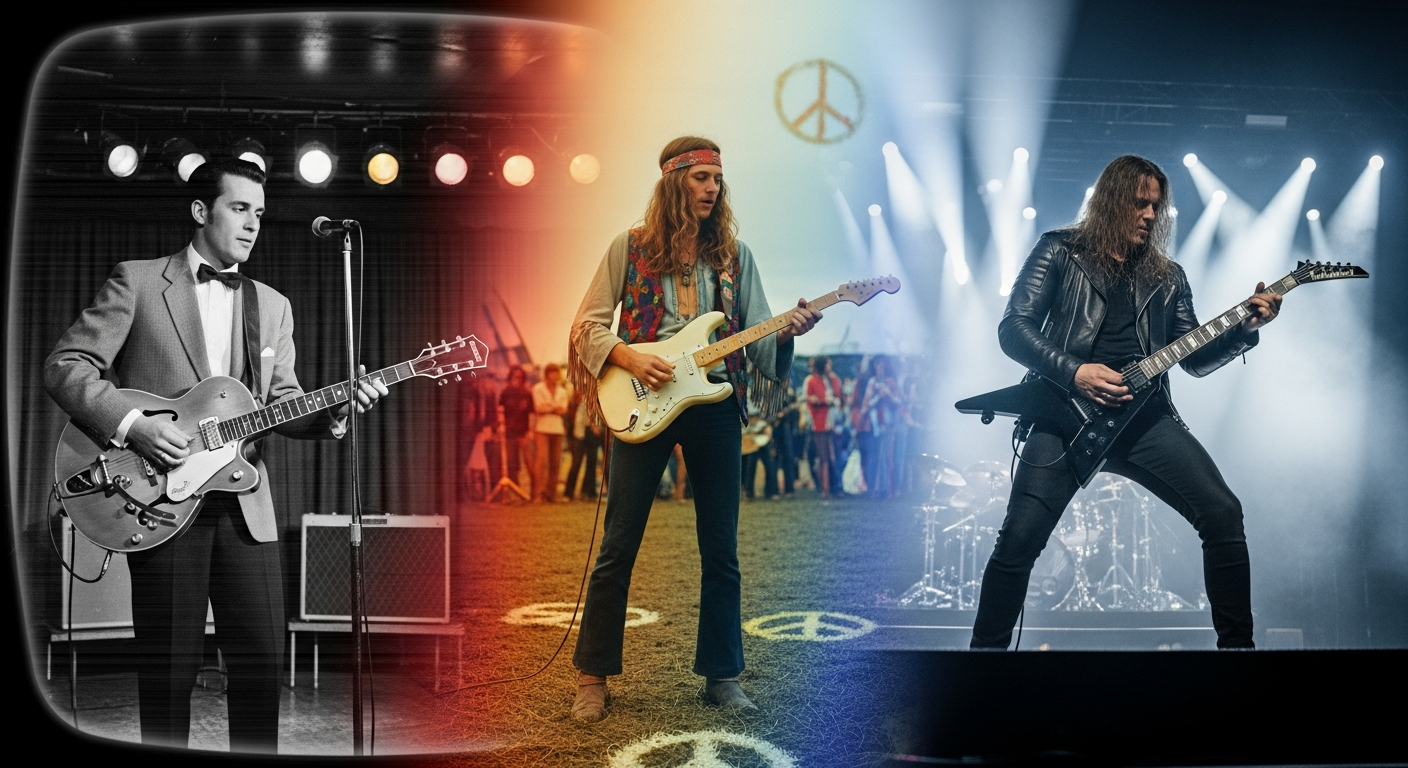
The History of Legendary Guitars: Those That Made Music
When we pick up a guitar, we often don't think about how many men and ideas lie behind that piece of wood and metal. It's not just an instrument. It's a piece of history, a concentration of ingenuity, and, let's face it, sometimes even a little madness. For someone like me, who's spent hours in the garage disassembling and reassembling, trying to understand Why one thing sounds a certain way, the story of these legendary guitars It's almost as fascinating as the sound they produce. I am not an academic, and I don't want to bore you with precise dates and encyclopedic notions. I want to tell you the stories, the strokes of genius, the challenges, and the characters behind what have become true icons. Those guitars that, once you get your hands on them, make you say: “Ok, now I understand”. And maybe, if I managed to understand them and get my hands on them, you can do it too.
Fender: The Clean Sound of the Industrial Revolution


Let's talk about Leo Fender. A name that is practically synonymous with electric guitar for many. A man who was not a luthier in the traditional sense,
he was a virtuoso musician. He was a radio repairman, a technician with incredible practical intelligence and an uncommon entrepreneurial vision. In his shops, Fender Radio Service, between the 1930s and 1940s, Leo didn't just repair, but began building amplifiers and lap steel guitars, very popular instruments at the time. The idea of a solid electric guitar, designed for mass production and with a bright, sharp sound, was revolutionary.
The real breakthrough came in 1950 with the Broadcaster, which in 1951 became the legendary Telecaster. It was a simple, almost spartan instrument: ash or alder body, bolt-on maple neck, two single coil pickups, a functional and “industrial” design. No frills, everything designed to play and last. The bolt-on neck, in particular, was a brilliant move. It allowed for faster production, easy replacement in case of breakage, and a sound with a more decisive attack, a brilliance that Fender himself defined as “twang”. It was the perfect sound for country, blues, and rock ‘
‘ emerging roll. Think of Muddy Waters, Keith Richards, Bruce Springsteen: all have found in the Telecaster an instrument capable of screaming, crying and singing with an unmistakable voice.
But Leo didn't stop. In 1954, he presented the Stratocaster. If the Telecaster was the tireless workhorse, the Stratocaster was the functional work of art. With its softer curves, the body shaped for the guitarist's comfort, and above all, the introduction of three single coil pickups with a three-way selector (later five-way), the Strat offered a range of sounds never heard before. The bright “cluck” of the bridge pickups, the warm and round sound at the neck, and the intermediate positions that created that very particular “quack” sound, loved by people like David Gilmour and Eric Clapton. The vibrato arm, then, added a completely new expressive dimension. The Stratocaster was not just a guitar, it was a platform for creativity, an instrument that invited experimentation.
Fender's philosophy was clear: to create reliable instruments, easy to maintain and with a distinctive sound. This “mass-production” approach made electric guitars accessible to a much wider audience, democratizing music and giving rise to genres that could only be imagined before. For those who love to tinker, Fenders are daily bread: changing a pickup, adjusting the truss rod, fixing the electronics are interventions that anyone with a little patience can tackle. The modular design is a blessing for those who want to customize their instrument.
Gibson: The Sonic Elegance of Craftsmanship


If Fender was the pragmatic technician, Gibson was the aristocrat of wood. Orville Gibson, in the late ‘800s, had a different idea: to build instruments that combined the structure of the violin with that of the mandolin, for superior resonance. This luthier approach was also carried forward with electricity. While Fender focused on mass production and the bolt-on neck, Gibson maintained a more traditional approach for its flagship models, with the glued neck (set neck) and bodies made of denser woods like mahogany.
Les Paul: The Man, the Wizard, the Guitar
One cannot talk about Gibson without talking about Les Paul. Not the guitar model, but the man. A true genius, an inventor, a visionary guitarist who already in the ’40s experimented with solid guitars, long before Leo Fender introduced the Broadcaster. His famous “The Log” was a 4×4 piece of wood with two acoustic guitar wings attached for aesthetics, a solid body to eliminate the feedback of the hollow body guitars of the time. Les Paul wanted sustain and power without compromise.
When Gibson launched its solid body guitar in 1952, it named it, precisely, “Les Paul”. It was a different idea from Fender. Solid mahogany body, often with a carved maple top to add brightness and definition, glued neck (set neck) for greater sustain and warmth. Initially, it was equipped with two P-90 pickups, single coils with a full-bodied and aggressive sound, but also prone to hum.
The Advent of the Humbucker: Goodbye Buzz!
The real breakthrough for the Les Paul (and for the history of the electric guitar in general) arrived in 1957. Seth Lover, a Gibson engineer, invented the humbucker. His mission? To eliminate the hum of single coils, a problem that afflicted many guitarists of the time. The solution was elegant: two coils wound in antiphase, with the magnets arranged to cancel external interference. The result was a pickup that not only eliminated the hum, but also produced a fatter, warmer, more powerful sound, with a higher output and almost infinite sustain. It was Gibson’s answer to Fender’s single coils, designed for more powerful and distortion-laden genres.
From that moment on, the Les Paul with humbuckers became the legendary guitar that we know. That infinite sustain, that fat and powerful sound, that ability to handle distortion without losing definition. Perfect for blues-rock, l’hard rock, metal. Think of Jimmy Page with Led Zeppelin, Slash with Guns ‘ Roses, Gary Moore, Joe Bonamassa. It's the guitar that roars, that makes you feel the power in your hands. When I tried to redo the wiring of an old Les Paul, I understood how much that design, apparently simple, hides a complexity and attention to detail that make it unique. It's not just an object, it's a sound experience.
ES-335 and SG: Variations on the Theme
Gibson didn't stop there, continuing to innovate and offer iconic instruments. In 1958, it introduced the ES-335, a true revolution in the field of semi-hollow body guitars. It combined the best of both worlds: a solid maple center block to reduce feedback, typical of solid bodies, but with the hollow wings of a hollow body to maintain some acoustic resonance and a more airy tone. The result was an incredibly versatile instrument, capable of warm, bluesy sounds as well as more aggressive attacks. It was a bridge between the worlds of Fender and Gibson, an instrument that found its place in jazz, blues, and rock.
Then, in the ’60s, the SG arrived. Born as a replacement for the Les Paul (which at the time wasn't selling very well and was temporarily withdrawn from the market), the SG was a concentrate of aggressiveness and practicality. It was lighter, thinner, with a radical double cutaway that offered unparalleled access to the higher frets. The neck, often thinner and faster than the Les Paul, made it ideal for guitarists seeking agility. Its sound, while retaining the warmth of Gibson humbuckers, was slightly brighter and sharper, thanks to the body's lower mass. Angus Young of AC/DC made it his main weapon, helping to define the sound of hard rock for generations.
Gretsch: The Sparkling Sound of Rockabilly and Beyond
Gretsch is a brand with a fascinating history, less “industrial” than Fender and less “luthier-like” than Gibson, but with a unique charisma and an unmistakable sound. Founded by Friedrich Gretsch in 1883 in Brooklyn, New York, it initially produced banjos, drums, and mandolins. It was when his son Fred Gretsch took the reins of the company that Gretsch ventured into the world of electric guitars, but with its own very specific vision, far from the beaten paths of its competitors.
Hollow Body and Filter'Tron: “That Great Gretsch Sound”
The Gretsch guitars they were (and are) primarily hollow body or semi-hollow, often with large and voluminous bodies, reminiscent of acoustic guitars. This made them perfect for a rich, resonant sound, with a pronounced acoustic character and natural sustain. But the real secret, beyond the bold and often sparkling design, lay in the pickups. The Filter’Tron pickups, introduced by Ray Butts in 1957 for the Gretsch 7570 “White Falcon”, were Gretsch's answer to Gibson's humbuckers and Fender's single coils. Designed to “filter” unwanted hum, they had a unique sound: more “jangly”, brighter and more defined than Gibson's, but with a body and power that distinguished them from Fender single coils. They were less compressed, with a harmonic clarity that made them perfect for genres like rockabilly, country, and surf rock, where note definition and a certain sparkling “twang” were fundamental.
Listen to Eddie Cochran with his Gretsch 6120, Chet Atkins, or Brian Setzer of the Stray Cats. That sound, clean but with a distinctive “twang”, that brilliance that cuts through the mix, is pure Gretsch. It's the sound that makes you want to put on an orchestra and dance, a sound full of energy and joy. The Gretsch was not just an instrument, it was a statement of style.
Style and Personality: Not Just Sound
Gretsch weren't just about sound; they were also about aesthetics. Classic models like the 6120, the 1958 Duo Jet, or the White Falcon, were true jewels. Flashy colors like l’Orange Stain, Cadillac Green, Candy Apple Red, elaborate bindings, conspicuous arrow or swan-shaped inlays, gold or polished chrome hardware. They were instruments that stood out, that had a strong visual soul. They weren't guitars for those who wanted to go unnoticed, but for those who sought a strong personality, a precise identity, an instrument that reflected their character on stage. When I held a Gretsch 6120 in my hands, I understood that it's not just a guitar. It's a statement. It's an instrument that invites you to play in a certain way, with a certain type of energy and stage presence. And there's nothing wrong with that! In fact, it's beautiful.
Rickenbacker: The Precursor and the British “Jangly” Sound
The history of Rickenbacker is that of an absolute pioneer in the field of electric guitars. Born in the 1930s as "Electro String Instrument Corporation" in Los Angeles, it was among the very first companies to mass-produce electric guitars, distinguishing itself through innovation and design. Their first creation, the "Frying Pan" (pan), designed by George Beauchamp and produced by Adolph Rickenbacher (who later simplified his surname to Rickenbacker), is considered the first solid-body electric guitar in history. A museum piece, certainly, but one that paved the way for everything else, demonstrating the potential of electrification.
The Rickenbacker Sound: Brilliance and Definition
In the ’50s and ’60s, Rickenbacker established itself with a unique design and an immediately recognizable sound. Their pickups, often single coil with a particular design (the famous “Toaster” for early guitars and the later “Hi-Gain” for ’60s models), produced a bright, very defined sound, with a strong presence of mid-highs and a sharp attack. They were not as powerful as Gibson's humbuckers,
they were as round as some Fender single coils, but they had a clarity and transparency that made them perfect for rock ‘
‘ melodic roll, pop-rock and, above all, to create that distinctive sound that would define an era.
The 12 Strings and the Beatles
The true explosion of popularity for Rickenbacker came with the Beatles. John Lennon, Paul McCartney, and George Harrison were among the first to adopt these innovative instruments. It was George Harrison, in particular, who with his 12-string Rickenbacker 360/12, purchased in 1964, created that “jangly” 12-string guitar sound that became iconic for the British Invasion. That guitar, with its wider neck to accommodate the additional strings and bright Rickenbacker pickups, produced a sound so rich in harmonics, so shimmering and full of natural reverb, that it defined the atmosphere of songs like “A Hard Day’s Night”, “Ticket to Ride”, and “If I Needed Someone”. It was the antithesis of the dirtier, bluesier sound of Gibsons. It was clean, melodic, almost ethereal, a sound that seemed to come from another world. When one thinks of a Rickenbacker, especially a 12-string, one almost always thinks of that unmistakable timbre.
For a hobbyist who wants modify a guitar, studying Rickenbacker pickups is an excellent training ground. Understanding how a different design, such as the arrangement of the coils or the shape of the magnets, can radically influence the timbre is fundamental. And maybe, one day, try to replicate that sound with a DIY project, perhaps using custom pickups or modifying existing ones. Who knows?
The Legacy of the Great Brands: What We Learn Today
These historic guitars They are not just collector's items or instruments for famous musicians. They are the foundations upon which almost all modern electric lutherie is based. Every design choice, every technical innovation, has had an impact on how we play and build our guitars. Understanding the history behind these instruments allows us not only to appreciate them more, but also to make more informed choices when it comes to choosing our next instrument or modifying an existing one.
Bolt-On Neck vs. Set Neck
Let's take the fundamental difference between the bolt-on neck (screwed, typical of Fender) and the set neck (glued, typical of Gibson). This constructive choice has enormous implications for the sound and feel of the instrument.
- Bolt-on: Easier to produce, to replace in case of breakage, and to adjust. It allows for a more “snappy” and brilliant attack, and a sustain that some define as slightly lower but more defined. It is the preferred choice of many DIY luthiers because it simplifies maintenance and modification operations. Great for those who disassemble and reassemble, for those who want to experiment with different necks, or for those looking for that sharp and defined sound typical of Fender.
- Set neck: It offers greater sustain, a warmer, rounder, and more resonant sound. The union between neck and body is stiffer and more direct, allowing for better vibration transmission. Neck repair or replacement is much more complex, requiring interventions from an experienced luthier. The feeling is often perceived as more “premium” and organic. There isn’t an absolute “best”. It depends on the sound you're looking for, the type of music you play, and, let's admit it, your willingness to get your hands dirty. For me, the bolt-on has always been a fantastic starting point for learning the anatomy of a guitar and for making my first modifications.
Pickups: Single Coil vs. Humbuckers
Here too, a choice that has defined entire musical genres and that is central to every modification or construction project.
- Single Coil: Brightness, attack, clarity, definition. Typical of Stratocasters and Telecasters, but also of Rickenbackers and Gretschs (even if Filter’Tron have unique characteristics). Excellent for clean sounds, funk, light blues, surf rock, country. The classic “defect” is the hum at 50/60 Hz, which can be mitigated with adequate shielding or by using “noiseless” pickups (which, however, can slightly alter the original sound). The original sound, with its crystalline harmonics, is unmistakable.
- Humbucker: Power, warmth, sustain, absence of hum. The Gibson trademark, invented by Seth Lover. Perfect for rock, hard rock, metal, more aggressive blues, jazz. The sound is more “fat”, more compressed, less transparent than single coils, but with incredible drive and an ability to handle high distortions without losing cohesion. They exist in infinite variants, from the more “vintage“ and warm to the more modern and aggressive.
When you find yourself choosing pickups for your project, it's not just a matter of “how much they cost” or “what my idol used”. It's a profound tonal choice that will radically change the character of the instrument. And understanding the history behind these innovations helps you make a more informed choice, to know what you are looking for and to identify it.
The Human Context: Visionaries and Artisans
These figures – Leo Fender, Les Paul, Seth Lover, George Beauchamp, Ray Butts – were not just engineers or luthiers. They were visionaries. They were people who saw a problem or an’opportunity and put their brains, hands, and soul into finding a solution. They weren’t afraid to make mistakes, to experiment, to think outside the box. Les Paul spent years in his garage modifying and building prototypes, searching for the perfect sound. Leo Fender, who couldn’t play an instrument, had the incredible ability to listen to musicians, understand their needs, and translate them into practical circuits and forms. This is the spirit of DIY, isn’t it? To try, make mistakes, learn, and improve. Every DIY luthier, in their own way, carries on this legacy of ingenuity and passion.
The Impact of Woods and Construction
In addition to circuits and pickups, the choice of woods and the construction method are fundamental pillars that define the character of a legendary guitar. It's not just a matter of aesthetics or weight; each wood has unique acoustic properties that influence the timbre, sustain, and resonance of the instrument.
The Body: Ash, Alder, Mahogany and beyond
Leo Fender, with his Telecaster and Stratocaster, preferred light and resonant woods like the ash (ash) and thealder (alder). Ash, especially “swamp ash”, is known for its variable density, which translates into a bright sound, with a decisive attack and a good dose of “twang”, especially in the high frequencies. Alder, more consistent in average density, offers a more balanced sound, with present lows, defined mids, and pleasant highs, without ever being strident. These characteristics made them ideal for the clean and defined sound that Fender was looking for.
Gibson, on the other hand, has made of the mahogany (mahogany) its trademark for the bodies of Les Pauls and SGs. Mahogany is a denser and heavier wood, which gives the instrument a warmer, fuller sound, with exceptional sustain and a rich harmonic response in the mid and low frequencies. This makes it perfect for genres that require thickness and “grit”, such as rock and more distorted blues. Often, mahogany bodies were topped with a maple top (maple), a harder and brighter wood, which added definition and bite to the overall sound, creating that tonal combination so appreciated in the Les Paul.
Hollow and semi-hollow guitars like Gretsch and Gibson ES-335 also use specific wood combinations. The hollow wings of Gretsch are often made of maple or laminated maple, contributing to the resonance and “sparkling” character, while the maple center block of the ES-335 helps control feedback and focus the sound.
The Neck: Maple vs. Mahogany
The choice of wood for the neck is equally crucial. As we mentioned, Fender uses almost exclusively maple (maple) for the necks, often with a maple or rosewood fretboard (rosewood). Maple is a hard and dense wood that contributes to the brightness and attack of the instrument. Its rigidity is ideal for bolt-on construction, ensuring tuning stability and good vibration transmission.
Gibson, instead, has traditionally used the mahogany for the necks, paired with rosewood fingerboards. Mahogany, with its softer and more resonant nature compared to maple, contributes to the warmth and sustain of the instrument. The union between a glued mahogany neck and a mahogany body creates a more homogeneous and deep resonance, which many associate with the “Gibson sound”.
The Importance of Luthierie and “Set-up”
Beyond the woods and components, the care in construction and in the so-called “set-up” (the fine adjustment of the instrument) makes a huge difference. The precision in the neck’s setting, the fretwork, the string height, the intonation of the bridge saddles: all these details, which are often overlooked in low-end guitars, are essential for making an instrument sound its best. A legendary guitar it is not only the result of great ideas, but also of impeccable execution.
For DIY enthusiasts, adjusting the set-up is one of the most rewarding ways to improve a guitar. Learning to adjust the truss rod to achieve the ideal neck relief, setting the action (string height) to find the right balance between comfort and sustain, and ensuring perfect intonation: these are all operations that, with a little patience and the right tools, anyone can learn to do. And the satisfaction of hearing your guitar play better after working on it is priceless.
From Iconic Guitars to DIY Projects
The history of the legendary guitars it offers us a valuable perspective not only on the music we love, but also on the practice of restoring, modifying, and building guitars. Every innovation, every design choice, every technical compromise has been made to achieve a certain type of sound, a certain feel, a certain reliability.
Understand to Improve
Knowing the differences between a Telecaster and a Les Paul, or between a single coil pickup and a humbucker, is not just general knowledge. It gives you the tools to understand what you're looking for when choosing a guitar, or what you want to achieve when you decide to modify one. Do you want that bright, defined sound for country? Perhaps a Telecaster or a Stratocaster with single coils is for you. Are you looking for that warm, powerful sound for rock? A Les Paul with humbuckers might be the answer.
But it doesn't end there. The beauty of DIY is that you can mix things up. An experienced hobbyist might decide to put humbuckers in a Telecaster (as some blues and rock artists did in the past), or to install single coil pickups in a Les Paul to get a more vintage and bluesy tone. These modifications, which might make purists cringe, are the beating heart of creativity and innovation in the world of guitars.
The “Inspired” Project Challenge
When I start working on a project, I often start with an’idea inspired by one of these historic guitars. Maybe I want to replicate the sound of a certain song, or get a similar feeling to that of an instrument I heard played live. Sometimes, I start with an inexpensive guitar, completely disassemble it and rebuild it piece by piece, choosing components that remind me of iconic models. Changing the pickups, replacing the potentiometers, installing a new bridge, or even repainting the body with a color that recalls a famous model. Every step is a tribute to those men who created these incredible instruments.
I still remember the first time I tried to install a set of humbucker pickups on a guitar that previously had single coils. It was an old beat-up guitar, and the idea was to give it a more “rock” sound. The operation wasn’t very simple: I had to slightly enlarge the body cavities and do new wiring. But when I plugged in the amplifier and heard that fuller, more powerful sound, with a sustain that wasn’t there before… well, it was an enormous satisfaction. I realized that with my own hands I could truly change the character of an instrument, directly inspired by those who had made history.
The Importance of Research
My advice, if you feel inspired by these stories, is to continue researching. Don't stop at what I've written. Read books, watch documentaries (there are beautiful ones on Fender, Gibson and great guitarists), explore online forums dedicated to lutherie and guitars. Every additional source will give you an extra piece of the puzzle. And above all, listen to a lot of music, trying to understand which instrument and which combination of components gave life to that sound that excites you.
The history of the legendary guitars It's a living story, which continues to evolve. And you, as an enthusiast and perhaps as a future builder or modifier, can be part of it. You don't have to be a professional luthier to understand these wonderful machines. All it takes is a bit of curiosity, a lot of passion, and the desire to get your hands dirty.
Practical Advice for the Enthusiast
If these stories have sparked an idea for you and you feel inspired to learn more or to get your hands on your guitar, here are some practical tips to delve deeper and experiment:
-
Listen actively: Take an iconic song played with a Strat (e.g. “Sultans of Swing” by Dire Straits), then one with a Les Paul (e.g. “Whole Lotta Love” by Led Zeppelin), one with a Gretsch (e.g. “Rock This Town” by Stray Cats) and one with a Rickenbacker (e.g. “A Hard Day’s Night” by Beatles). Try to isolate the guitar tone. Do you notice the differences we described in terms of brightness, body, sustain, attack? This exercise trains your ear to recognize the sonic characteristics of different instruments.
-
Visit a store: If you have the chance, go to a well-stocked instrument store and ask to try iconic models or their derivatives. You don't have to buy them, but feeling the differences under your hands is priceless. Note the weight, the shape of the neck (C, U, V profile?), the response to the attack, the general feeling. How does a Telecaster compare to a Stratocaster? And a Les Paul Standard with an SG? These direct experiences are fundamental.
-
Dismantle and study: If you have a “beater” guitar or an instrument you're not afraid to disassemble, try doing it. Study how the pickups are made, how the electronics are wired (potentiometers, capacitors, selector switch), how the neck is attached. Understanding the mechanics will give you a completely new perspective. There are a lot of diagrams online, like those from Seymour Duncan or DiMarzio, that show you the wiring of hundreds of models. Also look for video tutorials on YouTube, they are a goldmine.
-
Experiment with pickups: If you have a guitar you can tinker with, try changing the pickups. It's one of the modifications that most impact the sound. It doesn't have to be an expensive operation: even mid-range pickups or well-made clones can give you a clear idea of how a different type of magnet or a different winding can radically transform the sound of your instrument. You can switch from single coil to humbucker, or vice versa, or replace a humbucker with another of different impedance or output. The important thing is to understand the sonic result.
-
Search for woods: Every legendary guitar is built with specific woods that contribute enormously to its sound. Ash and alder for Fender bodies, mahogany for Gibson bodies, maple for the tops and necks of many guitars. Delve deeper into the acoustic properties of these woods: how they influence sustain, brightness, warmth. This will help you understand why a certain combination of woods sounds a certain way.
The story of these historic guitars it teaches us that there is no magic formula, but a path made of intuitions, trials and errors, often guided by passion and the need to express new musical ideas. And the most beautiful thing is that this journey is not over. Every time a hobbyist goes into the garage to build or modify his guitar, he adds a small piece to this infinite story of innovation and creativity. And you, are you ready to write a piece of it?
Frequently Asked Questions
What is the main difference between a Fender and a Gibson guitar?
The main difference lies in the construction and pickups. Fender (like Stratocaster and Telecaster) typically use lighter woods such as ash or alder, bolt-on maple necks, and bright single-coil pickups. Gibson (like Les Paul and SG) often use denser woods such as mahogany, set necks, and more powerful and warmer humbucker pickups. These choices significantly influence the sound and feel of the instrument.
Can I really get a “legendary” sound by modifying a cheap guitar?
Absolutely yes! While the basic materials and construction of an inexpensive guitar might have limitations, by modifying the pickups, the electronics, and perhaps taking care of the lutherie (such as fret filing or neck adjustment), you can get very close to the sound of more expensive instruments. The goal of DIY is not to replicate exactly, but to understand the principles and customize the sound according to your own tastes.
For further technical details you can consult this external resource.
Download the Luthier Survival Kit
Free PDF with checklist, problem-cause table and project card template.
 English
  Italiano
Stuck on your build?
If you ran into the same problem or have a question, drop it in the comments. I read and reply to every one.
Write a comment