

Guitar Pickup Wiring: 3 Essential Diagrams
Have you ever looked at the electronics compartment of a guitar and felt like you were standing in front of a Picasso painting? Wires everywhere, shiny or matte solder joints, components that look like they came from a space lab. "Impossible," you think, "this needs an electronics engineer." But no. I'm telling you, at first, a soldering iron in my hand felt like a surgeon's torch and a scheme of wiring electric guitar pickups a dead language.
But you know what? If I did it, and I made mistakes countless times before I figured it out, you can do it too. Guitar electronics, in the end, aren't as complicated as they seem. It's just a matter of understanding three or four basic concepts, having a little patience, and not being afraid to try again if the first try doesn't work. And trust me, it will happen.
This article isn't about giving you all the answers, but about giving you the tools to find them. I'll walk you through the three most common wiring diagrams, the ones that practically every electric guitar starts with. Understanding these gives you the foundation to tackle almost everything else. I'll give you not just the "how," but also the "why," because knowing what you're doing and why makes you a garage luthier, not just an assembler.
Get your soldering iron, your solder, and maybe a nice cup of coffee ready. Let's go.
Circuit Basics: It's Not Black Magic, I Assure You


Before we get our hands on the soldering iron, we need to take a step back. Don't worry, I'm not asking you to study Kirchoff's principles or Ohm's law (although a smattering of them never hurts). I just want you to understand what's behind those wires, potentiometers, and capacitors. I assure you, once you have the big picture in mind, every connecting the pickups it will make much more sense.
Imagine your guitar as a small plumbing system. The pickup is the pump that generates the signal, the water that flows. The potentiometers are taps that regulate the flow (volume) or change its "temperature" (tone). The switch is a diverter that decides which pump to draw water from. The jack is the drain pipe that carries the water to the amplifier. And the capacitor? Well, that's a little more complicated, but we'll get there.
The Fundamental Components: Who Does What
Pick-up: It's the heart of the sound. It transforms the vibrations of the strings into an electrical signal. Every pickup has at least two wires: the "hot" wire, which carries the signal, and the "ground" wire, which serves as a reference and eliminates noise.
Potentiometers (Pots): These are variable resistors. The volume ones adjust the signal's amplitude, while the tone ones filter it. Typically, values of 250kOhm (for single coils) or 500kOhm (for humbuckers) are used. We'll see the "reason" for this difference shortly.
Switch (Selector): It allows you to choose which pickup or combination of pickups to send to the circuit. They can have 3, 5, or more positions. It's sort of the "brain" of the tone selection system.
Capacitors (Caps): These are the "wizards" of tone. In guitar circuits, tone capacitors serve to "ground" high frequencies. The higher the capacitor value, the more high frequencies will be cut. The most common values are 0.022uF (microFarad) or 0.047uF.
Output Jack: The connector where you plug the cable going to the amplifier. It has two main contacts: the tip for the "hot" signal and the sleeve for ground. It's the final point of the guitar circuit.
Massa: The Silent (and Anti-Noise) Hero
There mass (or ground) is perhaps the most important and often overlooked concept in wiring. Think of ground as fertile soil in a garden: without it, nothing grows well. In an electrical circuit, ground is the zero-potential reference point. All signals are measured relative to this point.
Good grounding is essential for two reasons:n1. Signal stability: Ensures that the “hot” signal has a stable reference.n2. Noise reduction: Shielding and grounding are your primary defense against hum, buzz, and interference. Everything metal on the guitar (bridge, strings, tuning machines, cavity shielding) should be grounded to conduct unwanted noise.
The first time I built a guitar from scratch, I remember it had a hellish hum. I redid all the connections three times, changed cables, even tried a different amp. Ultimately, the problem was a small ground wire that wasn't making good contact on the bridge. A lesson learned the hard way, but one that taught me to respect every single ground point.
Welding: It's Not an Exam, It's Skill
Soldering scares many people. They see the hot iron, the dripping solder, and they think it's a delicate operation. In reality, soldering is a skill learned through practice. You don't need to be a master, you just need to be clean and precise.
Quick soldering tips: Right welder: A 30-40W soldering iron is perfect for guitar electronics. The tip should be clean and tinned (clean means free of oxide, tinned means with a thin layer of molten solder).
Quality pond: Use flux-cored solder (usually 60% tin, 40% lead, or lead-free solders specifically designed for electronics).
Clean and prepare: Always clean the parts to be soldered. If they are oxidized, scrape them lightly. Pre-tin any exposed wires.
The “sandwich”: Place the tip of the soldering iron on the contact point (e.g., a potentiometer terminal). Place the solder between the tip of the soldering iron and the terminal. The molten solder should "hug" the wire and the terminal. Don't heat for too long; 2-3 seconds is enough.
Cold welding: If the solder is dull, grainy, and looks like a small ball, it's a cold solder. Redo it. It should be shiny and form a "mound" that encases the wire well.
Reading the Patterns: The Treasure Map
A electrical diagram It may seem like a maze, but it's just a map. Guitar schematics are usually very practical. They often use simplified icons for components and lines for wires.
Threads: The black or colored lines represent the wires. Sometimes they are dashed to indicate ground.
Junction points: A black dot where the wires cross indicates a connection. If the lines cross without a dot, they "jump" each other without connecting.
Components: Each component has its own symbol. Potentiometers are a circle with three terminals, capacitors are two parallel lines, and pickups are a rectangle.
Don't be afraid to trace the path of each wire, mentally or with a pencil. From the pickup to the pot, from the pot to the switch, from the switch to the jack. Each piece has its place, and each wire its path. It's like assembling an IKEA piece of furniture, but with more attention to detail.
Basic Schematic 1: The Simple Single Coil (Telecaster Style)
Let's start with a classic, the simplest yet most effective circuit imaginable. It's the basis of many single-pickup guitars, like certain Telecasters or minimalist blues guitars. Understanding this opens your mind to how signal flow works.
Imagine having a guitar with:
A single single coil pickup (for example, in the bridge).
A volume potentiometer.
A tone potentiometer.
An output jack.
That's it. No complicated switches, no push-pull. Pure and simple.
Specific Components and Why
For this setup, we will use:
250k Ohm Potentiometers: For single coils, 250k is the standard. The reason is simple: single coils tend to be brighter (have higher frequencies) than humbuckers. A 250k pot offers a higher resistance than a 500k one, which means it "drains" a little more high frequencies to ground. The result? A sweeter, less shrill sound, which complements the inherent character of the single coil. If you were to use a 500k pot with a single coil, you might find it too bright.
0.022uF capacitor: This is the most common value for tone control on almost all guitars. When you turn the tone knob, this capacitor begins to "roll off" the high frequencies, making the sound darker. 0.022uF offers a good range of control, allowing you to go from a bright sound to a warmer, more muted one.
The Signal Path: Step by Step
Here's how it all connects, following the signal flow:
1. From Pickup to Volume: The pickup's "hot" wire (often black or white) should be soldered to the input terminal of the volume pot. This is usually the center terminal or one of the side terminals, depending on the type of pot (linear or logarithmic) and how you look at it. For clarity, imagine soldering it to the left terminal (if you look at the pot with the pins facing you).
The pickup's ground wire (often green or bare) should be soldered to the body of the volume pot. This is the primary ground point.
2. From Volume to Tone and Jack: The center terminal of the volume potentiometer (the one that regulates the output signal) must be connected with a wire to the input terminal of the tone potentiometer (again, usually a side terminal).
From this same central volume terminal, another wire runs to the “tip” terminal of the output jack.
3. The Tone Circuit: The 0.022uF capacitor has two terminals. One terminal is soldered to the center terminal of the tone potentiometer.
The other terminal of the capacitor is soldered to the body of the tone potentiometer. This connects the capacitor to ground, completing the high-frequency cutoff circuit.
The body of the tone pot also needs to be grounded, usually with a wire running from it to the body of the volume pot, or directly to the output jack (sleeve).
4. The General Mass: The output jack's "sleeve" terminal is the final ground. All ground points (pot bodies, pickup ground wires, shields) must converge here.
Don't forget to connect a ground wire from the volume pot body to the guitar's bridge. This is crucial for reducing hum and grounding the strings.
The first time I wired a homemade Telecaster, I'd done everything right, but the sound was a constant, annoying hum. I checked and rechecked, and finally, using a tester, I discovered that the wire connecting the volume pot to the bridge wasn't soldered properly. A rookie mistake, but it taught me the importance of every single ground connection. It seems trivial, but ground is your best friend against noise.
Practical Tips for this Pattern
Shielding: To further reduce noise, you can shield the electronics cavities with conductive paint or copper/aluminum tape. Make sure the shield is connected to the circuit's general ground.
Quality cables: Use shielded cables for longer connections, especially from the pickup to the potentiometers. This helps prevent interference.
Patience: Don't rush. Check every solder, every wire. A continuity tester is your best friend for verifying that every connection is secure and there are no short circuits.
Basic Diagram 2: The Humbucker with Volume and Tone (Les Paul Style Basic)
Let's move on to another pillar of guitar electronics: the humbucker. This type of pickup was created to solve the hum problem of single-coil pickups, hence the name "hum-bucker" (literally "hum-killer"). Its basic circuit is very similar to that of the single-coil pickup, but with some key differences in component values.
Imagine you have:
A single humbucker pickup.
A volume potentiometer.
A tone potentiometer.
An output jack.
It's the typical setup of many "minimalist" rock guitars or the basic circuit of a Les Paul before adding the second pickup and independent controls.
Specific Components and Why
For a humbucker, the values change slightly:
500k Ohm Potentiometers: This is the main difference compared to single coils. Humbuckers, having two coils in series and a higher inductance, tend to sound "darker" and with a more compressed frequency response than single coils. Using 500kOhm pots allows you to preserve more high frequencies, giving the sound greater "openness" and brightness. If you used 250kOhm pots, the humbucker might sound too dark.
0.022uF or 0.047uF capacitor: Again, 0.022uF is a great starting point. Some prefer 0.047uF for more drastic tone control and even darker sounds. The choice is often a matter of personal taste and the type of sound you're looking for. I usually start with 0.022uF, and if I want more darkness or a wah-like effect with the tone, I try 0.047uF.
Humbucker Cables: A Small Detail Not to Underestimate
Humbuckers can have different types of wiring:
2 conductors: The simplest. A "hot" wire and a ground/shield wire. Similar to a single coil.
4 conductors (+ ground): This is the most versatile type. It has four wires, one for each start and end coil, plus a ground/shield wire. These allow for modifications like coil splitting (making the humbucker sound like a single coil) or phase switching. For this basic schematic, we'll use only two of these wires (usually the two that connect the coils in series, and the other two are soldered and insulated, or grounded).
For our electric guitar pickup wiring diagram For a humbucker setup, let's say you have a 2-conductor pickup, or a 4-conductor one already configured in series (usually a "hot" wire and a ground wire, while the other two are already connected and insulated or connected to the pickup's ground). Always check your pickup manufacturer's instructions!
The Signal Path: Step by Step
The wiring is almost identical to the single coil, but with different potentiometer values:
1. From Pickup to Volume: The “hot” wire of the humbucker should be soldered to the input terminal of the volume pot (e.g. left terminal).
The humbucker ground wire (and the pickup shield ground, if present) should be soldered to the body of the volume pot.
2. From Volume to Tone and Jack: The center terminal of the volume potentiometer should be connected with a wire to the input terminal of the tone potentiometer (e.g. side terminal).
From this same central volume terminal, another wire runs to the “tip” terminal of the output jack.
3. The Tone Circuit: One lead of the capacitor (0.022uF or 0.047uF) should be soldered to the center terminal of the tone potentiometer.
The other terminal of the capacitor should be soldered to the body of the tone potentiometer.
The body of the tone potentiometer must be connected to ground (to the body of the volume potentiometer, or directly to the jack sleeve).
4. The General Mass: All ground points converge at the “sleeve” terminal of the output jack.
Remember the ground wire from the body of the volume pot to the bridge of the guitar.
Once, while working on a guitar with a single humbucker, I found myself with a strangely weak sound and no sustain. I checked the solder connections, and they all seemed fine. Then it hit me: I'd used a 250k potentiometer I had in the drawer, thinking "any pot is as good as any." I replaced it with a 500k, and the guitar roared back to its original sound. Small details, big difference.
Practical Tips for this Pattern
Pickup Orientation: Humbuckers have a specific orientation. Make sure the side with the screws or adjustable pole pieces is positioned correctly (usually toward the bridge for a bridge pickup, and toward the neck for a neck pickup, but this isn't a hard and fast rule and depends on the pickup design).
Multi-Conductor Cable Management: If your humbucker has 4 conductors, consult the electric guitar pickup wiring diagram supplied by the manufacturer. Usually, two wires are joined and insulated (to connect the coils in series), one is the "hot" wire and one is the ground wire. Don't improvise, or you may end up with a weak or nonexistent sound.
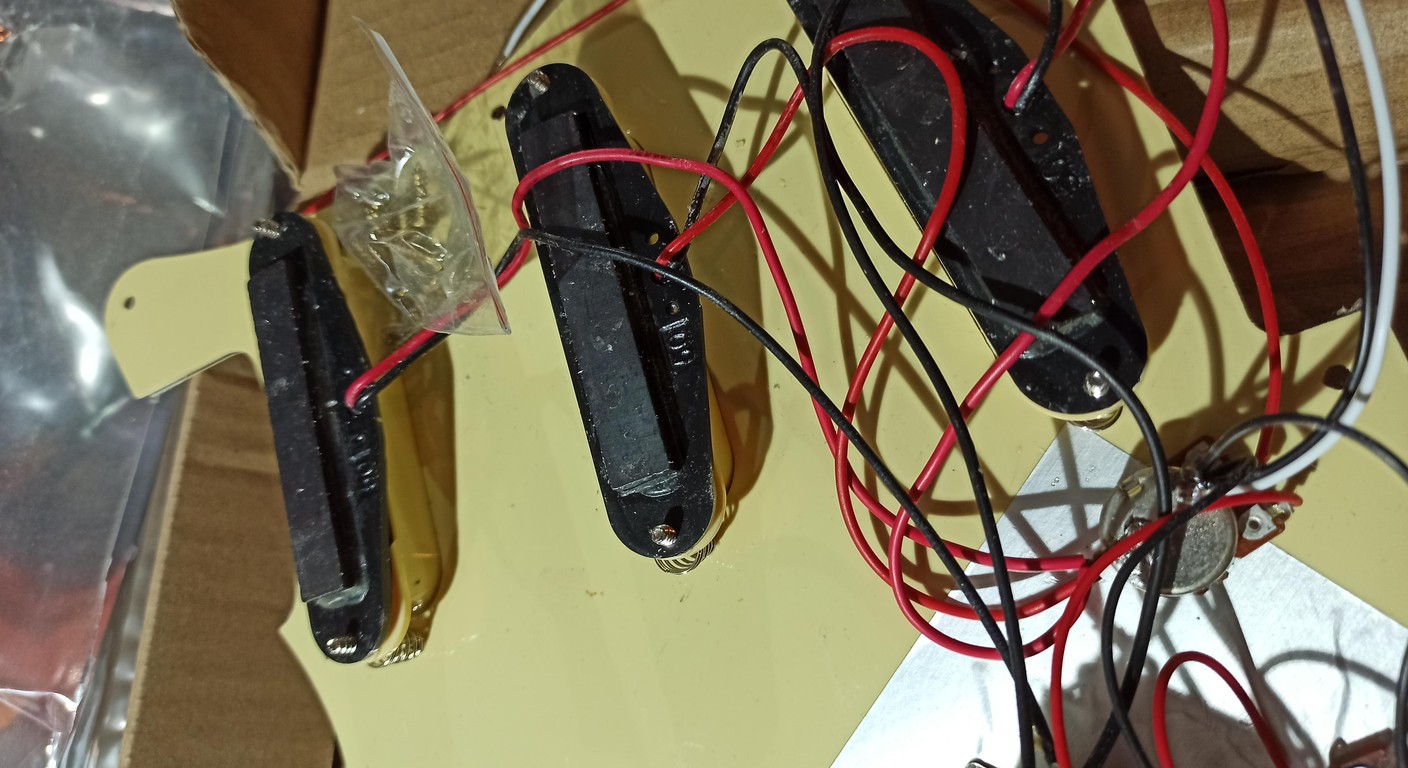
Essential Schematic 3: Three Single Coils with 5-Way Switch (Stratocaster Style)
Here's the king of single-coil wiring, the standard that has defined the sound of generations of guitarists: the three-single-coil circuit with a five-way selector switch. This is a bit more complex than the previous ones, because it introduces the concept of a single switch that manages multiple signal sources.
Imagine you have:
Three single coil pickups (neck, middle, bridge).
A potentiometer for the master volume.
Two tone pots (usually one for the neck and one for the middle).
A 5-way switch (selector).
An output jack.
This is the classic Stratocaster setup, a true test of your wiring skills.
Specific Components and Why
250k Ohm Potentiometers: As with the single coil scheme, 250kW is the standard here too to maintain a balanced and not too bright sound.
0.022uF Capacitors: Two capacitors, one for each tone pot, both 0.022uF, for the same reason explained before: to provide versatile tone control.
5-Way Switch: This is the most intimidating component. A 5-way guitar selector switch typically has 8 solder terminals (two rows of 4, or 4 per side). It works by wiring the pickups differently depending on the position. The 5 positions select:
1. Bridge pickup 2. Bridge + Middle (in parallel)
3. Central Pickup 4. Middle + Neck (in parallel)
5. Maniconn PickupsThe middle positions (2 and 4) are the most interesting, because they put two pickups in parallel and, if the pickups are reverse polarity, they can also cancel hum (hum-cancelling) creating a cleaner, “quackier” sound.
The Signal Path: Step by Step
This electric guitar pickup wiring diagram requires a little more attention to the switch.
1. From Pickups to Switch: Every single coil pickup has a “hot” wire and a ground wire.
The "hot" wires of the three pickups (neck, middle, and bridge) should be soldered to the input terminals of the 5-way switch. Each terminal corresponds to a specific pickup. Follow the wiring diagram for your switch carefully; there are usually three terminals for each pickup.
2. From Switch to Volume: The 5-way switch has one or two "common" output terminals that collect the selected signal. These terminals are joined together (if there are two) and then connected with a wire to the input terminal of the volume pot (e.g., the left terminal).
3. From Volume to Tone and Jack: The center terminal of the volume pot goes to the “tip” terminal of the output jack.
From this same central volume terminal, a wire also runs to the input terminal of the first tone potentiometer (e.g. left tone terminal for the neck).
Another wire runs from the input terminal of the second tone pot (e.g., the left tone terminal for the middle pickup). This wire goes to the input terminal of the middle pickup on the selector switch, or to the input terminal of the neck pickup on the switch, depending on which tone you want to control. The classic configuration is tone 1 for the neck pickup, tone 2 for the middle pickup.
4. The Tone Circuits: Tone 1 (for neck pickup): One lead of the capacitor (0.022uF) should be soldered to the center lead of the tone 1 potentiometer. The other lead of the capacitor should be soldered to the body of the tone 1 potentiometer.
Tone 2 (for middle pickup): One lead of the capacitor (0.022uF) should be soldered to the center lead of the tone 2 potentiometer. The other lead of the capacitor should be soldered to the body of the tone 2 potentiometer.
The tone pot bodies must be connected to ground (to the volume pot body, or directly to the jack sleeve).
5. The General Mass: All pickup ground wires, potentiometer bodies, and shields converge at the output jack “sleeve” terminal.
The ground wire from the volume pot body to the bridge is always critical.
The 5-way selector made me sweat the first time I used it. It looked like a spider with too many legs, and the wires crossed strangely. I remember printing out the full-size schematic, placing it under the selector, and soldering one wire at a time, checking each connection. It wasn't quick, but eventually, the sound was there, clean and powerful. Don't underestimate the power of a visual checklist!
Practical Tips for this Pattern
Tone for the Bridge: In "vintage" Stratocasters, the bridge pickup doesn't have a tone control. Many modern guitarists find it inconvenient not to be able to "tone down" the bridge pickup's brightness. A common modification is to wire tone 2 (the middle pickup) so that it also controls the bridge pickup. This is usually done by connecting the input wire of the tone 2 pot not only to the middle pickup, but also to the bridge pickup's input terminal on the switch.
Check the Phase: If the sound is weak and "nasal" in the intermediate positions (2 and 4), the pickups may be out of phase. This means the "hot" wire and the ground wire of one of the pickups are reversed. Simply swap them for that pickup.
Detailed Diagrams: For the 5-way selector, it is almost mandatory to consult one electric guitar pickup wiring diagram specific and detailed from the manufacturer of your switch (e.g., Fender, CRL, Oak Grigsby). Each brand may have a slight variation in the layout
