

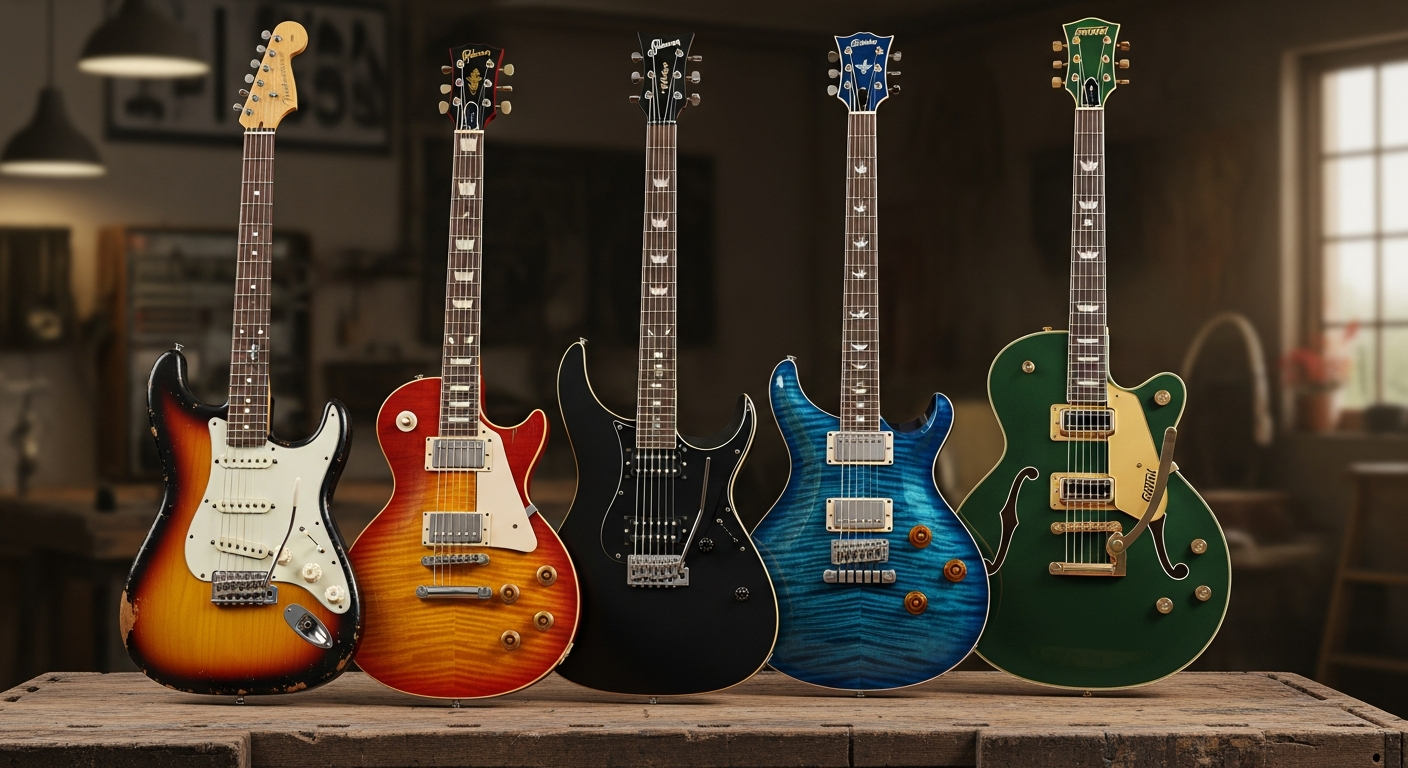
Affordable electric guitar: How much does it cost? The 3 best
When talking about guitars electric, especially if one is a beginner or has a limited budget, the question is always the same: how much does an affordable electric guitar cost that is decent? I don't mean a toy, but an instrument on which you can learn, have fun and maybe, why not, get your hands on it to make it sound even better. I'll tell you one thing right away: I also started with an inexpensive guitar. In fact, I've had several. And I'm not ashamed to say it, some of the most useful things I know about DIY electric lutherie I learned precisely by disassembling and reassembling those workhorse guitars. I discovered what works, what breaks immediately, and above all, where it's worth investing a little money for an upgrade. If I succeeded, with a bit of patience and some garage tools, you can too. In this article, we are not looking for the perfect guitar – that doesn't even exist among models costing thousands of euros. We are looking for the best compromise for those who want to start without breaking the bank, or for those looking for a solid base on which to experiment, perhaps for a project of guitar modification. I will give you my vision, based on years of “hands-on experience”, on what to expect and which models, in my opinion, offer the best value for money on the current market.
How much does a cheap electric guitar really cost? Let's clarify
The concept of “economical” is elastic, especially in the world of musical instruments. What for some is a bargain, for others could be a considerable investment. Let's try to define realistic price ranges for a low-cost electric guitar.
Tier 1: Less than 150 euros (The bet)
In this category, we often find “starter packs” that include a guitar, tiny amplifier, cable, and picks. The idea is tempting, but the reality is that the build quality can be very variable. These are often instruments with very cheap woods, basic hardware, and pickups that do their job, but are neither good nor bad. Most of the time, the greater attention goes to the aesthetic finish rather than to playability. Don't get me wrong, I have seen and tried some of these guitars that, with a good setup and some small modifications, could become decent instruments. But it's a gamble, and almost always requires immediate intervention to be playable.
Band 2: 150 – 300 euros (The right compromise)
This è the range where, in my opinion, you start to find a real value for money for an electric guitar. Here, the most well-known brands, like Squier (Fender's sub-brand) or Yamaha, offer entry-level models that are designed to be playable right away. The woods are still in the economic range, but their selection è more refined. The hardware è more robust, and the tuners hold tuning better. Often, the pickups are designed to give an acceptable and versatile sound. In this range, you'll find instruments that not only allow you to learn without frustration, but can also be an excellent base for future upgrades. È here that most guitarists start.
Range 3: 300 – 500 euros (The affordable you don’t expect)
When you exceed the 300 euro threshold, we enter a territory where the term “economical” starts to sound a bit off, but it’s here that true gems are found. These guitars often offer a build quality and components that sometimes border on the mid-range. We find better woods, more stable necks, more precise fretboards, and more reliable hardware. The pickups, while not “boutique”, are often well-balanced and have good character. These are instruments that can accompany a guitarist well beyond the initial phase, even in live or studio settings. They represent a smart investment for those who want something more than a simple beginner guitar, but don't yet want to spend significant amounts.
Why do prices vary so much?
Several factors influence the cost of a cheap electric guitar.
- Woods: The type and quality of wood used for the body and neck are crucial. Exotic or seasoned woods cost more. In economic models, woods like poplar, agathis, basswood, or maple are used for the necks.
- Hardware: Tuners, bridge, nut. Superior quality components (e.g. locking tun tuners, stable two-pivot bridges) increase the price, but improve stability and intonation.
- Electronics and Pickup: Pickups are the heart of the sound. Branded pickups with quality magnets (Alnico V, well-designed ceramic) cost more than generic pickups. Potentiometers and switches also play a role.
- Labor and Quality Control: Guitars produced in countries with lower labor costs and less stringent quality control processes can be sold at lower prices.
- Brand: The brand name has its weight. A Squier will have a different base price than a Fender, despite being produced by the same company.
What to look for in a cheap electric guitar: My garage checklist
When you evaluate a entry-level electric guitar, don't be fooled by appearances alone. There are crucial details that make the difference between a frustrating tool and one that will accompany you for years.
The Neck and the Fretboard
This is the most important point, in my opinion. A stable neck and a well-made fretboard are fundamental for playability.
- Stability: The neck must be straight and the truss rod (the internal metal bar that adjusts its curvature) must function correctly. A crooked neck or one with a blocked truss rod makes the guitar unplayable.
- Keys: Check that the frets are well leveled and finished at the edges. Protruding or sharp frets can make playing uncomfortable and cut your fingers. Good leveling is rare in cheap guitars, but essential for low action.
- Action: The height of the strings from the fretboard. A good action,
é too high (difficult to play)
is too low (frustrating for the buzz), is a sign of a good initial setup or a potential for a good setup.
Pickups: The Heart of the Sound
In cheap guitars, pickups are often the first component one looks at for an upgrade. However, even stock, they must do their job.
- Type: Single coil for bright and defined sounds (Stratocaster, Telecaster) or humbucker for fuller and more powerful sounds (Les Paul). Consider the musical genre you intend to play.
- General sound: Even if they won't have the depth or dynamics of expensive pickups, they must sound clean, without excessive hum (apart from the normal single coil hum) and with a decent volume.
The Hardware: Functionality and Durability
Machine heads and bridge are crucial for tuning stability and intonation.
- Mechanics (Tuners): They must turn smoothly and hold the tuning. If the strings go out of tune after a few minutes, it's a problem. In cheap ones, they are often the weak point, but sometimes it's enough to tighten the screws.
- Bridge: It must allow good intonation and not have parts that vibrate or make noise. A fixed bridge is often more stable than a cheap tremolo.
- Nut: Often made of cheap plastic, but it must be cut correctly so as not to pinch the strings or cause tuning problems.
Electronics: Potentiometers and Switch
Even if they seem like details, they affect the experience.
- Potentiometers (Pots): Volume and tone must turn without clicks or background noise (hissing).
- Pickup Selector (Switch): It must move from one position to another cleanly, without interruptions or false contacts.
The Finish and the Woods
Aesthetics aside, the finish can indicate general care.
- Painting: Check for cracks, bubbles, or coarse imperfections. A good finish can better protect the wood.
- Body/Neck Wood: Often undeclared or generic (poplar, agathis, linden). The important thing is that it is stable and well assembled.
The 3 best cheap electric guitars on the market: My choices
After years spent disassembling, reassembling, and playing electric guitars for beginners, I have compiled a list of models that, in my opinion, offer the best compromise between cost, quality, and upgrade potential. They are not perfect, but they are the most solid foundations you can find.
1. Squier Affinity Stratocaster (or Telecaster): The Classic Revisited for Light Pockets
The Squier Affinity is, for many, the gateway into the Fender world. Produced by Squier, Fender's sub-brand, it is one of the more accessible electric guitars and recognizable on the market. It's a classic for a reason: it offers the shape, feel, and a good part of the iconic sound at a fraction of the cost.
Technical features
There Squier Affinity Stratocaster typically features:
- Body: Poplar or alder (depending on the year and production). Light and resonant materials.
- Handle: Maple, with a thin “C” profile, very comfortable for beginners.
- Keyboard: Maple or Indian Laurel, with 21 or 22 Medium Jumbo frets. 25.5-inch (648 mm) scale.
- Pick-up: Three Standard Squier ceramic single-coils (or two single-coils and one humbucker in the HSS version). They offer a bright and versatile sound, typical Strat.
- Hardware: 2-point synchronized tremolo bridge (for more recent versions) or 6-screw, with block saddles. Sealed die-cast tuners. Synthetic bone nut.
- Finish: Gloss polyurethane.
- Relevant construction notes: The Affinity series has seen significant improvements in recent years, with more stable hardware and better fret finishing compared to previous generations.
Popular sentiment and what buyers say
The Squier Affinity is universally recognized as an excellent electric guitar to start with. The community appreciates its immediate playability and the fact that it's an excellent base for upgrades. Many call it the perfect “blank canvas” for modding projects. The most common flaws cited are related to the ceramic pickups, which some find a bit “cold” or lacking personality compared to Alnico, and the tuners which, while decent, are not always impeccable at holding tuning under intense tremolo use. The tremolo itself, in older versions, can be a bit problematic. However, for the price, it's almost impossible to ask for more.
PROS and CONS (in relation to price)
PROS:- Affordable price: One of the most affordable models with a historic brand.
- Playability: The thin “C” neck is very comfortable, ideal for beginners.
- Versatile sound: The single-coil pickups offer a wide range of sounds, from crystal clear cleans to light crunches. The HSS version further expands the possibilities.
- Great base for upgrades: Compatibility with Fender parts makes it perfect for future modifications (pickups, bridge, tuners).
- Classic aesthetics: The iconic look of the Stratocaster or Telecaster is always a plus.
- Pick-up: The ceramic single-coils might not satisfy finer tastes, lacking depth and dynamics.
- Hardware: The tuners and tremolo bridge (especially if used a lot) can be improved for greater tuning stability.
- Quality control: Although improved, there may be small imperfections in the fret finishing that require a setup.
Who it's suitable for / Who should avoid it
Suitable for:- Absolute beginners who want an iconic and versatile guitar to learn on.
- Experienced guitarists looking for an affordable base for a modding project.
- Anyone who wants a 'beater' guitar, to take around without too many worries.
- You're looking for a boutique sound or impeccable build quality out of the box.
- You don't plan to upgrade in the future and want the “ultimate sound” right away (which doesn't exist at this price).
2. Yamaha Pacifica 012/112: Low-Cost Versatility
Yamaha's Pacifica series is a true legend among inexpensive electric guitars. For decades it has been synonymous with reliability, playability, and above-average quality control for its price range. The Pacifica 112 (and its even more affordable version, the 012) is often recommended by guitar teachers and retailers as the most sensible choice for beginners.
Technical features
The Yamaha Pacifica 112V (the most common and recommended version) offers:
- Body: Solid alder. It's rare to find solid alder in this price range, which contributes to the balanced sound. The 012 often uses agathis.
- Handle: Maple, with a comfortable “C” profile.
- Keyboard: Rosewood or Indian Laurel, with 22 Medium Jumbo frets. 25.5-inch (648 mm) scale.
- Pick-up: One bridge humbucker and two single-coils in the middle and neck positions (HSS configuration). The pickups are Alnico V, offering a warmer and more dynamic sound compared to the ceramic ones of many competitors.
- Hardware: Vintage-style tremolo bridge. Chrome die-cast tuners. Urea nut.
- Finish: Gloss polyurethane.
- Relevant construction notes: The 112V version includes a coil-split on the tone potentiometer, which allows splitting the bridge humbucker to get a sound closer to a single-coil. This significantly increases versatility. Yamaha's quality control is renowned, with often well-finished fretboards.
Popular sentiment and what buyers say
The Pacifica is loved for its consistency. Few complain about serious defects. The community praises it for the excellent value for money, the sonic versatility (thanks to the HSS configuration and coil-split) and the feel of a more expensive instrument. Many consider it the best cheap electric guitar for those looking for a “ready-to-use” instrument with less likelihood of requiring immediate setup. Criticisms, when present, are usually directed at the tremolo bridge, which is not designed for extreme use, and at the pickups which, although good for their price range, do not have the specific character of more renowned models. Some desire a slightly thicker neck, but the “C” profile is generally well received.
PROS and CONS (in relation to price)
PROS:- Excellent quality control: Lower probability of receiving an instrument with manufacturing defects.
- Sound versatility: HSS and coil-split configuration offer a wide range of sounds, suitable for many genres.
- Pickup Alnico V: Warmer and more dynamic sound compared to many budget competitors.
- Body wood: Solid alder is a significant plus in this range.
- Playability: Comfortable neck and well-finished frets.
- Aesthetics: The design è functional, but some find it less “iconic” compared to Stratocaster or Les Paul.
- Tremolo bridge: It performs best with moderate use, it's not for extreme dive bombs.
- Upgrade Potential: Although upgrades are possible, the guitar is already so good that the need is less pressing than in other models.
Who it's suitable for / Who should avoid it
Suitable for:- Beginners who want a reliable and versatile instrument, with excellent value for money.
- Guitarists looking for a studio or travel instrument that sounds good without breaking the bank.
- Anyone who appreciates versatility and excellent build quality for the price.
- You are looking for a very specific design or a characteristic sound of another guitar (e.g., the pure twang of a Telecaster).
- You want a floating tremolo bridge for extreme uses.
3. Harley Benton ST-20 / TE-20: The Outsider That Surprises
Harley Benton è the brand of Thomann, the German giant in musical instrument sales. In recent years, it has earned an incredible reputation for its ability to offer inexpensive electric guitars with an almost unbeatable price-quality ratio. The ST-20 (Stratocaster type) and TE-20 (Telecaster type) models are among the most popular and represent a fantastic option for those on a very tight budget who don't want to give up a good base.
Technical features
Let's take the Harley Benton ST-20 Standard as an example (specifications may vary slightly between models and revisions):
- Body: Poplar. Light and resonant for the price.
- Handle: Maple, with a comfortable “C” profile.
- Keyboard: Roseacer (heat-treated maple to simulate rosewood) or Roasted Jatoba, with 22 frets. 25.5-inch (648 mm) scale.
- Pick-up: Three ceramic single-coils in ST style. For the TE-20, two single-coils in TE style. They offer a clean and bright sound, suitable for many genres.
- Hardware: 6-screw synchronized tremolo bridge. Chrome die-cast tuners. Plastic nut.
- Finish: Gloss polyurethane.
- Relevant construction notes: Harley Benton's true strength is the quality of the woods and the basic assembly, which often exceed expectations for the price. However, a professional setup is almost always recommended right out of the box.
Popular sentiment and what buyers say
The community is enthusiastic about Harley Benton, but with a note of realism. Many see it as the perfect budget electric guitar for those who want to modify it. The general opinion is that, for the price, you get a surprisingly good hardware base and wooden body. The most frequent complaints concern the pickups, often described as “generic” or “lacking character”, and the almost certain need for a good setup. The frets might require slight edge finishing, and the plastic nut is an ideal candidate for an upgrade. Despite this, the perceived value is very high.
PROS and CONS (in relation to price)
PROS:- Unbeatable price: Often the cheapest among “serious” guitars.
- Wood quality: The body and neck are surprisingly good for the price range.
- Excellent base for modding: Standard components that facilitate upgrades (pickups, tuners, bridge).
- Potential playability: With a good setup, it can become a very comfortable instrument.
- Setup needed: Almost always requires an accurate setup and potentially fret finishing.
- Pick-up: The stock ceramic pickups are the weakest point, often sounding a bit dull.
- Basic hardware: Tuners and bridge are functional but not exceptional; the nut is often made of cheap plastic.
Who it's suitable for / Who should avoid it
Suitable for:- Beginners with an extremely limited budget but the desire to learn how to do a setup or small upgrades.
- Hobbyists and modders looking for an inexpensive base for an ambitious project.
- Anyone who wants a “beater” guitar to experiment on without fear of ruining it.
- You want a perfectly set up guitar, ready to use right out of the box.
- You don't want or aren't able to do a setup or small luthier work.
Investing in upgrades: When and why it's worth it
One of the biggest advantages of a budget but quality electric guitar is its upgrade potential. Often, the base (body and neck) is solid, but the electronic components and hardware are inexpensive to keep the price low.
When to upgrade?
I'm telling you this as someone who has spent hours changing pickups and tuners: an upgrade makes sense when you feel the guitar is limiting you, not you limiting the guitar. If it feels comfortable, the neck is stable, but the sound doesn't satisfy you or the tuning doesn't hold, then it's time to consider it.
- Pick-up: It's the upgrade that changes the sound the most. Switching from generic ceramic pickups to good Alnico V or humbuckers with more character can totally transform the instrument.
- Mechanics: If tuning is a nightmare, quality tuners (perhaps locking ones) are an investment that pays off in peace of mind.
- Bridge and saddles: A more stable bridge or saddles made of better materials can improve resonance and tuning stability.
- Electronics: Quality potentiometers, a good selector switch, and clean wiring can eliminate background noise and improve signal fidelity.
- Capo: A bone or TUSQ nut can improve resonance and tuning stability, especially on the open strings.
Remember, upgrading is also a great opportunity to get hands-on and learn. On our blog, you'll find many guides on how to perform guitar modification, from pickup changes to shielding. Don't be afraid to experiment!
My final advice: Listen, try, and don't be afraid to get your hands dirty
Choosing the best cheap electric guitar is not just a matter of technical specifications or price. It's a personal experience. My most sincere advice is this: if you can, try it. Go to a store, hold it, feel the neck, pluck some strings (even without an amplifier). The feeling is everything. Don't be intimidated by the fact that it's an "economical" guitar. Many of the greatest guitarists started with modest instruments and, with time and passion, made them sound incredible. The important thing is that the instrument inspires you to play. And if after a while you feel something is wrong, or you simply want to improve your guitar, don't hesitate to get your hands dirty. Change a pickup, adjust the action, polish the frets. Every intervention will teach you something new and make the instrument even more "yours". DIY electric lutherie is a journey, and a good economical guitar is the ideal starting point.
Frequently Asked Questions (FAQ)
Is it possible to find a good used economical electric guitar?
Absolutely yes! The used market is an excellent resource for finding a affordable electric guitar. Often you can find slightly higher-end models that, when new, would be out of budget, at a very advantageous price. The important thing is to carefully check the condition of the instrument, especially the neck, the frets, and the functioning of the electronics, perhaps having it evaluated by a more experienced friend or a luthier.
What are the essential accessories to buy along with a cheap guitar?
Besides the guitar, you will need some essential accessories to start playing. A guitar amplifier (even a small studio combo), a good quality jack cable, a tuner (even a phone app), picks, and a strap are a must. A set of spare strings and a cleaning cloth will help you keep the instrument in good condition.
Download the Luthier Survival Kit
Free PDF with checklist, problem-cause table and project card template.
 English
  Italiano
Stuck on your build?
If you ran into the same problem or have a question, drop it in the comments. I read and reply to every one.
Write a comment