

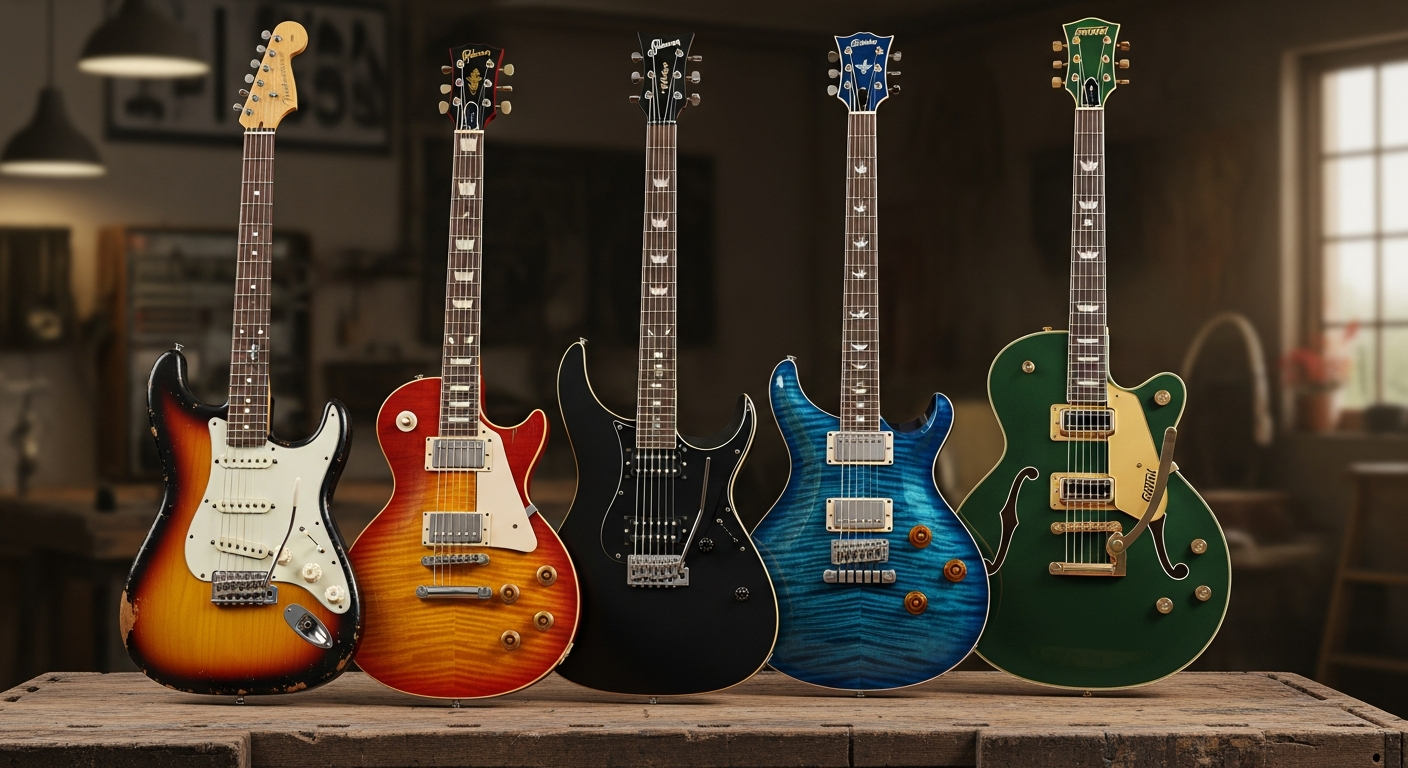
Guide: Best Guitar Amplifier for Beginners
Choosing your first amplifier, or even your second if the first one was a complete dump, is always a real hassle. I'll tell you, I've been there. At first you think, "Just make some noise, right?" Then you realize that "making some noise" isn't quite the same as "sounding good." And that's where the search for the perfect one begins. best guitar amp for beginners, something that can make your head spin between watts, speakers, effects and a thousand acronyms.I still remember the first time I had to buy an amp. I was convinced that more watts meant more awesomeness. I bought a used 100W head and a 4x12 speaker, enough to rattle garage windows. The result? I sounded like crap at apartment-sized volumes, and even worse if I tried to turn it up, because I lacked the technique to tame such a monster. Wasted money, taken up space, and a sound I didn't like at all. From there, I realized that to get started, you need something else. You need something that's fun, that sounds decent at human volumes, and that won't break the bank.
The point is this: there is no such thing as the "perfect" amp. There is just the right one. for you, for what you want to do, for where you'll be playing. But for beginners, or for those who want an upgrade without emptying their wallet, there are options that the community really appreciates and that offer a lot for the price. Let's see what they are and why.
What to look for in a starting amplifier?
The Boss Katana 50 MkII is a true workhorse for many guitarists, not just beginners. It's one of those amps that makes you think, "How did I ever manage without it?" It's compact, versatile, and offers a price-performance ratio that's honestly hard to beat. When the first Katana came out, I remember everyone talking about it, and the MkII took things even further.
Technical Features
Power: 50 Watts (switchable to 25W and 0.5W, ideal for playing at home)

Cone: 1×12″ custom-made Channels/Amp Types: 5 amp types (Clean, Crunch, Lead, Brown, Acoustic) plus variations, for a total of 10 basic sounds.
Effects: Over 60 professional-quality BOSS effects (distortion, modulation, delay, reverb, EQ, etc.) are built in, manageable via BOSS Tone Studio software.
Effects loop: No (present on the Katana 100).
Connectivity: Guitar input, Aux-in (mini-jack), headphone/recording output (mini-jack), USB (for recording and BOSS Tone Studio), footswitch input (for GA-FC or external pedals).
Dimensions: 470mm (W) x 238mm (D) x 398mm (H)
Weight: 11.6 kgn Relevant construction notes: Proprietary Tube Logic architecture for tube emulation, Power Control for playing at any volume, 4 storable Tone Settings for recalling complete amp and effects presets.
Popular Sentiment
On forums and online communities, the Katana 50 MkII is almost an institution. People love it for its versatility. Many say it's amazing how good it sounds for the price, especially the Brown channel, which emulates Marshall's high-gain sounds (but with a Boss twist).The BOSS Tone Studio software is seen as a huge strength, because it opens up a world of customization. You can really create your sound.
Some people complain that without the external footswitch (which must be purchased separately) changing presets on the fly is a bit cumbersome, and that there is no effects loop. However, for many, these are minor flaws for a entry-level amplifier With so many features, the lack of an effects loop isn't a big deal for beginners, who aren't likely to have a complex pedal chain.
Pros and Cons in relation to Price
PROS: Incredible versatility: With 5 amp types and a huge library of Boss effects, you have an infinite number of sounds at your disposal. It's the perfect place to experiment.Quality sound: Despite being solid-state, the tube emulation is convincing and the sound is rich and dynamic.
Power handling: Power Control lets you enjoy full sound even at very low volumes, perfect for home.
BOSS Tone Studio: A powerful and intuitive software to customize every single aspect of your sound, download patches and connect with the community.
Robust and reliable: It's a Boss, so it's built to last.
Price: For what it offers, the price is truly competitive. It's hard to find such a comprehensive package at this price. AGAINST: Lack of effects loop: If you want to use modulation or delay pedals in your loop in the future, you'll need to upgrade to the 100W model.
External footswitch: To change presets on the fly during a performance, it is almost mandatory to buy a dedicated footswitch (Boss GA-FC or compatible), increasing the total cost a bit.
No display: The physical interface is simple, but to see exactly which effect or parameter you're tweaking you need to use the software.
Who is it suitable for / Who should avoid it?
The Boss Katana 50 MkII is ideal for the beginner who wants to explore a lot of different musical genres and sounds without having to buy dozens of pedals. It's perfect for practicing at home, recording first ideas, and even for first band rehearsals (thanks to the 50W). If you want to tinker with software to get the most out of your amp, this is your toy.Anyone looking for a pure tube sound and not wanting to mess with digital software or menus should avoid it. If you're an analog purist or already have a complex pedal chain that you want to use with an effects loop, you might want to look elsewhere or the Katana 100. But for a novice guitarist, it's hard to go wrong with this one.
Review: Fender Mustang LT25
The Fender Mustang LT25 is another great contender for the title of best guitar amp for beginners, especially for those who are fans of Fender sounds and are looking for a plug-and-play experience with plenty of effects. I've tried it a couple of times, and I have to say that for the price, it's a fun and surprisingly capable little machine.Technical Features
Power: 25 Watts Cone: 1×8″ Fender Special Designn Channels/Amp Types: Over 20 amp models (from clean Fender to British crunch to high-gain sounds).Effects: 30 preloaded presets, with hundreds of customizable effects and chains (distortions, modulations, delays, reverbs, compressors, pitch shifts, etc.).
Effects loop: No.
Connectivity: Guitar input, Aux-in (mini-jack), headphone output (mini-jack), USB (for recording and firmware updates).
Display: Color LCD screen for intuitive navigation.
Dimensions: 360mm (W) x 210mm (D) x 325mm (H)
Weight: 5.7 kgn Relevant construction notes: Simplified user interface with color display, ideal for beginners. Flexible effects chain.
Popular Sentiment
The Mustang LT25 is loved by the community for its ease of use. Many recommend it for those who want to get playing right away, without too many frills, thanks to the ready-made presets. The color display is a great touch, making navigating sounds much easier than you'd expect from an amp in this price range.Fender’s clean tones are, of course, a strong point, but even the more “bad” amp emulations are considered good for the price range.
Some people complain that the 8-inch cone makes it sound a little "small" compared to a 12-inch, especially at low frequencies, and that at very high volumes the sound can become a bit muddy. However, for home use, no one seems to find this an insurmountable flaw.
Pros and Cons in relation to Price
PROS: Ease of use: The presets are great for getting started, and the color display makes everything easy to understand. You don't need external software to get started.Authentic Fender Tones: If you love Fender cleans and crunch, this amp will give you great satisfaction.
Compact and lightweight: Perfect for those who have little space or need to move it often.
Wide variety of sounds and effects: Lots of amps and effects to experiment with, all at your fingertips.
Great for studying: Headphone output and Aux-in make it ideal for practicing. AGAINST: 8 inch cone: The sound might be a little less ’full“ than a 10 or 12 inch, especially in the bass.
Limited power: 25W with an 8″ speaker is great for home, but not enough for playing with a drummer.
No footswitch included: As with the Katana, changing presets on the fly requires an optional external footswitch.
Less deep customization: While it has many effects, the depth of software tweaking isn't on par with the Katana, which offers more granular control.
Who is it suitable for / Who should avoid it?
The Fender Mustang LT25 is excellent for the beginner looking for an amp that is simple to use, with an intuitive interface and that offers a wide range of sounds and presets ready to use right away. If you like Fender tones, or want a lightweight, compact amp to keep on your desk, this is a solid choice. It's perfect for those who want a plug-and-play experience without having to spend hours setting up.Anyone looking for maximum power for band playing, or those who want the deepest, most granular control over every sound parameter via advanced software, should avoid it. If your goal is a fat, tube-like sound, this isn't the amp for you.
Review: Orange Crush 20RT
The Orange Crush 20RT is another very good option, but it positions itself a bit differently than the two digital models we've looked at so far. This is a solid-state analog amp, and it shows. If you're looking for a more "direct," more rock-oriented, and less "geeky" sound, this might be the one for you. best guitar amp for beginners for you. I remember a friend getting it for her son who was just starting out, and I was surprised by how “orange” it sounded, even though it was so small.Technical Features
Power: 20 Watts Cone: 1×8″ Voice of the World custom-made Channels/Amp Types: 2 channels (Clean and Dirty), fully analog.Effects: Built-in digital reverb, chromatic tuner.
Effects loop: No.
Connectivity: Guitar input, Aux-in (mini-jack), headphone output with CabSim speaker simulation (mini-jack).
Dimensions: 375mm (W) x 230mm (D) x 325mm (H)
Weight: 7.2 kgn Relevant construction notes: Fully analog signal path, four-stage circuitry for the Dirty channel, CabSim speaker simulation on the headphone output.
Popular Sentiment
Orange enthusiasts and those looking for a classic rock sound will appreciate the Crush 20RT. The Dirty channel is said to have a fantastic, very "Orange" crunch, warm and full-bodied, even at low volumes. The built-in reverb is considered good quality.The simplicity of the controls, with no menus or digital presets, is a big plus for those who want to focus only on playing and adjusting the sound with the knobs.
The 8-inch speaker, like the Mustang, is the most controversial point. Some find it limiting in terms of the fullness of the sound, especially at higher volumes. But for home use and practice, the response is generally positive. Some complain about the lack of effects beyond reverb, but after all, it's an analog amp; its strength lies precisely in its simplicity.
Pros and Cons in relation to Price
PROS: Authentic analog sound: The Dirty channel is a true Orange, with a warm, rocking crunch that many digital amps struggle to emulate with the same immediacy.Ease of use: No menus, no software. Just turn the knobs and play. Perfect for those who want something straightforward.
Built-in reverb: A good quality digital reverb, useful for adding depth to the sound.
Headphone output with CabSim: The speaker simulation on the headphone output makes the headphone experience much more pleasant and realistic.
Robust and iconic: The Orange look is unmistakable and the construction is solid.
Price: It offers a characterful sound at an affordable price. AGAINST: Lack of effects: Aside from reverb, there are no other effects. If you want delay, chorus, or flanger, you'll have to buy external pedals.
8 inch cone: It limits the fullness of the sound, especially in the bass and at high volumes.
Less versatile than digital: It doesn't have the same range of sounds and amp models that the Katana or Mustang offer.
No USB connectivity: You can't connect it to your PC to record directly or tweak sounds.
Who is it suitable for / Who should avoid it?
The Orange Crush 20RT is ideal for the beginner who loves rock, blues-rock, or punk sounds and is looking for an amp with a well-defined character, simple to use and with a "real" and analog sound. If you're the type who prefers fiddling with knobs rather than software, and maybe you're already thinking about buying some pedals in the future, this is a great base.Those looking for maximum versatility in terms of effects and amp models, or those looking for easy recording via USB, should avoid it. If your genre ranges from jazz to extreme metal and you want all the effects on board, a digital amp like the Katana or Mustang will give you more satisfaction.
Extra factors to consider for your initial setup
Ok, we have seen three great options of amps to start playing the guitar electric. But the amp is just one piece of the puzzle. There are other things to think about, especially if you're just starting out.The cables
Don't underestimate cables. A poor-quality cable can ruin the sound of even the best amplifier. You don't need to spend a fortune, but a good-quality cable, perhaps shielded, makes a difference. Avoid the five-euro ones at the supermarket, trust me.The headphones
If you play music at home, headphones are your best friend. Get a pair of closed-back, circumaural headphones (which cover the entire ear). They isolate you better from outside noise and keep sound out, so you don't disturb anyone.The plectrums
Yes, picks. It may seem trivial, but your choice of pick affects your sound and technique. Experiment with different shapes and thicknesses. I started out using very thin ones, but then I discovered that with a thicker pick (like 0.88mm or 1.0mm) I had more control and a fuller sound. It's a personal preference; experimentation is key.Audio interfaces and software simulations
If you have a computer and perhaps a quality pair of headphones, you might also consider a USB audio interface (such as a Focusrite Scarlett Solo or a Behringer UMC22) and amp simulation software (such as Amplitube, Guitar Rig, or Neural DSP plugins).This is a valid alternative, especially if your budget is very limited or you have limited space. It allows you to have an infinite number of sounds and record directly to your PC. The downside is that you don't get the physical sensation of the amp vibrating in the room, and latency can be an issue if you don't have a powerful enough computer. However, for studio and home recording, it's an excellent option. If you'd like to learn more about modifying your guitar to fit a setup with an interface, you might want to check out this article.
Volume is important, but it's not everything
Always remember that good sound isn't just about power. A 50W amp played at a low volume won't sound as good as a 5W amp cranked all the way up. Learn to use your amp's controls and understand how gain, volume, and EQ interact. That's where the magic lies.Final advice and alternatives
If I had to choose one guitar amplifier for a beginner Today, and I wanted the ultimate in versatility and value, I would probably go for the Boss Katana 50 MkII. It gives you enormous flexibility, tons of effects, and the ability to grow with the amp. It's an investment that will pay off over time.If you prefer simplicity and a more “analogue” and rock sound, the’Orange Crush 20RT It's an excellent choice. It has character, it's robust, and it teaches you how to work with knobs and a few effects.
The Fender Mustang LT25 It's the perfect solution if you're looking for something super intuitive, compact, lightweight, and with a user interface that guides you. The Fender sounds are a bonus. Alternatives to consider: Yamaha THR Series (THR5, THR10, THR30): These are compact desktop amps with incredible sound at low volumes. They're excellent for home, study, and recording. They cost a little more, but they're exceptional for those who need a discreet, quality amp. They're almost a category unto themselves, true "third amps." You can read some in-depth reviews on Sound On Sound, for example, to better understand their unique features: Yamaha THR10II & THR30II Wireless Review.
Blackstar ID:Core V3 Series: Similar to the Katana and Mustang in philosophy, they offer an excellent range of digital sounds and effects, with a user-friendly interface and interesting stereo sound.
The most important thing is to try them out. If you can, go to a store and try all three, or at least the ones that interest you the most. Plug in your guitar (or one similar to the one you have) and see which one sounds best, which one inspires you the most. Feel is key.
Remember, the best guitar amp for beginners It's not the most expensive or powerful, but the one that makes you want to plug in and play for hours. The one that makes you have fun, allows you to experiment, and accompanies you through your first steps (and maybe even beyond) in the world of electric guitar. Don't be afraid to make mistakes; it's the best way to learn. And if I've found my sound, you can too.
Download the Luthier Survival Kit
Free PDF with checklist, problem-cause table and project card template.
 English
  Italiano
Stuck on your build?
If you ran into the same problem or have a question, drop it in the comments. I read and reply to every one.
Write a comment