

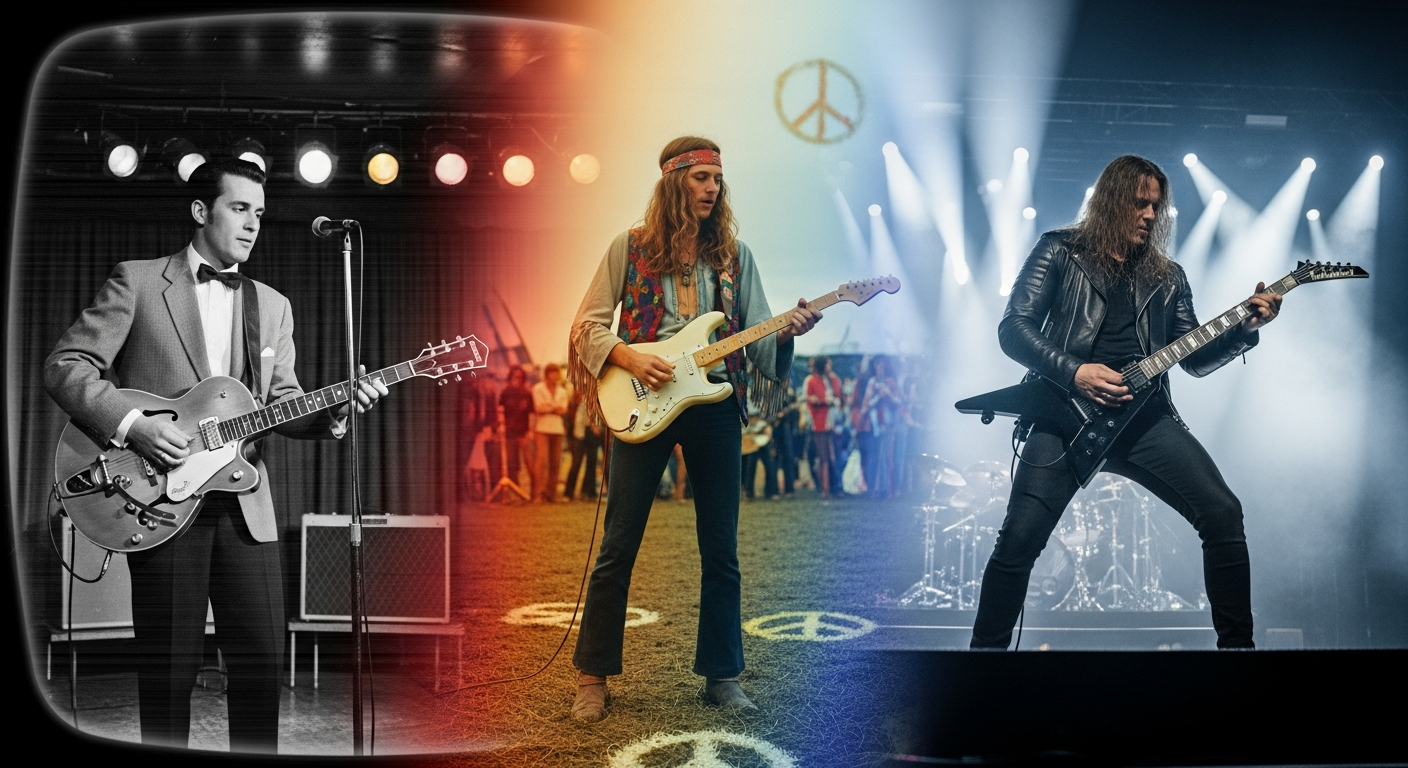
Types of Electric Guitar: How They Came into Being and Evolved
How many times have you found yourselves in front of a wall of guitars, perhaps in a shop, or even just online, and asked yourselves: “But why are there so many? And what difference does one make compared to another, besides the color?” Well, you're not alone. It happened to me too, especially at the beginning, when the world of electrified six-strings seemed like an endless labyrinth. Every shape, every pickup, every wood seemed to have a story, and a sound, all its own. I am not a music history professor, nor a luthier who has worked for big brands. I am someone who got his hands dirty in the garage, made a lot of mistakes – and trust me, I made holes where there shouldn't have been any and solders that looked like abstract works of art – but in the end, he understood that behind every iconic guitar there is a story of ingenuity, necessity and, often, pure chance. Understanding the origins and evolution of types of electric guitar it's not just a nerd exercise (even if it is a bit, let's admit it!), but it's fundamental to understand why a Telecaster sounds different from a Les Paul, and why one might be more suitable for your playing style or the project you have in mind. In this article, I want to take a journey with you, not like in a dusty encyclopedia, but as if we were at the bar, talking about old gear and how those sounds that made us dream were born. We'll see how these sound machines have evolved, starting from practical problems and going on to create legends.
The Cry of Necessity: Why was the Electric Born?
Imagine yourselves in the 1920s and 1930s. Jazz and blues were exploding, orchestras were getting bigger and bigger, and the places where they played were getting louder and louder. In this scenario, the poor acoustic guitar, with its delicate voice, found itself struggling to be heard. It was like trying to whistle in the middle of a rock concert. Impossible. Guitarists, who were certainly not the type to give up, began to look for solutions. At first, they tried external microphones, placed in front of the soundbox. A bit like putting a megaphone in front of a canary. The volume increased, yes, but not enough, and then there was the problem of feedback: that infernal whistle that is generated when the amplified sound re-enters the microphone and is amplified again in an infinite loop. A nightmare for anyone who has ever tried to play in a garage with a rickety sound system. The need was clear: an instrument was needed that could generate a strong, clean, and controllable sound, capable of holding its own against amplified brass, drums, and vocals. It was no longer a simple “amplified acoustic guitar”, but something radically new, designed from the outset to be electric. This desire for volume and projection planted the seeds for the incredible evolution we would see in the years to come, leading to the birth of countless models of electric guitars.
The First Experiments and the Pioneers of Electrified Sound
The history of the electric guitar is studded with attempts, some brilliant, others a little less so, but all fundamental. There wasn't a single “inventor”, but a series of visionaries who, each in their own way, contributed to defining the instrument we know today.
The “Frying Pan”: The Dawn of the Electromagnetic Pickup
In 1931, in a small laboratory in California, a man named George Beauchamp, along with Adolph Rickenbacker, created something amazing. They called it the “Frying Pan”, because of its round shape and thin neck. It was a lap steel guitar, meant to be played horizontally, but its true innovation was not the shape, but its beating heart: the electromagnetic pickup. This pickup consisted of two horseshoe magnets surrounding the strings, with a coil of copper wire wrapped around them. When the strings vibrated, they interrupted the magnetic field, generating a tiny electric current that could be amplified. It was the first time a guitar was designed with an integrated and truly effective amplification system. A giant step that marked the birth of types of electric guitar as we understand them today. The “Frying Pan” was made entirely of die-cast aluminum, an early solid body, designed precisely to eliminate the feedback that plagued acoustic guitars. The sound was metallic, almost like a bell, but incredibly loud for its time. It was certainly not a stage guitar in the modern sense, but it demonstrated that the idea of an electrified guitar was not only feasible, but revolutionary.
The Gibson ES-150: The First Commercial Success
A few years later, in 1936, the Gibson Guitar Corporation, already an established name in the world of archtop acoustic guitars, launched the ES-150. “ES” stood for “Electric Spanish”, indicating a guitar to be played in a traditional position, not lap steel. The number 150 referred to the selling price, which included guitar, amplifier, and cable: 150 dollars, a considerable sum for the time. The ES-150 was not a solid body. It was a hollow body guitar (with a hollow body) with an electromagnetic pickup, nicknamed “Charlie Christian pickup” in honor of the legendary jazz guitarist who made it famous. Christian was the first true “guitar hero” of the electric guitar, demonstrating that this new instrument could be a powerful and melodic solo voice, not just a rhythmic accompaniment. Its sound, warm and mellow, is still a reference today. Yet, even the ES-150 had its limits. Being a hollow body, it was still subject to feedback at high volumes. Christian's pickup was innovative, but the sound was still far from the power and sustain that guitarists would have desired. It was clear that to further push the boundaries of sound, the very structure of the instrument needed to be rethought. The path to the electric guitar variants to a solid body was now marked.
The Solid Body Revolution: When Wood Becomes Electronics
The real turning point in the history of the types of electric guitar It happened in the 40s and 50s, when two giants, Leo Fender and Gibson, with very different approaches, gave life to instruments that would define the sound of rock ‘
‘ roll and beyond.
Leo Fender and the Pragmatic Philosophy: Birth of Popular Icons
Leo Fender was not a luthier. He was a radio technician, a practical man, obsessed with reliability and ease of repair. His workshop in California, in an era of economic boom and desire for novelty, became the crucible of revolutionary ideas.
The Telecaster: Simplicity & Twang
In 1950, Fender introduced the Broadcaster (soon renamed Telecaster due to a name conflict with Gretsch). This guitar was the embodiment of Leo’s philosophy:
- Solid Body: A single block of solid wood (usually ash or alder) to almost completely eliminate feedback and increase sustain.
- Bolt-On Neck: The neck was screwed to the body, not glued. This made production simpler and, crucially, repairing or replacing the neck a breeze. A real advantage for touring musicians.
- Single Coil Pickup: Two single-coil pickups that produced a bright, crystalline sound, with a percussive attack and that characteristic “twang” that made it the queen of country and rockabilly.
- Simple Electronics: A three-position selector, a volume control and a tone control. Essential and functional.
The Telecaster, with its spartan but effective aesthetic, quickly became popular among musicians of all genres. It was a reliable, robust “workhorse” with an unmistakable sonic character. Even today, its simplicity is its strength, and its sound is immediately recognizable. I remember the first time I got my hands on an old Telecaster, the neck was a plank, but that sound was a drug. It made me realize that you don't need frills to make incredible music.
The Stratocaster: Ergonomics and Versatility
Four years later, in 1954, Fender raised the bar with the Stratocaster. If the Telecaster was a declaration of pragmatism, the Stratocaster was an evolution oriented towards ergonomics and versatility, introducing new electric guitar variants.
- Shaped Body: The curves of the body were designed to better adhere to the musician's body, making it more comfortable to play for long sessions.
- Three Single Coil: The presence of a third pickup and a five-way selector (although initially it was three, musicians soon discovered the intermediate positions) offered a much wider range of sounds, from the crystalline sound of the bridge pickup, to the warmer sound of the neck, up to “quacky” and percussive sounds in the intermediate positions.
- Synchronized Tremolo System: The vibrato of the Stratocaster, often called “tremolo arm”, allowed to alter the pitch of the notes with a fluid movement, opening up new expressive possibilities. It was a true revolution, even if at first it was a bit tricky to make it work well without making the guitar go out of tune (and who among us hasn't spent hours adjusting the springs in the back?)
The Stratocaster quickly became the icon of rock ‘
‘ roll, of blues and pop music, played by legends like Buddy Holly, Jimi Hendrix, Eric Clapton, and David Gilmour. Its versatility and futuristic design made it a global success, establishing a new standard for electric guitars.
Gibson and the Elegance of Sustain: The Birth of the Les Paul
While Fender was building its “machines” in series, on the other side of the country, in Michigan, Gibson had a different vision. Ted McCarty, then president of Gibson, was a luthier with a deep knowledge of tradition and craftsmanship. He was looking for an instrument that combined electric power with the elegance and sustain of high-quality acoustic guitars.
“The Log”: The Idea of Les Paul
Jazz guitarist and inventor Les Paul (yes, him, the name is no coincidence!) had already experimented with the idea of a solid body guitar in the 1940s. His prototype, called “The Log” (the log), was literally a 4×4 inch piece of wood to which he had attached the sides of an archtop guitar to make it look “normal”. The idea was to eliminate feedback and achieve infinite sustain. It wasn’t pretty to look at, but it worked.
The Les Paul: The Meeting between Craftsmanship and Power
In 1952, in collaboration with Les Paul, Gibson launched its answer to the solid body: the Les Paul. It was a masterpiece of design and engineering, with a much more refined aesthetic than the Telecaster.
- Mahogany Body with Maple Top: A combination that provided warmth and resonance from mahogany, and attack and brilliance from carved maple.
- Neck Set-Neck: The neck was glued to the body (set-neck), a technique that, according to many, promotes greater sustain and more uniform resonance compared to bolt-on.
- Humbucker Pickups: The most significant innovation arrived in 1957 with the introduction of the humbucker, invented by Seth Lover. This pickup, composed of two coils wired out of phase, solved the problem of “hum” (the 60-cycle buzz) that afflicted single coils, while simultaneously providing a fatter, warmer, and more powerful sound, with incredible sustain. Eric Clapton’s “woman tone” is the perfect example.
- Tune-o-Matic Bridge: A fixed, robust and precise bridge for intonation, contributed to sustain and stability.
The Les Paul became the preferred choice of blues and rock guitarists looking for a powerful sound, rich in harmonics and with almost infinite sustain. Jimmy Page, Slash, Gary Moore: all contributed to cementing the legend of this electric guitar. The differences between the early Les Pauls and the later ones, with different types of pickups and weight variations, are a world apart, and those who enjoy guitar modification know how much every small detail can change the final result.
The Expansion of the Soundscape: Hollow Body, Semi-Hollow and New Voices
Once solid body guitars had established themselves, the world of electric guitars did not stop evolving. Indeed, innovation continued to explore new sonic and aesthetic nuances, leading to the birth of other models of electric guitars iconic ones.
Gretsch: The Twangy Sound of Rockabilly and Country
In the 50s and 60s, while Fender and Gibson dominated the solid body market, Gretsch carved out a niche with its hollow body and semi-hollow guitars with sumptuous design and unmistakable sound. Gretsch guitars were the symbol of rockabilly, country, and surf rock. Models like the Gretsch 6120 Chet Atkins or the White Falcon were instruments of great visual and sonic impact. They were equipped with Filter’Tron pickups, designed to reduce hum while maintaining a certain brilliance and a “twang” that distinguished them from Gibson humbuckers and Fender single coils. Their sound, often described as “jangly” or “chimey”, became the soundtrack for artists like Eddie Cochran, Brian Setzer of the Stray Cats, and, of course, Chet Atkins. They were guitars with enormous personality, often with bigsby and gold hardware, which made them immediately recognizable.
Rickenbacker: The Jangle Sound and the British Invasion
Rickenbacker, the pioneer of the “Frying Pan”, returned to prominence in the '60s, thanks mainly to the British Invasion. The Beatles, and particularly John Lennon and George Harrison, adopted Rickenbacker guitars, catapulting them into legend. Models like George Harrison's 360/12 (a 12-string electric) defined the “jangle sound” that became synonymous with '60s pop-rock. Rickenbackers were characterized by a unique construction, often neck-through (neck and central body made from a single piece of wood), and single coil pickups with a bright and crystalline sound, but with a certain fullness. Their distinctive aesthetic, with “cresting wave” bodies and elegant finishes, made them instantly recognizable. The sound of a Rickenbacker 12-string is something magical, a wall of harmonies that no other instrument can replicate with the same ease.
Gibson ES-335: The Semi-Hollow Solution to Feedback
The feedback problem in hollow body guitars persisted, but people loved the resonance and warm sound of those guitars. Gibson, always attentive to the needs of musicians, found a brilliant solution in 1958 with the ES-335. The ES-335 was a “semi-hollow” guitar. It had a soundbox, but with a solid maple center block that ran the entire length of the body. This center block drastically reduced feedback at high volumes, while retaining much of the resonance and warmth of a hollow body. Equipped with humbuckers, the ES-335 offered an incredibly versatile sound, suitable for jazz, blues, rock, and pop. Artists like B.B. King (with his Lucille), Larry Carlton, and Dave Grohl have demonstrated the extraordinary versatility of this design, making it one of the types of electric guitar most loved and long-lived.
From Superstrat to Contemporary Visions: Speed, Power and Innovation
The 80s brought a new wave of innovation, driven by the explosion of hard rock, heavy metal, and the birth of 'shredding'. Guitarists wanted instruments that could keep up with increasingly faster techniques and increasingly aggressive sounds.
The Rise of the Superstrat: Speed and Aggressiveness
Japanese manufacturers, like Ibanez, and American brands like Charvel and Jackson, took the Stratocaster design as a starting point and pushed it to the extreme, creating the “Superstrat”. These models of electric guitars they were designed for speed and for power:
- Thin Necks and Jumbo Frets: To facilitate speed and extreme bending.
- High Output Pickup: Often humbucker, for powerful and distorted sounds, ideal for metal.
- Floyd Rose Bridges: A locking tremolo system that allowed extreme dive bombs and vibratos without the guitar going out of tune. A true blessing for guitarists who wanted to push the expressive capabilities of the tremolo to the limit.
- Light and Shaped Bodies: Often with deep cutaways for easy access to the last frets.
Guitarists like Steve Vai, Joe Satriani, Eddie Van Halen, and Randy Rhoads made these guitars famous, demonstrating that it was possible to achieve extreme speed and precision without sacrificing tone. Steve Vai's Ibanez JEM, with its “Monkey Grip” handle and its tree of life inlays, is a prime example of how aesthetics have evolved parallel to functionality.
PRS (Paul Reed Smith): The Balance between Tradition and Modernity
In the years ’80 and ’90, new players also emerged who sought to bridge the gap between the Fender and Gibson philosophies. Paul Reed Smith, a luthier with a deep passion for guitar building, founded PRS Guitars. PRS guitars, like the Custom 24, are an example of how it is possible to combine the elegance and sustain of a Les Paul with the versatility and ergonomics of a Stratocaster. With their breathtaking flamed maple tops, bird inlays, and versatile pickups, PRS have become synonymous with high-quality craftsmanship and great playability. They offer a balance between crystal-clear cleans and powerful distortion, making them suitable for a wide range of musical genres.
Contemporary Visions: Beyond the Six Strings
The evolution has not stopped. In recent years, we have witnessed an explosion of innovations and electric guitar design that push the boundaries even further:
- Baritone Guitars: With a longer scale and lower tunings, for darker and more powerful sounds, popular in metal and alternative rock.
- Multi-Scala (Fanned Fret): An ingenious solution where the frets are slanted, allowing a different scale for each string. This improves intonation, string tension, and note clarity, especially on the low strings of 7 or 8-string guitars.
- Extended Range Guitars: 7, 8, 9 strings and beyond, to explore new sound possibilità, from djent to jazz fusion.
- Innovative Materials: The use of exotic woods, carbon fibers, and even 3D printed bodies, to explore new resonances and reduce weight.
Today, the market is more varied than ever. From faithful reproductions of vintage models to futuristic designs, there’s a guitar for every taste and every need. And the beauty is that, thanks to an ecosystem of independent luthiers and enthusiasts like us, the possibilities for customization and guitar modification are practically infinite. This allows us to have an instrument that not only sounds as we want, but that reflects our personality and our history.
Conclusions
We've had a good journey, haven't we? From the necessità of making oneself heard in a noisy orchestra, to the first experiments with rudimentary pickups, up to the sophisticated sound machines we use today. Every type of electric guitar that we have encountered is not just a piece of wood and metal, but the result of an idea, of a problem to solve, of a brilliant intuition and, often, of a bit of luck. Understanding how these instruments were born and evolved helps us not only to choose the right guitar for us, but also to better understand the music we love. Behind that sharp riff of a Telecaster or the infinite sustain of a Les Paul, there's a story of innovation and human passion. And the most beautiful thing is that this story continues to be written, every day, by luthiers, musicians and, yes, even by us, in our garage, armed with a soldering iron and a great desire to experiment. Hoping, of course, not to make too many holes where there shouldn't be any.
FAQ
What is the main difference between a single coil pickup and a humbucker?
The main difference lies in the construction and sound. A single coil pickup (like those on the Fender Stratocaster or Telecaster) has a single coil of wire wrapped around magnets, producing a bright, clear, and percussive sound, but is susceptible to hum. A humbucker (like those on the Gibson Les Paul) uses two coils wired out of phase to cancel hum, offering a fatter, warmer, and more powerful sound, with greater sustain and output.
Why do some guitars have a solid body and others a hollow body?
Solid body guitars (e.g. Fender Stratocaster, Gibson Les Paul) were created to eliminate feedback at high volumes and increase sustain, because the solid body does not resonate with the amplified sound. Hollow body guitars (e.g. Gibson ES-150, Gretsch hollow body) have a soundbox like acoustics, offering a warmer, more resonant and “airy” sound, but are much more prone to feedback at high volumes. Semi-hollow guitars (e.g. Gibson ES-335) seek a compromise, with a central block to reduce feedback while maintaining some of the acoustic resonance.
Download the Luthier Survival Kit
Free PDF with checklist, problem-cause table and project card template.
 English
  Italiano
Stuck on your build?
If you ran into the same problem or have a question, drop it in the comments. I read and reply to every one.
Write a comment