

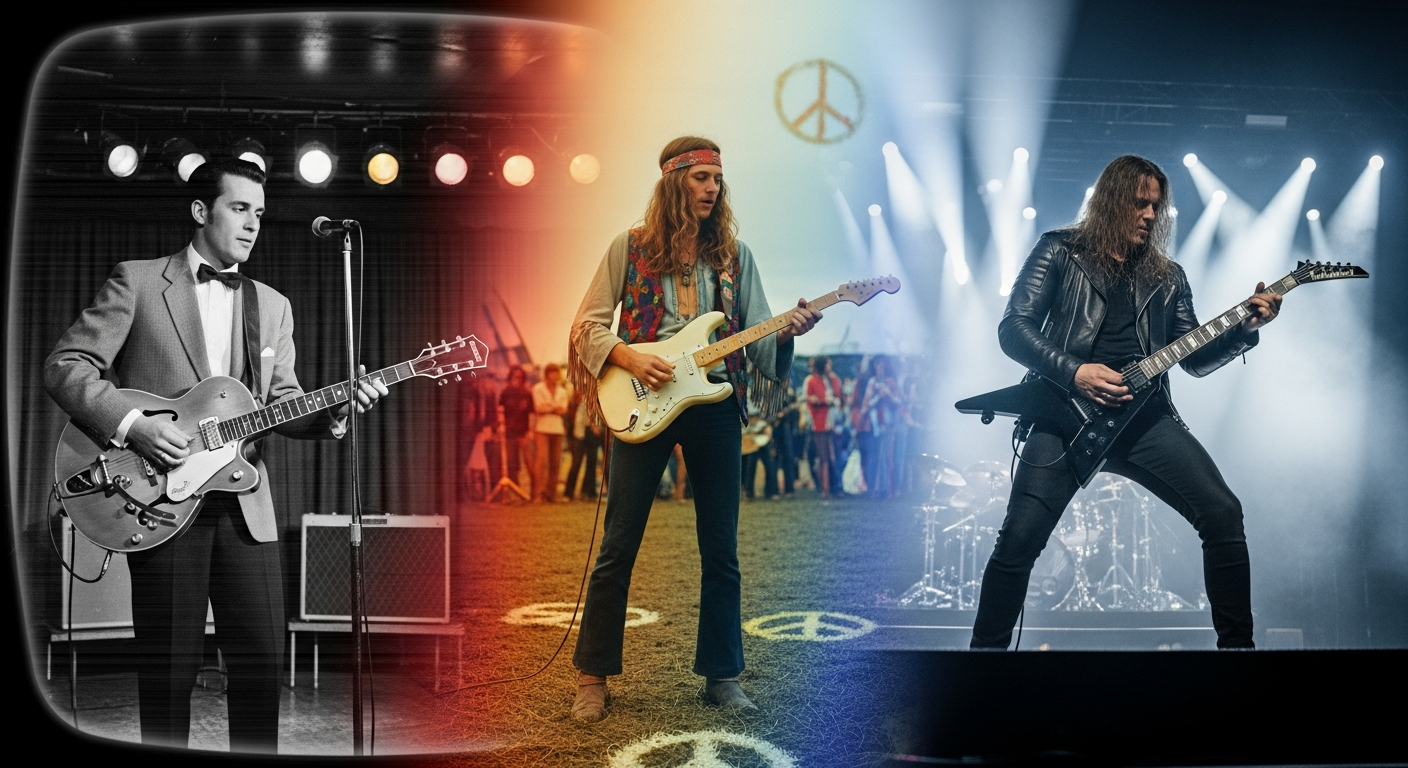
Electric guitar 1950s: 5 models that made history
The 1950s. A decade that, for those like me with hands dirty with sawdust and tin, is a bit like Genesis. It's where everything, or almost, began. I'm not just talking about music—rock and roll, electric blues, country taking off—but the instruments that made that sound possible. 50s electric guitars they were not just objects, they were manifestos. They were visions of engineers, musicians and artisans who, often without knowing it, were designing the future.I still remember the first time I got my hands on a vintage-style Telecaster, a well-made replica. There was something about that thick neck, that direct and no-frills sound, that made me realize it wasn't just an instrument. It was a piece of history, a simple but incredibly effective machine. And from there, curiosity exploded.nI'm not a professional luthier, I've always said that. I'm someone who in the garage has disassembled, reassembled, milled badly, soldered worse, and then learned to do a decent job. But one thing I understood: to understand where we are going, we must know where we come from. And the electric guitars of the ’50s are the starting point to understand Why things are made in a certain way even today.
So, grab a coffee, or a beer if it's the right time. I'll take you with me on a journey through five icons, five instruments that changed everything. With a few anecdotes and my usual 'I've laid my hands on it, trust me' approach.nn
1. Fender Telecaster (1950/1951): The birth of the solid body for the masses
nn nnnnnn
If Leo Fender was the pragmatic engineer, Les Paul was the visionary artist. A legendary guitarist, a crazy innovator, an inventor of recording studio tricks. Already in the '40s, Les Paul had experimented with his 'Log', a homemade solid body guitar made from a 4x4 inch piece of wood and two archtop wings for aesthetics. He knew that guitars had to evolve.
When the Fender Telecaster started making waves, Gibson, which was a giant in the production of acoustic and archtop guitars, understood that it had to respond. And the answer arrived in 1952, with the Gibson Les Paul.nn
Elegance and power: another philosophy
nnnn
nGibson's philosophy was different from Fender's. Where Fender aimed for simplicity and modularity, Gibson sought elegance, resonance, and tonal richness. The Les Paul was (and is) a work of art: a solid mahogany body with a carved maple top, a mahogany neck glued to the body (set neck). This more complex and expensive construction guaranteed incredible sustain and a resonance that a bolt-on could hardly match.The first models, the famous 'Goldtop', featured P-90 pickups, Gibson single coils with a fatter and more powerful sound compared to Fender. But the real revolution arrived in 1957.nnSeth Lover and Humbucker pickups: This is where a genius comes in: Seth Lover, Gibson engineer. His goal? To eliminate the hum typical of single coils. The solution? Two coils side by side, wired out of phase. The humbucker was born. The first models were called 'Patent Applied For' (PAF), and their warm, powerful, harmonically rich sound changed the history of the guitar forever. electric.
The Les Paul with PAFs became the definitive guitar for blues-rock, harder rock and roll, and generally for those seeking a big, full sound. The sustain was legendary, the ability to saturate amplifiers was unparalleled.nnMy experience: Working on a Les Paul is different from working on a Tele or a Strat. The glued neck means you can't just unscrew and replace it. Any work on the body requires more attention. But the sound… ah, the sound! I've spent hours experimenting with different PAF replicas, trying to capture that magical "mojo." It's not easy, but once you get close, it's a priceless feeling.
The Les Paul has gone through ups and downs, with periods of lesser popularity (especially in the early '60s, when the Stratocaster was booming), but it has always returned forcefully, becoming one of the most iconic and desired guitars of all time.nn
3. Fender Stratocaster (1954): The alien from the future
Advertising

60s Guitar Control Knobs 24-Spline Imperial Knobs 6mm (15/64") 2 Tone + 2 Volume Knobs Aluminum Top Speed Knobs for Gibson Les Paul SG Guitars Pack of 4 JT/XN-09 Black with Silver Top
See on Amazon

The result was a masterpiece of design and engineering. The body was revolutionary: no longer a flat board, but contoured (contoured body) to perfectly adhere to the guitarist's body, both standing and sitting. The famous 'belly' and the right arm cutaway made it incredibly ergonomic.nn
An arsenal of sounds and vibrations
The Stratocaster featured three single-coil pickups. This, in itself, offered a wider tonal range. But the real magic was in the selector switch. Originally a three-position switch (neck, middle, bridge), guitarists soon discovered that positioning it halfway between the fixed positions produced unique “out-of-phase” sounds, the famous “quacks” of positions 2 and 4. Fender cleverly introduced the five-way selector switch shortly thereafter.And then there was the tremolo. Fender's 'synchronized tremolo' was an ingenious system: a massive block under the bridge, springs holding it in tension, and a lever to modify the intonation. It wasn't perfect, and keeping it stable is still an art today (ask anyone who has tried to do a full setup!), but it allowed for vibratos and dive bombs that were previously impossible.nnThe sound of the Strat: Versatile like few others, the Stratocaster could go from a crystalline and 'bell-like' sound to a more aggressive twang, up to bluesy and warm sonorities. It became the voice of surf rock, of Hendrix, of Clapton, of Gilmour... the list is endless.nnMy struggle with the tremolo: How many nights have I spent balancing the tremolo springs of a Strat! It's one of those things you either love or hate. When it works well, it's a marvel. When it doesn't work, it makes you want to throw the guitar out the window. But the satisfaction of a perfect setup is priceless. I believe every DIY guitarist should try their hand at adjusting a vintage-style tremolo bridge at least once. It's an excellent training ground for patience and precision.
The Stratocaster is a design icon, a symbol of modernity and versatility. Even today, every guitar with a contoured body and three single coils owes something to it.nn
4. Gretsch 6120 (1955): The roar of rockabilly
While Fender and Gibson competed for the solid body market, Gretsch, a company with a long history in producing drums, banjos, and archtop guitars, had its own vision. And this vision, embodied by the Gretsch 6120 of 1955, was anything but conventional.The 6120 was not a solid body. It was a hollow body (hollow body) or semi-hollow guitar, designed to have resonant acoustics but with significant electric volume. It was the quintessential guitar for rockabilly, country, and wilder rock and roll.nn
The orange soul of rockabilly
The look was unmistakable: bright orange finish, elaborate binding, snow-patterned fretboard inlays, and often a Bigsby vibrato. But it was the sound that made it unique.The heart of the 6120 were the Filter'Tron pickups, designed by Ray Butts. They were humbuckers, yes, but very different from Gibson PAFs. Filter'Trons were thinner, with a brighter, almost 'jangly' sound, but with the power and noise cancellation of a humbucker. Their character was distinctive, perfect for the 'twang' and full chords of rockabilly.nnPersonal anecdote: Gretschs, due to their hollow-body construction, are a feedback nightmare at high volumes. I've seen bandmates struggle with uncontrolled hum. But that's also part of their charm: a feedback that, when controlled, can become pure expression. It's a guitar that asks you to tame it, not dominate it.
The Bigsby, then, was another key element. It wasn't as precise as the Fender tremolo, but it offered soft and 'wavy' vibratos, perfect for the musical aesthetic of that period.nnA different experience: Working on a hollow-body Gretsch is an adventure. You can't access the electronics from the back like on a solid-body. You often have to pull everything out through the F-holes. It's a process that requires patience, long pliers, and a fair amount of swearing. But it makes you appreciate the engineering behind these instruments even more.
The Gretsch 6120, made famous by guitarists like Chet Atkins and Eddie Cochran, left an indelible mark. It's proof that not all electric guitars have to be solid body to be revolutionary. Sometimes, a hollow body and a distinctive sound can create a legend.nn
5. Rickenbacker 325 (1958): The Little Big Revolution
Rickenbacker is a company that has always had a unique approach to building electric guitars. They introduced the first solid-body electric guitars in the 1930s with the "Frying Pan." But in the 1950s, they continued to innovate with their Capri series, and in particular with the Rickenbacker 325, introduced in 1958.This guitar was an anomaly, a rebel. While everyone was going for long scales and large bodies, the 325 was compact, with a very short scale of only 20.75 inches (compared to Fender's 25.5″ or Gibson's 24.75″).nn
The “jangly” sound that conquered the world
The 325 was equipped with three “Toaster Top” single-coil pickups, so named for their appearance. These pickups, combined with the short scale and semi-hollow construction (the first models were solid body, but Lennon’s iconic 325 was semi-hollow), produced a bright, “jangly” sound, with a percussive attack and unique resonance.The guitar was equipped with a Rickenbacker Vibrato and peculiar electronics, with a 'blend' potentiometer that allowed mixing the pickups in unconventional ways. It was an instrument that invited experimentation.nnThe impact of John Lennon: The Rickenbacker 325 would not have become so iconic without John Lennon. When the Beatles brought it to the United States in 1964, the small short-scale guitar became a symbol of the British Invasion sound. Its clear and distinctive timbre was perfect for the vocal harmonies and innovative arrangements of the Beatles.nnThe short scale, a surprise: The first time I picked up a Rickenbacker 325 replica, I was surprised by the feel. The short scale makes the strings softer, easier to bend, and the chords more “tight”. It completely changes the approach to the guitar. It’s an experience I recommend, if only to understand how an apparently small variable can so greatly influence playability and sound.
The Rickenbacker 325 is proof that you don't have to follow the current to make history. Sometimes, all it takes is an out-of-the-box idea and a sound no one has ever heard before.nn
The legacy of a golden decade
These five electric guitars, born and bred in the 1950s, are more than just instruments. They are monuments to creativity, engineering, and passion. Each brought an innovation, a sound, and an aesthetic that shaped modern music in ways their creators perhaps never imagined.From the pragmatism of Leo Fender to the flair of Les Paul, from Seth Lover's sound research to the iconic “jangly” of the Rickenbacker, the ’50s were a real “big bang” for the world of electric guitar.
For those like me who love to get their hands dirty, these instruments are also an inexhaustible source of inspiration. Studying their construction and electronics means understanding the fundamental principles that still guide guitar design today. And it also means realizing that, with a little desire and the right tools, you too can. get your hands on your guitar and make it sound how you want it.nIt's not necessary to have a vintage model worth thousands of euros to appreciate these icons. A good replica, or even just the curiosity to understand, how they work. Because in the end, the magic isn't just in the wood or the threads, but in the history they carry with them and the music they still inspire today.
If you'd like to delve deeper into the history of these guitars and many other instruments, I recommend checking out sites like Reverb.com, which often publish detailed articles on the history and evolution of the most iconic models. For example, here's a great overview of the history of the Telecaster: A Brief History of the Fender Telecaster.
And you, which of these '50s icons made you fall in love first? Or which one would you like to get your hands on for your next modification? Let me know!nn
nnnn
See also
nnDownload the Luthier Survival Kit
Free PDF with checklist, problem-cause table and project card template.
 English
  Italiano
Stuck on your build?
If you ran into the same problem or have a question, drop it in the comments. I read and reply to every one.
Write a comment