

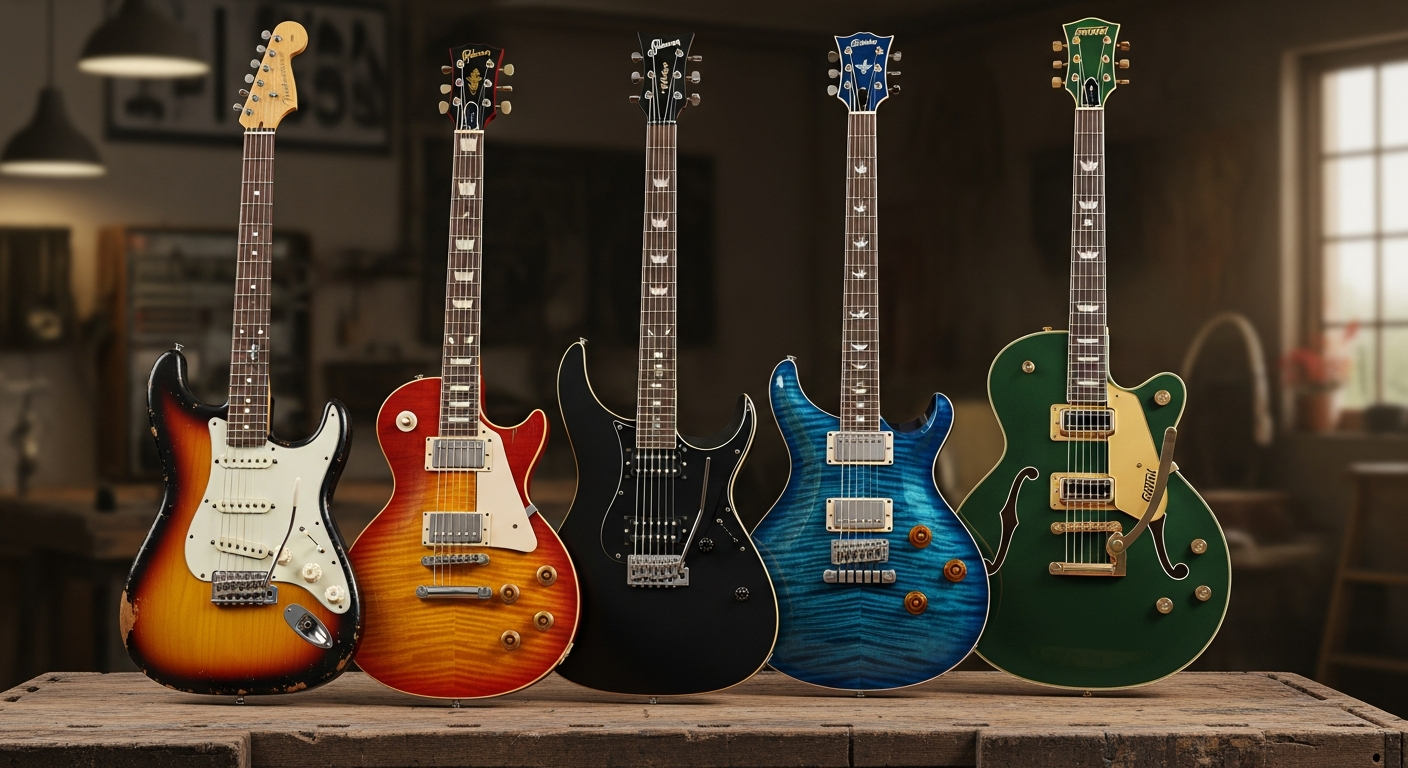
Gibson Les Paul Studio Review: Pros and Cons
How many times have you found yourself looking at a Les Paul Standard, perhaps one of those with the dreamy flamed top, and then looked at the price? I'm telling you, I've been there countless times. The desire to own a real Gibson, with that unmistakable sound and feel, is strong. But your wallet often doesn't agree. That's where the price comes in. Gibson Les Paul Studio, a guitar that for decades has bridged the gap between the dream and reality of many guitarists. It's no secret that the Studio was designed as the most accessible entry point into the world of Gibson Les Pauls, without sacrificing too much in terms of tone and playability. But accessible doesn't mean cheap, and above all, it doesn't mean without compromises. And trust me, when it comes to guitars, I've seen and made plenty of compromises in my garage. I've installed the wrong pickups, painted a body that looked like an orange peel, and I've learned that perfection is a relative concept, especially when you're working on a budget.The intent of this review of the Gibson Les Paul Studio It's precisely to clarify. I won't tell you it's the perfect guitar for everyone, because it isn't. Instead, I'll tell you what to expect, where it excels, where it falls short, and, most importantly, whether it's the right choice for you and your money. I've had it in my hands, I've disassembled it, I've tried to understand what's beneath that more Spartan finish and what makes it a Gibson nonetheless.
Technical Specifications: What's Under the Hood of the Les Paul Studio
When we talk about a guitar like the Gibson Les Paul Studio, Popular sentiment is a melting pot of conflicting opinions. On forums, in social media groups, and in conversations with other guitarists, you read and hear all sorts of things. Some praise it as "the real Gibson for those who can't afford a Standard," while others dismiss it as "a stripped-down, soulless Gibson." The truth, as is often the case, lies somewhere in the middle.
The "pro" chorus: Why people love it
Many enthusiasts, myself included, see the Studio as an opportunity. It's the guitar that lets you have a logo on the headstock, that big, unmistakable sound, without having to take out a mortgage.

The sound is there: The one thing almost everyone agrees on is that the Studio sounds like a Les Paul. The 490R/498T pickups, while not the Burstbuckers of the Standard, have a well-defined, powerful, and versatile character. You get that fat crunch you expect from a Gibson.
The Gibson feeling: Despite the aesthetic differences, the overall feel, the scale, the neck profile (especially the Slim Taper) and the weight (lightened or not) make you feel like you are holding a Gibson in your hand.
A great base for modifications: This is a crucial point for us DIYers. Many people buy them precisely with the idea of customizing them. Modifying a guitar Like the Studio, perhaps by changing the pickups to something more boutique, or the electronics, it's a classic. It has enormous potential to become your guitar, unique and with an even more personal tone. It's a bit like a good chassis on which to build your own race car.
Playability: Thanks to Plek and a good factory setup, most Studios offer excellent playability right out of the box. Low action and accurate intonation are no slouch.
The most common "cons" and complaints
But as I was saying, all that glitters is not gold. Budget-conscious buyers, who perhaps make a sacrifice to buy a Studio, often notice details that can turn their noses up.The Spartan aesthetic: The lack of binding on the body and neck is the most common complaint. It's the distinguishing feature that visually separates it from its bigger siblings. Some find it "naked," others appreciate its functional simplicity. I have to say, I've gotten used to it, but I understand those who seek that extra touch of elegance.
The finish: Nitrocellulose is a plus, but its application on Studio models is often thinner and less thorough than on Standard models. It's not uncommon to find small imperfections, a bit of orange peel, or less glossy areas, especially on satin finishes. This isn't a functional defect, but if you're picky, you might notice it.
Weight Relief: Body lightening, especially Ultra-Modern Weight Relief, is a thorny issue. While it makes the guitar more comfortable to carry on your shoulder for hours, some purists complain about a slight loss of sustain or "organic" resonance. It's a matter of personal taste, but it's a fact that the sound of a lightened Les Paul is slightly different from a solid body. I've tried both and, yes, there is a difference, but not enough to make one guitar "worse" than the other. It's just different.
Quality Control (QC): This is a sore point for Gibson in general, and the Studio is no exception. Occasionally, you hear stories of examples with small manufacturing defects: a less-than-perfect nut, a slightly dry fretboard, small paint chips. It's not the norm, but it's a risk that exists with any mass-produced guitar, and on a guitar at this price, it can be annoying. Therefore, my advice is always to try the guitar before buying, if possible, or to buy from a reputable dealer with a good return policy.
In short, the Gibson Les Paul Studio It's a divisive guitar. It offers the heart of Gibson's sound at a more accessible price, but requires some aesthetic and construction compromises. For many, the price-performance ratio is still advantageous, especially considering the potential for upgrades and customization.
Pros and Cons of the Gibson Les Paul Studio in Relation to Price
Let's be clear: the price of a Gibson Les Paul Studio It's not that of an entry-level model. We're still talking about a guitar that costs around €1,500-2,000 (prices fluctuate, so always check the current price list). This is a significant amount for many, so it's crucial to understand whether the investment is worth it.The real “Pros” that justify the cost
1. The Gibson DNA: Despite the simplifications, you're holding a guitar with Gibson DNA. The sound, the feel, the set-neck construction, the scale, the primary materials (mahogany, maple, rosewood) are all there. It's not a clone, it's a Gibson. And that, for many, has intrinsic value. Basic build quality: Aside from a few minor finish imperfections, the overall construction is solid. The neck is well-glued, the bridge and tailpiece are sturdy, and the Plek fretboard is a real plus for playability. You're unlikely to encounter any serious structural issues. The versatile sound: The 490R/498T pickups, especially with the push/pull options on recent models, offer a surprisingly wide tonal range. From blues to classic rock, from hard rock to pop, the Studio knows how to hold its own. It's not a "dull" guitar; on the contrary. Great base for upgrades: If you like tinkering with guitars, the Studio is a perfect canvas. You can easily upgrade the electronics, swap out the pickups for more “boutique” models (like Burstbuckers, Seymour Duncans, or Bare Knuckles), or replace the nut with a bone one. The initial cost, combined with a small investment in targeted modifications, can lead to a guitar that sounds and feels like much higher-end models. This is my bread and butter, and I assure you, the potential is enormous. Resale Value: A Gibson, even a Studio, holds good value over time. It's not an investment that depreciates like some other brands. If you ever decide to sell it, you'll recoup a good portion of your money.The "Cons" that weigh on the budget
1. “Spartan” aesthetics: The price is high, but the appearance is that of a more basic guitar. The lack of binding, the plain (unflamed) top, and often a satin finish make it seem less "luxurious" than its cost. If you're a fan of Les Pauls with all the bells and whistles, you might be disappointed. n2. The “almost” of some details: Sometimes, it feels like an "almost" Les Paul Standard. The pickups are good, but not the Burstbuckers. The finish is nitro, but not impeccable. The lightening is there, but not everyone appreciates it. These "almosts" can annoy those seeking absolute perfection or the "complete" Gibson experience.n3. Fierce competition: In the same price range, or even less, there are excellent guitars from other brands that offer more elaborate finishes, exotic woods, or top-notch hardware. I'm thinking of PRS SEs, some high-end Tokai models, or even Epiphone Les Paul Custom Pro/Prophecys, which, while not bearing the Gibson logo, offer truly remarkable aesthetic and functional value. The choice, at this point, becomes a question of priorities: the Gibson logo and DNA, or the highest perceived quality per euro spent?Ultimately, the Gibson Les Paul Studio It's a purchase that requires careful consideration. It's not the Les Paul of your dreams if your dreams include binding and flamed tops. But it's an authentic Les Paul, with high-end sound and playability, that's sure to become a faithful companion for years, especially if you're willing to put your hands on it and customize it a bit.
Who is the Gibson Les Paul Studio suitable for? And who should avoid it?
Deciding whether a guitar is right for you is like choosing the right drill for a job: it depends on what you need to do and how much you're willing to spend. Gibson Les Paul Studio It's no different. It's a specific guitar for a certain type of guitarist.This guitar is perfect for you if…
1. You want the Gibson sound, period. If the classic Les Paul tone is what you're looking for—that rounded sustain, fat sound, and unmistakable crunch—and your budget doesn't allow for a Standard or Custom, the Studio is your gateway. It won't disappoint on the sonic front. n2. You value functionality over aesthetics. You don't care about binding, a flamed top, or other cosmetic finishes. What matters to you is that the guitar sounds good, is comfortable to play, and is sturdy. The Studio is a workhorse, and it's not ashamed of it.n3. Are you a modder or do you want to become one?. If you like the idea of customizing your guitar, changing the pickups, electronics, or even just the nut, the Studio is an excellent foundation. It has enormous upgrade potential and responds very well to modifications. It's an investment that allows you to create your definitive guitar in time.n4. Are you looking for a reliable studio or stage guitar?. Lightweight (thanks to the weight reduction), playable and with a powerful sound, it is perfect for long studio sessions or for concerts where you don't want to bring your thousand-euro "collector's" guitar.n5. You want a good resale value. Even though it's not a Standard, the Gibson name on the headstock ensures it retains its value well over time. It's not a purchase that depreciates quickly.You should think twice (or avoid it) if…
1. Aesthetics are a top priority. If you dream of a Les Paul with cream binding, a flamed top, and a flawless gloss finish, the Studio will feel “incomplete.” It lacks the “bling” many associate with the iconic Les Paul. And if your eyes are what you fall in love with, you might be disappointed.n2. You're a purist about weight and sustain. If the idea of weight relief makes you squirm, and you're convinced that only a solid mahogany body can deliver true Les Paul sustain and resonance, then the Studio might not be for you. While the differences are subtle, they are there.n3. Your budget is much more limited. If you're spending your last 800-1000 euros, there are excellent alternatives that offer arguably better aesthetic and functional value. For that price, you might find a higher-end Epiphone Les Paul Custom or Tokai LS that would give you much more satisfaction, even if they're not "true" Gibsons.n4. You are not willing to accept small imperfections. If you're a quality control freak and expect the 100% to have the same impeccable finish as a €3,000-€4,000 guitar, you might be disappointed by some of the Studio's small details. It's a production guitar, with its ups and downs.In short, the Gibson Les Paul Studio It's an honest guitar. It delivers what it promises: the heart of a Les Paul at a more affordable price. But it doesn't promise what it can't deliver: the opulence and aesthetic perfection of its bigger brothers. You have to decide what's most important to you.
Final advice and alternatives
Here we go. After having explored the pros, cons, specifications, and feelings, what do I recommend?My advice, from someone who has spent years buying, selling, and dismantling guitars, is always the same: try the guitar before buying it. Don't just rely on online reviews or YouTube videos. Every guitar is unique, and your experience with it is extremely personal. Go to a store, pick it up, and play it. Listen to the sound when it's turned off, feel the vibration of the neck, check the frets, the nut, and the tuning. Have a coffee with your guitar, in short.
If you can't try it in person, buy from a retailer that offers easy, hassle-free returns. That's the only way to be sure you won't be disappointed.
Alternatives to consider
If the Gibson Les Paul Studio If you're not entirely convinced, or if your budget is different, there are some excellent alternatives on the market that are worth exploring: 1. Epiphone Les Paul (high-end): For a more modest budget (€300-€800), models like the Epiphone Les Paul Custom, the Les Paul Prophecy, or the Inspired by Gibson series offer incredible value. They often feature binding, flamed tops, and good-quality pickups (sometimes even ProBucker or Gibson USA on some models). They're fantastic platforms for modding and can sound really good. If the logo isn't a priority for you, you might find your ideal guitar here. Gibson Les Paul Standard (used): If you're patient and look carefully, you might find a used Les Paul Standard (even a few years old) for a price not far off a new Studio. This is where you enter the world of the finest finishes, flamed tops, and Burstbuckers. It's a lottery, but sometimes you can find a deal. Always check the guitar's condition carefully and, if possible, have an expert accompany you. PRS SE 245/Singlecut: If you like the idea of a single-cut guitar with a big sound but want to explore an alternative to Gibson, the PRS SE (especially the 245 or the Singlecut) are fantastic. They have excellent build quality for the price, great playability, and pickups that really do their job. The aesthetics are a little different, but the substance is all there. Tokai/Greco/Orville (vintage or reissue): Japanese brands that have produced (and continue to produce) top-notch Les Paul clones. Sometimes, a good used model from these brands can give you build quality and sound that rivals original Gibsons, at a very attractive price. It requires a bit of research and knowledge, but the rewards can be great.There Gibson Les Paul Studio It's a guitar with its own merits. It's not the cheapest option,
It's the most luxurious. It's an honest compromise that gives you the Gibson heart without breaking the bank. If you know what you're buying and are willing to accept its compromises, you could find a faithful and characterful traveling companion. And maybe, with a few small modifications of your own, it will become your favorite guitar.
References and further information
For a detailed breakdown of the specs and history of Gibson Les Paul Studio models, I always recommend checking out the official Gibson website, which offers archives and details on current and past models: [Gibson Official Website](https://www.gibson.com/en-US/Electric-Guitar/USALPC757/Wine-Red) (this link is for a current Studio model, but you can browse to find the specs for the years you're interested in).To delve deeper into Gibson's weight relief techniques and their impact on tone, there are many technical articles online and discussions on specialized forums offering different perspectives. A good place to start is by searching for "Gibson weight relief types" or "chambered vs. solid body Les Paul" to get a sense of the various schools of thought.
See also
Download the Luthier Survival Kit
Free PDF with checklist, problem-cause table and project card template.
 English
  Italiano
Stuck on your build?
If you ran into the same problem or have a question, drop it in the comments. I read and reply to every one.
Write a comment