

Signature Guitar Modding: The Ultimate Wiring

nnHow many times have I happened to look at a guitar signature, one of those you dream about for years, and think: “Damn, it sounds awesome, but… it's not the my guitar.” It's a bit like buying a custom-made suit made for someone else: it looks good, sure, but it doesn't fit perfectly. And that's where modding comes in, the true magic of DIY. Not to distort an instrument, but to make it your, to tailor that sound, that response, that sensation that only you seek.nnI'm not a luthier with a historic workshop, I'll tell you right away. I'm someone who, like many of you, has spent entire evenings in the garage, with a soldering iron in hand and the wiring diagram printed next to it, sometimes understanding little, other times enlightened. I've made mistakes, I've burned potentiometers, I've made guitars buzz like crazy mosquito nets. But every mistake was a lesson, and in the end, the sound I was looking for arrived. And if I could do it, with my "garage patience," you can do it too.nnIn this article, we'll delve into the beating heart of your signature model guitar: electronics. Let's talk about how the wiring, pickups, potentiometers, switches, jacks, and capacitors aren't just components, but actual pieces that make up your sound. I'll take away your fear of soldering, show you the wiring diagram like a treasure map, and give you all the tricks I've learned on the job. Your goal? A definitive, clean, quiet, and above all, the perfect wiring. your sound.

The Electronic Heart: Pickups and Potentiometers – The Choice That Makes the Difference

n

n

n Standard Stratocaster Electric Guitar - Olympic Whiten

n

n

Standard Stratocaster Electric Guitar – Olympic White

n

★ 4.4 (23 reviews)

nn See on Amazonn

n

When we think about the sound of a guitar, the first thing that comes to mind is pickups. And rightly so. They're the microphones that capture the vibrations of the strings. But it's not just a matter of "single coil" or "humbucker." There's a whole world behind it, and understanding it will help you make an informed choice.

Pickups: Not Just Coils and Magnets

Each pickup is a universe unto itself. Regardless of the configuration (single or double), what really matters are the magnets and the type of winding.

Types of Magnets:n Alnico II: They're weaker magnets, which give a smoother, warmer sound, with less attack and more emphasis on the mids. Perfect for blues, jazz, or anyone looking for a vintage, singable sound. I remember the first time I put a set of Alnico IIs on a Les Paul: it seemed to sing like a human voice. Alnico V: The most common. It offers a good balance of attack, sustain, and clarity. It has a higher output than the Alnico II and a brighter, more dynamic sound. Excellent for classic rock, pop, and just about everything. If you're not sure where to start, a good Alnico V is almost always a safe bet. Ceramics: These are the most powerful pickups. They have high output, a very pronounced attack, and a more aggressive sound, often with a flatter frequency response or a boost in the highs and lows. Ideal for metal, hard rock, or when you're looking for maximum punch. I once tried putting a ceramic humbucker in the bridge position on a Stratocaster that usually had Alnico V single coils. The result? A wall of sound, but zero nuance. It always depends on what you're looking for!

Pickup Outputs:n Low Output: Less signal, more dynamics, crystal-clear cleans, but they require a good overdrive to push the amp. Excellent for those who play with the guitar volume to clean up the sound. Medium Output: The ideal compromise for many, versatile for various genres. High Output: Lots of signal, ideal for distorted sounds and for easily overdriving the amp. However, they can sacrifice some dynamics and clarity on clean sounds.

Resistance (DCR): It's the Ohm value you often find in specifications. Generally, a higher value indicates more windings and therefore a higher output and a darker sound. But beware: it's not the only metric and it's not always directly proportional to perceived output or timbre. It's just one piece of the puzzle. My experience? I learned the hard way that it's not enough to buy the most expensive pickup or the one "used by X guitarist." You have to understand how it interacts with the wood of your guitar, with your amplifier and, above all, with your hands. Your signature model guitar deserves pickups that enhance your playing.

Potentiometers (Pots): Control Down to the Detail

Potentiometers are often overlooked, yet they're crucial for shaping your sound. They not only control volume and tone, but directly influence your instrument's frequency response.

Resistance Values:n 250kΩ: The classic for single coils. It loads the circuit less, allowing more high frequencies to pass through. If used with humbuckers, the sound will be darker and less bright. 500kΩ: The standard for humbuckers. It allows the sound to be more open and bright. If used with single coils, you may find them too bright or "shrill." 1MΩ: Sometimes used to make the sound even brighter, especially with very dark humbuckers or in neck positions. Why these differences? Pickups, depending on their design (single coil vs. humbucker, number of windings), have different impedances. The potentiometer acts like a resistor in parallel, forming a low-pass filter with the circuit's parasitic capacitance. A lower value (250kΩ) cuts out more high frequencies, "darkening" the sound. A higher value (500kΩ or 1MΩ) lets more of them through, making the sound brighter. Choosing the right potentiometer is crucial for balancing the pickup's tone.

The Taper Curve: Audio/Log (A) vs. Linear (B):n Audio/Log (A): Resistance varies logarithmically. This means that most of the change occurs in the first half of the rotation. It's ideal for volume because the human ear perceives volume logarithmically. An Audio/Log volume pot will give you a smoother, more "natural" variation. Linear (B): The resistance varies evenly across the entire rotation. It's often used for tone, although many prefer an Audio/Log for a more gradual adjustment. For volume, a linear control can result in a sudden "all or nothing" effect.

Quality of Potentiometers:n Not all potentiometers are created equal. CTS, Alpha, and Bourns are reliable brands. Quality translates into smoother rotation, longer life, and better resistance consistency. I've had cheap potentiometers that started to grind after a few months, or had a "dead spot" where nothing happened. It's not worth saving here.

Practical Tip: Treble Bleed Circuit: A small capacitor (often with a resistor in parallel) soldered across the terminals of the volume pot. It serves to maintain high frequencies when you turn down the guitar's volume. Without it, turning down the volume tends to make the sound darker and muddy. It's a simple but effective modification that really makes a difference in playability.

The Secret of Tone: Capacitors and Switches – Micro-Tweaks, Macro-Results

If pickups are your voice and potentiometers are your volume, capacitors are your vocal cords, shaping your tone. Switches, on the other hand, are your brain, deciding which path the signal takes.

Capacitors: The True Sculptor of Tone

nnThe capacitor in the tone circuit is that little component that allows you to “cut” the high frequencies, making the sound warmer and smoother.

How They Work: Together with the tone pot, they form a low-pass filter. The more you turn the pot (decreasing the resistance), the more the capacitor comes into play, diverting high frequencies to ground. Capacitance Values (in microfarads, uF or nF):n 0.022uF (or 22nF): The standard for humbuckers. It offers a good range of high-end cut, without making the sound too dull too quickly. 0.047uF (or 47nF): The classic for single coils (e.g., Stratocaster, Telecaster). It cuts higher frequencies, allowing for a darker, more jazzy sound when the tone is off. Alternative Values:n 0.01uF (10nF): Cuts less highs, for more subtle tone control. Useful if your pickup is already very dark or if you just want to sweeten it a little. 0.1uF (100nF): It cuts a lot of high frequencies, making the sound very dark and "muddy" quickly. Rarely used, perhaps for very specific effects. My experience: I've done a lot of blind testing with capacitors of different values. The difference between 0.022uF and 0.047uF is clearly audible, but between a 0.022uF type X and a 0.022uF type Y? It's much more difficult there, often imperceptible. Don't believe anyone selling you a "magic capacitor" at crazy prices.

Types of Capacitors:n Ceramics: Small, cheap, but sometimes less thermally stable. These are the ones you find in most budget guitars. They do the job. Polyester (Mylar): A good compromise. Stable, relatively inexpensive, and sound good. You'll find them on many mid-range guitars. Paper-in-Oil (PIO): The most "renowned" for their warm, vintage sound. They cost more. Personally, I tried replacing a polyester capacitor with a PIO of the same value. The difference? Minimal, if not entirely psychological, unless you have a bionic ear and a studio system. But if it makes you feel better, why not? The important thing is that the value is the right one for your setup. Orange Drop: Very popular, these are polypropylene capacitors. They offer excellent stability and reliability. They're a great choice for an upgrade.

The Switches: Your Control Center

nnSwitches are the brains of your wiring, allowing you to select pickups or change their configuration.

Common Types:n Toggle Switch: Classics on Gibson Les Pauls, usually 3-position (neck, both sides, bridge).n Blade Switch (blade): Typical of Fender Stratocasters and Telecasters, with 3 or 5 positions. Mini-Toggle Switch: Small toggle switches, used for additional functions such as coil split, phase reverse, series/parallel. Push-Pull / Push-Push Pots: Potentiometers that integrate a switch. By pulling or pushing the knob, you activate or deactivate a function. They're brilliant because they allow you to add options without drilling holes in your guitar's body. signature model guitar. They are my favorite solution for coil split!

Advanced Features:n Coil Split/Tap: It turns a humbucker into a single coil (or almost). It gives you more versatility, going from a fat and powerful sound to a brighter and more defined one. Phase Reverse: It reverses the phase of one pickup with respect to the other. When used together, the sound becomes thinner and more nasal, an "out of phase" effect that can be very interesting for certain genres (think Peter Green). Series/Parallel: It changes the way a humbucker's coils are wired. In series (standard), you get more output and a fuller sound. In parallel, you get less output, more clarity, and a sound similar to a single coil, but without the hum. Choosing the right switch and understanding how to wire it is crucial to unlocking your guitar's hidden potential. It's not as complicated as it seems; just follow the diagrams and be patient.

The Ultimate Wiring: Jacks, Wires, and Grounding – Clean and Silent

Well, we've talked about the main components that shape the sound. But all this potential can be ruined by a wiring Poor wiring or poor grounding. This is where cleanliness and attention to detail really pay off.

The Jack: The Critical Contact Point

The output jack is the bridge between your guitar and the outside world. It's often overlooked, but a poorly made or poorly soldered jack can cause signal dropouts, hum, and frustration.

Mono vs. Stereo:n Mono (Tip-Sleeve): The most common. It has two contacts: the “tip” for the signal and the “sleeve” for the ground. Stereo (Tip-Ring-Sleeve): It has three contacts. It's necessary for guitars with active circuits (e.g., EMG pickups, preamps) that require a battery. The third contact (the ring) is used to turn the battery on when the jack is inserted, prolonging its life. If you have an active guitar, make sure you have a properly wired stereo jack.

Jack Quality:n Invest in a good jack. Switchcraft and Pure Tone are reliable brands. Cheap jacks tend to lose tension on the contacts, causing intermittent dropouts. I had a cheap jack that ruined my live show one night. The sound would come and go, a nightmare. From that day on, I learned that you can't skimp on certain components. Yours signature model guitar deserves the best here too.

The Wires: The Signal Path

Even wires have their importance. They're not just "pieces of copper.".

Gauge (Thickness): Typically 22 AWG (American Wire Gauge) wire is used for the wiring inside of guitars. It is sturdy yet flexible enough to work in tight spaces. Type:n Solid Core (solid core): A single, rigid conductor. Excellent for fixed, short connections, but less flexible. Stranded Core (stranded core): Made of many thin strands woven together. It is more flexible and resistant to bending fatigue, making it easier to use for most guitar connections. Shielded Wire: ESSENTIAL for long connections or where the signal is more sensitive (e.g., between the pickups and the selector switch, or between the selector switch and the volume pot). It has a center conductor for the signal and an outer shield connected to ground. This dramatically reduces hum and electromagnetic interference. I've seen guitars buzz like a beehive and then go dead silent just by replacing a couple of wires with shielded ones. A small expense, a huge gain.

Grounding: The Enemy of the Hum

This is the most crucial point for having a silent guitar. A good grounding is the basis of a final wiring.

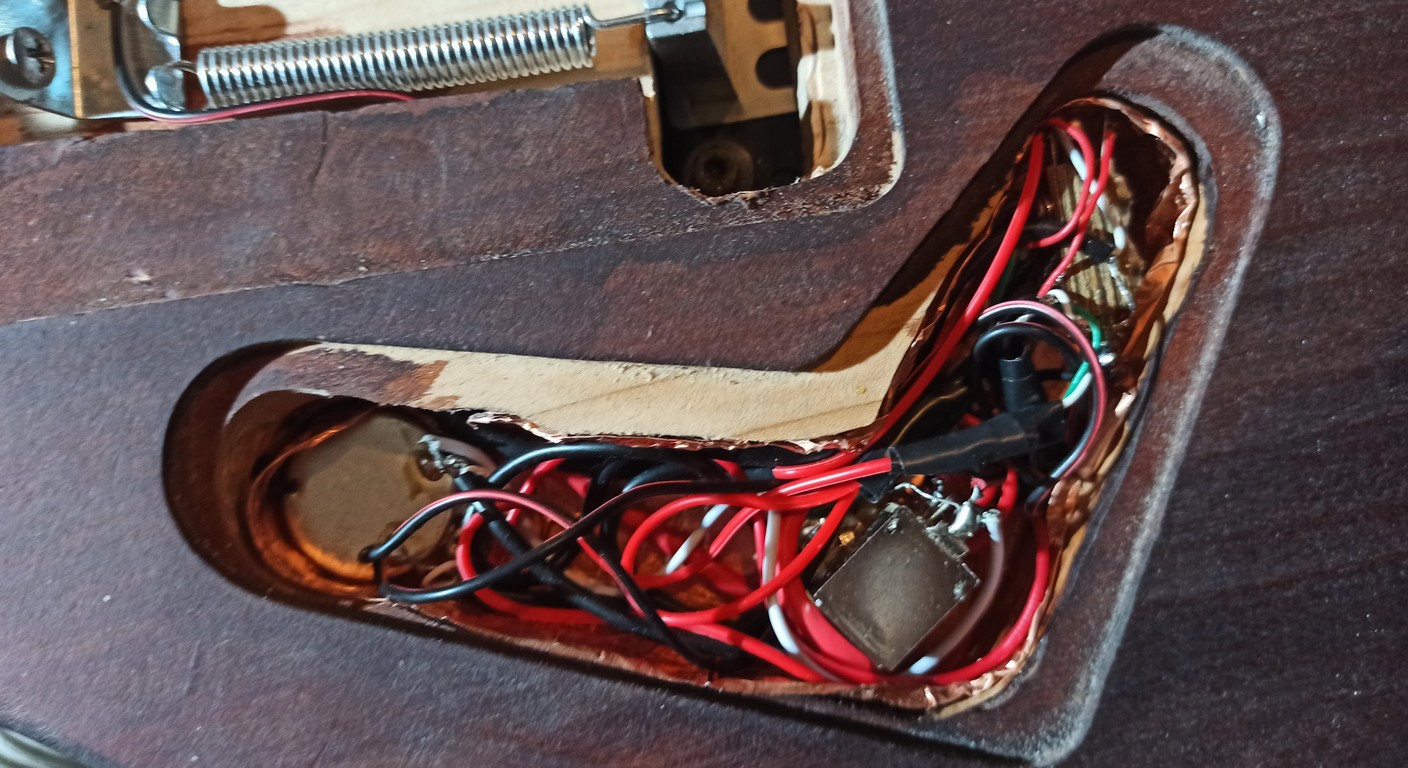
What is Earthing: It is the zero-potential reference point for all electrical components. All metal components that can pick up interference (pickups, potentiometers, bridge, strings) must be connected to this common ground point. Star Ground vs. Daisy Chain:n Daisy Chain: All components are connected in series to ground. Easy to implement, but can create ground loops that amplify noise. Star Ground (Star Mass): All ground connections converge to a single central point. This is more difficult to implement, but it minimizes ground loops and noise. It's my preferred solution for a wiring really clean.n Cavity Shielding:n Copper/Aluminum Foil: Line the inside of the cavities (pickups, electronics) with copper foil or adhesive aluminum foil. This creates a Faraday cage that blocks external interference. Make sure the foil is grounded. Conductive Paint: An alternative to foil, easier to apply in irregular cavities. Again, it must be grounded.

Common Grounding Mistakes and How to Avoid Them:n Cold Welding: A weak or broken ground connection is the number one cause of humming. Check every solder joint. Bridge Not Grounded: The strings and bridge act as antennas. Make sure the ground wire from the bridge is securely connected. Output Jack: The jack's sleeve is the main ground. Make sure it's well soldered. Broken Ground Wire: Sometimes, the wire from the bridge or some other component breaks. A multimeter can help you check this. How I Learned to Tame the Buzz in My Modded Guitars This is an article I wrote about this very thing, because I've been struggling with it for years. It's not a losing battle, I assure you! A good grounding is like the foundation of a house: it can't be seen, but if it's missing or poorly done, everything collapses. Take the time to do it well, and your signature model guitar he will thank you with an enviable silence.

Soldering and Interpreting: Say Goodbye to the Fear of Electrical Schematics

I know, soldering and electrical diagrams may seem like stuff for aerospace engineers. But trust me, it's not. I, who wasn't exactly a physics major in school, learned to solder decently and read a schematic. And if I could do it in my garage, with the light bulb acting up, you can do it too.

Welding: It's Not Open-Heart Surgery

Welding is a technique, not a mystical art. You learn, you practice, and you improve.

Minimum Essential Equipment:n Fine Tip Soldering Iron (30-40W): You don't need a thousand-euro soldering station. A good soldering iron with a clean, well-tinned tip (i.e., covered with a thin layer of tin) is perfect. I've been using an Ersa Multitip for years. Tin (60/40 or Lead-Free): The 60/40 (60% tin, 40% lead) is the easiest for beginners to use, because it melts at a low temperature and creates shiny joints. If you prefer lead-free, be aware that it requires higher temperatures and tends to be less visually “bright.” Desoldering Braid or Desoldering Pump: To correct errors. Essential. “Third Hand”: A stand with two alligator clips to hold wires and components. It's like having an assistant. Goggles: Always, don't joke with your eyes. Wet Sponge or Wire Wool: To clean the soldering iron tip. A clean tip is your best friend.

The Basic Technique (in 3 steps):n 1. Clean and Prepare: Clean the tip of the soldering iron. Clean the terminals of the components you want to solder (if they are oxidized, scrape them a little). 2. Warm, Don't Burn: Place the tip of the soldering iron on the terminals to be soldered, so that it heats up

Leave a Comment

en_USEnglish