

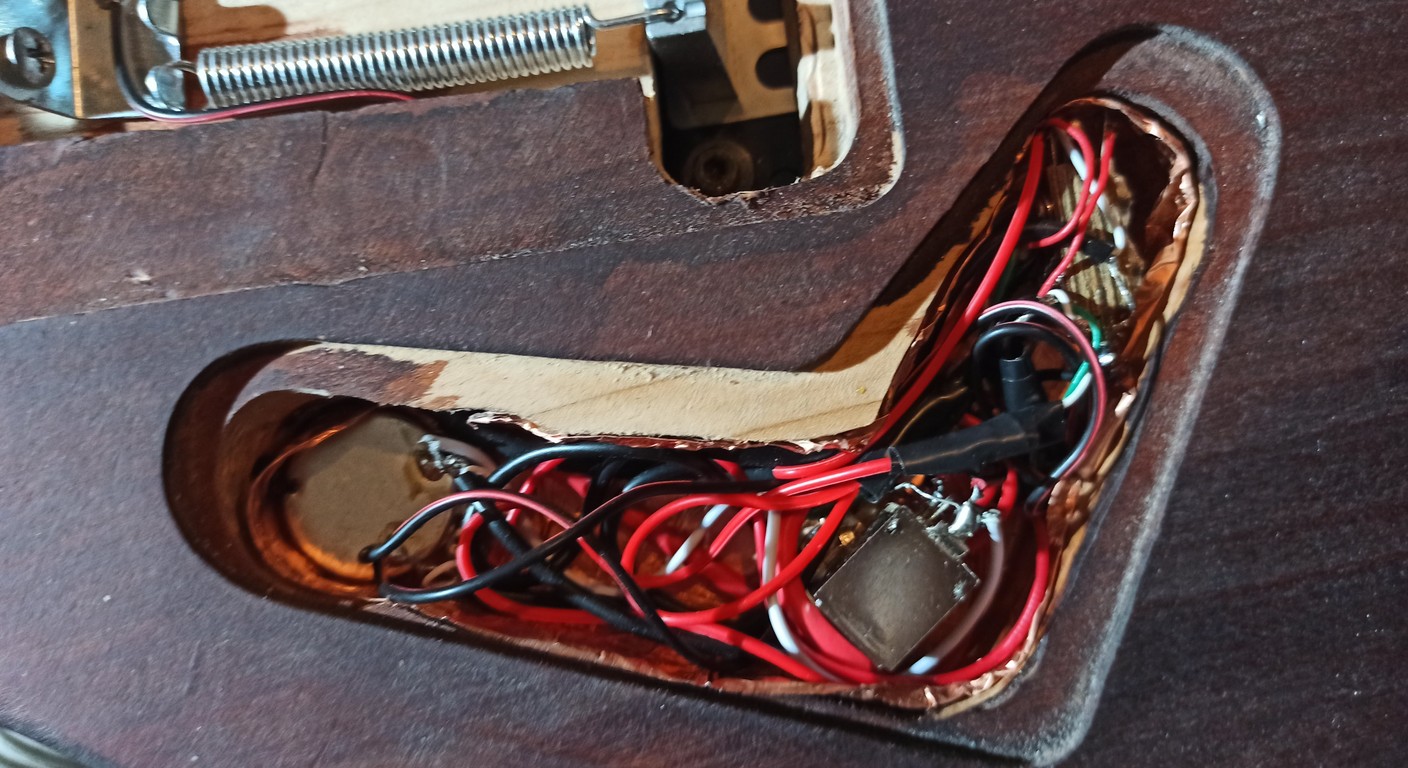
Guitar Killswitch Modification: Wiring

There's an effect, a sound, that when you hear it for the first time makes something click inside you. That rhythmic "cut and paste," that sudden silence that breaks the musical phrase and then restarts it with a burst of energy. I heard it live for the first time, on the guitar of a friend who played in a prog-metal band, and I said to myself: "I want this too!" Let's talk about killswitch guitar, a switch that, when pressed, instantly silences your six-string.

It's not for electronics wizards, I assure you. You don't need an engineering degree or years of experience with a soldering iron. All you need is a basic understanding of your guitar's signal path, a little patience, and a bit of soldering. I burned more potentiometers than I can remember and drilled crooked holes in a couple of bodies before learning, and I can tell you that if I can do it, you can too.

In this article I will not only explain to you as mount a muting switch, but also Why It works a certain way. We'll look at where to insert it into the circuit, what components you need, and how to avoid classic beginner mistakes (the ones I made, basically). The goal is to get you to the end with a solid understanding, not just a list of steps.

What is a killswitch and why do we want one on our guitar?

Tesi IDO Super M 10mm Kill Switch Gold
★ 4.7 (27 reviews)
See on Amazon

Let's start with the basics. A killswitch guitar It is, in its simplest sense, a momentary switch. This means it only works as long as you hold it down. Once released, it returns to its original position and the signal continues to flow. It's like a horn button, so to speak.

Its main purpose is to completely cut off the guitar's audio signal for a fraction of a second. Imagine playing a distorted riff, pressing the button, the sound disappears, releasing it, and the sound returns. If you do it in rhythm, you get that staccato, almost gating or chopper-like effect that has become a trademark for guitarists like Tom Morello (who used it with the pickup selector, but the concept is similar) and Buckethead. It's a way to add dynamics, groove, and a touch of aggression to your playing.

But it's not just a matter of sound effects. A killswitch It can also be useful in more practical situations. Like when you need to quickly switch guitars on stage and want to be sure you don't make any annoying noises while unplugging, or to quickly mute your guitar between songs without having to adjust the amp or guitar volume. It's a convenience, sure, but above all, a creative tool.

So why do we want it on our guitar? For the fun, the expression, the ability to explore new sonic textures. And because it's a relatively simple tweak that gives you instant satisfaction.

How it works conceptually: cutting the hot wire

The idea behind the killswitch It's simple: interrupt the flow of the audio signal. Think of your guitar signal as water flowing through a pipe. The kill switch is a valve that, when closed, stops the water from flowing. As soon as you open it again, the water starts flowing again.

In practice, this means that our switch is inserted “in series” with the wire carrying the “hot” signal (the hot signal) from the guitar to the amplifier. When the switch is open (i.e., not pressed, in its rest position), the signal passes undisturbed. When you press it, the switch closes, the circuit is broken, and the signal can no longer pass. Silence.

There are various types of switches. For a killswitch guitar, the choice almost always falls on a momentary Normally Open (NO) type switch. “Normally Open” means that, when not pressed, its contacts are open and the circuit is interrupted. But wait, I just said that the signal must pass when it is not pressed! And in fact, there is a trick here: the kill switch does not interrupt the signal by opening the circuit, but closing the signal to ground. Or, more commonly, it is wired so that interrupt physically the hot signal path.

Ok, let's get this straight. There are two main approaches to a killswitch or mute switch:

1. Hot signal interrupt (the real killswitch): This is what we'll be using. The switch is wired in series with the hot wire. When you press it, the contacts open and the hot signal can no longer pass to the jack. This type of switch is usually a momentary Normally Closed (NC) switch, or a Normally Open (NO) switch that must be pressed for a moment. close the circuit, but then you have to wire it so that when you press it it stops. Confused? Don't worry, we'll use a NO switch and I'll explain how to wire it to interrupt the signal. The point is that the hot signal is physically blocked.n2. Short to ground (the mute switch): Here, the switch, when pressed, connects the hot signal directly to ground. This "drains" the signal to ground, effectively muting the guitar. A Normally Open (NO) switch is often used, which, when pressed, closes the circuit between the hot signal and ground. This method works, but can sometimes generate a small "pop" or noise that's slightly different than pure signal interruption. For our purposes, killswitch guitar pure, we prefer the first option, which is cleaner.

So, to recap: we'll use a momentary switch, and wire it so that, when pressed, it interrupts the audio signal flow. This is the simplest and cleanest way to achieve the desired effect. Don't worry, it's easier said than done.

The fundamentals of electronics to avoid making a mess

Before you pick up the soldering iron, it's essential to understand how your guitar's electronics work. You don't need to be an expert, but knowing the basics will prevent you from doing any damage and help you understand the purpose of each step. It's not magic, it's physics. And a little garage patience is a must.

The signal path: the road of sound

Imagine the sound of your guitar as a small electrical impulse. This impulse originates from your pickups (which are essentially magnetic microphones). From there, it must travel to the amplifier and be transformed into music. The typical path is this:

1. Pick-up: They generate the signal.n2. Pickup selector: Decides which pickup (or combination) to send.n3. Potentiometers (volume and tone): They modify the signal (attenuate the volume, cut high frequencies).n4. Output jack: The last stage, from which the signal exits to the amplifier cable.

Our killswitch guitar It will be located along this road, at a strategic point.

Ground: the reference point

Every electrical circuit needs a reference point, which we call "ground." Think of ground as a collector where all signal returns meet, which serves to stabilize the circuit and minimize noise. Without a good ground, your guitar would be full of hum and noise.

Ground wires are usually black or uninsulated (bare wire). You'll find them connected to the metal part of potentiometers, the guitar bridge, and the shielding of the electronics compartment. This is a crucial element; never underestimate it.

The Hot Signal: The Real Sound

This is the wire that carries the sound. It's the "positive" of our audio circuit. It's usually an insulated wire, often red or white, that runs from the pickups and through all the controls (selector, potentiometers) to the "hot" terminal of the output jack. When we talk about interrupting the signal for the killswitch, it is precisely this thread that interests us.

Welding: the biggest fear, but you can learn.

“Oh no, I have to solder!” I know, it’s the phrase that terrifies many. But welding isn’t a test, it’s a technique. And you learn by doing it, and doing it again. My first attempt at soldering looked like a swallow’s nest made of tin. But with a little practice, it becomes easy.

What you need: Welder: A 30-40 watt amp is perfect for guitar electronics. You don't need to spend a fortune.
Pond: Prefer the one with a flux core (lead-free solder is best for your health, but the old 60/40 lead/tin is easier for beginners). A diameter of 0.8-1mm is fine.
Soldering iron stand: So as not to burn the table (or yourself).
Wet sponge or steel wool: To clean the tip of the soldering iron.
Protective glasses: The hot pond can splash.
Table fan: To keep fumes away (they're not the best to breathe).

Quick tips for good welding:n1. Clean the tip: Always. A clean, tinned tip (with a thin layer of solder) conducts heat better.n2. Heat the components, not the solder: Place the tip of the soldering iron on the wire and the terminal you want to join. Let them heat up. 3. Apply the tin: Once the components are hot, place the solder on them, not on the tip of the soldering iron. It should melt and flow, creating a shiny, conical joint.n4. Remove the solder, then the soldering iron: Hold still until the solder solidifies (a few seconds).n5. Practice: Take some old wires, a broken potentiometer, and practice. You'll see that after a while, you'll feel much more confident.

Where to Insert a Kill Switch in a Circuit: Options and Why

Okay, we've got the basics covered. Now comes the fun part: where the hell do we put this? muting switchThe position is crucial because it determines what will be muted when you press it. There are several options, but one is by far the most common and the easiest for a killswitch guitar effective.

Our goal is always the same: to interrupt the hot signal before it leaves the guitar.

Option 1: After the main volume (the most common and recommended)

This is the classic position, the one I highly recommend if it's your first time. killswitch It is inserted on the “hot” wire coming out of the master volume pot (or the last volume pot if you have more than one and there is no general master) and goes to the output jack.

Why is it the best? Simplicity: It's easy to identify the point where you need to intervene. There's only one hot wire exiting the entire control circuit.
Effectiveness: When you press the button, the entire signal generated by all pickups, already processed by the tone and volume controls, is cut off. It doesn't matter which pickup you've selected or how the knobs are set: silence is guaranteed.
Cleaning: The sound disappears completely, without residue or strange noises, because you actually interrupt the signal flow.

Conceptual scheme:
`Pickup(s) -> Selector -> Potentiometers (Volume/Tone) -> Master Volume Output -> KILLSWITCH -> Output Jack`

Basically, you identify the terminal on the master volume potentiometer where the hot wire runs to the jack. Cut that wire and insert your switch in the middle. One end of the wire goes to one terminal of the switch, the other end to the other terminal. It's a series connection, like a bridge that opens and closes.

I assure you, this is the straightest path. Don't get any crazy ideas about overcomplicating things if it's your first time. "Keep it simple" is the golden rule in the garage.

Option 2: After a single pickup (more complex, for the more adventurous)

This configuration is less common and definitely more complex. Here, the interrupting device It is inserted after a single pickup, before that pickup's signal reaches the selector or potentiometers.

Why might you want that? If you want to have an effect killswitch only on a specific pickup, maybe the bridge for aggressive riffs, leaving the others free.
To create more particular effects, combine the muting of one pickup with the sound of the others.

Warning: Complexity: This means you should have a killswitch for each pickup you want to control this way, or an additional switch to route a specific pickup's signal to the killswitch. The wiring becomes much more complicated.
Less versatile: If you want to mute the entire guitar, you should press multiple buttons at once (if you have a killswitch for each pickup) or use the master volume.

If you're not already familiar with complex electrical diagrams and don't know exactly what you want to achieve with this setup, I recommend leaving it alone for now. Let's stick with option 1, which will give you the most satisfaction with the least effort and the least risk of errors.

Option 3: Short to ground (the alternative “mute switch”)

This is not technically a killswitch which interrupts the signal, but a “mute switch” that diverts it. In this configuration, the momentary switch is wired so that, when pressed, it shorts the hot signal directly to ground.

How it works:
Imagine the hot signal coming in. When you flip the switch, you create a direct path from the hot signal line to ground. Since electricity tends to take the path of least resistance, the signal will prefer to go directly to ground rather than continue on to the amplifier. The result is silence.

Differences and considerations: Silence vs. interruption: The end result is always silence, but the way it's achieved is different. Signal interruption (Option 1) is "cleaner" at the circuit level.
Pop potential: Sometimes, especially with high-gain signals or if the circuit isn't perfectly shielded, this solution can generate a slight "pop" or background noise when the switch is toggled. This is because you're suddenly discharging a charge. electric on the ground.
Switch Type: For this configuration, a Normally Open (NO) switch is typically used, which, when pressed, closes the circuit between the hot signal and ground.

Personally, for a real killswitch guitar, I prefer Option 1. Physically interrupting the hot signal gives me the feeling of greater control and absolute silence, without the risk of that little "pop" that sometimes occurs with the ground-short approach. But it's good to know that this alternative is also available. For our purposes, we'll focus on Option 1.

Practical wiring of the kill switch: step by step

Well, it's time to get your hands dirty. Here I'll explain how to wire your killswitch Step by step. Don't rush, take your time, and follow along carefully. Remember: I've made mistakes plenty of times, and I've learned from them.

Materials needed: the garage shopping list

Before you begin, make sure you have everything you need on your workbench.

Momentary switch (push button): Look for a SPST (Single Pole, Single Throw) Normally Open (NO). 24mm or 30mm arcade button switches are popular for their sturdiness and ease of use, but you can also find smaller ones for a more subtle look. Make sure it's sturdy and has easy-to-solder terminals.
Soldering iron and tin: As discussed before.
Electrical cables: A piece of shielded wire (such as 22AWG) or two pieces of single-conductor wire. It doesn't need to be too long; 15-20 cm is enough.
Drill and bits: To drill a hole in the body or pickguard, start with a small drill bit and gradually widen it.
Multimeter: Useful for checking continuity and welds.
Screwdrivers, pliers, wire strippers: The basic tools in your DIY luthier kit.
Electrical tape or heat shrink tubing: To insulate welds.
Protective glasses and fan: For your safety.

Preparation: Don't ruin the finish!

This is a crucial step, don't underestimate it. A mistake here could ruin the look of your guitar.

1. Unplug everything: Unplug the guitar from the amplifier. Remove the strings (or loosen them significantly to access the electronics compartment). 2. Open the electronics compartment: Remove the pickguard or backplate, depending on the type of guitar. Put the screws in a safe place; don't be like me and lose them all the time! 3. Choose the hole position: This is the most delicate moment.
Ergonomics: Think about where it's most comfortable for you to press the button while playing. Usually, it's near the volume or tone knobs, within easy reach of your pinky or ring finger on your picking hand.
Interior space: Make sure there's enough room inside the electronics compartment for the switch and its wiring, without it touching other components, wires, or the backs of the potentiometers. Don't do what I did the first time, where I put it too close to a potentiometer and it wouldn't fit.
Aesthetics: Mark the spot precisely. Use a fine-tipped marker or pencil.n4. Drill carefully: Duct tape: Apply masking tape (such as auto body tape) to the area where you'll be drilling the hole. This helps prevent chipping the paint.
Pilot tip: Start with a very small drill bit (e.g. 2-3mm) to make a pilot hole.
Gradually widen: Then, using bits of increasing diameter, enlarge the hole to the diameter required by your switch (usually 12mm, 16mm, 24mm, or 30mm; check your switch's specifications). Proceed slowly, without forcing. If you're drilling a plastic pickguard, you can go a little faster, but always use caution.
Smooth the edges: Once the hole is drilled, you can use a small file or a larger bit turned by hand to slightly smooth the edges and remove any burrs.

Welding: the heart of the modification

Now that the hole is ready, we can proceed with the wiring of the killswitch guitar.

1. Identify the hot wire coming out of the master volume: This is the key step. On most guitars, the master volume pot will have three terminals.
One terminal goes to the pickup selector (input signal).
One terminal goes to ground.
One terminal (the center one or the one opposite ground) is the hot output signal, which goes to the jack.
Follow the wire from this terminal to the jack. That's our goal. If you're unsure, use the multimeter in continuity mode to trace the path. 2. Cut the hot wire: Using electrician's scissors or a wire stripper, cut the identified hot wire at a convenient point, leaving enough length on both ends for easy soldering. Leave a little margin; don't cut it too short! 3. Strip the ends: Strip about 5-7 mm of insulation from each end of the wire you just cut.n4. Prepare the switch: If your switch has ring or tab terminals, you can pre-tin them (apply a little solder to them) to make soldering easier.n5. Weld the first piece: Take one end of the cut wire and solder it to one of the terminals of your momentary switch. Remember the technique: heat the wire and the terminal, then apply the solder. n6. Solder the second end: Take the other end of the cut wire and solder it to the other terminal of the switch.
Attention: You're creating a series connection. The signal must "pass through" the switch. If the switch is Normally Open (NO), when it's not pressed, the circuit is open and the signal doesn't pass. This is the exact opposite of what we want for a kill switch!

IMPORTANT CORRECTION (Mimmo style):
Ah, there you go, I got carried away with the theory and made a mess! That's exactly where it goes wrong, and it's a classic mistake. We don't want a Normally Open switch for
stop the signal when you press it. We want a switch that is Normally Closed (NC) when not pressed, and that open the circuit when you press it.

Let's take stock, which is important:
For a real killswitch guitar That
interrupts the hot signal when pressed, you have two switch options:
Normally Closed (NC) momentary switch: This is ideal. At rest, the contacts are closed and the signal passes. When you press it, the contacts open and the signal is interrupted. It's the most intuitive for this purpose.
* Normally Open (NO) momentary switch wired to short to ground: This is what I described to you as an alternative "mute switch." Here, at rest, the circuit is open. When you press it, it closes the circuit between the hot signal and ground, muting everything. It works, but it can pop.

My recommendation for a clean killswitch is a NC momentary switch.
If you have already bought a Normally Open (NO), do not despair, you can use it for the short circuit to ground option

See also

Leave a Comment

This site uses Akismet to reduce spam. Learn how your comment data is processed.

en_USEnglish