

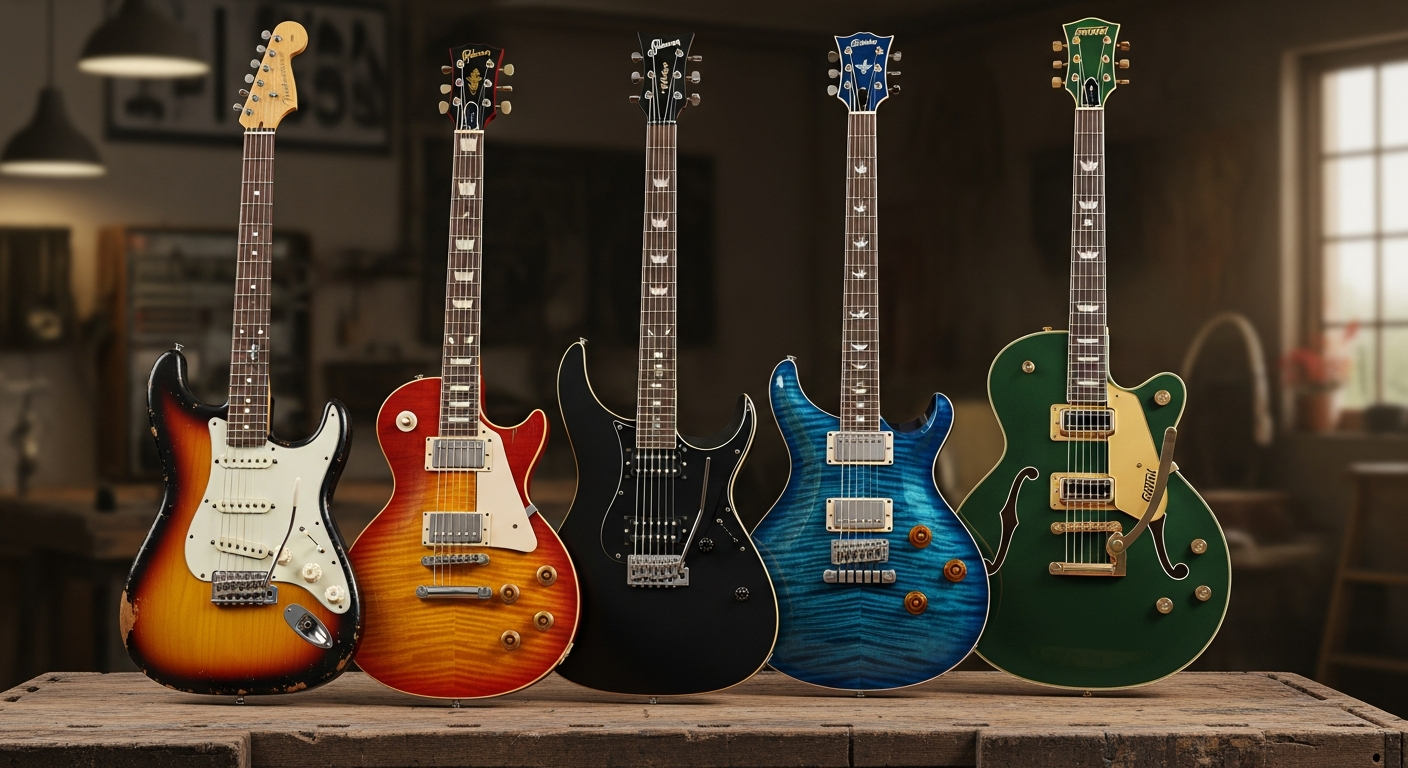
Fender Am Pro II Stratocaster Review: Advantages and Disadvantages
So, let's be clear: when we talk about Fender American Professional The Stratocaster, We're not talking about just any guitar. It's not the latest arrival from the budget catalog,It's a toy to hang on the wall. This is one of those guitars that makes you think, makes you sweat about your mortgage, and makes you dream of sleepless nights spent practicing riffs.
In the garage, between one wiring harness and another, I've often found myself working on tools of all kinds. From cheap replicas to older models. The American series Professional II, or Am Pro II as we call it for convenience, is one of those that often ends up under the magnifying glass.
Why are we talking about this? Simple. Many of you, like me years ago, find yourself at a crossroads. You've outgrown the first budget guitar phase, maybe you've already modified a couple of Squiers or Epiphones, and now you're feeling the call of the "real deal." You want to know whether to invest a significant sum on a Fender American Professional II Stratocaster it makes sense.nI'm not a professional luthier, I've always said that. I'm someone who learned by making mistakes, who burned a few potentiometers and drilled a few holes in the wrong place. But precisely for this reason, I know what it means to look for practical answers, those that make you understand if a certain instrument really suits you, or if it's money thrown away.
So, let's put aside the glossy marketing and see this Strato for what it is: a piece of wood, metal, and electronics, with a significant price tag and important promises. Let's analyze it, take it apart (metaforically, for now) and try to understand if it's the right guitar for your next project or for your jam sessions.nn
Tech Specs: What's Under the Hood of the Am Pro II
nn nnnnnn
What fans say
nnnn
nMany call it a modern “workhorse”. A lot of people appreciate its versatility. It's not an extreme guitar in any sense, but it does a bit of everything well. From blues to rock, passing through pop and funk, it adapts.The Deep C neck It's one of those elements that divides. Those who love it praise its comfort and solid feel. Those who don't like it find it too thick, preferring thinner, faster profiles. It's a matter of taste, but it's something to consider if you have small hands or are used to very thin handles.
THE V-Mod II pickups They're another point of contention. Some people find them fantastic, with just the right mix of vintage and modern, capable of cutting through the mix without being too shrill. Others, more purist, find them a bit too "clean" or "sterile" compared to vintage-style pickups, or perhaps would prefer something with more character and less output. I've heard people say, "They're good, but they don't have the soul of the old alnico Vs.".
The function push-push that activates the neck pickup is almost universally appreciated. It's a clever modification that adds a lot of sonic options without altering the aesthetics. Many see it as an added value, especially for those who, like us, love to experiment with sounds.nn
Complaints from budget-conscious shoppers (and not only)
Here we come to the sore points, or at least, the expectations that are not always met, especially considering the price.The most debated point? The non-locking mechanics. On a guitar costing around €1,800-2,000 (prices fluctuate, but we're talking about it), many expect locking tuners to come standard. They're a huge convenience for tuning stability, especially when using a tremolo. I've heard more than one guitarist say, "It's a shame, I would have liked them factory-installed, but now I'll have to install them myself."“
And this brings us to a key point for us tinkerers: many see the Am Pro II as a great base, but with room for improvement. Not so much for intrinsic defects, but for customization. Some people immediately think of changing the pickups, some want locking tuners, some perhaps a different bridge. This isn't a defect, but it's an indication that the guitar, while high-quality, isn't "perfect" for everyone, and the expense doesn't always end with the purchase.
Another criticism that sometimes comes up is on the factory setup consistency. While Fender's quality control is excellent, you may receive a guitar that requires a complete setup (action, intonation, pickup height) right out of the box. This is common with any new instrument, but at this price point, you expect it to be almost plug-and-play.
Finally, the price. It's high, there's no denying it. And for many, the question is: “Is it worth it compared to a Player Plus or an American Performer, perhaps modified?” It's a legitimate question, and the answer is never simple.nn
Pros and Cons: My honest assessment in relation to the price
nnnnnnNow that we have put the features and network chatter on the table, let's sum up. How does this position itself Fender American Professional II Stratocaster in the landscape of high-end guitars, especially in relation to how much they ask us to take it home?nn

The Advantages (Pros)
nn1. Sonic versatility: The V-Mod II pickups, combined with the push-push system, offer an impressive range of sounds. From crystal-clear twang to full-bodied rock, this guitar can adapt. For those who play in different contexts, this is a significant advantage. You don't have to change guitars for every genre.n2. Handle comfort: The Deep C profile, if you like, is extremely comfortable. It offers excellent sustain and a robust feel under the fingers. The satin finish on the back is a classy touch that makes it easy to play.n3. Tuning stability: Despite the lack of locking tuners, the two-point tremolo and bone nut do a great job. With proper setup and well-adjusted strings, the guitar holds its tuning more than decently.n4. Build quality: It's a Fender made in the USA. The attention to detail, wood selection, and assembly are top-notch. It's not a guitar that will cause any short-term structural or finish issues. n5. Access to the high keys: The sculpted neck heel is a detail I really appreciate. If you're someone who often ventures beyond the twelfth fret, you'll feel the difference.nnThe Disadvantages (Cons)
nn1. High price: This is the sore point. At over €1,800, it's not an impulse purchase. Expectations are sky-high for that price. And here's where the "buts" come in. #2. No locking tuners: Again, it's almost standard on guitars in this price range. Not having them as standard means many users, myself included, will immediately consider upgrading. It's an additional cost, albeit a small one, on an already expensive guitar.n3. Deep C is not for everyone: If you have small hands or prefer super-thin handles for speed, you might not be comfortable with this one. It's essential to try it before buying; don't just rely on reviews. n4. The V-Mod II: love it or hate it: They're not Fender's most distinctive pickups. If you're looking for the pure vintage sound of a '60s Strat, you might find them a bit too modern. If you're looking for a more versatile and defined sound, you might like them. But it's a matter of taste, and taste sometimes leads you to spend more money on a pickup replacement. Upgrade Potential: Paradoxically, the fact that it's an excellent base can also be a disadvantage, considering the price. One might expect that at that price, there's little or nothing to improve for one's needs. Instead, for many, it's just the beginning of a series of improvements. modifications and customizations.In short, the Fender American Professional II Stratocaster offers a high-quality package, with excellent versatility and solid construction. The price, however, puts it in competition with instruments that perhaps offer more in terms of standard “extras” (like locking tuners) or with a more specific sonic character. It's a matter of compromises.nn
Who is the Am Pro II Stratocaster suitable for? And who should avoid it?
This is the million dollar question, or in this case, the almost two thousand euro question. There is no perfect guitar for everyone, and the Fender American Professional II Stratocaster is no exception. Let's try to understand who it can give the most to and who would do better to look elsewhere.nnWho is it suitable for:
nn1. The versatile musician: If you're someone who spans different genres—blues, rock, funk, pop—and need a guitar that can adapt to everything without changing instruments, this Strat is a great choice. Its sound palette is broad and well-balanced.n2. Those looking for a definitive upgrade (but on a budget): If you own a Squier or Fender Player and feel like it's time to upgrade, but want to stay true to Fender without going for the Custom Shop or ultra-boutique models, the Am Pro II is a great choice. It offers superior build quality, better tonewoods, and more reliable hardware.n3. Those who appreciate the comfort of the “Deep C” handle: If you've had a chance to try it and find it comfortable, or if you have large hands and are looking for a neck with more "meat", then this guitar will fit you perfectly.n4. Who wants a solid foundation for future changes: Despite the price, if you're a DIY enthusiast and already know you'll want to tinker with the electronics, pickups, or hardware, the Am Pro II offers an excellent starting platform. You start with quality woods and construction, which is always an advantage. I remember the first time I tried to put a different set of pickups on a cheap guitar, and I had to redo half the routing. Here you won't have these problems.nnWho should avoid it (or think twice):
nn1. The vintage sound purist: If your reference is the sound of a '50s or '60s Strat, with the harsh, ringing character of less powerful pickups, the V-Mod IIs may not be entirely satisfying. You may end up replacing them, adding unnecessary cost.n2. Those on a budget: If you're on a tight budget and every dollar counts, this guitar is a solid investment. There are excellent, lower-priced alternatives (even Fender) that could give you the 80%'s performance at half the price, leaving you room for modifications.n3. Those who prefer ultra-thin and fast handles: If you're used to necks like the Ibanez Wizard or similar, the Deep C will feel like a tree trunk. This isn't a pure shredder's neck. Try it, but be aware.n4. For those who expect “out-of-the-box perfection”: Even though it's a high-end guitar, you're not guaranteed to receive it with the perfect setup for your hands. It'll likely require a good professional setup or, if you're like me, a few hours in your garage to fine-tune it to your tastes. And the lack of locking tuners, at that price, is a detail that can be annoying.n5. Those looking for a very specific sound character: If you have a specific sound in mind, perhaps for a niche musical genre, and you know that stock pickups won't cut it, consider whether it's worth spending a lot on a foundation that you'll later heavily modify. It might be wiser to start with a lower-end guitar and invest the difference in specialized pickups and hardware.In short, the Fender American Professional II Stratocaster is an excellent guitar for many, but it's not the answer to all prayers. Carefully evaluate your priorities, your sound style, and, above all, your budget.nn
Final advice and plausible alternatives
After having thoroughly examined the Fender American Professional II Stratocaster from every angle, it's time to draw conclusions. If you asked me, “Mimmo, should I buy it or not?”, my answer wouldn't be a simple yes or no. It depends, as always.nnMy honest advice
If you're on a budget and looking for a versatile, well-built Strat with a comfortable neck (if you like the Deep C) and a good foundation for playing live or in the studio, the Am Pro II is a solid choice. It's a guitar that will last you for years, and it won't disappoint in terms of reliability and sound quality.But, there is a but. Budget for a small additional expense for the locking tuners. Trust me, your tuning stability will improve significantly, especially if you use a tremolo. It's a simple modification you can do yourself in your garage with a few tools and a little patience.
And a good setup, of course. Don't expect it to come out of the box perfect for you. Every guitar, even the most expensive, deserves to be set up to your strings and your playing style.
Consider this guitar as an excellent starting point, not as the definitive destination. It's an investment, and like any investment, it needs to be well thought out.nn
Alternatives to consider
If the Fender American Professional II Stratocaster doesn't completely convince you, or if the budget makes your knees tremble, here are some alternatives worth examining:nn1. Fender American Performer Stratocaster: A step below the Am Pro II in terms of price, but still offers excellent Made in USA quality. It has Yosemite pickups, a Modern C neck, and a vintage-style tremolo. It's less "modern" in the details, but for many, that's exactly what they're looking for. Excellent for those who want a more traditional sound.n2. Fender Player Plus Stratocaster: This is a series I really like for its quality-price ratio. Made in Mexico, but with Player Plus Noiseless pickups, a 2-point bridge, and, listen up, locking tuners as standardThe neck is a Modern C, and the finish is excellent. If you want a lot of modern features without breaking the bank, and you don't care about the "Made in USA" label, this is a choice worth keeping an eye on. With the money you save, you might even consider swapping out the pickups to customize the sound.n3. Fender Vintera II Stratocaster: If your heart beats for vintage, the Vintera II series (Made in Mexico) features specs from specific years (e.g., '50s, '60s, '70s). Thicker necks, smaller frets, and era-specific pickups. They're not as modern as the Am Pro II, but they have an unmistakable character and aesthetic. For purists, it's a solid option. Used Guitars (American Standard/Professional I): Don't underestimate the used market. An American Standard or an American Professional A first-generation Stratocaster in good condition can be an incredible deal. You can often find them at much more affordable prices, and with a good setup and maybe a few small modifications, you can have a top-notch guitar. I've refurbished several used Strats, and I can assure you, the satisfaction is doubled. Building your own “partcaster”: This is my favorite solution, you know. If you want to get your hands dirty, you can buy a quality body and neck (even from non-Fender manufacturers, there are excellent luthiers who sell parts) and assemble your own custom Strat. Choose the pickups you want, the hardware you prefer, the wiring you like. I assure you, with a little research and patience, you can build a guitar that sounds and feels better than many high-end models, and for a fraction of the cost. And the satisfaction of saying "I made it myself" is priceless.The final choice is always yours. Do your research, try as many guitars as you can, and don't be afraid to ask for advice. And if you decide to buy the Fender American Professional II Stratocaster, know that you have an excellent instrument in your hands. But never stop tinkering with it, eh! That's where the real fun begins.nn
Frequently Asked Questions (FAQ)
While writing, some questions came to mind that you are probably also asking yourself. Let's try to answer them directly.nn1. Are V-Mod II pickups loud?
nno, for single-coils, the V-Mod II are quite quiet. Fender has worked to reduce the typical single-coil background noise (hum), while maintaining their character. They are not “noiseless” like humbuckers or stack pickups, but the hum is managed very well. In my tests, under normal rehearsal room conditions, the noise is acceptable.nn2. Does the satin finish on the handle wear easily?
The satin finish on the back of the neck is quite durable, but like any finish, with intense use it will tend to polish in the areas of contact with the hand, slowly transforming into a kind of “glossy satin”. It's not a defect, but normal aesthetic wear. For me, it's an advantage, because it becomes even smoother.nn3. Can I install the locking tuners myself?
Absolutely yes. If you have a minimum of manual skill and the right tools (a screwdriver, a wrench for the tuner nuts), you can do it without problems. Many aftermarket locking tuners are “drop-in”, meaning they mount in existing holes without modifications. I advise you to look for specific tutorials online or on my site. It's one of the first modifications I suggest to improve tuning stability.nn4. Is the push-push system worth it?
Yes, for me it's worth it. It adds remarkable versatility without altering the classic look of the guitar. Having the ability to activate the neck pickup in combination with the bridge (or all three together) opens up to sounds that you wouldn't have with a traditional Strato. It's an extra that I really appreciate, and which is usually a modification done in the workshop.nn5. Is the Am Pro II good for metal?
nnIt's not its main calling, let's face it. V-Mod II pickups are single-coil and, despite having good output, are not designed for extreme sounds. For metal, high-gain humbuckers and a flatter neck are usually sought. You could mount a bridge humbucker (with a pre-routed pickguard) and make modifications, but if metal is your main genre, there are probably more suitable guitars from the start. It's not impossible, but it's not the most straightforward choice.nn6. Where can I find the official Fender specifications?
For the most detailed and up-to-date specifications, I recommend always consulting the official Fender website. There you'll find all the precise information on woods, hardware, finishes, and often, manuals. It's always the most reliable source to avoid misunderstandings. You can find the product page here.I hope these answers help you further clarify your thoughts on the Fender American Professional II Stratocaster. The most important thing is always to try it in person, if possible, and understand if the feeling is right for you.nn
nnnn
See also
n- n
- Fender American Performer Telecaster Review: Is It Worth It? n
- Fender American Performer Stratocaster review n
Download the Luthier Survival Kit
Free PDF with checklist, problem-cause table and project card template.
 English
  Italiano
Stuck on your build?
If you ran into the same problem or have a question, drop it in the comments. I read and reply to every one.
Write a comment