

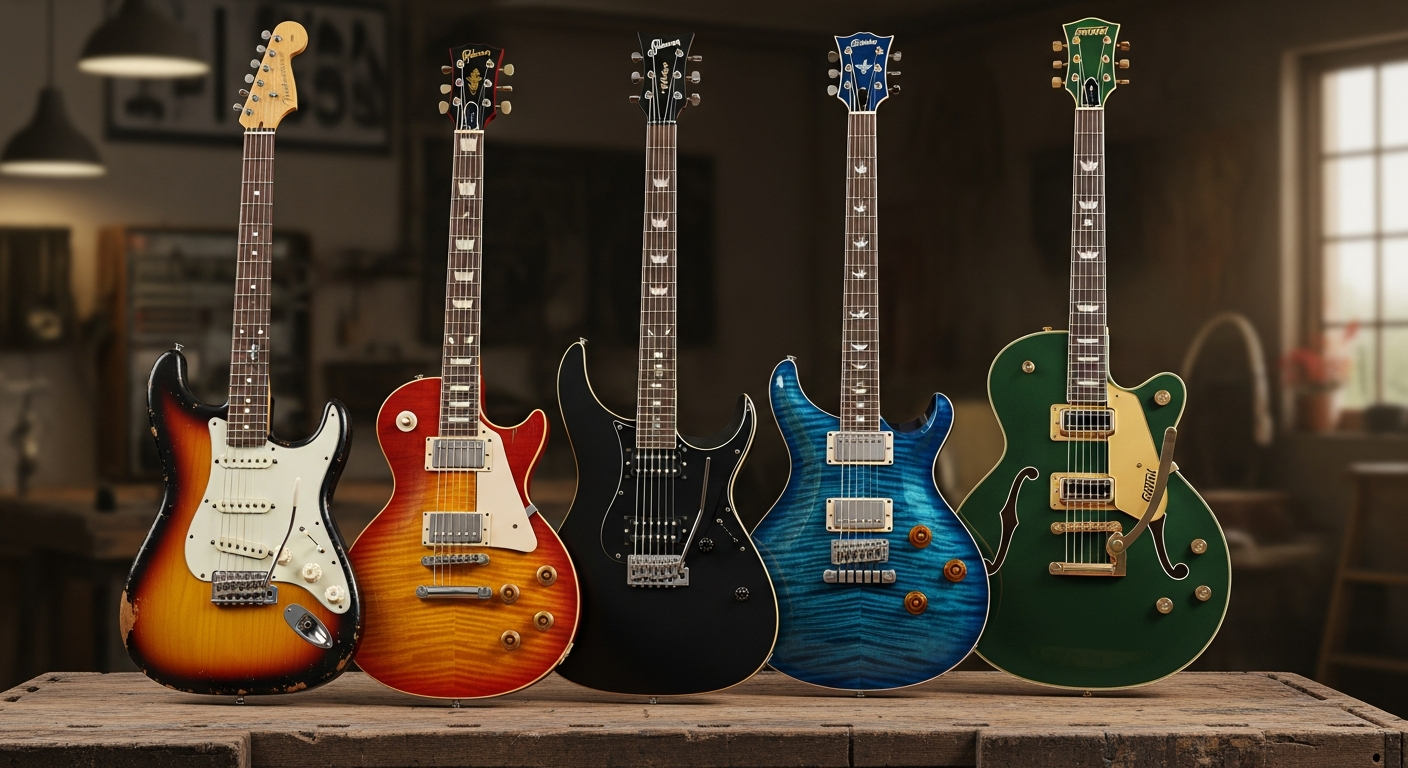
PRS S2 Standard 24 Review: Complete Analysis
Sooner or later, anyone of us who hangs around the world of electric guitars a bit will find themselves with a nagging thought in their head: “I want a PRS”. It's not just a brand, it's a philosophy. But let's face it, the price list of the Core Series, those that make you dream with figured tops and museum-quality finishes, often makes you lose the desire to dream and brings you back down to earth, or rather, into the garage. The wallet cries, and your wife (or the mortgage) gives you a dirty look. And here comes the PRS S2 Standard 24. It's Paul Reed Smith's answer to those who want a piece of Stevensville, Maryland, without having to mortgage their house. But is it a “real” PRS? Does it work? Is it worth the money? These are the questions I asked myself, and that you're probably asking yourself too, if you're here. I got my hands on several examples of this guitar, I disassembled it, adjusted it, and listened to quite a few opinions around. Let's see what came out of it. The question is always the same: you want that mix of playability, tonal versatility, and build quality for which PRS is famous, but with a budget that doesn't force you to eat plain pasta for the next six months. The PRS S2 Standard 24 it presents itself as the intermediate solution, the one that stands between the economical (but excellent) SEs of Asian production and the stratospheric Cores. Is it a compromise? Certainly. But is it a well-made compromise? This is the crucial point. When talking about guitars, especially at these price levels, you don't just buy wood and hardware. You buy an experience, a sound, a feeling under your fingers. And you buy the peace of mind of knowing that, if something goes wrong, it's not the guitar's fault, but ours. I've seen a lot of "economical" guitars that, with some targeted intervention, manage to sound amazing. But with a PRS S2, the starting point should already be solid. Let's see together if that's the case.
Technical Specifications: The Identity Card of the PRS S2 Standard 24
Before delving into “feelings” and opinions, it's essential to understand exactly what we're talking about. The PRS S2 Standard 24 it's not just any guitar; it carries the DNA of an iconic brand, even with some choices that differentiate it from its older sisters in the Core Series. Below you will find an overview of its technical specifications, based on information provided by PRS and on my direct experience with various models.
Body (Body)
The body è made entirely of solid mahogany. This is a classic choice for PRS and contributes significantly to the guitar's sustain and resonance, offering a warm and round sound with good attack. Unlike the Custom 24 (also S2), it does not feature a figured maple top, which is one of the factors that lowers its cost and gives it a more sober, but no less elegant aesthetic.
Neck (Neck)
Also the handle is in mahogany, with a “Pattern Regular” profile. This profile is a classic PRS: comfortable, not too thin
It is too thick, it adapts well to different hands and playing styles. It is an excellent compromise between speed and comfort, allowing both complex chords and fast riffs.
The construction is of the “set neck” type, meaning the neck is glued to the body. This is another key element for sustain and resonance, typical of high-quality guitars.
Fretboard (Fretboard)
- Wood: Rosewood (Rosewood), a standard choice for its soft feel and contribution to a warm sound.
- Keys: 24 keys, perfect for those looking for a complete extension for solos and high-speed passages.
- Stairs: 25 inches (635 mm), the “hybrid” scale length of PRS. It sits between the 24.75″ of Gibson and the 25.5″ of Fender, offering a balanced mix of string tension, ease of bending, and harmonic richness.
- Intarsi (Inlays): Generally, the most recent S2 Standard 24 models feature the classic “Bird Inlays” in acrylic, an icon of PRS. Some older or specific models might have “Dot” inlays.
Pick-up
There PRS S2 Standard 24 is equipped with pickup PRS 85/15 “S”. These are humbuckers designed to replicate the sound of the 85/15 pickups from the Core Series, but with a more efficient production process for the S2 line. They offer a balanced sound, with good clarity and versatility.
Controls
The configuration of the controls is simple and effective:
- 1 Volume
- 1 Tone with Push/Pull function for coil split (transforms humbuckers into single coils, enormously expanding the tonal range)
- 3-way selector (blade switch) to choose between neck pickup, both, or bridge pickup.
Hardware
The hardware is another strong point that inherits PRS quality:
- Bridge: PRS Patented Tremolo. This tremolo is famous for its tuning stability and fluidity. It's not a Floyd Rose, but it allows expressive bends and vibratos without problems.
- Tuners: PRS Low Mass Locking Tuners. These locking tuners contribute significantly to tuning stability and make string changes a breeze.
- Hardware Finish: Nickel.
Finish
Finishes are typically glossy polyurethane, offering durability and a refined look. As mentioned, don't expect the flame tops or complex finishes of the Core Series, but the paint quality is still high and free of imperfections.
For a more detailed and updated overview of the specifications, you can consult the official product page on the PRS Guitars website: PRS S2 Standard 24
Popular Sentiment: What's Being Said About the PRS S2 Standard 24?
When a guitar like the PRS S2 Standard 24 arrives on the market, it doesn't take long to generate debates and discussions among enthusiasts. I spent hours on forums, social groups, and chatting with other guitarists in stores or rehearsal rooms, and I've gathered a bit of the pulse of the situation. The general consensus is that the S2 Standard 24 is a solid guitar, but with some “buts”.
The Merits Acclaimed by the Community
- Playability and Comfort: This is the point everyone agrees on. The “Pattern Regular” neck is a blessing, and the 25″ scale makes the guitar incredibly comfortable to play. The action can be set very low without buzzing problems, and the 24 frets are well-finished. Many say it's a guitar that “invites you to play”.
- Made in USA Build Quality: Despite the lower price compared to the Core, the S2 Standard 24 is built in Stevensville, Maryland. This translates into impeccable assembly, good quality woods (the mahogany is resonant), and a general feeling of robustness and reliability. There are no flaws, the joints are perfect.
- Tuning Stability: The combination of the patented PRS tremolo bridge and locking tuners is a guarantee. You can abuse the tremolo arm (within the limits of a non-locking system) and the guitar will return to pitch without problems. This is a huge advantage for those who play live or record.
- Tonal Versatility: Thanks to the 85/15 “S” pickups and the push/pull for coil splitting, this guitar covers a wide range of sounds. From classic rock to blues, from fusion to light metal, the S2 Standard 24 performs admirably. It's not a “one trick pony”, and this is very appealing to those who need a guitar for different contexts.
- Quality/Price Ratio (for a USA model): Many see it as a unique opportunity to enter the world of Made in USA PRS without emptying their bank account. It's a significant investment, but you have the certainty of a high-level product.
The Criticisms and the Common “Buts”
ot all that glitters is gold, and also the PRS S2 Standard 24 has its weaknesses, or rather, its compromises. And this is where the famous “popular sentiment” comes into play.
- The PRS 85/15 “S” Pickups: This is probably the most debated point. They are not “bad” pickups; in fact, they are clear, balanced, and versatile. The problem is that, for many, they don't have that “character” or “magic” expected from a high-end PRS. They are often described as a bit “generic” or “sterile”. Many buyers end up changing them, making it an excellent base for future modifications. Personally, I find them honest for the price, but I understand those who seek more.
- “Sober” Aesthetics: The absence of the figured maple top is one of the biggest visual differences compared to the Core and S2 Custom. For some, the solid mahogany finish is elegant and understated. For others, it lacks that “wow factor” aesthetic associated with the PRS brand. It's a matter of taste, but it's a recurring complaint.
- Lack of Core Series “Mojo”: This is a more abstract concept, but many guitarists who have tried both the S2 and Core Series report a difference in the overall “feel”. The Core, with their more elaborate finishes, selected woods, and boutique pickups, convey an aura of luxury and craftsmanship that the S2, while excellent, cannot match. It's like comparing a BMW 3 Series with an M3: both fantastic, but one has that something extra.
- Price not “Cheap”: Although it is much more accessible than a Core, the S2 Standard 24 is not a cheap guitar. Its price places it in a range where competition is fierce, with brands that perhaps offer more “boutique” stock pickups or more attractive aesthetics for the same price. This leads to careful evaluations and the question: “Is it really worth it, or could I get more elsewhere?”
Pros and Cons of the PRS S2 Standard 24 in Relation to the Price
After analyzing the characteristics and the general sentiment, it is time to draw conclusions and weigh the true pros and cons, always keeping in mind the price positioning of this guitar. Remember, we are talking about a Made in USA guitar with a cost ranging around 1500-2000 euros (the price may vary).
PRO: The Strengths that Justify the Price
- Accessibility to “Made in USA” PRS: This is the main advantage. You get a guitar built in the United States, with the same quality control standards and the same attention to detail as the Core Series, but at a fraction of the cost. For many, this is a decisive factor.
- Impeccable Build Quality and Reliability: The solders are clean, the frets are well finished, the hardware is precisely mounted. It is a robust guitar, made to last and to be used. You will not have problems with crackling electronics or parts that loosen after a few months.
- Superior Playability and Comfort: The Pattern Regular neck is one of the best around, and the rosewood fretboard with 24 frets is a pleasure to play. The 25″ scale is a perfect balance. If comfort is your priority, the S2 Standard 24 excels.
- Tuning Stability and Tremolo Functionality: The PRS tremolo system is a masterpiece of engineering. Coupled with locking tuners, it guarantees solid tuning even with moderate use of the whammy bar. This is a crucial point for musicians who rely on the tremolo.
- Remarkable Timbral Versatility: The 85/15 “S” pickups with the split coil make it a chameleon guitar. You can switch from powerful rock sounds to crystalline single coils with a simple push/pull. It's a true “workhorse” for those who play different genres.
- Excellent Platform for Upgrade: If the stock pickups don't fully satisfy you, the S2 Standard 24 is a fantastic base for an upgrade. The mahogany body, neck, hardware, and construction are of such quality that installing boutique pickups (for example, Seymour Duncan, Bare Knuckle or even PRS Core pickups) transforms it into a guitar that can rival much more expensive models.
CONS: The Compromises to Consider
- The Pickups “S” Are Not for Everyone: As mentioned, although good, the 85/15 “S” pickups do not have the same character or harmonic complexity as the Core pickups. They might lack that “punch” or “sweetness” that some look for in a PRS. This is the biggest compromise in terms of “out of the box” sound.
- Less “Premium” Aesthetics than the Core Series: The absence of the figured maple top is the main aesthetic factor that distinguishes it. If you dream of the breathtaking beauty of the PRS Core, the S2 Standard 24 might leave you a little disappointed visually. It's a matter of taste, but it's a fact.
- Lack of the Boutique “Wow” Effect: Despite the build quality, the S2 Standard 24 does not have the same “luxury” or “art instrument” feel that you get with a Core Series. It is an excellent workhorse, but not a collector's item in the strictest sense.
- Price Still High for Some: Although it is an “affordable” PRS USA, its cost still places it above many mid/high-end guitars. For those with a very tight budget, a well-set-up PRS SE Custom 24 or a guitar from another brand (like Ibanez or Schecter) in the same price range might offer a better perceived quality/price ratio, especially when considering the stock pickups.
Who is the PRS S2 Standard 24 Suitable For? And Who Should Avoid It?
Understanding who a guitar was designed for is essential for a conscious purchase. The PRS S2 Standard 24 is not for everyone, but for its target audience, it is an excellent choice.
This Guitar is Perfect If...
- Do You Want a PRS Made in USA at an Affordable Price: If your dream is to own a guitar built in Stevensville, Maryland, but the Core Series budget is out of reach, the S2 Standard 24 is your ideal entry point. You get PRS build quality and playability without having to sell a kidney.
- Looking for a Versatile “Workhorse”: Do you need a reliable guitar for studio, rehearsal room, and live, capable of switching from clean and crystalline sounds to powerful distortions without batting an eyelid? The tonal versatility offered by the 85/15 “S” pickups and coil split makes it perfect for genres ranging from rock to blues, from fusion to pop, and even light metal.
- Do You Appreciate PRS Playability and Ergonomics: If you have already tried a PRS Pattern Regular neck and appreciated its comfort, or if you are looking for a guitar with low action and superior ease of use, the S2 Standard 24 will not disappoint you. It is an instrument that allows you to focus on the music, not on struggling with the instrument.
- Are You Willing to Consider a Pickup Upgrade: If you are a guitarist who loves to experiment with sounds and is not afraid to get your hands on the guitar (or have a luthier do it), the S2 Standard 24 is an excellent base. With a pickup change, you can elevate its sound to truly professional levels, choosing the tonal character you prefer.
- Do You Prefer Sober and Functional Aesthetics: If you are not a fan of super figured tops and flashy finishes, but appreciate the beauty of solid mahogany and a clean, no-frills design, the aesthetic of the S2 Standard 24 might be exactly what you are looking for.
Better to Avoid the PRS S2 Standard 24 If…
- Is Your Budget Very Tight: Although it is the most affordable USA option, the price of the S2 Standard 24 is still significant. If your budget is under 1000 euros, there are excellent guitars in the PRS SE series or from other brands that could offer you better value for that price range.
- Are You Looking for the Aesthetics and “Mojo” of the Core Series: If your dream is a PRS with a jaw-dropping flamed or quilted maple top, a deep glossy finish, and that “boutique” instrument aura that only Core models can provide, the S2 Standard 24 will not satisfy you. Its design is more functional than flashy.
- You Absolutely Don't Want to Change the Pickups: If for you the “out of the box” sound is everything and you don't intend to spend an extra euro on an upgrade, you might find the 85/15 “S” pickups a bit lacking in terms of distinctive character compared to other options on the market in the same price range.
- Are You Looking for a Very Specific and Non-Versatile Sound: If you need a pure ultra-vintage single coil sound, or extreme output for the heaviest metal without modifications, you might find the S2 Standard 24 too balanced and versatile. There are more specialized guitars for these purposes.
Final Advice and Alternatives
After dissecting it in every aspect, my advice on PRS S2 Standard 24 It's this: it's an excellent guitar, a true workhorse that offers incredible value for those seeking PRS Made in USA build quality and playability. It's not a Core Series, and it doesn't try to be, but it's an honest, reliable, and versatile guitar that will accompany you for years. The crucial point is awareness. If you buy it expecting a half-price Core Series, you might be disappointed by the more understated aesthetics or the character of the pickups. But if you see it for what it is – a professional, well-built guitar, with exceptional ergonomics and versatile sound – then you will be extremely satisfied. Consider the budget for a potential pickup upgrade. Many guitarists, including myself, find that investing in a set of boutique pickups (whether Seymour Duncan, DiMarzio, Bare Knuckle, or even used PRS Core pickups) unlocks the true potential of this guitar, transforming it into a top-tier instrument.
Alternatives to Consider
If the PRS S2 Standard 24 hasn't completely convinced you, or you want to explore other options, here are some valid alternatives in the same price range or with similar features:
- PRS SE Custom 24: If budget is your main limit, the SE series offers an unbeatable quality/price ratio. They are Asian-made guitars, but with excellent quality control and a design very similar to the Custom 24. The playability is great and the SE pickups are surprisingly good. It might not have the “Made in USA” but it's a fantastic guitar for the price.
- PRS S2 Custom 24: If you like the idea of the S2 but don’t want to give up the figured maple top and bird inlays, the S2 Custom 24 is the logical choice. It costs slightly more than the Standard 24, but offers that more “classic” PRS aesthetic while maintaining the same USA build quality.
- PRS CE 24: If you can push the budget a little higher, the CE 24 is another excellent Made in USA option. Its bolt-on maple neck gives it a brighter attack and a slightly different flavor, halfway between a PRS Core and a Fender. They often mount Core 85/15 pickups, eliminating the “problem” of S2 pickups.
- Ibanez Prestige/Premium or High-End Schecter: If you are looking for a guitar with high-end specifications (active or passive pickups from famous brands, advanced tremolo bridges, exotic woods) and you are not tied to the PRS brand, many high-end Ibanez Prestige/Premium or Schecter models offer an exceptional playing experience and sound, often at competitive prices with the S2.
- Gibson Les Paul Studio or SG Standard: If you are looking for a more “classic” sound and a more traditional aesthetic, the Gibson Les Paul Studio or SG Standard (also Made in USA) are in a similar price range. They offer a completely different playing experience and tone, more oriented towards traditional rock and blues.
The choice always depends on your priorities: budget, desired sound, aesthetics, and if “Made in USA” is an indispensable factor for you.
Conclusion
There PRS S2 Standard 24 It is a guitar that deserves all our attention. It is not simply an “economical” version of the Core Series, but an instrument with its own well-defined identity. It offers a winning mix of Made in USA build quality, exceptional playability, and tonal versatility, all at a price that, while not negligible, makes it accessible to a wider audience compared to its older siblings. If you are a guitarist looking for a reliable companion, ready for any musical situation and with the possibility of being customized over time, the S2 Standard 24 could be the right choice for you. It is a guitar that, with a few small adjustments (perhaps a pickup change), can easily compete with higher-end instruments, demonstrating that true value is not just in the price, but in substance and potential.
FAQ
Are the PRS S2 Standard 24 pickups really that “bad”?
Oh, the PRS 85/15 “S” pickups are not bad at all. They are well-balanced, clear, and versatile pickups, capable of covering a wide range of musical genres. The perception of being “less performant” arises from the comparison with the Core Series pickups, which have a more selected production process and materials, giving them a more distinctive and “boutique” character. For many, the S2 pickups are excellent, but for those looking for that extra “mojo”, an upgrade is often recommended.
Is it worth spending more for a PRS Core Series instead of the S2 Standard 24?
It depends on your priorities. If you're looking for the breathtaking aesthetics of figured tops, the most selected woods, stock boutique pickups, and the aura of a collector's instrument, then yes, the Core Series is worth the additional expense. However, if your priority is pure functionality, Made in USA playability, and a solid platform for versatile sound (even with a potential pickup upgrade), the S2 Standard 24 offers exceptional value for money, making it a more practical and sensible choice for many guitarists.
Download the Luthier Survival Kit
Free PDF with checklist, problem-cause table and project card template.
 English
  Italiano
Stuck on your build?
If you ran into the same problem or have a question, drop it in the comments. I read and reply to every one.
Write a comment