

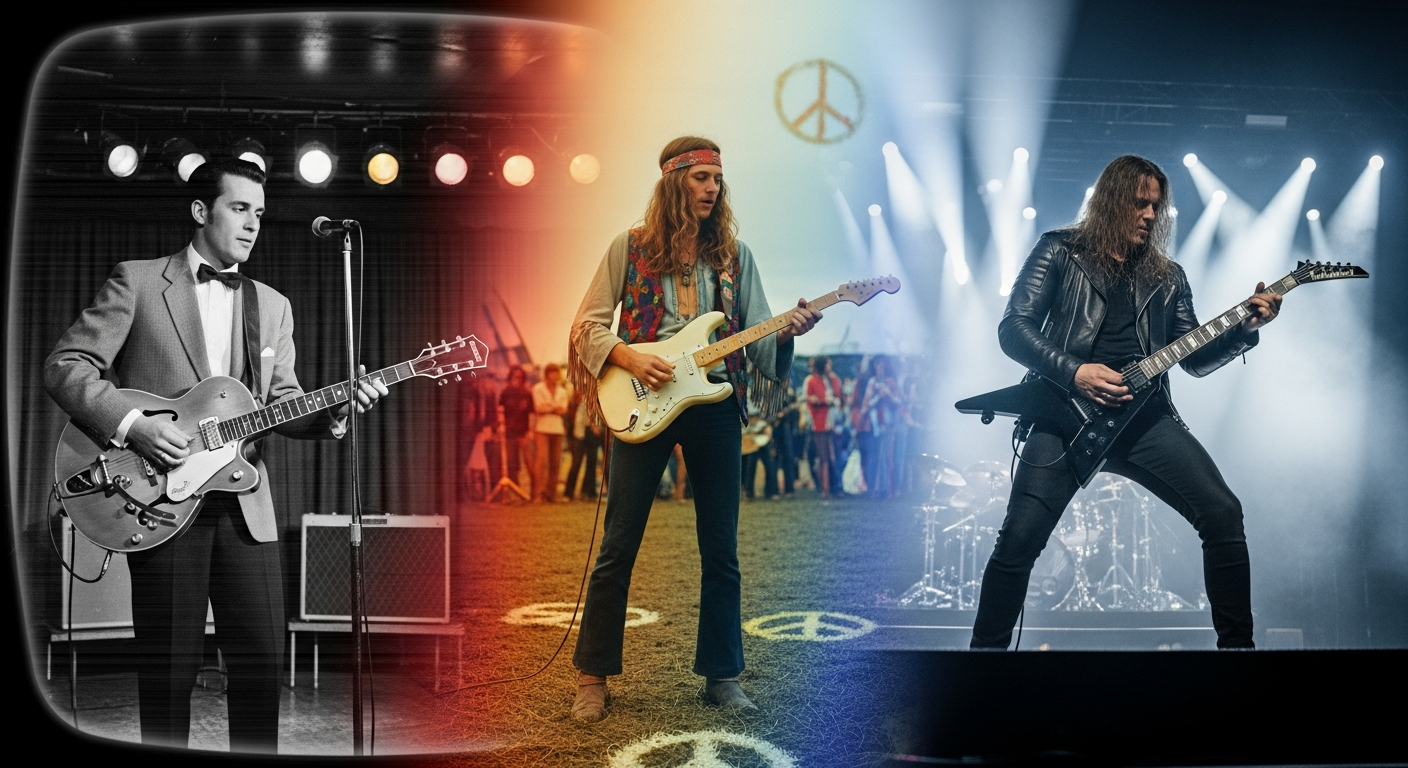
The History of Electric Guitar Listening: 5 Key Stages
Since I started tinkering with guitars in my garage, I've always had an obsession: sound. Not just “hearing” the guitar, but *understanding* how that sound is formed, how it evolves, and how it can be shaped. It's a journey that has led me to dismantle pickups, solder cables, try a thousand combinations of woods and circuits. And every time, I realize that the’evolution The electric guitar is not just a matter of technique or design, but of how we, musicians and listeners, have learned to perceive it. Think about it: the electric guitar was not born with a predefined sound. It has been a continuous search, an evolution dictated by the needs of musicians, by the discoveries of designers and, let's face it, also by a bit of healthy stubbornness and luck. Today I take you on a journey through the history of how we learned to hear the electric guitar, from its first, timid voices to the sonic explosions we know. It's not an encyclopedia lesson, but a story to tell, perhaps over a beer, at the next concert.1. The Dawn of Electrification: Hearing Beyond the Acoustic (1920s – Early 1930s)
Imagine a jazz orchestra from the 1920s or 1930s: winds, drums, double basses, pianos. The acoustic guitar, however vigorously played, got lost in that wall of sound. It was a serious problem for guitarists who wanted to emerge, be heard, and not just provide an almost imperceptible rhythmic accompaniment. Necessity, as always, was the mother of invention. The first attempts at amplification were rudimentary and often comical. They tried with contact microphones applied to the soundboard, or even modified phonographs to capture vibrations. The sound was often thin, full of feedback, and almost unnatural, but it was a start. It was the first step for thelistening to the electric guitar as a standalone and audible instrument. The real turning point came with George Beauchamp and Adolph Rickenbacker. Beauchamp, a guitarist dissatisfied with his acoustic, began experimenting with magnetic pickups. His idea was simple but revolutionary: to capture the vibrations of metal strings directly, without going through the resonance of the wood. After various prototypes, in 1931-1932 the “Frying Pan” (pan) was born, officially the Rickenbacker A-22. It was a lap steel guitar with a cast aluminum body and a horseshoe pickup that surrounded the strings. The sound was metallic, almost strident, with limited sustain, but it was *loud*. It was audible over an entire band. For the first time, the guitar no longer had to compete: it could converse, or even dominate. I remember the first time I held a replica of that type of pickup, trying to understand its logic. The engineering was simple but effective: a large magnet and a coil that collected the variations in the magnetic field induced by the moving strings. It was a raw sound, far from the richness we associate with the electric guitar today, but it was the seed. It was the sound that said: “Hey, I'm here!”. The limits were evident: feedback was a nightmare if the volume was turned up too high, the timbre was often thin and lacking body. But that “frying pan” paved the way for a completely new way of perceive the sound of the guitar. It was no longer just an accompaniment, but a voice that could sing.2. The Solid Body Revolution: Sound Takes Shape (Mid-40s – Early 50s)
With the end of World War II, America was ready for new sounds. Guitarists, who had tasted amplification, wanted more: more volume, more sustain, and above all, less feedback. Amplified hollow body guitars were beautiful, but as soon as the amplifier was pushed a little, they started to howl like hungry wolves. Here two legendary figures enter the scene: Les Paul and Leo Fender. Two different approaches, but a common goal: to solve the feedback problem and give the electric guitar a voice *of its own*, not just an amplified version of an acoustic. Les Paul, a genius of guitar and sound engineering, had already experimented in 1941 with “The Log”. He took a 4×4 pine wood block, mounted a neck and two pickups on it, and sawed an Epiphone acoustic guitar in half to glue the two side wings onto it. The appearance was that of an acoustic guitar, but the soul was purely solid. The result? Zero feedback, incredible sustain, and a dense, full-bodied sound that Les Paul loved. It was a rudimentary prototype, but it demonstrated the potential of the solid body. On the other side of the country, in California, Leo Fender, a radio repairman with no experience as a guitarist, had an even more radical vision. Observing the needs of country and western musicians who frequented his shop, he understood that a robust instrument was needed, easy to produce, to repair, and, above all, that sounded loud and clear. In 1950, his company introduced the Broadcaster (later renamed Telecaster due to copyright issues). The Telecaster was a piece of solid wood, often ash or alder, with a bolted neck and two single coil pickups. It was spartan, essential, almost brutal in its simplicity. But the sound… the sound was something never heard before. The bridge pickup produced a bright, percussive, and penetrating “twang”, perfect for country and blues. The neck pickup was warmer and rounder. It was the sound of the electric guitar asserting itself, without compromise. When I assembled my first Telecaster from a kit, I understood Leo’s genius. There was no soundbox that could vibrate uncontrollably. The wood was just a support for the hardware, but its type and density still influenced the overall character. It was a true sonic blank slate on which the pickups could express their potential. Shortly after, in 1952, Gibson, which had initially snubbed the idea of the solid body, joined the party with the Les Paul, designed in collaboration with the eponymous guitarist. With its thicker body and P90 pickups (larger and more powerful single coils), the Les Paul offered a warmer, rounder sound with even greater sustain than the Telecaster. The’listening to the electric guitar it was no longer a compromise to be heard. It was a standalone sound experience, with unique timbres and dynamics, which opened the doors to completely new musical genres. The solid body had given the electric guitar an unmistakable sonic identity.3. The Tone Explosion: Humbucker, P90 and Rock’n’Roll (Mid-50s – Early 60s)
The ’50s saw the explosion of rock’n’roll, and with it, an incessant demand for more powerful, louder guitars with a *bigger* sound. Fender single coils were great, but they had an Achilles’ heel: the 60-cycle “hum” (or 50, depending on the power grid). That background hum, though characteristic for some, was a problem for many. This is where Seth Lover, a Gibson engineer, comes in. In 1955, he patented the “humbucking” pickup, an ingenious invention that would forever change the soundscape of the electric guitar. The idea was simple: use two coils side-by-side, wound in opposite directions and with opposite magnetic polarities. In this way, the background noise picked up by one coil was canceled out by the other, while the string signal was summed. Lover’s first humbucker, often called PAF (Patent Applied For) due to the label on the back, provided a warmer, thicker sound with a higher output compared to the single coils of the era. Sustain increased, noise decreased. It was perfect for the blues and rock’n’roll that were gaining traction, with artists like Chuck Berry and B.B. King exploiting its potential. But it wasn’t just the humbucker that defined the sound of those years. Gibson’s P90s, introduced even earlier, were single coils with a wider, flatter coil, producing an aggressive, gritty sound with a nice “bite” that made them perfect for rockabilly and rawer blues. They were a bridge between the Fender twang and the warmth of the humbucker. Other brands were also exploring new sounds. Gretsch, with its semi-hollow guitars and Filter’Tron pickups (also humbuckers, but with a different design), offered a bright, percussive sound with a distinctive attack, loved by artists like Chet Atkins and later by Malcolm Young of AC/DC. Rickenbacker, for its part, with its “Toaster Top” and later “Hi-Gain” pickups, created that crystalline and ringing “jangle” sound that became the sonic signature of bands like the Byrds and the Beatles (in their more psychedelic period). The first time I wired a humbucker into one of my guitars, I immediately heard the difference. It wasn’t just a matter of volume, but of sonic *density*. The sound was fuller, with more harmonics, and that annoying hum was gone. It was as if the guitar had finally found its deeper, more powerful voice. During this period, the ’listening to the electric guitar became incredibly varied. There was no longer a single “electric sound”, but a palette of distinct timbres, each with its own personality, perfectly matching the emerging musical genres. From the crystalline twang of the Telecaster, to the “growl” of the P90s, to the warmth of the humbuckers, to the jangle of the Rickenbackers: every pickup, every design, contributed to sculpting a unique sonic identity.4. The Era of Distortion and Controlled Feedback: Sound as Expression (Mid-60s - 70s)
If the ’50s had given the electric guitar a voice, the ’60s saw it scream, wail, and sing with a passion never heard before. The era of distortion was not a planned innovation, but rather an accidental evolution, later embraced and transformed into art. Initially, distortion was considered a “defect”. Guitarists sought clean sounds. But then someone, by mistake or necessity (think of the broken speaker cones of Link Wray or Dave Davies' amplifiers), discovered that pushing an amplifier to its maximum, or using a pedal that “dirtied” the signal, produced an aggressive, powerful, and incredibly expressive sound. The fuzz pedal was one of the first architects of this revolution. The Maestro Fuzz-Tone, first used by Grady Martin in 1961 and later made famous by Keith Richards in the riff of “(I Can’t Get No) Satisfaction” (1965), opened the doors to a world of gritty and saturated sounds. The Tone Bender, the Fuzz Face, and a myriad of other pedals followed, allowing guitarists to actively shape their sound. But it was Jimi Hendrix who elevated distortion and feedback to the rank of art. With his Stratocaster, his Marshall amplifiers pushed to the limit, and a pedalboard that included Fuzz Face, Wah-Wah, and Uni-Vibe, Hendrix didn't just use distortion: he *played* it. Feedback, from an annoying problem, became an expressive instrument, an extension of his voice. His guitars didn't just emit notes, but screams, wails, laments, capable of evoking primordial emotions. Eric Clapton with Cream and his Marshall JTM45 amplifiers, Jimmy Page with Led Zeppelin and his sound-saturated Les Paul guitars, Jeff Beck with his timbral experiments: all contributed to defining a new way of listen to the electric guitar. It was no longer just a melodic or rhythmic instrument, but a force of nature, capable of creating immense soundscapes charged with emotion. I remember the first time I assembled my first fuzz pedal, a clone of a Big Muff. The sound was enormous, thick, almost a wall of sound. It was an almost physical experience. I understood that there were no rules, that "beautiful" and "ugly" in sound were relative concepts, and that true art lay in shaping that noise to create something meaningful. It was here that I started to seriously get interested in modifying my guitar, experimenting with different types of circuits and pickups to get that “growl” or that perfect “saturation”. This period taught guitarists and listeners that the sound of the electric guitar could be malleable, aggressive, psychedelic, and deeply personal. Distortion was not a mistake, but a conscious artistic choice, which redefined the boundaries of what a guitar could express.5. The Sound Without Limits: Versatility, Digital Modeling and Beyond (Years ’80 – Today)
With the arrival of the 80s, the electric guitar had already proven to be an incredibly versatile instrument. But technology didn’t stop. The need for ultra-clean and defined sounds for pop and funk, and at the same time for extreme and surgical gain for heavy metal and shred, pushed innovation towards new frontiers. One of the answers to these needs was active pickups. Companies like EMG, with their 81 and 85 models, introduced pickups that included a battery-powered preamplifier. This provided a much higher output, a flatter frequency response, and exceptional noise resistance. The sound was powerful, compressed, and incredibly suitable for genres that required clarity even under tons of distortion. In parallel, digital electronics began to make giant strides. The first rack multi-effects of the 80s, like those from Roland or Yamaha, allowed combining reverbs, delays, choruses, and distortions in programmable sequences. Guitarists like Steve Vai and John Petrucci made sonic versatility an art, moving from crystalline cleans to distorted, effects-laden leads with a simple preset change. The 90s and 2000s saw the rise of digital amplifier and effects modeling. Companies like Line 6, with its Pod, allowed guitarists to emulate the sound of dozens of famous amplifiers and pedals, all in a single compact unit. This democratized access to a wide range of tones, making it possible for anyone to experiment with sounds that previously required expensive and bulky equipment. Today, modeling has reached astonishing levels of realism with products like Kemper Profiler and Fractal Audio Axe-FX. These devices are not limited to *emulating* an amplifier, but can *profile* or *capture* the sound of a specific setup (amplifier, cabinet, microphone) with incredible fidelity. The limit for thelistening to the electric guitar it's no longer technical, but only our imagination. I spent entire nights tinkering with an old Pod 2.0, trying to replicate the sound of this or that guitarist. It wasn't always perfect, but the ability to have so many tones at hand was revolutionary for a kid working in his garage. Today, with modern systems, the ability to sculpt sound is almost infinite, and the distinction between a tube amplifier and its digital counterpart has become incredibly nuanced for the common ear. This phase has redefined versatility. The electric guitar can now adapt to any musical context, from the purest jazz to the most extreme metal, passing through experimental electronics. Sound has become a completely manipulable entity, shapeable in every nuance, offering guitarists unprecedented control over their tone.The Human Context Behind Every Sound
Behind every single stage of this history of listening to the electric guitar there are not only circuits and woods, but people: visionary engineers like Leo Fender and Seth Lover, rebellious musicians like Les Paul and Jimi Hendrix, and millions of anonymous guitarists who, in their garage or on stage, have pushed the limits of sound. Every “key stage” was not a switch that turns on, but a long process of trials, errors, successes, and adaptations. Think how many times a guitarist has said “I would like a more... sound” and someone tried to give it to them. Or how many times a technical innovation has opened new expressive possibilities that no one had imagined. Our way of *feeling* the electric guitar is the result of this dynamic interaction between human creativity and technical ingenuity. It's not just a matter of decibels or frequencies, but of emotions, of culture, of a deep desire to express oneself through the instrument.Conclusion
The journey through the history of how we learned to hear the electric guitar is a powerful reminder: sound is not static, but a living and constantly evolving entity. From the first, timid amplifications that barely stood out in an orchestra, we have arrived at instruments capable of generating complex and infinitely shapeable soundscapes. Every innovation, every new pickup, every pedal, every amplifier, has added a new color to the sonic palette, expanding our perception and our appreciation for this iconic instrument. And the beauty is that the journey is not over yet.FAQ
What was the role of feedback in the history of electric guitar sound?
Initially, feedback was an unwanted problem, a sign of uncontrolled amplification. However, starting in the 1960s, artists like Jimi Hendrix began to intentionally use it as an expressive tool, transforming it into an integral part of rock and psychedelic sound, adding sustain and a unique emotional intensity.How have the different types of pickups influenced the evolution of the tone?
Pickups have played a fundamental role. The first magnetic pickups were thin and metallic. The introduction of Fender single coils brought clarity and “twang”, while P90s offered a more aggressive sound. The invention of the humbucker eliminated hum and provided a warmer and more powerful tone, essential for rock, while modern active pickups allowed for ultra-clean or extremely compressed and high-gain sounds.Download the Luthier Survival Kit
Free PDF with checklist, problem-cause table and project card template.
 English
  Italiano
Stuck on your build?
If you ran into the same problem or have a question, drop it in the comments. I read and reply to every one.
Write a comment