

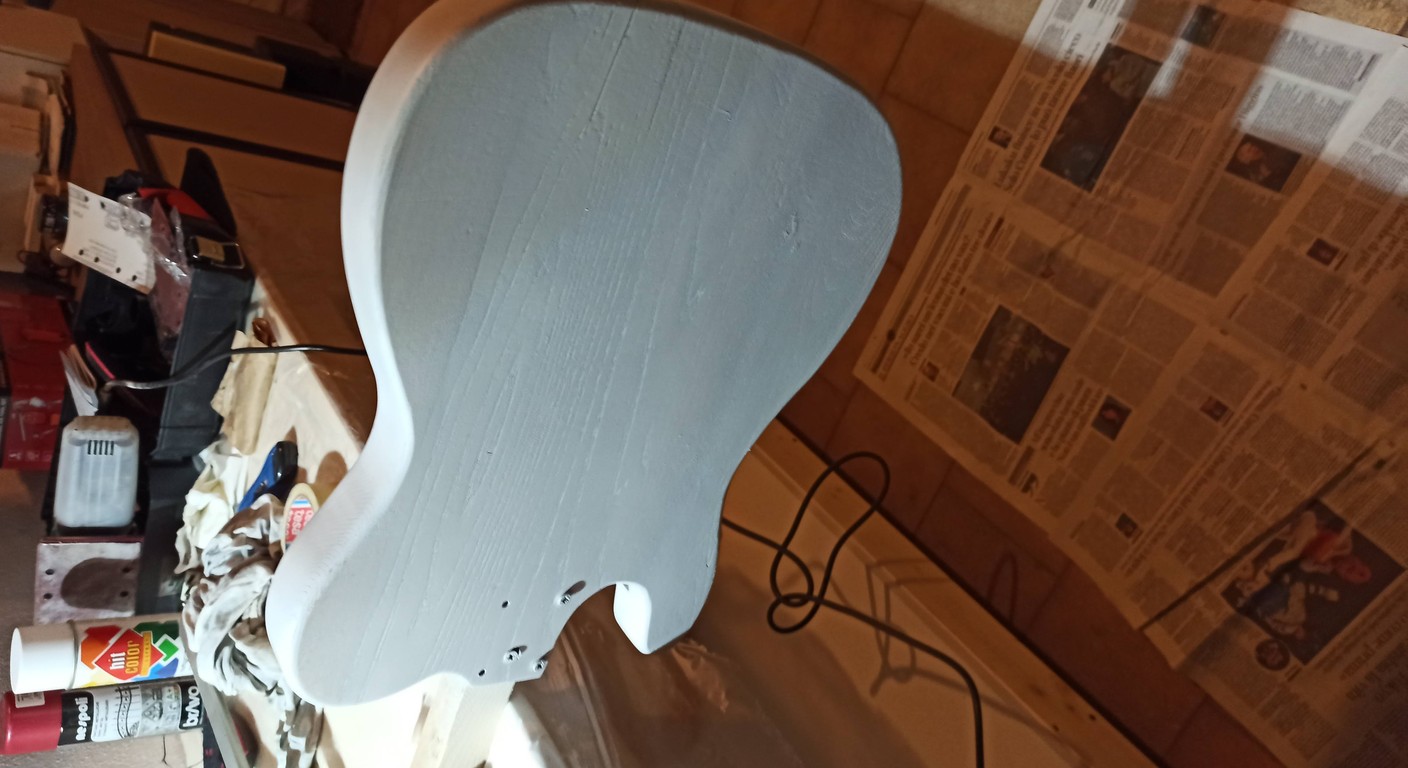
DIY Hollow Body Electric Guitar: 5 Steps
When I first started thinking about building a guitar DIY hollow body electric, The idea seemed like one of those ventures for luthiers with a historic workshop, tools that cost as much as a small car, and years of apprenticeship behind them. Sitting in my garage, with a table saw, a Dremel, and a second-hand drill press, I felt like a bit of an impostor. And yet, you know what? With patience, a few mistakes, a fair amount of finishing touches, and a desire to understand... why things work (or don’t work), in the end I made it. It wasn’t easy, I’ll tell you right away. I glued a top badly, I routed a chamber too deep, I cursed the binding for hours. But every mistake was a lesson, and the final result, imperfect as it is, sounds wonderful and has a soul that no production model can give you. If I succeeded, with my means and my stubbornness, you can succeed too. The important thing is not to get scared and proceed one step at a time. Let's look together at the 5 fundamental steps to create your hollow body instrument, with all the tips and mistakes I learned the hard way.
1. Design: Drawing and Material Selection (your nightmare begins here)
The first step to building a DIY hollow-body electric guitar It is, paradoxically, not touching a single tool. It starts with paper and pen, or rather, with CAD software and a good deal’ of research. This is where most hobbyists get stuck, overwhelmed by the myriad of choices. I remember the first time: I got lost among diagrams, forum discussions on tonewoods and hundreds of photos of guitars from which to draw inspiration. The biggest fear is choosing the wrong wood or getting the fundamental measurements wrong. And believe me, it's a well-founded fear. A good project, however, saves you from a lot of headaches later.
Choosing the right wood: body, top, neck, fretboard
The choice of woods, the so-called tonewoods, is crucial for the final sound of your hollow body guitar. It's not just aesthetics, but pure acoustic physics. A different wood has a different specific weight, density, and resonance. For the body, woods like mahogany, maple, or poplar are common choices. Mahogany offers a warm sound rich in sustain, maple is brighter and more defined. Poplar is light and workable, great for initial experiments. For the top (soundboard), spruce is often used for acoustic guitars, but for hollow or semi-hollow electrics, figured maple (flamed or quilted) is very popular for aesthetics, while maintaining good sonic properties. Maple offers brightness and attack. The neck is almost always made of maple or mahogany, for stability and resonance. The fretboard can be rosewood, ebony, or maple, each with its own tactile and sonic characteristics. Rosewood is warm and soft, ebony is bright and fast, maple is bright and responsive. In my first attempts, I used a birch plywood top because I didn't want to waste precious woods. The sonic result wasn't the best, but it allowed me to understand the construction dynamics without too many regrets.
Drawings and templates: the importance of a good base
Don't improvise. Never. Take a technical drawing of a guitar you like and use it as a base. There are many free or paid plans online (for example, on sites like StewMac or independent luthiers). These plans will give you the precise measurements for the fretboard scale, the neck angle, the pickup position, and the body dimensions. Once you have the drawing, create templates from MDF or thin plywood. These will be your guides for routing and shaping. Prepare templates for the body outline, internal chambers, neck, headstock, and pickup routing. I wasted quite a bit of plywood for the initial templates, but every mistake on the template saved me a mistake on the final wood.
Essential tools (minimum)
you don't need a million-euro laboratory, but some tools are almost mandatory:
- A band saw or a table saw: to cut the rough pieces of the body and the neck.
- A router (router) with a set of bits: indispensable for routing out the chambers, pickup channels, and the binding channel. A bench router is a luxury, but a good manual router with a sturdy base works perfectly.
- A drill press: for precise holes for potentiometers, jacks, and access holes.
- Clamps and woodworking glue (Titebond is a classic): for gluing.
- Measuring tools: caliper, metal ruler, square, protractor. Precision is everything.
- Files, rasps, planes and sandpaper: for shaping and finishing.
Remember, patience and attention to detail are the most important tools of all.
2. Body Carving: Creating the Acoustic Chambers (the true hollow heart)
Once you have your templates and chosen woods, it's time to shape the body of your hollow body electric guitar. This is the most delicate and characteristic step of a hollow body: the creation of the internal chambers. The fear of milling too deep, of making holes or of ruining the body is palpable. Believe me, I've experienced it firsthand.
Preparation of the body blank
The body blank is the solid wood piece from which you will carve the body. It is often made up of two or more pieces glued together to achieve the desired thickness and width. Make sure the joints are perfect and that the blank is perfectly flat on both faces. I learned the importance of good gluing here: once I had a minimal separation, and the milling highlighted the defect, forcing me to start over.
Chamber routing: routing template
Here the router and the internal chamber template come into play. For a true hollow body, the body is almost completely empty, with only a central block (center block) for mounting the neck and pickups, or internal braces for support. In semi-hollows, like an ES-335, the center block is continuous along the entire length of the body. This block helps control feedback and provides greater sustain. Place the chamber template on the body blank and secure it firmly. Use a flush trim bit (bearing guided bit) or a straight bit with a jig to guide the router. Proceed with shallow passes, about 3-5 mm at a time, to avoid overheating the bit and tearing the wood. The final depth of the chambers will depend on your project, but usually walls of about 10-15 mm are left. My first deep routing pass made me break out in a cold sweat. I had to fill a couple of times because the bit slipped slightly in a corner. It's frustrating, but it's part of learning. The key is patience and using sharp bits.
The center block (if semi-hollow)
If you are building a semi-hollow body, the center block is fundamental. It is a solid wood block that runs through the center of the body, from the neck to the bridge. This block provides the necessary rigidity for mounting the bridge and neck, reducing the risk of unwanted feedback at high volumes, a common problem in pure hollow bodies. Make sure the center block is well glued to the bottom of the body and that its surfaces are perfectly flat for gluing the top. I have seen guitars with center blocks that were too thin or poorly glued, which vibrated strangely, or worse, did not hold intonation.
Channels for pickups and electronics
While you are routing the chambers, don't forget the channels for the pickups and for passing the electronics cables. These holes must be precise and wide enough to accommodate the pickups and cables. For the pickups, you will use another specific template. For the channels, a straight bit is usually sufficient. Remember that, unlike a solid body, the electronics of a hollow body are often inserted through the pickup holes or f-holes (if present), which makes wiring a surgeon's operation. Plan these access points well.
Speaking of pickups, if in the future you want modify your guitar, replacing the pickups on a hollow body can be an interesting experience. Make sure you have all the right tools to access the inside of the body.
3. Gluing and Rough Shaping: The Body Takes Shape (and weight)
After digging the chambers, the body of your hollow body electric guitar It starts to take shape. The next step is to glue the top (and the back, if you are building a multi-layer body) and shape the exterior. This is an exciting moment, but also full of pitfalls, especially when it comes to gluing and applying the binding. The binding, in particular, has been my personal nightmare for days.
Gluing top and back
Once the internal chambers are routed and cleaned, it's time to glue the top. Make sure the surfaces to be glued are perfectly flat and free of dust or residue. Apply an even layer of wood glue (like Titebond Original) to both surfaces. Don't overdo it, but make sure the entire area is covered. Place the top on the body and align it precisely. Then, apply even pressure using a good number of clamps. Pressure is essential for a strong, gap-free bond. I learned the hard way that a few clamps are not enough: for my first hollow body, I used about fifteen, distributed over the entire surface, to prevent the top from “opening up” in some places. Let it dry for at least 24 hours, or according to the glue's instructions.
Routing for binding (if planned)
Many hollow body guitars have binding along the edge of the body, both for aesthetics and to protect the wood. If you have decided to add it, this is the time to rout the channel. Use a router with a specific binding bit, which allows you to adjust the depth and width of the channel. Precision here is everything: a channel that is too wide or too narrow will make applying the binding a nightmare. Do some tests on a scrap piece of the same wood to ensure the bit is set correctly. Proceed slowly and carefully, keeping the router stable and perpendicular to the edge.
Binding application
The application of binding is an art and a science. Binding is usually made of plastic (ABS, celluloid) or wood. To apply it, you will need specific glue (such as ABS glue for plastic bindings, or Titebond for wooden ones) and adhesive tape to hold it in place while the glue dries. Start by applying glue in the channel and then inserting the binding, pressing it firmly. Use adhesive tape (usually painter's tape) to tightly wrap the guitar body, holding the binding in place. This is where my patience was put to the test. I had to redo a piece of binding because I had used too little glue and it came off, or too much glue and it made a mess. Let it dry for another 24 hours. After drying, remove the tape and finish the binding with a sharp blade and fine sandpaper.
External shaping with router or sander
Once all the glues are dry and the binding è in place, you can start the external shaping of the body. If you have used a template for the body outline, you can use a flush trim router bit to precisely finish the edges. For rounded contours or bevels (like the “comfort cut” on the upper or lower edge), you can use a roundover bit, a belt sander, or simply files and rasps. The goal è to obtain an ergonomic and visually pleasing shape. This è a process that requires time and “eye”: proceed gradually, sanding and constantly checking the symmetry and fluidity of the curves. I spent hours balancing the sides, because once you remove the wood, you can't put it back!
4. The Neck: The Soul of Playability (and your patience)
The handle is, without exaggeration, one of the most critical parts of your hollow body electric guitar. If the body determines its general timbre, the neck defines playability and comfort. A well-made neck, well-matched to the body, transforms an instrument from a “piece of wood with strings” into a true extension of the musician. The biggest fear here is getting the neck angle wrong, imprecise fretting, or truss rod management. And yes, I've been there.
Neck selection and preparation (or building from scratch)
You have two options: buy a prefabricated neck or build it from scratch. Buying a neck is simpler for beginners. Make sure it is compatible with your project's fretboard scale and the type of neck joint you have planned (set-neck, i.e., glued, or bolt-on, screwed). Check the wood quality, straightness, and fret finish. Building a neck from scratch is a complex challenge, requiring millimeter precision. You start with a piece of solid wood (often maple or mahogany), carve the channel for the truss rod, glue the fretboard, fret it, and shape it. The first time I tried to build a neck, I ruined the truss rod channel and had to start over. Never underestimate the complexity of this phase.
The truss rod
The truss rod è a metal bar inserted into the neck that allows you to adjust the curvature of the neck itself. È essential to compensate for string tension and maintain optimal action. Make sure to choose the appropriate truss rod type (single action or dual action) and install it correctly in its channel before gluing the fretboard. A poorly installed truss rod can render the neck unusable.
Fretting and fret leveling
Fretting, or the installation of frets, è a delicate operation. Frets must be inserted with the right pressure into the fretboard slots, ensuring they are all at the same height and firmly seated. Specific tools, such as a fret press or a fret hammer, are indispensable. After installing the frets, è almost certain that they will not be perfectly level. This is where fret leveling comes into play. A file or a flat abrasive stone is used to level the surface of all frets, then they are crowned (fret crowning) with a specific file to restore the dome shape of the frets. Finally, they are polished. Well-leveled and polished frets are fundamental to avoid “buzz” (string buzzing on the frets) and to have good playability. I have spent hours filing and crowning frets, and the difference between a job well done and a poorly done one è abysmal.
Gluing or screwing the neck to the body
For hollow bodies, the most common neck joint è the set-neck (glued neck), but bolt-on models (screwed neck) also exist. If you opt for a set-neck, the “pocket” in the body (the seat where the neck is inserted) must be routed with extreme precision. The neck angle relative to the body è crucial for the final action and bridge height. My first time, I mounted a neck with a slightly wrong angle, and the action was unmanageable, forcing me to disassemble and re-glue it. Use strong wood glue and many clamps. Check the neck alignment with the center block and the string symmetry. For bolt-ons, ensure the holes are precise and the neck è firmly attached. Regardless of the joint type, the goal è a solid, play-free coupling that maximizes vibration transfer.
5. Finish, Electronics and Setup: The Grand Finale (and the first notes)
If you've made it this far, the hard part è done! Your DIY hollow-body electric guitar now has its shape. Now it's time to make it shine, give it a voice, and make it playable. The finish, electronics installation, and final setup are steps that require patience and attention, but they are also the most rewarding. Dripping paint, cold solders, and high action are just some of the problems you might encounter.
Preparation for finishing (sanding)
Before any finish, the wood must be perfectly smooth. This means hours of sanding, starting from coarser grits (120-180) and gradually moving up to very fine grits (400-600). Every scratch left by a previous grit will be amplified by the finish. Wipe the wood with a damp cloth between grits (“grain raising”) to raise the fibers, which you will then sand again. This ensures a smooth and uniform surface. Do not skip this step; it è the foundation for a flawless finish.
Application of the finish
The finish protects the wood and enhances its beauty. The options are different:
- Nitrocellulose (Nitro): Traditional, thin, allows the wood to “breathe” and ages beautifully. It requires many thin coats and careful polishing. Difficult to apply in a home environment due to fumes and the need for a spray booth.
- Polyurethane: Very resistant and durable, it offers excellent protection. È easier to apply than nitro, but can be thicker and less “resonant” according to some.
- Olio/Cera: Oil finishes (like tung oil or danish oil) or wax finishes offer a natural feel to the touch and allow the wood to resonate freely. They offer less protection but are easy to apply and repair.
I've tried everything, from spray cans (questionable results) to two-component polyurethane paint (better, but requires equipment). Painting è always a gamble, and I've learned that preparation è 90% of the job. For more in-depth advice on finishing, you can consult resources like those from StewMac, which offer detailed guides on different types of painting and polishing: StewMac Finishing Resources.
Hardware and electronics assembly
Once the finish is completely dry, you can start assembling the hardware: tuners, bridge, tailpiece, pickups, potentiometers, selector switch, jack. For the electronics of a hollow body, as mentioned, access is limited. Often all components (potentiometers, capacitors, selector switch) are mounted on a control plate or a piece of cardboard, everything is wired externally, and then the entire "wiring" is inserted through the pickup holes or f-holes, securing the potentiometers and the jack with their nuts. Soldering must be clean and robust. I burned a potentiometer due to a solder joint that was too long and hot, so be careful with the iron and solder. Make sure to shield the pickup and electronics cavities with conductive paint or copper/aluminum foil to reduce background noise.
Final setup: action, intonation, pickup height
This is the moment when your hollow body electric guitar comes to life.
- Action: Adjust the string height from the neck by acting on the bridge and/or the truss rod. The goal is a low action without buzzing.
- Intonation: Adjust the length of the strings (with the bridge saddles) so that the notes are in tune all over the neck. Check with an electronic tuner.
- Pickup height: Adjust the height of the pickups relative to the strings to achieve the desired volume balance and optimal tone.
- Nut: Check that the nut (nut) is cut correctly and that the strings slide freely.
Every guitar is a world unto itself, and the setup is a fine-tuning process that can take some time. But when you finally plug your creation into the amplifier and hear the first notes resonate, all the hours of work and mistakes made will vanish.
Conclusions
Build a DIY hollow-body electric guitar it's an adventure. It's a journey made of decisions, manual skill, but above all, patience and resilience. I won't hide from you that there were times when I wanted to throw everything out the window, but every difficulty overcome made the final result even more special. The guitar I built, with all its imperfections, has a unique sound and a story all its own, which no other instrument can ever replicate. If you have the passion and the desire to learn from your mistakes, I can assure you that you too can do it. And the feeling of playing an instrument created with your own hands is priceless.
FAQ: Frequently Asked Questions about DIY Hollow Body Guitar Building
What is the main difference between a hollow body and a semi-hollow body guitar in terms of construction and sound?
The main difference lies in the center block: a pure hollow body has a completely empty body or with minimal internal bracing, which gives it a more acoustic, warm, and resonant sound, but makes it more prone to feedback at high volumes. A semi-hollow body includes a solid wood “center block” that runs the entire length of the body, reducing feedback and increasing sustain, bringing the sound closer to that of a solid body, while maintaining a certain acoustic resonance.
What are the most common mistakes a beginner should avoid when building a hollow body guitar?
The most common errors include imprecise design (wrong measurements and angles), weak or gapped glue joints, internal chamber routings that are too deep or irregular, and poorly applied binding. Also, insufficient sanding before finishing and a rough final setup can severely compromise the playability and aesthetics of the instrument. Patience and precision are fundamental to minimizing these risks.
Download the Luthier Survival Kit
Free PDF with checklist, problem-cause table and project card template.
 English
  Italiano
Stuck on your build?
If you ran into the same problem or have a question, drop it in the comments. I read and reply to every one.
Write a comment