

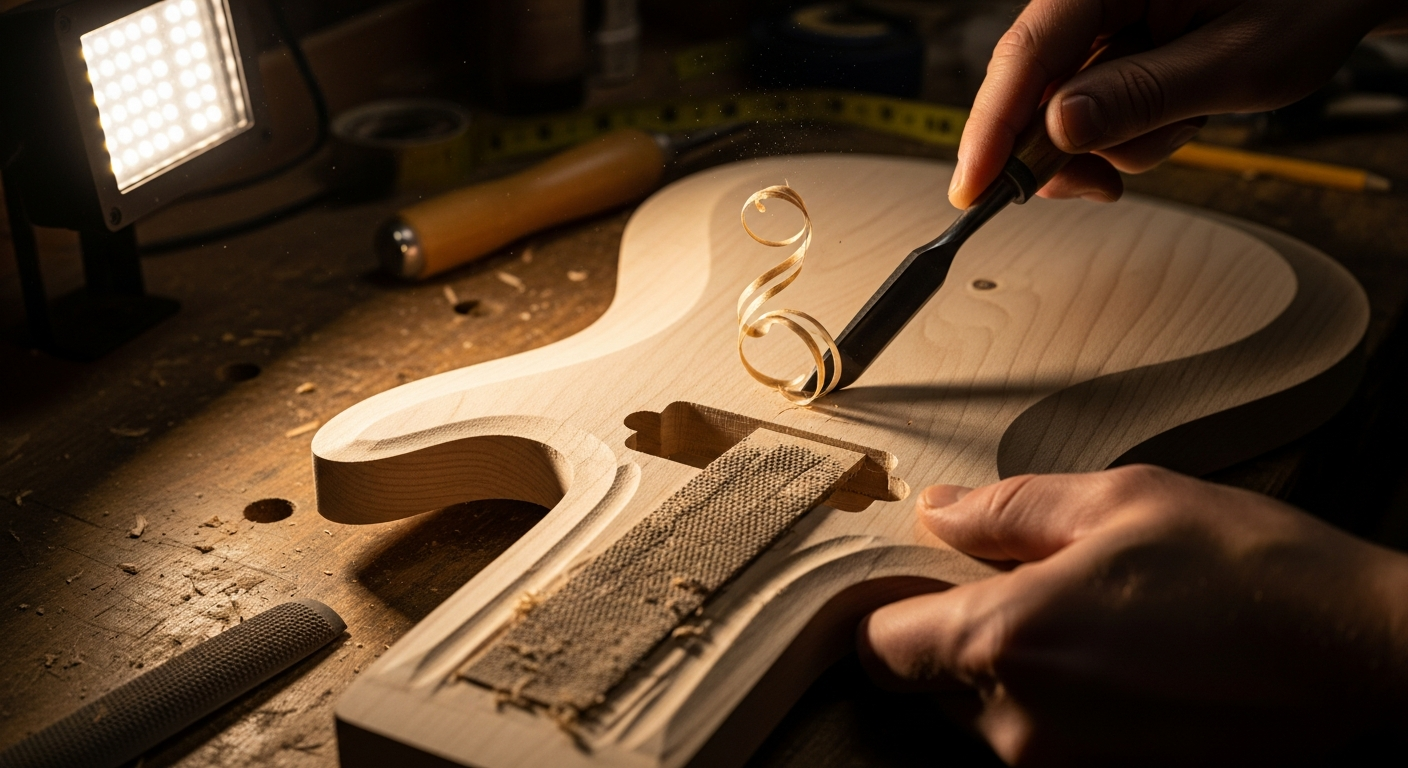
Install Electric Guitar Mechanics: Practical Guide
I still remember the first time I found myself in front of a bare handle, without even a hole for the mechanics. It seemed like something for aerospace engineers, stuff where if you made a mistake by a millimeter, goodbye guitar. In reality, it's one of those steps where precision is important, yes, but patience and a minimum of method beat any super professional equipment. If I managed it in the garage, with the tools I had, you can do it too. Guaranteed. Let's be clear: the terror of drilling the neck crooked, or ruining the freshly painted headstock, is real. I’ve experienced it. But it's a fear that can be overcome with the right knowledge and, let's face it, a bit of masking tape and a hand drill. You don't need a CNC router, I assure you. You need to understand what you're doing, why you're doing it, and what are the points where you absolutely cannot afford distractions. This article is for those who have already assembled something, have already seen a soldering iron, and know what a pickup is. We're not starting from absolute basics, but we're delving deep into the details that make the difference between an “acceptable” job and a “solid” one, without necessarily spending a fortune on tools.Choosing the Right Mechanics: Not All Are Equal
Here opens the first real dilemma for those venturing into assembly: which mechanics to buy? It's not just a matter of aesthetics or budget. Compatibility is fundamental, and often underestimated. I've seen people buy beautiful sets only to find out that the holes on the headstock were too small or too large. A disaster that can be avoided with a bit of research and, believe me, a digital caliper. The mechanics are mainly divided into two categories regarding mounting: standard (or vintage style) and modern. Standard ones, often used on ’50s or ’60s replicas, have a press-fit bushing and a fixing screw on the back of the headstock. The required holes are usually 8.5mm or 9mm. They have that classic look that many love, but sometimes they can be a bit less precise or stable than their modern counterparts. Modern tuners, on the other hand, are often “sealed” or “locking” type. The latter are my favorite for tuning stability, especially if a tremolo bridge is used. They have a tightening nut on the front of the headstock and often a positioning pin that fits into a small auxiliary hole on the back. The holes for these are typically 10mm. They are robust, reliable, and hold tuning like a block of concrete.Diameter is Crucial: Don't Get the First Step Wrong
Before purchasing, measure the existing holes on your headstock, if any. If you are building a neck from scratch, you have the freedom to decide the diameter of the holes based on the tuners you intend to use. It's a trivial detail, but making a mistake here means having to enlarge holes (risky and unsightly) or fill and re-drill (a tedious job you'd want to avoid).- Measure with Precision: Use a digital caliper for maximum accuracy. Don’t just trust your eye or an imprecise ruler. Every tenth of a millimeter counts.
- Consult the Specifications: Every serious manufacturer provides technical drawings with the exact measurements of their products. Gotoh, Schaller, Grover: all of them have them on their websites. Take the time to consult them. For example, you can find detailed technical diagrams on the Gotoh website.
- Beware of the “Cluson Style”: Some tuners, like vintage Kluson, have smaller holes and a specific design. If you are unsure, search for “Kluson style tuners dimensions” and compare carefully.
Essential Equipment: Less is More, but Quality
It is often thought that lutherie work requires very expensive or specific tools that only professionals have. This is not true. For installing electric guitar tuners, with a bit of ingenuity and the right precautions, you can do an excellent job with relatively simple and accessible tools. The key is precision and patience, not the power or cost of the tool. Here's my 'garage' list of tools I regularly use and that have allowed me to achieve professional results:- Drill: A good hand drill, battery-powered or corded, is sufficient. If you have access to a drill press, even better, it will guarantee perfectly perpendicular holes and greater precision. But it's not essential; I've done most of my work with a cordless drill.
- Wood drill bits: High quality, sharp. You'll need the exact diameter bit for the tuner holes (usually 8.5mm, 9mm, or 10mm) and a smaller bit (like 1.5mm or 2mm) for the pilot holes of the mounting screws. Wood bits with a center point (Brad Point type) are ideal because they don't 'walk' on the material and create a clean hole.
- Digital Caliper: Essential for measuring diameters, thicknesses, and distances with millimeter precision. Don't skimp here; a good caliper will last a lifetime and save you from a thousand mistakes. It's one of the best investments you can make for DIY lutherie.
- Steel ruler or carpenter's square: For drawing straight and parallel lines on the headstock. Steel is preferable because it is more wear-resistant and more precise.
- Soft pencil (2B or 3B): For marking without leaving permanent grooves or damaging the wood. Erases easily.
- Paper Adhesive Tape (Masking Tape): You'll use tons of it. It protects the wood from chipping, helps you mark drilling points, and define work areas. It's a real lifesaver for finishing.
- Awl or small nail: To precisely mark the centers of the holes before drilling. This helps prevent the drill bit from slipping.
- Screwdriver: The right size for the tuner screws. Make sure the screwdriver tip fits perfectly into the screw head to avoid stripping it or damaging the finish.
- Socket or open-end wrench: For the tightening nuts of modern tuners. Here too, the precise size is important to avoid scratching the nuts or the headstock.
- Cable ties or Clamps: To hold the neck steady while you work. Stability is crucial for safety and precision.
- Scrap wood board: To be used under the neck during drilling to prevent chipping the wood on exit. A piece of plywood or solid wood works perfectly.
A couple of “tricks of the trade” for tools:
- Drilling Depth: If you don't have a drill press, you can use a piece of masking tape wrapped around the drill bit to mark the maximum drilling depth. It's a 'low-tech' method but surprisingly effective for not drilling too much or too little.
- Sharp Tips: A dull bit generates friction, heat, and chips. Invest in good quality bits and keep them sharp. They will make the difference between a clean hole and a disaster. I learned the hard way that an old bit can ruin a job in a few seconds.
- Caliber: When measuring, take multiple readings and ensure they are consistent. Eyes can deceive, but calipers don't. Precision here saves you a lot of headaches.
Preparation and Measurement: The Foundation of Success
This is the crucial step. If you make a mistake here, you'll carry it through the entire assembly. The goal is to have all holes aligned, equidistant, and perfectly perpendicular to the headstock surface. Take a deep breath and proceed calmly, without rushing. It's better to spend an extra half hour at this stage than to have to fix a crude error later.1. Paddle Protection:
Start by covering the entire surface of the headstock with good quality masking tape. This has a dual purpose: first, it protects the finish (especially if it's already painted) from scratches and chips; second, it provides a surface on which to draw and mark with a pencil without damaging the wood. Press the tape down well to avoid air bubbles, which could compromise the precision of your marks.2. Positioning of the Mechanics (and the Fixing Screws):
If your tuners have a positioning tab (pin) or a rear mounting screw, it is crucial to align them correctly. This aesthetic detail is what distinguishes amateur work from a well-done job.- Modern tuners (with tab/pin): They usually have a small pin that fits into an auxiliary hole. This pin prevents the tuner from rotating once installed. You will also need to mark and drill this small hole with extreme precision.
- Vintage/standard tuners (with rear screw): They have a small screw that fastens the base of the tuner to the headstock. The alignment of these screws is purely aesthetic but very important for a clean and symmetrical job.
3. Marking of the Main Holes:
If the neck is already drilled (for example, if you are replacing tuners), skip this step and go to 4. If you are working on a raw neck, you will need to mark the centers of the tuner holes.- Find the Center Line: Draw a center line on the headstock. You can do this by measuring the width of the headstock at multiple points and connecting the midpoints. Make sure it is perfectly straight and parallel to the edges of the neck.
- Measure the Distances: Tuners are never all in a straight line. Usually, there are 3 tuners per side, arranged staggered or in a line, depending on the headstock style. Consult the diagram of your tuners or use a similar guitar as a reference. The typical distance between the centers of the holes is about 35-38mm.
- Mark the Centers: With the caliper and ruler, accurately measure and mark the centers of each main hole. Use the awl to make a small, precise indentation where the drill bit should start. This prevents the bit from 'slipping,' which is one of the biggest risks at this stage.
4. Alignment of the Fixing Screws (or Pins):
This is a sore point for many. Seeing crooked mounting screws is an eyesore and ruins the overall appearance of the work.- Ruler and Square Method: Temporarily insert all tuners into the main holes (without tightening them, just for positioning). Take a carpenter's square or a long metal ruler and position it so that it cuts across all the points where the screws (or pins) should be. The goal is to draw a guideline perfectly parallel to the edge of the neck or the center line of the headstock.
- Mark with Precision: Use a fine pencil to mark the exact center of each screw/pin hole. This is crucial for aesthetic alignment. If your tuners have pins, make sure they are resting firmly on the tape before marking the exact point to drill.
- Visual Check: Take a step back and look at the alignment from different angles. Are they straight? Are they parallel to the edge of the palette? It's time to be picky. Better to correct now than later.
Drilling: Technique and Anti-Splintering Precautions
Here we are at the moment of truth. The drill is in hand, the heart beats a little harder. There’s no need to be afraid, but to be methodical and focused. Wood chipping is the number one enemy at this stage, and it can be avoided with the right precautions.1. Choose the Right Tip:
It is essential to use the correct drill bit for each type of hole.- Main Holes (for the tuner body): Use a wood drill bit of the exact diameter (8.5mm, 9mm or 10mm) that matches your tuners' specifications. Make sure it's sharp. A Forstner bit is excellent for clean and precise holes, but a good Brad Point wood bit works just as well and is easier to find.
- Pilot Holes (for mounting screws/pins): Use a much smaller bit, typically 1.5mm or 2mm. The diameter should be slightly smaller than the diameter of the screw body, excluding the thread. If the bit is too large, the screw won't grip; if it's too small, the screw might split the wood or break during screwing. Do a test on a scrap piece if you have doubts.
2. Preparation for Drilling:
Workbench preparation is crucial for safety and work quality.- Stand: Place the headstock on a solid, flat surface. Under the drilling point, place a piece of scrap wood. This is crucial! When the drill bit passes through the headstock wood, if there is no support, the fibers on the exit side will tear, creating an ugly chip on the finish. The scrap wood "catches" the bit and prevents tearing, ensuring a clean exit.
- Fixing: Securely block the handle with clamps or cable ties to prevent it from moving during drilling. Safety first, and a stable handle guarantees precision.
3. Drilling of the Main Holes:
This is the first real step with the drill.- Speed and Pressure: If you use a hand drill, start with a medium speed and constant but not excessive pressure. Let the bit do its work, don't “push” the drill. Excessive pressure can overheat the bit and burn the wood.
- Perpendicularity: Keep the drill as perpendicular as possible to the surface of the paddle. If you have a drill press, set the depth and you're good to go, it's the ideal solution. With a hand drill, use your eye and check from different angles. You can also use a small magnetic level on the drill body if you have one, or ask a friend to look from another angle.
- Depth: Drill until the bit completely passes through the paddle. The scrap board underneath will prevent chipping.
4. Drilling Pilot Holes (for screws or pins):
This is the most delicate step for l’aesthetics, because the holes are small and close to the edge.- Punta Piccola: Use the 1.5-2mm drill bit, depending on the screw diameter.
- Limited Depth: You only need to drill for the length of the screw or pin. Wrap a piece of tape around the drill bit to mark the maximum depth. Do not drill too deep.
- Light Pressure: Apply very light pressure. The wood of the headstock, especially if it is maple or mahogany, is relatively soft for these small screws. Too much pressure can split the wood, creating an annoying crack.
- Centering: Make sure the tip is perfectly centered on the marks you previously made with the awl. A minimal deviation can cause the screw to be screwed in crooked.
Final Assembly: Tightening and Alignment
With the holes ready and clean, we are almost at the end. Now it's about assembling everything in a solid and precise way. This step is less stressful than drilling, but requires attention to detail to ensure both functionality and aesthetics.1. Insertion of the Mechanics:
The way you insert the mechanics depends on their type.- Meccaniche Moderne (with front nut): Insert the tuning machine into the main hole from the back of the headstock. Make sure that the positioning pin, if present, fits perfectly into its pilot hole. If it's difficult, do not force it. Check that the pilot hole is clean and of the correct size. Once inserted, screw the locking nut onto the front of the headstock. Leave it slightly loose for now.
- Vintage/Standard Tuners (with press-fit bushings): Insert the bushing (the ferrule) into the main hole from the front of the headstock. Sometimes it goes in by hand, other times it requires light pressure with a rubber mallet or a piece of wood to avoid damaging the finish. Then insert the tuning machine from the back, making sure it aligns with the hole for the fixing screw.
2. Alignment of the Fixing Screws (or Nuts):
This is a crucial moment for the overall aesthetics of the headstock. Precise alignment of the screws or nuts makes the work appear much more professional.- Mounting Screws (Vintage/Standard): With the tuners inserted but not yet fully tightened, position a ruler or a square along the row of screws on the back of the headstock. Gently rotate each tuner until the screw hole aligns perfectly with the ruler's line. Once you are satisfied with the alignment, screw the screws into their pilot holes. Tighten by hand, do not overtighten, to avoid stripping the wood. The screws should be firm, but not tightened to death.
- Clamping Nuts (Modern): Tighten the locking nuts with a socket or open-end wrench. Again, don't overdo it. The nut should be snug, but you shouldn't risk damaging the headstock finish or the tuner body. Overtightening can also compress the wood too much, causing long-term problems or even cracks in the paint.
3. Final Tightening:
Once all the mechanics are in place and the screws/nuts are aligned, do a final tightening round. Check that every screw and every nut is firmly in place. But, I repeat, without forcing. Wood is not metal. A stripped screw is a nightmare to fix and can ruin your beautiful work. The feeling of “arrival” with the screwdriver or wrench is sufficient.4. Final Checks:
Before proceeding, do one last check.- Movement: Turn each key back and forth. It should move smoothly and without hindrance. If you feel friction or strange noises, something is wrong. It could be an alignment problem or a defect in the mechanism itself.
- Stability: The mechanics must be stable. They must not have play or move freely once tightened. If you notice any play, try to tighten the nut or screw slightly more, but always with caution.
- Aesthetics: Do a final visual inspection. Are the mechanics straight? Are the screws aligned? If you did a good job in the previous steps, you shouldn’t have any surprises here, just the satisfaction of a clean job.
Common Mistakes and Garage Solutions
We talked about how to do things well, but it's just as important to know where you can go wrong and, above all, how to fix it without having to scrap the project. I've made almost all these mistakes, so trust me: you learn much more from one mistake than from a hundred successes. DIY lutherie is also this: problem solving.1. Chipped Holes:
- Problem: The wood around the hole is torn or chipped, ruining the aesthetics.
- Cause: Lack of support under the paddle during drilling, blunt drill bit, excessive pressure or wrong drilling speed.
- Solution: For small and superficial chips, you can fill them with wood glue mixed with wood dust (obtained by sanding the same type of wood). Once dry, sand finely and finish. For larger chips, the only solution is to fill with epoxy wood filler, let it harden, sand, and repaint the area. Prevention is the best cure: always use a scrap piece underneath!
2. Crooked or Stripped Fixing Screws:
- Problem: The screws are not aligned or, worse, they spin freely because the pilot hole is too large or the wood is stripped.
- Cause: Inaccurate marking, pilot hole too large or not centered, excessive tightening that ruined the wood fibers.
- Solution (Crooked Screws): If the screw is only slightly crooked, you can try to unscrew it and re-screw it gently, trying to guide it better. If it is very crooked, you will need to fill the hole with a wooden toothpick (or a thin wooden dowel) dipped in wood glue, let it dry, cut flush, and re-drill with a new pilot hole.
- Solution (Stripped Screws): This is a classic “garage luthier” trick. Insert one or more toothpicks or a piece of matchstick (without sulfur) into the stripped hole, with a drop of wood glue. Let it dry completely, then trim flush and screw in the screw. The surrounding wood will have “swelled” and the screw will grip again. It almost always works.
3. Main Holes Too Large or Too Small:
- Problem: The tuners do not fit or wobble in the hole, compromising stability.
- Cause: Incorrect drill bit size, measurement error of existing holes or tuner specifications.
- Solution (Too Small): Enlarging a hole is relatively simple. Use a slightly larger drill bit and carefully re-drill the hole, perhaps with a round file or a Dremel router bit. Proceed gradually and check often.
- Solution (Too Large): This is the most complex. If the hole is only slightly too large, you can try using a reduction bushing (conversion bushing) if available for your type of tuner. Otherwise, the only option is to plug the hole with a wooden dowel of the correct diameter, glue it with wood glue, let it dry, sand it flush, and re-drill from scratch. A patient job that requires a steady hand and the ability not to get discouraged. I remember when I had to completely redo a hole: it was frustrating, but the final result paid off.
4. Blocked Mechanics or That Have Play:
- Problem: The tuning pegs do not turn smoothly or have too much play, making tuning imprecise.
- Cause: Defective mechanics, dirt in the mechanism, excessive or insufficient tightening of the nut/screw.
- Solution: First of all, try unscrewing and re-screwing the clamping nut or the rear screw. Sometimes it’s enough to adjust the tension. If the problem persists, the mechanics might be faulty. For sealed mechanics, there’s not much to do but replace them. For open ones, you can try cleaning and lubricating the mechanism with a dry silicone lubricant or a light oil.
5. The Palette is Already Painted and I'm Afraid of Ruining It:
- Problem: The terror of chipping the glossy finish or ruining a beautiful paint job.
- Cause: Fear, justified, and lack of precautions.
- Solution: Paper masking tape is your best friend. Cover the entire headstock with multiple layers of tape. When drilling, the tape will help hold the paint fibers together, reducing chipping. Additionally, you can very gently use a countersink bit to smooth the edges of the holes after drilling, to further reduce the risk of surface chipping when inserting the tuners. Remember, tape is not an absolute guarantee, but it drastically increases your chances of success.
FAQ
Are locking tuners really better?
For tuning stability, especially with tremolo bridges, locking tuners are a great advantage. They lock the string, reducing the wraps on the post and minimizing slippage, even if they don't improve the intrinsic quality of the tuners themselves.How often should I replace the mechanics?
There is no fixed rule. Replace them when you notice excessive play, difficulty tuning precisely, or if they are visibly damaged. A good quality set can last decades, while a cheap set might need to be changed after a few years.Download the Luthier Survival Kit
Free PDF with checklist, problem-cause table and project card template.
 English
  Italiano
Stuck on your build?
If you ran into the same problem or have a question, drop it in the comments. I read and reply to every one.
Write a comment