

Guitar Pickup History: 3 Innovations That Changed Everything
How many times have we dreamed of a sound, that precise sound we hear on a record and that sparks something in us? For me, it's always been that way. And every time, I end up thinking about the heart of the guitar. electric: The pick-up. That piece of magnet and wire that transforms the vibrations of the strings into an electrical signal. Magic? No, engineering. But also a lot of passion and strokes of genius.As a hobbyist, I've dismantled, rewound, and modified dozens of these "sound sensors." And each time, I realize how fascinating their story is. It's not just a matter of copper and magnets. It's a story of men, of problems to solve, of brilliant intuitions that have literally given voice to an instrument that previously had none.
Today I don't want to lecture you like a professor. I want to tell you, as one enthusiast to another, three key moments, three innovations that shaped the guitar's sound. electric as we know it. Three stories that, I assure you, will make you look at your next pickup truck with different eyes.
Get ready, because we're going to dig a little into the past, into the cigarette smoke of the first clubs and into the dusty workshops where these little miracles were born.nn
The Dawn of Electric: When the Guitar Needed to Make Its Voice (And Rickenbacker Answered)
nn nnnnnn
After the pioneers, Leo Fender arrived. And Leo wasn't a luthier, he was an electronics technician. His approach? Pragmatic, almost obsessive in solving problems and making things simple, effective, and mass-produced. A bit like me when I try to wire a pedal: it has to work, be sturdy, and not drive me crazy.
His genius manifested itself with the single coil pickup, which have defined the sound of entire generations of guitarists.nn
The Telecaster pickup: essential and direct
nnnn
nWhen I think of the Telecaster, I think of a workhorse. Robust, simple, with a sound that cuts through the air. And much of that character comes from its pickup.The Telecaster bridge pickup, in particular, is a masterpiece of essentiality.nn Design: It features six flat pole pieces (pole pieces) made of Alnico (a magnetic alloy), wrapped with hundreds, sometimes thousands, of turns of very thin copper wire. The whole thing is often protected by a steel base that contributes to the magnetic field and its distinctive sound.
Sound: It's bright, sharp, with an unmistakable “twang”. Perfect for country, rockabilly, more aggressive blues. That “snap” sound that makes your foot tap. You hear it in tracks by artists like Muddy Waters or Keith Richards. It's a no-frills sound that gets straight to the point.nIt's no coincidence that Leo started with such a pickup. He wanted volume, of course, but also clarity and attack. And with the Telecaster, he hit the bullseye.nn
Stratocaster Pickups: Sculptural and Versatile
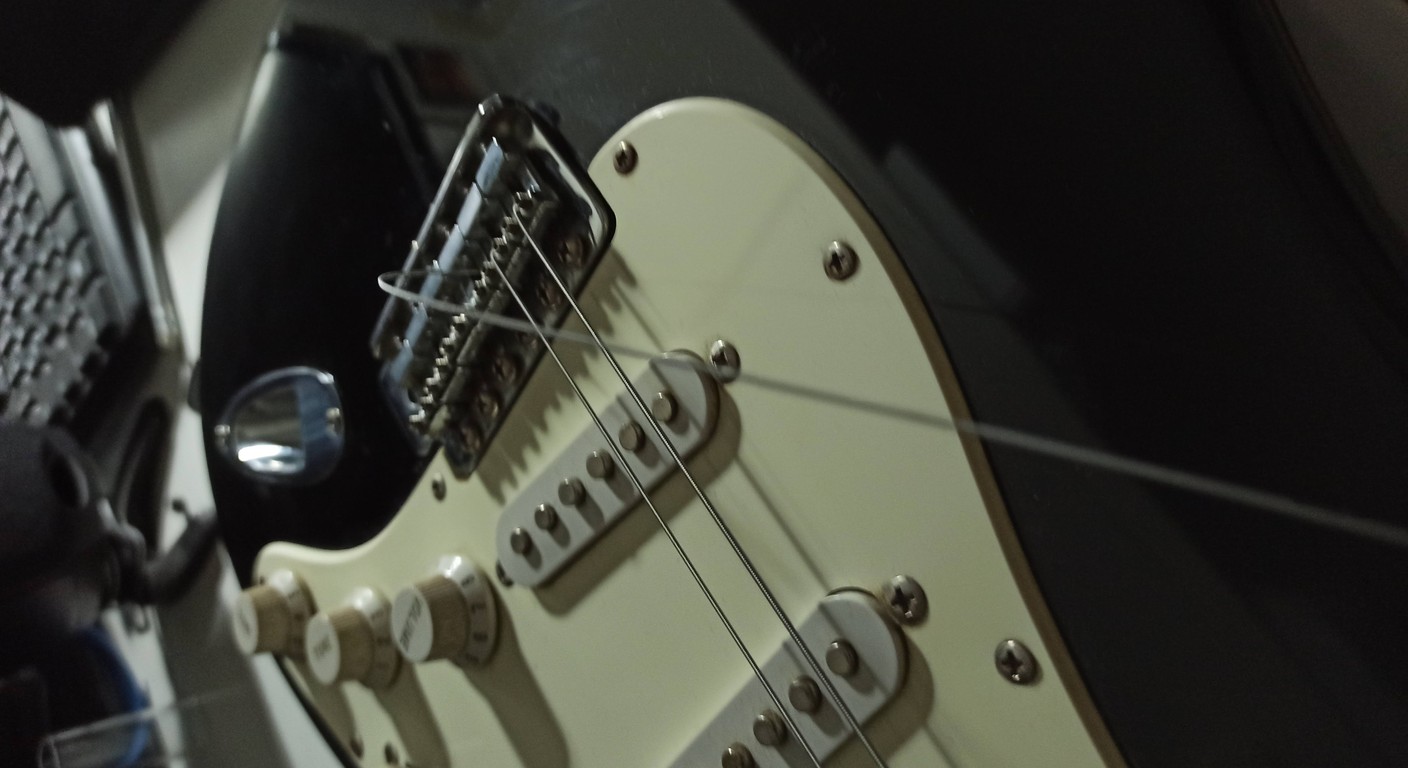
Then came the Stratocaster, in 1954. And with it, a refinement of the concept of single coil.Stratocaster pickups are also single coil, but with a key difference: the poles are “staggered”, meaning stepped. Each pole has a different height to compensate for the different tensions and volumes of the strings.nn Design: The pole pieces are often higher under louder strings (G, D) and lower under thinner strings (high E) or thicker strings (low E, A). This is to balance the volume of each string.
Sound: This design, combined with slight variations in the winding, gave the Stratocaster a more "bell-like" sound, with a softer attack and greater resonance. It's the sound of blues, classic rock, and funk. Think Jimi Hendrix, David Gilmour, or John Mayer. Versatile, rich in harmonics, with that transparency that lets you hear every note.
When I tried to rewind a single coil pickup for my DIY Stratocaster, I realized it's not just wire and magnets. There's a science behind it, but also a lot of “ear” and many attempts. Small differences in the number of turns, the type of wire (AWG 42, AWG 43), the magnet (Alnico II, III, V) radically change the character of the sound.nnMimmo's Tip: The orientation of magnets and the phase
A detail that is often ignored, but which is fundamental when modify a guitar, is the orientation of the magnets and the winding direction of the coils.
If you mount two single coils with magnets oriented in the same polarity (for example, both north towards the strings) and wound in the same direction, when you use them together (for example, middle positions of the Strat), you will hear quite a bit of noise.
To get hum cancellation (like in a humbucker, which we'll talk about shortly) when you use two single coils together, you need to make them “hum-cancelling”. This is achieved with:nn Opposite magnetic polarity: One pickup with the North pole facing the strings, the other with the South pole.
Opposite winding direction: If one is wound clockwise, the other counterclockwise.
This “RWRP” (Reverse Wound, Reverse Polarity) combination is what gives you the clean, bright sound of a Stratocaster's intermediate positions, without the annoying 60-cycle hum. I learned this the hard way, wiring a set of pickups and wondering why it sounded like a chainsaw!nn
Innovation 2: The Humbucker – Gibson's Silent Giant
Advertising

GRG131DX - Black Flat | Infinity R humbuckers with 5-way selector and 24 jumbo frets for rock, metal and practice
See on Amazon

Imagine: you're on stage, playing a solo, and your amp is buzzing like an angry beehive. Frustrating, right?
Here enters Gibson, Fender's historic rival, and a man named Seth Lover.nn
The noise problem and the ingenious solution
Gibson was looking for a pickup that was more powerful, fatter in sound, and above all, quieter. They wanted to overcome the limitations of single-coils in terms of noise and output.Seth Lover, a Gibson engineer, had the brilliant intuition in 1955. His idea was to take two identical single coil bobbins and place them side by side, wiring them in a particular way.nn Principle: The two coils are wound in opposite directions (one clockwise, the other counterclockwise) and their magnets have opposite polarities.
Magic: When the string signal passes through the coils, it is added in phase, producing a strong signal. However, ambient noise (the "hum"), which is external electromagnetic interference, is picked up by both coils in antiphase. This means that the two noise signals cancel each other out.
Here's hum-cancelling in action! Hence the name: humbuckers, literally “hum eliminator”.nn
The PAF: The Sound That Changed Rock
The first humbucker Gibson produced was the legendary PAF, an acronym for "Patent Applied For." This was because, when they were released on the market in the late 1950s, the patent had been filed but not yet granted.That small “Patent Applied For” sticker on the back of the pickup became a symbol, a hallmark of the early, and today very expensive, Gibson humbuckers. Each PAF had small variations in the windings, making each example almost unique. This generated a cult around these pickups, with guitarists and collectors searching for the “golden era” tone.nn Sound: The humbucker pickups It has a fatter, warmer sound, with more sustain and a richer midrange response. It's less bright and edgy than a single coil, but it makes up for it with incredible power and fullness. It's the sound of rock, blues-rock, jazz-fusion. Think of artists like Jimmy Page, Eric Clapton (in his Les Paul phase), or B.B. King.
The first humbucker I disassembled made me understand Lover's genius. Two coils, a simple but revolutionary idea. And how many times do we DIYers look for “clever” solutions to complex problems? Sometimes, the solution is right under our nose.nnMimmo's Tip: How to Split a Humbucker for More Versatility
The beauty of a humbucker is its fullness, but sometimes you want that thinner, brighter sound of a single coil. Many modern humbuckers (with four conductors plus ground) allow you to "split" the coil, using only one of the two coils for a sound more similar to a single coil.
To do this, simply break the connection between the two coils and ground one of the two internal wires. This can be done with a push-pull potentiometer or a switch. It's a relatively simple modification, but it opens up a world of sonic possibilities for your guitar.
When I wired my first splittable humbucker, I felt like a little Seth Lover in my garage. The versatility it adds to a guitar is incredible. If you've never done it, I recommend you try!nn
Innovation 3: The Gretsch Filter'Tron – Clarity and Twang, Without Compromise
After the hum of single coils and the fullness (sometimes perceived as “muddy” or muddy) of PAF humbuckers, there was still room for a different sound, something that combined the best of both worlds. And that's where Gretsch comes in, with its iconic Filter'Tron.Gretsch had its own well-defined sonic identity, linked to rockabilly, country, and a certain type of jazz. Think of guitarists like Chet Atkins or Duane Eddy. Their sound was twangy, bright, but with a certain fullness that pure single coils didn't always provide.nn
Ray Butts: The Man Behind the Gretsch Sound
The genius behind the Filter'Tron was Ray Butts, an electronics engineer who worked with Gretsch and, in particular, Chet Atkins. Atkins wanted a hum-cancelling pickup that retained the clarity and twang he loved, without the compression and midrange response of Gibson PAFs.Butts carefully studied existing pickups and developed his own solution, patented in 1957, almost simultaneously with Lover's PAF.nn Design: Unlike the PAF, which used two wide, shallow coils, the Filter'Tron employed two smaller, taller coils, with ceramic or Alnico bar magnets positioned under the coils, rather than single pole pieces running through the coils. They often also had an external metal grid that contributed to shielding.
Principle: The Filter’Tron is also a humbucker, based on the principle of phase cancellation for noise. But its different design, with smaller coils and a more concentrated magnetic field, gave it a unique sonic character.nn
The Gretsch sound: brightness with body
The sound of the Filter’Tron is difficult to describe if you've never heard it. It's a halfway point between a single coil and a traditional humbucker.nn Sound: It has a brilliance and clarity reminiscent of single coils, but with the fullness and absence of noise of a humbucker. It has a distinctive “twang”, but it's not thin. It's articulate, dynamic, with excellent note separation and an excellent harmonic response. It's less “mid-heavy” than a PAF, resulting in a more open sound.nnIt's the sound that has defined genres and artists. Think of Brian Setzer of the Stray Cats, or George Harrison on some of his Gretsch guitars. An unmistakable sound that immediately makes you say: “Ah, it's a Gretsch!”.The Filter'Tron is a bit like that relative you don't see often, but always throws a party when he arrives. A unique sound that makes you realize there's more to life than just Fender and Gibson. Its existence demonstrates that the search for the "perfect sound" is a never-ending journey, made up of many different paths.
To delve deeper into the history and specifications of Filter'Trons, you can check out resources like Seymour Duncan, which often publishes very detailed articles on the history of the pickups and their original designs. For example, this article on Gretsch pickups offers a good overview: Gretsch Pickups: History and Tone.nn
Beyond the three innovations: the journey continues
These three innovations – the first magnetic pickups, Fender's single coils, and Gibson and Gretsch's humbuckers – laid the foundation for almost everything that came after in the world of guitars. electric guitar transducers.Of course, the story doesn't end there. There were Gibson's P90s, a sort of "super single coil" before the advent of humbuckers, with a fat, growling sound. Then came active pickups, like EMGs, which use a built-in preamp for extremely high output and an ultra-clean sound, beloved by metalheads and fusion guitarists for their compressed dynamics and extreme silence.
And let's not forget the countless variations and reinterpretations of these classic designs: humbuckers with ceramic magnets, noiseless single coils, stacked pickups, blade pickups… every luthier, every brand has contributed to trying to improve, personalize, or replicate those legendary sounds.nn
Your path in sound
As a DIY luthier enthusiast, I can tell you that understanding the history and technology behind these little gems opens up a world. It helps you choose the right pickup for your next project, understand why you like or dislike a certain sound, and maybe, who knows, even try to modify one yourself.n You don't need to be an electronics engineer to appreciate and experiment. You need curiosity, a little patience, and the willingness to get your hands dirty. I've burned some wires, broken some magnets, but every mistake has taught me something.Next time you pick up your guitar, think about how much history is in those small blocks of metal and wire under the strings. They are what give voice to your instrument, transforming your music into something tangible. And you, now, have a story to tell. Maybe at the next concert, between beers.nn
nnnn
See also
n- n
- The History of the Electric Guitar: The 7 Key Stages n
- Types of Electric Guitar: How They Came into Being and Evolved n
Download the Luthier Survival Kit
Free PDF with checklist, problem-cause table and project card template.
 English
  Italiano
Stuck on your build?
If you ran into the same problem or have a question, drop it in the comments. I read and reply to every one.
Write a comment