

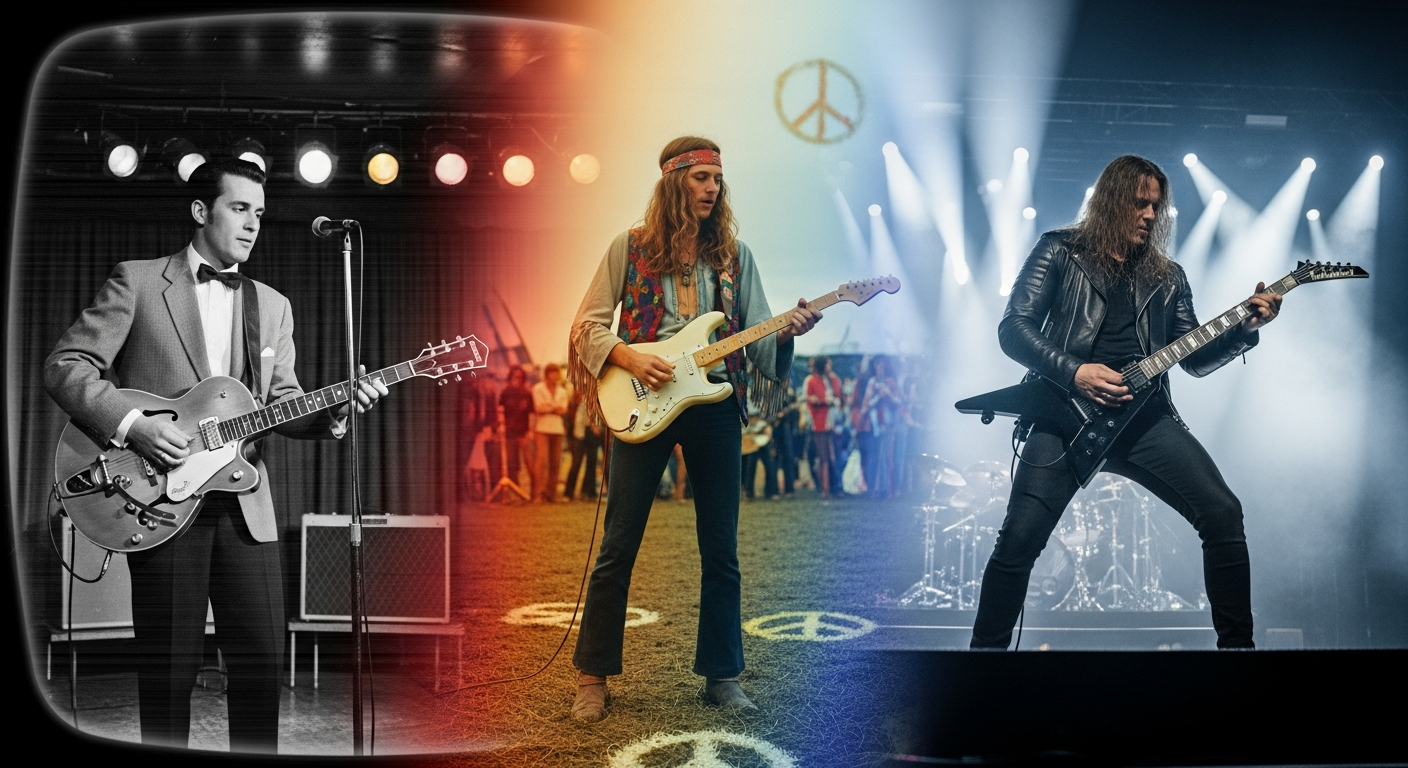
When was the electric guitar born? The 3 key moments.
You know, the story of how the guitar became “electric”" is one of those that makes you realize how crazy human creativity is when there's a problem to solve. We, in our garage, tinker with pickups and potentiometers, but have we ever stopped to think about who invented all this stuff? It's happened to me often.When I first laid my hands on my first guitar, I remember feeling a bit like an explorer. But in reality, I was just following in the footsteps of people who had done the real exploration, the kind that gave birth to the amplified six-string. And it wasn't something that happened overnight, in a flash of universal genius. It was a journey.
What I'm telling you today isn't your usual encyclopedia chronicle. I want you to leave here with a few more anecdotes, something to share the next time you find yourself talking about guitars with friends. It's the story of how an idea became an icon, and how, ultimately, it changed music forever.
To fully understand how we arrived at the electric guitar we know today, we need to look at three key moments, three turning points that set the pace.nn
1. The first “key moment”: The need to make yourself heard and the idea of the magnetic pickup
nn nnnnnn[GRIGLIA FOTO]nnnnnn nThe first electric guitars were all hollow body, that is, with a hollow soundbox, like acoustic guitars. The pickup amplified the sound of the box, which was fine, but it brought with it a huge problem: feedback.
The more the volume was turned up, the more the soundboard resonated uncontrollably, creating annoying whistles and hums. It was a nightmare for guitarists playing in noisy environments or wanting to push the volume to the limit. Imagine being on stage, your solo about to explode, and suddenly... a deafening whistle! Not the best for the ego.nn
Les Paul and “The Log”: One Man, One Saw, One Idea
nnnnnHere enters another absolute genius, Les Paul. Yes, him, the one from Gibson Les Pauls. Les Paul was an innovative guitarist and a tireless inventor. He was obsessed with feedback and wanted to eliminate it. His intuition was brilliant in its simplicity: if feedback comes from the resonating soundbox, then let's eliminate the soundbox!nIn 1941, Les Paul took an Epiphone acoustic guitar, sawed it in half lengthwise, and glued a solid 4×4 inch block of wood in the middle. Then, he reassembled the two halves of the soundbox only for aesthetic reasons, to make it look like a “normal” guitar. He called it “The Log” (the log).The Log was ugly, but it worked. The solid body almost completely eliminated feedback, allowing for much higher volumes and a sustain (the length of the note) that was unthinkable with hollow-body guitars. The sound was different, more direct, with a more pronounced attack.
Les Paul tried to propose his idea to Gibson, but at first, they sent him packing. “No one will buy a broom with pickups!” they told him. Ah, if only they had known... This is a classic example of how great innovations are often initially misunderstood.nn
Leo Fender and the Broadcaster/Telecaster: Mass Production
While Les Paul was experimenting in his lab, another giant was about to enter the scene: Leo Fender. Leo wasn't a guitarist; he was a radio technician and amplifier repairman. This gave him a unique perspective: he didn't think like a musician, but like an engineer who wanted to solve problems.Leo understood that the key was simplicity, modularity, and ease of production. He wanted a robust, reliable instrument, easy to assemble and repair. And above all, he wanted a solid-body instrument to eliminate feedback and achieve that direct, powerful sound that was becoming increasingly in demand.nIn 1949, Fender produced the prototype of a solid-body guitar, nicknamed “Esquire”. In 1950, the first commercial single-pickup version was released, and then, in 1951, the legendary Broadcaster (which later became Telecaster due to copyright issues with Gretsch, which had a “Broadkaster” drum line).
There Fender Telecaster (or Broadcaster, if you prefer its original name) wasn't as beautiful as the elegant hollow-body models, but it was a tank. It had an ash or alder body, a bolt-on maple neck, and two bright and powerful single-coil pickups. It was a basic, almost Spartan, yet incredibly effective instrument.
His sound was aggressive, twangy, perfect for country, blues and nascent rock.’
‘roll. Artists like Muddy Waters and James Burton made it legendary. The Telecaster demonstrated that the solid body was not just a solution to feedback, but opened the way to completely new sounds and greater versatility.nn
Gibson and the Les Paul: Elegance Meets Power
After initially rejecting the Les Paul idea, Gibson realized his mistake. The Telecaster was selling like hotcakes, and the market was clamoring for solid-body guitars. So, in 1952, Gibson finally launched its solid-body model, the Gibson Les Paul.Unlike the Telecaster, the Les Paul was a work of art. It had a mahogany body with a carved maple top (often flame maple), a set-neck mahogany neck, and two P90 pickups (initially, then humbuckers). It was heavy, elegant, and had a warm, powerful sound with incredible sustain.
The Les Paul was designed to compete with the finest guitars, while offering the power and lack of feedback of solid body guitars. This was the second key moment: the consecration of the solid body, which not only solved a technical problem but also defined the sound of rock.’
‘roll, of blues rock and future genres.nn
3. The third “key moment”: The diversification and evolution of pickups and electronics
[AFFILIATE BOX] nnnnnnOnce it was established that the electric guitar had to be amplified (thanks to the magnetic pickup) and that the solid body was the way to go for power and control (thanks to Les Paul and Fender), the field was open for innovation. The third key moment is precisely this phase of diversification, refinement, and the continuous evolution of what is in the guitar: pickups and electronics.nnHumbucker pickups: goodbye to hum
The first solid-body guitars, both Telecaster and Les Paul (with P90s), used single-coil pickups. Their sound was bright and defined, but they had a flaw: they were susceptible to hum caused by electromagnetic interference. An annoying problem, especially with more powerful amplifiers.nIn 1955, a Gibson engineer named Seth Lover (another name to engrave in history!) invented the humbucker pickup. His genius was to combine two coils wound out of phase, so that the hum picked up by one coil was canceled by the hum picked up by the other. The result? A “hum-bucking” pickup, i.e., “anti-hum”.nNot only did it eliminate hum, but it also produced a fatter, warmer sound with higher output than single coils. The first humbuckers, the famous PAF (Patent Applied For), were mounted on Gibson Les Pauls starting in 1957. This pickup change gave the Les Paul the iconic sound we know today, perfect for rock, hard rock, and metal.The invention of the humbucker was not just a technical solution, but opened the way to a new sonic palette. Suddenly, guitarists could push their amplifiers into distortion without being plagued by hum, creating those gritty and powerful sounds that would define decades of music.nn
The Fender Stratocaster: Versatility and Iconic Design
While Gibson was focusing on the Les Paul, Fender was not sitting idly by. In 1954, Leo Fender and his team (George Fullerton, Freddie Tavares) launched the Fender Stratocaster. If the Telecaster was the workhorse, the Stratocaster was the race car.With its ergonomic lines, a body contoured to fit the player, a tremolo (or vibrato), and three single-coil pickups with a 5-way selector switch (initially a 3-way switch, later modified by the musicians themselves), the Stratocaster offered unprecedented sonic versatility. You could go from crystal-clear sounds to fuller tones with a simple touch.
Its futuristic design, playability, and ability to adapt to almost any musical genre quickly made it an icon. Artists like Buddy Holly, Jimi Hendrix, Eric Clapton, David Gilmour elevated it to legend. The Stratocaster not only consolidated the idea of the solid body but took it to a new level of refinement and expressive capability.nn
Electronics: Potentiometers, Capacitors, and Wiring
As pickups evolved, the guitar's internal electronics also began to become more refined. It was no longer just about having a volume control. Tone controls, different capacitor values, and pickup selector switches all contributed to shaping the sound.When we put our hands to modify a guitar, Often, the first step is the electronics: changing pickups, replacing potentiometers, trying different capacitors. This is because every component, even the smallest, has an impact on the final sound.
Potentiometers, for example, are not all the same. 250kOhm ones are often used with single coils for a sweeter sound, while 500kOhm ones are used with humbuckers to maintain brightness. Capacitors also determine how much of the high frequencies are cut when you lower the tone. These are details that make a huge difference.
This phase of experimentation and standardization of electronics has allowed musicians to have ever greater control over their sound, transforming the electric guitar into an incredibly versatile and malleable instrument. This is the third key moment: the maturation of design, the evolution of pickups, and the electronics that have given us an infinite sonic range.nn
Beyond the 3 Moments: The Creative Explosion and DIY
After these three key moments, the road was clear. The '60s and '70s saw an explosion of brands and models. Gretsch with its semi-hollow guitars perfect for rockabilly, Rickenbacker with its jingle-jangle sounds made famous by the Beatles and the Byrds, and then all the other brands that helped shape the musical landscape.Every innovation, every new pickup, every modification to the body or neck, wasn't just a technical improvement. It was an opportunity for musicians to find their sound, to express something new. From blues to rock, from jazz to metal, the electric guitar has become the principal instrument for sonic innovation.nn
The impact on sound and music
Think how different rock would be.'’‘'roll without Chuck Berry or Keith Richards' Telecaster. Or blues-rock without Jimmy Page or Eric Clapton's Les Paul. And psychedelia without Jimi Hendrix's Stratocaster? It's almost unthinkable.
Every step forward in the history of the electric guitar had a direct impact not only on how it was played, but on What was played. It gave birth to entire musical genres, allowed musicians to express emotions in ways previously impossible, to fill stadiums with a wall of sound that was once just a dream.nn
The “why” behind the “how” for the garage luthier
For those of us who get our hands dirty with soldering irons and Dremels, understanding this history isn't just a curiosity. It gives us perspective on why certain things are made a certain way. Why are solid-body guitars created? For feedback. Why are humbuckers created? For hum.When you find yourself choosing a pickup, or deciding whether to use a 250k or 500k pot, you're participating in this evolution. You're making the same choices, on a different level, that the pioneers did. And that's the beauty of DIY: we don't just replicate, we understand and, if we want, we innovate.
This story also teaches us that innovation often arises from a problem. Early guitarists just wanted to be heard. Then they wanted to eliminate feedback. Then they wanted a cleaner or more powerful sound. Each time, the solution opened new sonic doors.nn
“The electric guitar is a constant evolution. It's never been a finished product, but a project in constant development. And in this, we're all a bit like Les Paul or Leo Fender, in our little garage.’nn
A practical tip: experiment!
Remember, the pioneers didn't have guides or YouTube tutorials. They tried, failed, and tried again. This is the spirit we must bring to our lab. Don't be afraid to experiment with components.If you have a cheap guitar, try swapping out the pickups. Hear the difference. Try changing the potentiometers or capacitors. Every little change will teach you something about the sound and the electronics. That's how you really learn. You don't need a CNC mill to do decent cavity routing, you just need a good template, a Dremel, and some breathing, as I always say.
This is the story of how the electric guitar became what it is today, through ingenuity, perseverance, and a touch of madness. A story of men who never gave up in the face of limitations and who, with their inventions, changed the world of music. And now, when you pick up your six-string, you know you're holding a piece of this incredible adventure in your hands.
To delve deeper into Leo Fender's history and inventions, an excellent resource is the biography "Leo Fender: The Quiet Giant of Electric Guitars" by Phyllis Fender and Forrest White, or more simply, his Wikipedia page, which provides a good starting point for exploring his innovations. You can find it here: Wikipedia – Leo Fender.nn
nn
The history of the amplified guitar, with its three key moments, brought us to the mid-1950s. But believe me, it was just the beginning. What happened next was a real creative explosion, a wave that swept through the world of music and continues to do so today.
The golden age and the birth of genres: The roaring ’60s and ’70s
Once the solid body electric guitar had established itself, musicians around the world began to experiment. The 1960s and 1970s were not only a period of great social change but also an unprecedented sonic laboratory.
Guitars were no longer just instruments to be heard; they had become voices, capable of evoking emotions, of defining musical identities. Every emerging genre demanded a specific sound, and manufacturers responded with new ideas.
Gretsch and Rickenbacker: Iconic alternatives
While Fender and Gibson dominated the solid body market, other brands were carving out their niche. Let's take the Gretsch, for example. His semi-hollow guitars, like the Country Gentleman or the White Falcon, they were perfect for rockabilly and country.
Their sound was unique: a blend of brilliance and resonance, with Filter’Tron pickups that had a character all their own. Artists like Chet Atkins and Brian Setzer of the Stray Cats made them immortal, proving that there was room for sonorities different from the more aggressive ones.
And then there was the Rickenbacker. With its futuristic lines and unmistakable “jingle-jangle” sound, it became the iconic guitar of the British Invasion. The Beatles, in particular John Lennon and George Harrison, were in love with it.
Rickenbackers, often with their “toaster” pickups and semi-acoustic design, defined the sound of bands like the Byrds, bringing the electric guitar into psychedelic and pop territories, with a tone that was the exact opposite of the grit of a Les Paul.
The British wall of sound and amplification
Innovation wasn't just about guitars. The ’60s also saw the rise of increasingly powerful and “badass” amplifiers. Marshalls, for example, born in England, were not designed to be clean, but to distort, to create a wall of sound.
This combination of powerful electric guitars and amplifiers pushed to the limit gave birth to blues-rock and hard rock. Think of Eric Clapton with his Les Paul and a Marshall, or Jimmy Page squeezing every drop of sustain from those woods and circuits.
It was during this period that the electric guitar transformed from an accompanying instrument to an absolute protagonist. Solos became epic, riffs iconic. The sound was no longer just a matter of volume, but of timbre, saturation, pure expression.
The guitar as an extension: Hendrix and psychedelia
No one has embodied this transformation more than Jimi Hendrix. His Stratocaster was not just an instrument, it was an extension of his body, of his soul. He explored every nuance of feedback, of distortion, using the tremolo in ways never heard before.
Hendrix demonstrated that the electric guitar could be a canvas for sound art, a means to create psychedelic landscapes, animalistic screams, and celestial melodies. He pushed the limits of guitar design and amplification, inspiring generations of musicians.
Innovation doesn't stop: From Superstrats to active pickups
The ’80s brought another wave of innovation, driven by the birth of metal and guitar virtuosity. Musicians wanted guitars that allowed extreme speed, infinite sustain, and an even wider sound range.
The “Superstrats”: Speed and Precision
This is where the Superstrat. Brands like Ibanez, Jackson, and Charvel have taken the concept of the Stratocaster and pushed it to the extreme. Thinner and more ergonomic bodies, fast necks with flat fingerboards and jumbo frets, and versatile pickup configurations (often H-S-H or H-S-S).
The bridge Floyd Rose, which allowed for extreme dive bombs and vibrato without losing tuning, has become a standard. These guitars were war machines, designed for shredding and for high-gain sounds, perfect for guitarists like Steve Vai, Joe Satriani and Eddie Van Halen.
If today you see a metal guitarist tapping at insane speeds, very likely he is wielding a descendant of those first Superstrats. They redefined what was possible to do with a six-string, both in terms of technique and sound.
Active pickups: Power and Cleanliness
Another crucial innovation was the introduction of active pickups, in particular by EMG. Unlike passive pickups which generate a weak signal and are more susceptible to noise, active pickups incorporate a preamplifier.
This means a stronger, cleaner signal, with less background noise and a more controlled frequency response. They were perfect for metal, where clarity under distortion and the absence of hum were fundamental. Many garage luthiers, myself included, experimented with these pickups, looking for that 'tight' and aggressive sound.
Certainly, they require a battery (often 9V) and have a different sound, less “organic” for some, but their effectiveness in providing high, noise-free output is undeniable. They have opened up a world of possibilities for modern and heavy sounds.
Modern electronics and the boutique world
Today, innovation continues with digital modeling, integrated MIDI systems, and a myriad of pedal effects that can transform the sound of a guitar in ways unthinkable for the pioneers. However, there's also a strong return to the roots, with an emphasis on craftsmanship and quality materials.
The world of lutherie boutique It is booming. Small artisans create custom guitars, often inspired by classic models but with modern touches, using rare woods and hand-wound pickups. This shows that, despite all technological advances, the passion for “wood and wire” remains strong.
It's a bit like us in our garage. Maybe we're not inventing the next humbucker, but we're taking lessons from history, applying them, and maybe, just maybe, adding our own little personal touch. Whether it's new wiring or a handcrafted pickup, the goal is always the same: finding the perfect sound.
The garage luthier and the legacy of the pioneers
Understanding the history of the electric guitar is not è just an academic exercise. For those who, like us, love to get their hands on instruments, it è a compass, a source of d’inspiration. Every time we disassemble a pickup or wire a potentiometer, we are retracing steps taken by giants.
Les Paul who sawed a guitar to eliminate feedback, Leo Fender who sought modularity for mass production, Seth Lover who canceled hum with two coils: these are all examples of creative problem-solving. And this is exactly what we do when modify a guitar in our laboratory.
Perhaps we are trying to improve the sustain with a new bridge, or to get more clarity by changing a capacitor. We are not reinventing the wheel, but we are applying principles that have deep roots in the history of this instrument.
This spirit of experimentation, of not settling for "as is", is the most precious legacy left to us by the pioneers. They didn't have YouTube or online forums; they only had their ingenuity and a great desire to make music that sounded better, louder, more expressive.
So, the next time you find yourself with a soldering iron in hand, think of them. Think of how much has been done and how much more can still be done. The electric guitar is a living organism, constantly evolving, and we, in our small way, are part of this wonderful story.
We are the Les Pauls and Leo Fenders of the twenty-first century, armed with screws, wires, and a good dose of passion. Every modification, every experiment, every new setup is a small tribute to those who dared to dream of a different sound. And, after all, isn't this the beauty of DIY? Learning from the past to build our sonic future.
Frequently Asked Questions (FAQ)
What was the first mass-produced solid-body electric guitar?
There Fender Broadcaster, later renamed Telecaster, launched in 1950-1951, is widely recognized as the first commercially successful mass-produced solid body electric guitar. Before it, there were experiments like the Rickenbacker “Frying Pan” (a Hawaiian guitar) and Les Paul's “The Log” prototype, but they did not achieve mass production like the Telecaster.
Why did original hollow body guitars suffer from feedback?
Hollow body guitars, having an empty soundbox, are designed to resonate and amplify sound acoustically. When a magnetic pickup amplified the sound of this body through a high-volume speaker, the sound vibrations of the speaker made the guitar’s body vibrate again, creating an uncontrolled resonance cycle that manifested as a high-pitched whistle or hum, known as feedback.
And so, from the need to be heard in a noisy orchestra, up to the shredding machines of modern metal, the electric guitar has made an incredible journey. A journey made of ingenuity, errors, brilliant insights, and so much, so much music. And the best part is that, with a bit of curiosity and a soldering iron, you too can be part of this story.
Download the Luthier Survival Kit
Free PDF with checklist, problem-cause table and project card template.
 English
  Italiano
Stuck on your build?
If you ran into the same problem or have a question, drop it in the comments. I read and reply to every one.
Write a comment